
Question 1
(a) In the following list, underline all quantities that are SI base quantities.
charge electric current force time (1 mark)
(b) Under certain conditions, the distance \(s\) moved in a straight line by an object in time \(t\) is given by
\(s=\frac{1}{2}at^2\)
where \(a\) is the acceleration of the object.
State two conditions under which the above expression applies to the motion of the object. (2 marks)
1. ________________________________________________
2. ________________________________________________
(c) The variation with time \(t\) of the velocity \(v\) of a car that is moving in a straight line is shown in Fig. 1.1.
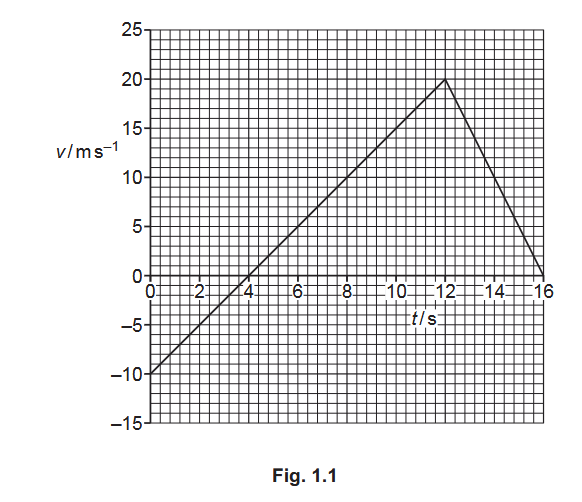
(i) Compare, qualitatively, the acceleration of the car at time \(t=8.0\,\mathrm{s}\) and at time \(t=14.0\,\mathrm{s}\) in terms of:
• magnitude
_______________________________________________
• direction
_______________________________________________
(ii) Determine the magnitude of the acceleration of the car at time \(t=4.0\,\mathrm{s}\). (2 marks)
acceleration = __________________________________ \(\mathrm{m\,s^{-2}}\)
(iii) The car is at point X at time \(t=0\).
Determine the magnitude of the displacement of the car from X at time \(t=12.0\,\mathrm{s}\). (2 marks)
displacement = __________________________________ \(\mathrm{m}\)
Syllabus Topic Codes (Cambridge International AS & A Level Physics 9702):
• 2.1: Equations of motion — parts (b), (c)(i), (c)(ii) and (c)(iii)
▶️ Answer/Explanation
(a) [1 mark]
The SI base quantities in the list are electric current and time.
Charge and force are derived quantities.
Answer: \( \boxed{\text{electric current and time}} \)
(b) [2 marks]
The equation
\(s=\frac{1}{2}at^2\)
is valid when:
1. The initial velocity is zero.
2. The acceleration is constant or uniform.
Answer: \( \boxed{u=0\text{ and constant acceleration}} \)
(c)(i) [2 marks]
Acceleration is the gradient of a velocity-time graph.
At \(t=8.0\,\mathrm{s}\), the gradient has a smaller magnitude than at \(t=14.0\,\mathrm{s}\).
Therefore, the magnitude of the acceleration at \(8.0\,\mathrm{s}\) is less than at \(14.0\,\mathrm{s}\).
The gradient is positive at \(8.0\,\mathrm{s}\) and negative at \(14.0\,\mathrm{s}\), so the accelerations are in opposite directions.
Answer: \( \boxed{|a_{8.0}|<|a_{14.0}|} \), and the directions are opposite.
(c)(ii) [2 marks]
Acceleration is the gradient of the velocity-time graph:
\(a=\frac{\Delta v}{\Delta t}\)
Using the points \((0,-10)\) and \((12,20)\):
\(a=\frac{20-(-10)}{12}\)
\(a=\frac{30}{12}\)
\(a=2.5\,\mathrm{m\,s^{-2}}\)
Answer: \( \boxed{2.5\,\mathrm{m\,s^{-2}}} \)
(c)(iii) [2 marks]
The displacement is the area under the velocity-time graph.
From \(t=0\) to \(t=4\,\mathrm{s}\), the velocity is negative. The triangular area is
\( \frac{1}{2}(4)(10)=20\,\mathrm{m} \)
This gives a displacement of \(-20\,\mathrm{m}\).
From \(t=4\,\mathrm{s}\) to \(t=12\,\mathrm{s}\), the velocity is positive. The triangular area is
\( \frac{1}{2}(8)(20)=80\,\mathrm{m} \)
Therefore, the resultant displacement is
\(s=80-20=60\,\mathrm{m}\)
Answer: \( \boxed{60\,\mathrm{m}} \)
Question 2
A high-altitude balloon is stationary in still air. A solid sphere is suspended from the balloon by a string, as shown in Fig. 2.1.
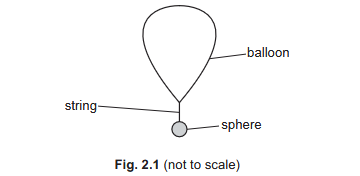
The volume of the balloon is \(7.5\,\mathrm{m^3}\). The total weight of the balloon, string and sphere is \(65\,\mathrm{N}\). The upthrust acting on the string and sphere is negligible.
(a) Calculate the density of the air surrounding the balloon. (2 marks)
density = __________________________________________ \(\mathrm{kg\,m^{-3}}\)
(b) The string breaks, releasing the sphere.
(i) State the magnitude of the acceleration of the sphere immediately after the string breaks. (1 mark)
acceleration = _____________________________________ \(\mathrm{m\,s^{-2}}\)
(ii) State and explain the variation, if any, in the magnitude of the acceleration of the sphere when it is moving downwards before it reaches terminal (constant) velocity. (3 marks)
________________________________________________________________________________
(c) The sphere has a mass of \(4.0\,\mathrm{kg}\).
Calculate the total resistive force acting on the sphere at the instant when its acceleration is \(1.9\,\mathrm{m\,s^{-2}}\). (2 marks)
resistive force = __________________________________ \(\mathrm{N}\)
Syllabus Topic Codes (Cambridge International AS & A Level Physics 9702):
• 3.1: Momentum and Newton’s laws of motion — parts (b)(i) and (c)
• 3.2: Non-uniform motion — part (b)(ii)
▶️ Answer/Explanation
(a) Density of the surrounding air [2 marks]
The balloon is stationary, so the upthrust is equal to the total weight:
\( U=65\,\mathrm{N} \)
The upthrust is given by
\( U=\rho Vg \)
Therefore,
\(65=\rho(7.5)(9.81)\)
Rearranging:
\(\rho=\frac{65}{(9.81)(7.5)}\)
\(\rho=0.88\,\mathrm{kg\,m^{-3}}\)
Answer: \( \boxed{0.88\,\mathrm{kg\,m^{-3}}} \)
(b)(i) Initial acceleration [1 mark]
Immediately after the string breaks, the sphere is in free fall, so its acceleration is approximately equal to \(g\).
\(a=g=9.8\,\mathrm{m\,s^{-2}}\)
Answer: \( \boxed{9.8\,\mathrm{m\,s^{-2}}} \)
(b)(ii) Variation of acceleration [3 marks]
As the sphere moves downwards, its air resistance increases as its speed increases.
The upward resistive force therefore becomes larger, so the resultant downward force decreases.
Since \(F=ma\), the magnitude of the acceleration decreases.
When terminal velocity is reached, the resistive force equals the weight, so the resultant force and acceleration are zero.
Answer: \( \boxed{\text{acceleration decreases as air resistance increases, reaching zero at terminal velocity}} \)
(c) Resistive force [2 marks]
The downward weight of the sphere is
\(W=mg\)
\(W=(4.0)(9.81)=39.24\,\mathrm{N}\)
The resultant force is
\(F=ma\)
\(F=(4.0)(1.9)=7.6\,\mathrm{N}\)
Taking downward as positive,
\(mg-F_{\mathrm{R}}=ma\)
Therefore,
\(F_{\mathrm{R}}=(4.0\times9.81)-(4.0\times1.9)\)
\(F_{\mathrm{R}}=31.64\,\mathrm{N}\)
To an appropriate number of significant figures,
Answer: \( \boxed{32\,\mathrm{N}} \)
Question 3
A vertical rod is fixed to the horizontal surface of a table, as shown in Fig. 3.1.
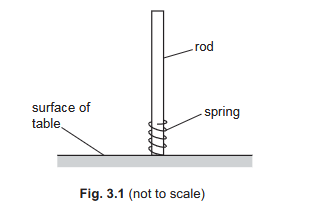
A spring of mass \(7.5\,\mathrm{g}\) is able to slide along the full length of the rod.
The spring is first pushed against the surface of the table so that it has an initial compression of \(2.1\,\mathrm{cm}\). The spring is then suddenly released so that it leaves the surface of the table with a kinetic energy of \(0.048\,\mathrm{J}\) and then moves up the rod.
Assume that the spring obeys Hooke’s law and that the initial elastic potential energy of the compressed spring is equal to the kinetic energy of the spring as it leaves the surface of the table. Air resistance is negligible.
(a) By using the initial elastic potential energy of the compressed spring, calculate its spring constant. (2 marks)
spring constant = __________________________________ \(\mathrm{N\,m^{-1}}\)
(b) Calculate the speed of the spring as it leaves the surface of the table. (2 marks)
speed = __________________________________________ \(\mathrm{m\,s^{-1}}\)
(c) The spring rises to its maximum height up the rod from the surface of the table. This causes the gravitational potential energy of the spring to increase by \(0.039\,\mathrm{J}\).
(i) Calculate, for this movement of the spring, the increase in height of the spring after leaving the surface of the table. (2 marks)
increase in height = ______________________________ \(\mathrm{m}\)
(ii) Calculate the average frictional force exerted by the rod on the spring as it rises. (2 marks)
average frictional force = _________________________ \(\mathrm{N}\)
(d) The rod is replaced by another rod that exerts negligible frictional force on the moving spring.
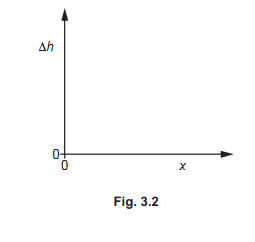
The initial compression \(x\) of the spring is now varied in order to vary the maximum increase in height \(\Delta h\) of the spring after leaving the surface of the table. Assume that the spring obeys Hooke’s law for all compressions.
On Fig. 3.2, sketch a graph to show the variation with \(x\) of \(\Delta h\). Numerical values are not required.
Syllabus Topic Codes (Cambridge International AS & A Level Physics 9702):
• 5.2: Gravitational potential energy and kinetic energy — parts (b) and (c)(i)
• 5.1: Energy conservation — part (c)(ii)
▶️ Answer/Explanation
(a) Spring constant [2 marks]
The elastic potential energy stored in a compressed spring is
\( E_{\mathrm{P}}=\frac{1}{2}kx^2 \)
The initial elastic potential energy is equal to \(0.048\,\mathrm{J}\).
The compression is
\(x=2.1\times10^{-2}\,\mathrm{m}\)
Therefore,
\(0.048=\frac{1}{2}k(2.1\times10^{-2})^2\)
Rearranging:
\(k=\frac{2(0.048)}{(2.1\times10^{-2})^2}\)
\(k\approx220\,\mathrm{N\,m^{-1}}\)
Answer: \( \boxed{220\,\mathrm{N\,m^{-1}}} \)
(b) Speed of the spring [2 marks]
The kinetic energy of the spring is
\(E_{\mathrm{K}}=\frac{1}{2}mv^2\)
The mass is
\(m=7.5\times10^{-3}\,\mathrm{kg}\)
Therefore,
\(0.048=\frac{1}{2}(7.5\times10^{-3})v^2\)
\(v^2=\frac{2(0.048)}{7.5\times10^{-3}}\)
\(v\approx3.6\,\mathrm{m\,s^{-1}}\)
Answer: \( \boxed{3.6\,\mathrm{m\,s^{-1}}} \)
(c)(i) Increase in height [2 marks]
The increase in gravitational potential energy is
\(\Delta E_{\mathrm{P}}=mg\Delta h\)
Therefore,
\(0.039=(7.5\times10^{-3})(9.81)\Delta h\)
\(\Delta h=\frac{0.039}{(7.5\times10^{-3})(9.81)}\)
\(\Delta h\approx0.53\,\mathrm{m}\)
Answer: \( \boxed{0.53\,\mathrm{m}} \)
(c)(ii) Average frictional force [2 marks]
The spring initially has \(0.048\,\mathrm{J}\) of kinetic energy as it leaves the table.
Of this energy, \(0.039\,\mathrm{J}\) is transferred into gravitational potential energy.
Therefore, the energy dissipated by friction is
\(E_{\mathrm{friction}}=0.048-0.039=0.009\,\mathrm{J}\)
The work done by friction is
\(W=F\Delta h\)
Hence,
\(F(0.53)=0.048-0.039\)
\(F=\frac{0.009}{0.53}\)
\(F\approx0.02\,\mathrm{N}\)
Answer: \( \boxed{0.02\,\mathrm{N}} \)
(d) Graph of \(\Delta h\) against \(x\) [2 marks]
With negligible friction, the elastic potential energy becomes gravitational potential energy:
\(\frac{1}{2}kx^2=mg\Delta h\)
Therefore,
\(\Delta h=\frac{k}{2mg}x^2\)
Thus, \(\Delta h\propto x^2\).
The graph must start at the origin and be a curved line with increasing gradient.
Answer: \( \boxed{\Delta h\propto x^2} \), so the graph is an upward-curving parabola through the origin.
Question 4
(a) A ball Y moves along a horizontal frictionless surface and collides with ball Z, as illustrated in the views from above in Fig. 4.1 and Fig. 4.2.
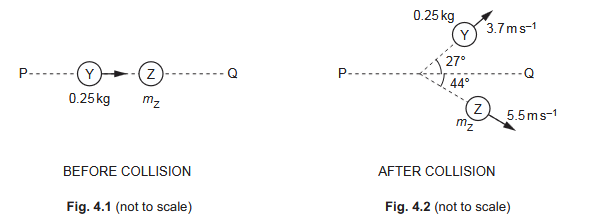
Ball Y has a mass of \(0.25\,\mathrm{kg}\) and initially moves along a line PQ.
Ball Z has a mass \(m_Z\) and is initially stationary.
After the collision, ball Y has a final velocity of \(3.7\,\mathrm{m\,s^{-1}}\) at an angle of \(27^\circ\) to line PQ and ball Z has a final velocity of \(5.5\,\mathrm{m\,s^{-1}}\) at an angle of \(44^\circ\) to line PQ.
(i) Calculate the component of the final momentum of ball Y in the direction perpendicular to line PQ. (2 marks)
component of momentum = __________________________ \(\mathrm{N\,s}\)
(ii) By considering the component of the final momentum of each ball in the direction perpendicular to line PQ, calculate \(m_Z\). (1 mark)
\(m_Z\) = __________________________________________ \(\mathrm{kg}\)
(iii) During the collision, the average force exerted on Y by Z is \(F_Y\), and the average force exerted on Z by Y is \(F_Z\).
Compare the magnitudes and directions of \(F_Y\) and \(F_Z\). Numerical values are not required. (2 marks)
magnitudes: _______________________________________
directions: _________________________________________
(b) Two blocks, A and B, move directly towards each other along a horizontal frictionless surface, as shown in the view from above in Fig. 4.3.
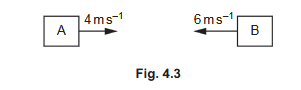
The blocks collide perfectly elastically. Before the collision, block A has a speed of \(4\,\mathrm{m\,s^{-1}}\) and block B has a speed of \(6\,\mathrm{m\,s^{-1}}\). After the collision, block B moves back along its original path with a speed of \(2\,\mathrm{m\,s^{-1}}\).
Calculate the speed of block A after the collision. (1 mark)
speed = __________________________________________ \(\mathrm{m\,s^{-1}}\)
Syllabus Topic Codes (Cambridge International AS & A Level Physics 9702):
▶️ Answer/Explanation
(a)(i) Component of momentum [2 marks]
The component of momentum perpendicular to line PQ is
\(p_\perp=mv\sin\theta\)
For ball Y:
\(p_\perp=(0.25)(3.7)\sin27^\circ\)
\(p_\perp\approx0.42\,\mathrm{N\,s}\)
Answer: \( \boxed{0.42\,\mathrm{N\,s}} \)
(a)(ii) Mass of ball Z [1 mark]
Initially, the total momentum perpendicular to PQ is zero. Therefore, the final perpendicular components of momentum must be equal and opposite.
\(m_Z(5.5)\sin44^\circ=(0.25)(3.7)\sin27^\circ\)
\(m_Z(5.5)\sin44^\circ=0.42\)
\(m_Z\approx0.11\,\mathrm{kg}\)
Answer: \( \boxed{0.11\,\mathrm{kg}} \)
(a)(iii) Forces during the collision [2 marks]
By Newton’s third law, the force exerted by Y on Z and the force exerted by Z on Y are an action-reaction pair.
Therefore, the forces have equal magnitudes.
They act in opposite directions.
Answer: magnitudes: \( \boxed{\text{equal}} \); directions: \( \boxed{\text{opposite}} \)
(b) Perfectly elastic collision [1 mark]
Take the direction of A’s initial motion as positive.
Before collision:
\(v_A=+4\,\mathrm{m\,s^{-1}}\)
\(v_B=-6\,\mathrm{m\,s^{-1}}\)
After collision, B reverses direction:
\(v_B’=+2\,\mathrm{m\,s^{-1}}\)
For a perfectly elastic one-dimensional collision, the relative speed of separation equals the relative speed of approach:
\(6+4=2+v_A’\)
\(v_A’=8\,\mathrm{m\,s^{-1}}\)
Answer: \( \boxed{8\,\mathrm{m\,s^{-1}}} \)
Question 5
(a) A beam of vertically polarised light is incident normally on a polarising filter, as shown in Fig. 5.1.
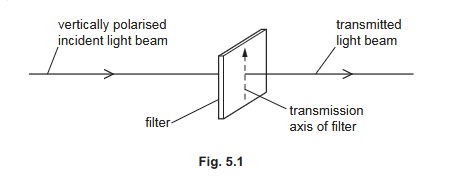
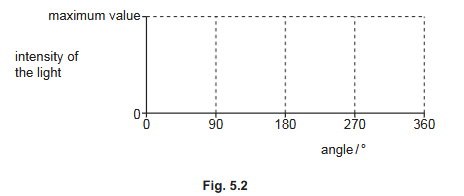
(i) The transmission axis of the filter is initially vertical. The filter is then rotated through an angle of \(360^\circ\) while the plane of the filter remains perpendicular to the beam.
On Fig. 5.2, sketch a graph to show the variation of the intensity of the light in the transmitted beam with the angle through which the transmission axis is rotated. (2 marks)
(ii) The intensity of the light in the incident beam is \(7.6\,\mathrm{W\,m^{-2}}\). When the transmission axis of the filter is at an angle \(\theta\) to the vertical, the intensity of the transmitted light is \(4.2\,\mathrm{W\,m^{-2}}\).
Calculate angle \(\theta\). (2 marks)
\(\theta\) = ______________________________________ \(^{\circ}\)
(b) State what is meant by the diffraction of a wave. (2 marks)
________________________________________________________________________________
(c) A beam of light of wavelength \(4.3\times10^{-7}\,\mathrm{m}\) is incident normally on a diffraction grating in air, as shown in Fig. 5.3.
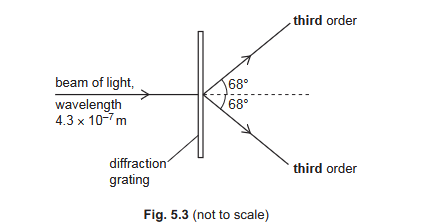
The third-order diffraction maximum of the light is at an angle of \(68^\circ\) to the direction of the incident light beam.
(i) Calculate the line spacing \(d\) of the diffraction grating. (2 marks)
\(d\) = __________________________________________ \(\mathrm{m}\)
(ii) Determine a different wavelength of visible light that will also produce a diffraction maximum at an angle of \(68^\circ\). (2 marks)
wavelength = ____________________________________ \(\mathrm{m}\)
Syllabus Topic Codes (Cambridge International AS & A Level Physics 9702):
• 8.2: Diffraction — part (b)
• 8.4: The diffraction grating — parts (c)(i) and (c)(ii)
▶️ Answer/Explanation
(a)(i) [2 marks]
For polarised light passing through a polarising filter, the transmitted intensity follows Malus’ law:
\(I=I_0\cos^2\theta\)
The intensity is maximum when the transmission axis is parallel to the polarisation direction, at \(0^\circ\), \(180^\circ\) and \(360^\circ\).
The intensity is zero when the transmission axis is perpendicular to the polarisation direction, at \(90^\circ\) and \(270^\circ\).
The graph is therefore a sinusoidally shaped curve following a \(\cos^2\theta\) variation.
Answer: maximum at \(0^\circ,180^\circ,360^\circ\), zero at \(90^\circ,270^\circ\).
(a)(ii) [2 marks]
Using Malus’ law:
\(I=I_0\cos^2\theta\)
\(4.2=7.6\cos^2\theta\)
\(\cos^2\theta=\frac{4.2}{7.6}\)
\(\theta=\cos^{-1}\left(\sqrt{\frac{4.2}{7.6}}\right)\)
\(\theta\approx42^\circ\)
Answer: \( \boxed{42^\circ} \)
(b) [2 marks]
Diffraction is the spreading of a wave when it passes through an aperture or around an edge.
The spreading is most significant when the size of the aperture or obstacle is comparable to the wavelength.
Answer: \( \boxed{\text{spreading of waves through an aperture or around an edge}} \)
(c)(i) Line spacing of the diffraction grating [2 marks]
For a diffraction grating:
\(n\lambda=d\sin\theta\)
Here, \(n=3\), \(\lambda=4.3\times10^{-7}\,\mathrm{m}\), and \(\theta=68^\circ\).
Therefore,
\(d=\frac{3(4.3\times10^{-7})}{\sin68^\circ}\)
\(d\approx1.4\times10^{-6}\,\mathrm{m}\)
Answer: \( \boxed{1.4\times10^{-6}\,\mathrm{m}} \)
(c)(ii) Different wavelength [2 marks]
At the same angle, the same grating spacing \(d\) is used. A different wavelength can therefore correspond to a different order.
Using the second-order maximum:
\(d\sin68^\circ=2\lambda\)
Substituting \(d=1.4\times10^{-6}\,\mathrm{m}\):
\(1.4\times10^{-6}\sin68^\circ=2\lambda\)
\(\lambda\approx6.5\times10^{-7}\,\mathrm{m}\)
Answer: \( \boxed{6.5\times10^{-7}\,\mathrm{m}} \)
Question 6
(a) A metal wire has a resistance per unit length of \(0.92\,\Omega\,\mathrm{m^{-1}}\). The wire has a uniform cross-sectional area of \(5.3\times10^{-7}\,\mathrm{m^2}\).
Calculate the resistivity of the metal of the wire. (2 marks)
resistivity = ____________________________________ \(\Omega\,\mathrm{m}\)
(b) A battery of electromotive force (e.m.f.) \(E\) and negligible internal resistance is connected in series with a fixed resistor and a light-dependent resistor (LDR), as shown in Fig. 6.1.
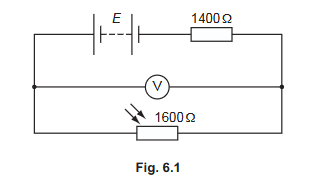
The resistance of the fixed resistor is \(1400\,\Omega\). The intensity of the light illuminating the LDR causes it to have a resistance of \(1600\,\Omega\). A voltmeter connected across the LDR reads \(6.4\,\mathrm{V}\).
(i) Show that the current in the LDR is \(4.0\times10^{-3}\,\mathrm{A}\). (1 mark)
_______________________________________________
(ii) Calculate the number of free electrons passing through the LDR in a time of \(3.2\) minutes. (2 marks)
number of free electrons = _______________________
(iii) Calculate the e.m.f. \(E\). (2 marks)
\(E\) = __________________________________________ \(\mathrm{V}\)
(iv) Determine the ratio
\(\displaystyle \frac{\text{power dissipated in LDR}}{\text{power dissipated in fixed resistor}}\)
ratio = _________________________________________
(c) The environmental conditions change causing a decrease in the resistance of the LDR in (b). The temperature of the environment does not change.
State whether there is a decrease, increase or no change to:
(i) the intensity of the light illuminating the LDR (1 mark)
________________________________________________
(ii) the current in the battery (1 mark)
________________________________________________
(iii) the reading of the voltmeter. (1 mark)
________________________________________________
Syllabus Topic Codes (Cambridge International AS & A Level Physics 9702):
• 9.1: Current, charge and potential difference — parts (b)(i) and (b)(ii)
• 9.2: Potential difference and power — parts (b)(iii), (b)(iv), (c)(ii) and (c)(iii)
▶️ Answer/Explanation
(a) Resistivity [2 marks]
The resistance of a wire is related to its resistivity by
\(R=\frac{\rho L}{A}\)
Therefore, the resistance per unit length is
\(\frac{R}{L}=\frac{\rho}{A}\)
Hence,
\(\rho=\left(\frac{R}{L}\right)A\)
\(\rho=(0.92)(5.3\times10^{-7})\)
\(\rho=4.9\times10^{-7}\,\Omega\,\mathrm{m}\)
Answer: \( \boxed{4.9\times10^{-7}\,\Omega\,\mathrm{m}} \)
(b)(i) Current in the LDR [1 mark]
Using \(V=IR\):
\(I=\frac{V}{R}\)
\(I=\frac{6.4}{1600}\)
\(I=4.0\times10^{-3}\,\mathrm{A}\)
Answer: \( \boxed{4.0\times10^{-3}\,\mathrm{A}} \)
(b)(ii) Number of free electrons [2 marks]
First calculate the charge passing through the LDR:
\(Q=It\)
The time is
\(t=3.2\times60=192\,\mathrm{s}\)
Therefore,
\(Q=(4.0\times10^{-3})(192)\)
\(Q=0.768\,\mathrm{C}\)
The number of electrons is
\(N=\frac{Q}{e}\)
\(N=\frac{0.768}{1.6\times10^{-19}}\)
\(N=4.8\times10^{18}\)
Answer: \( \boxed{4.8\times10^{18}} \)
(b)(iii) E.m.f. [2 marks]
The \(1400\,\Omega\) resistor and the \(1600\,\Omega\) LDR are in series, so the same current flows through both.
The total resistance is
\(R_{\mathrm{total}}=1400+1600=3000\,\Omega\)
Therefore,
\(E=IR_{\mathrm{total}}\)
\(E=(4.0\times10^{-3})(3000)\)
\(E=12\,\mathrm{V}\)
Answer: \( \boxed{12\,\mathrm{V}} \)
(b)(iv) Ratio of powers [2 marks]
Power dissipated by a resistor can be calculated using
\(P=\frac{V^2}{R}\)
Therefore,
\(\text{ratio}=\frac{6.4^2/1600}{(4.0\times10^{-3})^2(1400)}\)
\(\text{ratio}\approx1.1\)
Answer: \( \boxed{1.1} \)
(c)(i) Intensity of light [1 mark]
For an LDR, a decrease in resistance at constant temperature indicates an increase in light intensity.
Answer: \( \boxed{\text{increase}} \)
(c)(ii) Current in the battery [1 mark]
The resistance of the LDR decreases, so the total resistance of the series circuit decreases.
Since the battery e.m.f. is unchanged, the current increases.
Answer: \( \boxed{\text{increase}} \)
(c)(iii) Voltmeter reading [1 mark]
The voltmeter is connected across the LDR.
When the LDR resistance decreases, the potential difference across it decreases because the voltage division across the two series resistors changes.
Answer: \( \boxed{\text{decrease}} \)
Question 7
(a) In the following list, underline all the particles that are not fundamental. (1 mark)
antineutrino baryon nucleon positron
(b) A nucleus of thorium-230 \(\left(^{230}_{90}\mathrm{Th}\right)\) decays in stages, by emitting \(\alpha\)-particles and \(\beta^-\)-particles, to form a nucleus of lead-206 \(\left(^{206}_{82}\mathrm{Pb}\right)\).
Determine the total number of \(\alpha\)-particles and the total number of \(\beta^-\)-particles that are emitted during the sequence of decays that form the nucleus of lead-206 from the nucleus of thorium-230.
number of \(\alpha\)-particles = __________________________________
number of \(\beta^-\)-particles = __________________________________
(2 marks)
(c) A meson has a charge of \(-1e\), where \(e\) is the elementary charge. The quark composition of the meson includes a charm antiquark.
State and explain a possible flavour (type) of the other quark in the meson. (2 marks)
________________________________________
Syllabus Topic Codes (Cambridge International AS & A Level Physics 9702):
• 11.1: Atoms, nuclei and radiation — part (b)
• 11.2: Fundamental particles — part (c)
▶️ Answer/Explanation
(a) Fundamental particles [1 mark]
A fundamental particle has no known smaller constituent particles.
An antineutrino and a positron are leptons and are fundamental particles.
A baryon is a hadron made from three quarks, while a nucleon is a composite particle made from quarks. Therefore, neither is fundamental.
Answer: underline \( \boxed{\text{baryon and nucleon}} \)
(b) Nuclear decay [2 marks]
An \(\alpha\)-particle has nucleon number \(4\) and proton number \(2\).
The change in nucleon number is
\(230-206=24\)
Therefore, the number of \(\alpha\)-particles is
\(\frac{24}{4}=6\)
Six \(\alpha\)-decays reduce the proton number by
\(6\times2=12\)
The proton number would therefore change from \(90\) to
\(90-12=78\)
The final proton number is \(82\), so an increase of \(4\) is required.
Each \(\beta^-\)-decay increases the proton number by \(1\), so there must be \(4\) \(\beta^-\)-decays.
Thus,
number of \(\alpha\)-particles \(=6\)
number of \(\beta^-\)-particles \(=4\)
Answer: \( \boxed{6\ \alpha\text{-particles}} \), \( \boxed{4\ \beta^-\text{-particles}} \)
(c) Quark composition of a meson [2 marks]
A charm quark has charge
\(+\frac{2}{3}e\)
Therefore, a charm antiquark has charge
\(-\frac{2}{3}e\)
The total charge of the meson is \(-1e\). Therefore, the other quark must have charge
\(q+\left(-\frac{2}{3}e\right)=-1e\)
\(q=-\frac{1}{3}e\)
Quarks with charge \(-\frac{1}{3}e\) include the strange and bottom quarks.
Hence, a possible flavour is the strange quark (or bottom quark).
Answer: \( \boxed{\text{strange quark}} \) or \( \boxed{\text{bottom quark}} \)