
Question 1
(a) In the following list, underline all the scalar quantities. (1 mark)
acceleration charge momentum power upthrust
(b) A uniform cylinder has diameter \(D\), length \(L\) and mass \(M\).
The density \(\rho\) of the cylinder is given by
\( \rho=\frac{4M}{\pi D^2L} \)
Table 1.2 shows the data obtained from an experiment to determine the density of the cylinder.
Table 1.2
| quantity | measurement | percentage uncertainty |
|---|---|---|
| \(D\) | \((26.2\pm0.1)\,\mathrm{mm}\) | __________ \(\%\) |
| \(L\) | \((162\pm1)\,\mathrm{mm}\) | __________ \(\%\) |
| \(M\) | \((247\pm1)\,\mathrm{g}\) | \(0.4\%\) |
(i) Calculate the percentage uncertainties in \(D\) and \(L\). Write your answers in Table 1.2. (1 mark)
(ii) Calculate the density of the cylinder. Give your answer to three significant figures. (2 marks)
density = __________________________________________ \(\mathrm{kg\,m^{-3}}\)
(iii) Calculate the percentage uncertainty in the density. (2 marks)
percentage uncertainty = __________________________ \(\%\)
Syllabus Topic Codes (Cambridge International AS & A Level Physics 9702):
• 1.3: Errors and uncertainties — parts (b)(i) and (b)(iii)
• 4.3: Density and pressure — part (b)(ii)
▶️ Answer/Explanation
(a) Scalar quantities [1 mark]
Scalar quantities have magnitude only, whereas vector quantities have both magnitude and direction.
Charge and power are scalar quantities.
Answer: \( \boxed{\text{charge and power}} \)
(b)(i) Percentage uncertainties [1 mark]
For \(D\):
\(\text{percentage uncertainty in }D=\frac{0.1}{26.2}\times100\)
\(\approx0.4\%\)
For \(L\):
\(\text{percentage uncertainty in }L=\frac{1}{162}\times100\)
\(\approx0.6\%\)
Answer: \( \boxed{D=0.4\%} \), \( \boxed{L=0.6\%} \)
(b)(ii) Density of the cylinder [2 marks]
The density is given by
\( \rho=\frac{4M}{\pi D^2L} \)
Convert the measurements to SI units:
\(M=247\,\mathrm{g}=0.247\,\mathrm{kg}\)
\(D=26.2\,\mathrm{mm}=26.2\times10^{-3}\,\mathrm{m}\)
\(L=162\,\mathrm{mm}=0.162\,\mathrm{m}\)
Therefore,
\( \rho=\frac{4(0.247)}{\pi(26.2\times10^{-3})^2(0.162)} \)
\( \rho=2.83\times10^3\,\mathrm{kg\,m^{-3}} \)
Answer: \( \boxed{2.83\times10^3\,\mathrm{kg\,m^{-3}}} \)
(b)(iii) Percentage uncertainty in density [2 marks]
Since
\( \rho=\frac{4M}{\pi D^2L} \)
the percentage uncertainty in \(D\) is multiplied by \(2\), because \(D\) is squared.
Therefore,
\(\text{percentage uncertainty}=0.4+(2\times0.4)+0.6\)
\(\text{percentage uncertainty}=1.8\%\)
Answer: \( \boxed{1.8\%} \)
Question 2
A ball on horizontal ground is kicked towards a vertical wall. Fig. 2.1 shows the path of the ball.
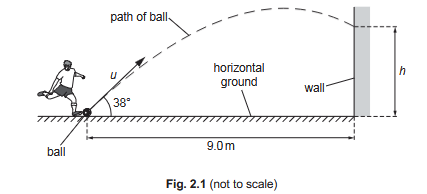
The ball has an initial velocity \(u\) at an angle of \(38^\circ\) to the ground. The ball travels a horizontal distance of \(9.0\,\mathrm{m}\) before striking the wall at a height \(h\) above the ground. The horizontal component of the velocity is \(9.5\,\mathrm{m\,s^{-1}}\).
Air resistance is negligible.
(a)
(i) Show that the time for the ball to reach the wall is \(0.95\,\mathrm{s}\). (1 mark)
_______________________________________________
(ii) Calculate the vertical component \(u_{\mathrm{v}}\) of the initial velocity of the ball. (2 marks)
\(u_{\mathrm{v}}\) = __________________________________ \(\mathrm{m\,s^{-1}}\)
(iii) Determine \(h\). (2 marks)
\(h\) = __________________________________________ \(\mathrm{m}\)
(b) The speed of the ball just after striking the wall is less than its speed just before striking the wall.
State what this indicates about the nature of the collision of the ball with the wall. (1 mark)
_______________________________________________
Syllabus Topic Codes (Cambridge International AS & A Level Physics 9702):
• 2.1: Equations of motion — parts (a)(i), (a)(ii) and (a)(iii)
• 3.3: Linear momentum and its conservation — part (b), nature of the collision
▶️ Answer/Explanation
(a)(i) Time for the ball to reach the wall [1 mark]
The horizontal component of velocity is constant because air resistance is negligible.
Using
\(s=vt\)
\(t=\frac{s}{v}\)
\(t=\frac{9.0}{9.5}\)
\(t=0.95\,\mathrm{s}\)
Answer: \( \boxed{0.95\,\mathrm{s}} \)
(a)(ii) Vertical component of initial velocity [2 marks]
The horizontal component of the initial velocity is
\(u\cos38^\circ=9.5\)
Therefore, the vertical component is
\(u_{\mathrm{v}}=u\sin38^\circ\)
Using \(u=9.5/\cos38^\circ\):
\(u_{\mathrm{v}}=\frac{9.5}{\cos38^\circ}\sin38^\circ\)
\(u_{\mathrm{v}}=9.5\tan38^\circ\)
\(u_{\mathrm{v}}\approx7.4\,\mathrm{m\,s^{-1}}\)
Answer: \( \boxed{7.4\,\mathrm{m\,s^{-1}}} \)
(a)(iii) Height of the ball [2 marks]
For vertical motion,
\(s=u_{\mathrm{v}}t+\frac{1}{2}at^2\)
Taking upward as positive, \(a=-g\). Hence,
\(h=(7.4)(0.95)-\frac{1}{2}(9.81)(0.95)^2\)
\(h\approx2.6\,\mathrm{m}\)
Answer: \( \boxed{2.6\,\mathrm{m}} \)
(b) Nature of the collision [1 mark]
The speed after the collision is less than the speed before the collision, indicating that kinetic energy has been lost during the collision.
Therefore, the collision is inelastic.
Answer: \( \boxed{\text{inelastic collision}} \)
Question 3
(a) State the conditions for a system to be in equilibrium. (2 marks)
________________________________
(b) Fig. 3.1 shows an airship in flight. The airship is propelled by identical fans that can be angled to control the motion of the airship.
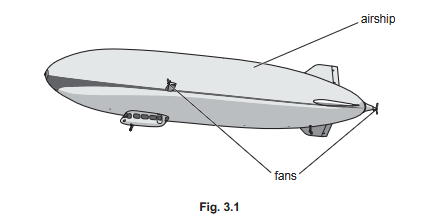
The upthrust on the airship is \(93000\,\mathrm{N}\).
The density of the surrounding air is \(1.2\,\mathrm{kg\,m^{-3}}\).
(i) Calculate the volume of air displaced by the airship. (1 mark)
volume = __________________________________________ \(\mathrm{m^3}\)
(ii) When fully loaded, the weight of the airship is greater than the upthrust.
To maintain horizontal flight, the fans provide a total vertical force of \(3.0\times10^3\,\mathrm{N}\) upwards on the airship.
Calculate the mass of the airship. (2 marks)
mass = __________________________________________ \(\mathrm{kg}\)
(c) At a certain time, the airship in (b) is stationary. The thrust force exerted by a fan on the airship is \(2800\,\mathrm{N}\).
To produce this force, a mass of \(64\,\mathrm{kg}\) of air is propelled through the blades of the fan in a time \(0.50\,\mathrm{s}\). Assume that this air is initially stationary at the entrance to the fan.
Calculate:
(i) the change in momentum \(\Delta p\) of the air propelled through the fan blades in this time. (2 marks)
\(\Delta p\) = __________________________________ \(\mathrm{kg\,m\,s^{-1}}\)
(ii) the speed of the air as it leaves the fan. (2 marks)
speed = ________________________________________ \(\mathrm{m\,s^{-1}}\)
(iii) the total kinetic energy of this air due to its movement through the fan. (2 marks)
kinetic energy = _________________________________ \(\mathrm{J}\)
Syllabus Topic Codes (Cambridge International AS & A Level Physics 9702):
• 4.3: Density and pressure — part (b)(i)
• 3.1: Momentum and Newton’s laws of motion — parts (c)(i) and (c)(ii)
• 5.2: Gravitational potential energy and kinetic energy — part (c)(iii)
▶️ Answer/Explanation
(a) Conditions for equilibrium [2 marks]
For a system to be in equilibrium:
The resultant force in any direction must be zero.
\( \sum F=0 \)
The resultant moment (or torque) about any point must be zero.
\( \sum \tau=0 \)
Answer: \( \boxed{\text{resultant force}=0\text{ and resultant moment}=0} \)
(b)(i) Volume of air displaced [1 mark]
The upthrust is equal to the weight of the displaced air:
\( F=\rho Vg \)
Therefore,
\( V=\frac{F}{\rho g} \)
\( V=\frac{93000}{(1.2)(9.81)} \)
\( V\approx7900\,\mathrm{m^3} \)
Answer: \( \boxed{7900\,\mathrm{m^3}} \)
(b)(ii) Mass of the airship [2 marks]
The airship is in horizontal flight and is stationary, so the vertical forces are balanced.
Therefore,
\(\text{weight}=\text{upthrust}+\text{vertical fan force}\)
\(\text{weight}=93000+3.0\times10^3\)
\(\text{weight}=96000\,\mathrm{N}\)
Since \(W=mg\),
\(m=\frac{96000}{9.81}\)
\(m\approx9800\,\mathrm{kg}\)
Answer: \( \boxed{9800\,\mathrm{kg}} \)
(c)(i) Change in momentum of the air [2 marks]
Impulse is equal to the change in momentum:
\( \Delta p=F\Delta t \)
\( \Delta p=(2800)(0.50) \)
\( \Delta p=1400\,\mathrm{kg\,m\,s^{-1}} \)
Answer: \( \boxed{1400\,\mathrm{kg\,m\,s^{-1}}} \)
(c)(ii) Speed of the air leaving the fan [2 marks]
The air is initially stationary, so its initial momentum is zero.
Hence,
\( \Delta p=mv \)
\( v=\frac{\Delta p}{m} \)
\( v=\frac{1400}{64} \)
\( v\approx22\,\mathrm{m\,s^{-1}} \)
Answer: \( \boxed{22\,\mathrm{m\,s^{-1}}} \)
(c)(iii) Kinetic energy of the air [2 marks]
The kinetic energy is
\( E_{\mathrm{K}}=\frac{1}{2}mv^2 \)
\( E_{\mathrm{K}}=\frac{1}{2}(64)(22)^2 \)
\( E_{\mathrm{K}}\approx1.5\times10^4\,\mathrm{J} \)
Answer: \( \boxed{1.5\times10^4\,\mathrm{J}} \)
Question 4
Fig. 4.1 shows the variation with extension \(x\) of the tensile force \(F\) for two wires, G and H, made from the same material.
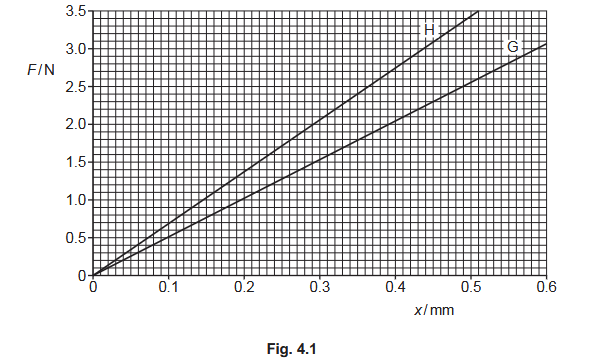
The elastic limit has not been exceeded for G or H.
(a) For the lines in Fig. 4.1:
(i) state what is represented by the gradient. (1 mark)
____________________________________________________________
(ii) explain why the area under the line represents the elastic potential energy of the wire. (2 marks)
___________________________________
(b) Wires G and H are joined together end-to-end to form a composite wire of negligible weight. The composite wire hangs vertically from a fixed support.
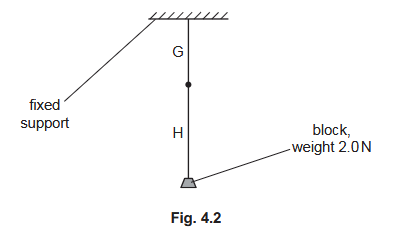
A block of weight \(2.0\,\mathrm{N}\) is attached to the end of the wire, as shown in Fig. 4.2.
(i) Use Fig. 4.1 to determine:
• the extension \(x_{\mathrm{G}}\) of wire G
\(x_{\mathrm{G}}\) = __________________________________ \(\mathrm{mm}\)
• the extension \(x_{\mathrm{H}}\) of wire H.
\(x_{\mathrm{H}}\) = __________________________________ \(\mathrm{mm}\) (1 mark)
(ii) Calculate the total elastic potential energy \(E_{\mathrm{P}}\) of the composite wire due to the weight of the block. (2 marks)
\(E_{\mathrm{P}}\) = __________________________________ \(\mathrm{J}\)
(iii) The original length of wire G is \(L\) and the original length of wire H is \(1.5L\).
Calculate the ratio
\(\frac{\text{cross-sectional area of wire G}}{\text{cross-sectional area of wire H}}\)
ratio = __________________________________________ (3 marks)
Syllabus Topic Codes (Cambridge International AS & A Level Physics 9702):
• 6.2: Elastic and plastic behaviour — parts (a)(i), (a)(ii), (b)(i) and (b)(ii)
▶️ Answer/Explanation
(a)(i) Gradient of the force-extension graph [1 mark]
For a wire obeying Hooke’s law,
\(F=kx\)
Comparing this with the equation of a straight line, the gradient of the \(F\)-against-\(x\) graph is \(k\).
Answer: \( \boxed{\text{spring constant}} \)
(a)(ii) Area under the graph [2 marks]
The area under a force-extension graph represents the work done in extending the wire.
The work done in extending the wire is stored as elastic potential energy, provided the elastic limit has not been exceeded.
Answer: The area represents the work done to extend the wire, which is equal to the elastic potential energy stored in the wire.
(b)(i) Extensions of wires G and H [1 mark]
The tension in each wire is \(2.0\,\mathrm{N}\), because the block is stationary.
Reading from Fig. 4.1 at \(F=2.0\,\mathrm{N}\):
\(x_{\mathrm{G}}=0.39\,\mathrm{mm}\)
\(x_{\mathrm{H}}=0.29\,\mathrm{mm}\)
Answer: \( \boxed{x_{\mathrm{G}}=0.39\,\mathrm{mm}} \), \( \boxed{x_{\mathrm{H}}=0.29\,\mathrm{mm}} \)
(b)(ii) Elastic potential energy of the composite wire [2 marks]
For a wire obeying Hooke’s law,
\(E_{\mathrm{P}}=\frac{1}{2}Fx\)
For wire G:
\(E_{\mathrm{P,G}}=\frac{1}{2}(2.0)(0.39\times10^{-3})\)
\(E_{\mathrm{P,G}}=3.9\times10^{-4}\,\mathrm{J}\)
For wire H:
\(E_{\mathrm{P,H}}=\frac{1}{2}(2.0)(0.29\times10^{-3})\)
\(E_{\mathrm{P,H}}=2.9\times10^{-4}\,\mathrm{J}\)
Therefore,
\(E_{\mathrm{P}}=3.9\times10^{-4}+2.9\times10^{-4}\)
\(E_{\mathrm{P}}=6.8\times10^{-4}\,\mathrm{J}\)
Answer: \( \boxed{6.8\times10^{-4}\,\mathrm{J}} \)
(b)(iii) Ratio of cross-sectional areas [3 marks]
Young modulus is given by
\(E=\frac{FL}{Ax}\)
The two wires are made from the same material, so their Young modulus values are equal:
\(\frac{FL_{\mathrm{G}}}{A_{\mathrm{G}}x_{\mathrm{G}}}=\frac{FL_{\mathrm{H}}}{A_{\mathrm{H}}x_{\mathrm{H}}}\)
The force \(F\) is the same in both wires, so
\(\frac{A_{\mathrm{G}}}{A_{\mathrm{H}}}=\frac{L_{\mathrm{G}}x_{\mathrm{H}}}{L_{\mathrm{H}}x_{\mathrm{G}}}\)
Given \(L_{\mathrm{H}}=1.5L_{\mathrm{G}}\),
\(\frac{A_{\mathrm{G}}}{A_{\mathrm{H}}}=\frac{L(0.29\times10^{-3})}{(1.5L)(0.39\times10^{-3})}\)
\(\frac{A_{\mathrm{G}}}{A_{\mathrm{H}}}=0.50\)
Answer: \( \boxed{0.50} \)
Question 5
Two point sources, A and B, produce coherent electromagnetic waves. The waves from A and B are emitted in phase and have wavelength \(\lambda\), as shown in Fig. 5.1.
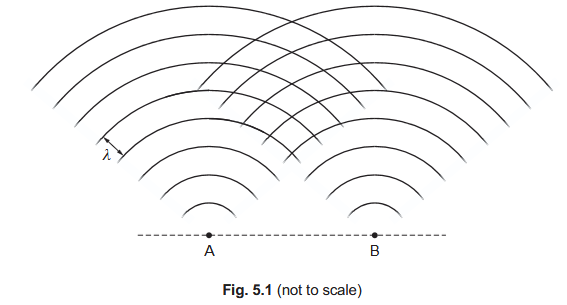
The lines on Fig. 5.1 represent wavefronts. All the points on a wavefront are in phase.
(a) On Fig. 5.1, mark with a cross (×):
(i) the position of an interference maximum (label this cross Y). (1 mark)
(ii) the position of an interference minimum (label this cross Z). (1 mark)
(b) The waves in air have a wavelength of \(2.9\times10^{-5}\,\mathrm{m}\).
An interference pattern is detected along a line parallel to AB and at a perpendicular distance of \(140\,\mathrm{m}\) from AB. The spacing between adjacent interference maxima is \(1.2\,\mathrm{cm}\).
(i) Calculate the separation \(a\) of the sources A and B. (3 marks)
\(a\) = __________________________________________ \(\mathrm{m}\)
(ii) State the principal region of the electromagnetic spectrum to which the waves belong. (1 mark)
_______________________________________________
Syllabus Topic Codes (Cambridge International AS & A Level Physics 9702):
• 7.4: Electromagnetic spectrum — part (b)(ii)
▶️ Answer/Explanation
(a)(i) Interference maximum [1 mark]
An interference maximum occurs where the waves from A and B arrive in phase. On the diagram, this can be at a point where wavefronts from A and B cross.
Answer: \( \boxed{\text{Any position where the wavefronts from A and B cross}} \)
(a)(ii) Interference minimum [1 mark]
An interference minimum occurs where the waves arrive out of phase by half a cycle. A suitable position is on a wavefront from one source midway between adjacent wavefronts from the other source.
Answer: \( \boxed{\text{A point midway between adjacent wavefronts from the other source}} \)
(b)(i) Separation of the sources [3 marks]
For a two-source interference pattern, the fringe spacing is given by
\( \lambda=\frac{ax}{D} \)
Rearranging,
\( a=\frac{\lambda D}{x} \)
The fringe spacing is
\(x=1.2\,\mathrm{cm}=1.2\times10^{-2}\,\mathrm{m}\)
Therefore,
\(a=\frac{(2.9\times10^{-5})(140)}{1.2\times10^{-2}}\)
\(a=0.34\,\mathrm{m}\)
Answer: \( \boxed{0.34\,\mathrm{m}} \)
(b)(ii) Electromagnetic spectrum region [1 mark]
The wavelength is \(2.9\times10^{-5}\,\mathrm{m}\), which lies in the infrared region of the electromagnetic spectrum.
Answer: \( \boxed{\text{infrared}} \)
Question 6
A train travels at constant speed along a straight horizontal track towards an observer standing adjacent to the track, as shown in Fig. 6.1.
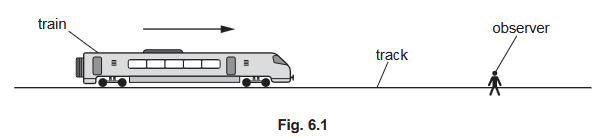
The train sounds its horn continuously as it approaches the observer. The horn emits a sound of constant frequency \(251\,\mathrm{Hz}\). The frequency of sound heard by the observer is \(291\,\mathrm{Hz}\). The speed of sound in air is \(340\,\mathrm{m\,s^{-1}}\).
(a) Calculate the speed of the train. (2 marks)
speed = __________________________________________ \(\mathrm{m\,s^{-1}}\)
(b) The train approaches and then passes the observer. The intensity \(I\) of the sound heard by the observer varies with the distance \(d\) of the horn from the observer.
When the horn is at a distance \(x_0\) from the observer, the intensity of the sound heard is \(I_0\) and the amplitude \(A\) of the sound wave at the observer is \(A_0\).
Fig. 6.2 shows the variation with \(d/x_0\) of \(I/I_0\) as the train moves away from the observer.
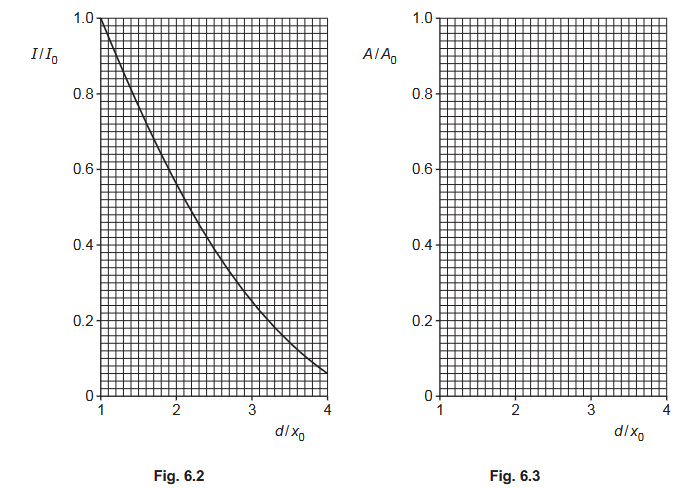
(i) State the relationship between amplitude \(A\) and intensity \(I\) for a progressive wave. (1 mark)
____________________________________________________________
(ii) On Fig. 6.3, sketch the variation with \(d/x_0\) of \(A/A_0\). (2 marks)
Syllabus Topic Codes (Cambridge International AS & A Level Physics 9702):
• 7.1: Progressive waves — parts (b)(i) and (b)(ii)
▶️ Answer/Explanation
(a) Speed of the train [2 marks]
For a source moving towards a stationary observer, the Doppler equation is
\( f_{\mathrm{o}}=f_{\mathrm{s}}\frac{v}{v-v_{\mathrm{s}}} \)
where \(v\) is the speed of sound and \(v_{\mathrm{s}}\) is the speed of the train.
Substituting the values:
\(291=251\frac{340}{340-v_{\mathrm{s}}}\)
Rearranging gives
\(v_{\mathrm{s}}\approx47\,\mathrm{m\,s^{-1}}\)
Answer: \( \boxed{47\,\mathrm{m\,s^{-1}}} \)
(b)(i) Relationship between amplitude and intensity [1 mark]
For a progressive wave, intensity is proportional to the square of the amplitude.
\(I\propto A^2\)
Answer: \( \boxed{I\propto A^2} \)
(b)(ii) Variation of \(A/A_0\) with \(d/x_0\) [2 marks]
Since
\(I\propto A^2\)
the amplitude is proportional to the square root of the intensity:
\(A\propto\sqrt{I}\)
At \(d/x_0=1\), the amplitude ratio is \(A/A_0=1\).
Using the values from Fig. 6.2, at \(d/x_0=4\), \(I/I_0\approx0.06\), so
\(\frac{A}{A_0}=\sqrt{\frac{I}{I_0}}\approx\sqrt{0.06}\approx0.25\)
Therefore, the required graph is an approximately straight line with negative gradient, starting at \((1.0,1.0)\) and ending at approximately \((4.0,0.25)\).
Answer: \( \boxed{\text{straight line from }(1.0,1.0)\text{ to approximately }(4.0,0.25)} \)
Question 7
(a) State Ohm’s law. (2 marks)
______________________________
______________________________
(b) A battery of electromotive force (e.m.f.) \(6.2\,\mathrm{V}\) and negligible internal resistance is connected in a circuit to a uniform resistance wire, a voltmeter, a fixed resistor and a switch, as shown in Fig. 7.1.
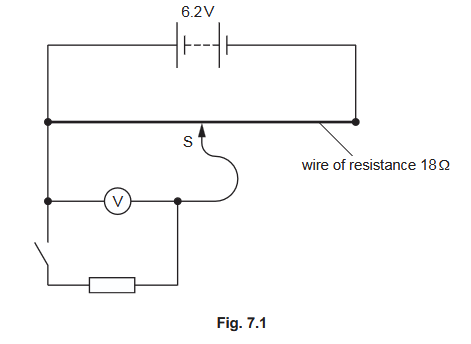
The resistance wire has resistance \(18\,\Omega\), length \(0.94\,\mathrm{m}\) and cross-sectional area \(7.2\times10^{-8}\,\mathrm{m^2}\). The slider \(S\) is positioned half-way along the length of the resistance wire.
(i) Calculate the resistivity \(\rho\) of the material of the resistance wire. (2 marks)
\(\rho=\) __________________________________________ \(\Omega\mathrm{m}\)
(ii) The switch is open.
State the reading on the voltmeter. (1 mark)
voltmeter reading = ______________________________ \(\mathrm{V}\)
(iii) The switch is now closed.
State whether there is an increase, decrease or no change to:
• the current in the battery
• the voltmeter reading. (2 marks)
____________________________________________________________
(iv) The switch remains closed. The slider \(S\) is moved along the resistance wire so that the voltmeter reading is \(3.1\,\mathrm{V}\).
On Fig. 7.1, draw a cross (×) on the resistance wire to show a possible new position of the slider. (1 mark)
The possible position is to the right of the original position of \(S\), but not at the right-hand end of the resistance wire.
(c) The circuit in (b) is altered by changing the battery for one of a different e.m.f. The switch is open.
A student records the following data for the resistance wire:
current in the wire \(=0.93\,\mathrm{A}\)
mean drift speed of charge carriers \(=1.3\times10^{-3}\,\mathrm{m\,s^{-1}}\)
number density of charge carriers \(=9.0\times10^{28}\,\mathrm{m^{-3}}\)
(i) Determine the charge \(q\) of a charge carrier in the wire suggested by this data. (2 marks)
\(q=\) __________________________________________ \(\mathrm{C}\)
(ii) With reference to the value of \(q\), explain why the data recorded by the student cannot be correct. (1 mark)
____________________________________________________________
Syllabus Topic Codes (Cambridge International AS & A Level Physics 9702):
• 10.3: Potential dividers — parts (b)(ii), (b)(iii) and (b)(iv)
• 9.1: Electric current — parts (c)(i) and (c)(ii)
▶️ Answer/Explanation
(a) Ohm’s law [2 marks]
Ohm’s law states that the current through a conductor is directly proportional to the potential difference across it, provided the temperature remains constant.
\( I\propto V \)
Answer: \( \boxed{\text{current is directly proportional to p.d. at constant temperature}} \)
(b)(i) Resistivity of the resistance wire [2 marks]
Using
\( R=\frac{\rho L}{A} \)
Rearranging,
\( \rho=\frac{RA}{L} \)
Substituting the values:
\( \rho=\frac{(18)(7.2\times10^{-8})}{0.94} \)
\( \rho=1.4\times10^{-6}\,\Omega\mathrm{m} \)
Answer: \( \boxed{1.4\times10^{-6}\,\Omega\mathrm{m}} \)
(b)(ii) Voltmeter reading with switch open [1 mark]
The slider \(S\) is halfway along the \(18\,\Omega\) wire, so the resistance between the left end and \(S\) is \(9\,\Omega\).
The voltmeter measures the p.d. across this half of the wire.
\( V=\frac{9}{18}\times6.2 \)
\( V=3.1\,\mathrm{V} \)
Answer: \( \boxed{3.1\,\mathrm{V}} \)
(b)(iii) Effect of closing the switch [2 marks]
When the switch is closed, the fixed resistor is connected in parallel with the left-hand section of the resistance wire.
The equivalent resistance of this parallel combination decreases. Therefore, the total resistance of the circuit decreases.
Since the battery has constant e.m.f., the current in the battery increases.
The p.d. across the parallel combination, and hence the voltmeter reading, decreases.
Answer:
• Current in the battery: \( \boxed{\text{increases}} \)
• Voltmeter reading: \( \boxed{\text{decreases}} \)
(b)(iv) New position of slider [1 mark]
With the switch closed, the voltmeter reading must be reduced to \(3.1\,\mathrm{V}\). A possible new position of \(S\) is therefore to the right of its original position, but not at the right-hand end of the resistance wire.
Answer: \( \boxed{\text{cross to the right of the original position of }S} \)
(c)(i) Charge of a charge carrier [2 marks]
For a current-carrying conductor,
\( I=Anvq \)
Therefore,
\( q=\frac{I}{Anv} \)
Substituting the values:
\( q=\frac{0.93}{(7.2\times10^{-8})(9.0\times10^{28})(1.3\times10^{-3})} \)
\( q\approx1.1\times10^{-19}\,\mathrm{C} \)
Answer: \( \boxed{1.1\times10^{-19}\,\mathrm{C}} \)
(c)(ii) Why the data cannot be correct [1 mark]
Electric charge is quantised. The magnitude of the charge on a charge carrier cannot be less than the elementary charge \(e=1.6\times10^{-19}\,\mathrm{C}\).
The calculated value \(1.1\times10^{-19}\,\mathrm{C}\) is less than \(1.6\times10^{-19}\,\mathrm{C}\), so the recorded data cannot be correct.
Answer: \( \boxed{\text{the calculated charge is less than the elementary charge}} \)
Question 8
(a) The nuclide \(^{23}_{12}\mathrm{Mg}\) is an isotope of magnesium that undergoes \(\beta^+\) decay to form a new nuclide X according to the equation
\(^{23}_{12}\mathrm{Mg}\rightarrow{}^{\phantom{2}23}_{\phantom{1}\,\cdots}\mathrm{X}+{}^{\phantom{2}\cdots}_{\phantom{1}\,\cdots}\beta^+ +{}^{0}_{0}\nu\)
Four numbers are missing from the equation.
(i) For the nuclide \(^{23}_{12}\mathrm{Mg}\), state what is represented by the numbers 23 and 12. (2 marks)
23 represents: ______________________________________________
12 represents: ______________________________________________
(ii) Complete the equation by inserting the missing numbers. (2 marks)
____________________________________________________________
(iii) State the name of the group (class) of fundamental particles to which the positron and neutrino belong. (1 mark)
____________________________________________________________
(b) A radioactive source emits particles from its nuclei when it decays.
Fig. 8.1 shows, for the source, the variation with kinetic energy of the number of particles emitted.
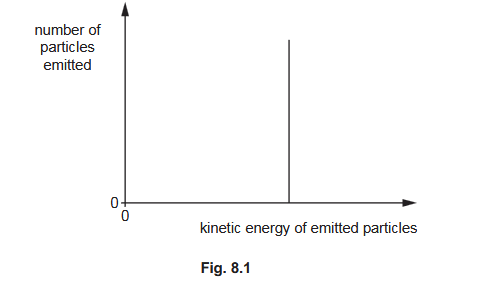
State how Fig. 8.1 shows that these nuclei do not undergo beta-decay. (1 mark)
____________________________________________________________
Syllabus Topic Codes (Cambridge International AS & A Level Physics 9702):
• 11.2: Particle physics — part (a)(iii)
▶️ Answer/Explanation
(a)(i) Meaning of the numbers in the nuclide notation [2 marks]
The nuclide is written as \(^{A}_{Z}\mathrm{X}\), where \(A\) is the nucleon number and \(Z\) is the proton number.
Therefore, 23 represents the nucleon number, the total number of protons and neutrons in the nucleus.
12 represents the proton number, the number of protons in the nucleus.
Answer:
\( \boxed{23=\text{nucleon number}} \)
\( \boxed{12=\text{proton number}} \)
(a)(ii) Completing the nuclear equation [2 marks]
In \(\beta^+\) decay, a proton changes into a neutron. Therefore, the nucleon number remains unchanged, while the proton number decreases by 1.
For the daughter nucleus X:
\(A=23\)
\(Z=12-1=11\)
The positron has nucleon number \(0\) and charge number \(+1\), so it is written as \(^{0}_{+1}\beta^+\).
Hence, the completed equation is
\(^{23}_{12}\mathrm{Mg}\rightarrow{}^{23}_{11}\mathrm{X}+{}^{0}_{+1}\beta^+ +{}^{0}_{0}\nu\)
Answer: \( \boxed{^{23}_{12}\mathrm{Mg}\rightarrow{}^{23}_{11}\mathrm{X}+{}^{0}_{+1}\beta^+ +{}^{0}_{0}\nu} \)
(a)(iii) Classification of positron and neutrino [1 mark]
Both the positron and neutrino belong to the group of fundamental particles called leptons.
Answer: \( \boxed{\text{leptons}} \)
(b) Evidence that the nuclei do not undergo beta-decay [1 mark]
The graph shows that the emitted particles all have a single kinetic energy.
Beta particles have a continuous range of kinetic energies because the decay energy is shared between the beta particle and the neutrino or antineutrino.
Answer: \( \boxed{\text{the emitted particles have a single kinetic energy}} \)