
Question 1
(a) Define the radian. (1 mark)
______________________________________________
(b) The minute hand of a clock revolves at constant angular speed around the face of the clock, completing one revolution every hour. A small piece of modelling clay is attached to the hand with its centre of gravity at a distance \(L\) from the fixed end of the hand, as shown in Fig. 1.1.
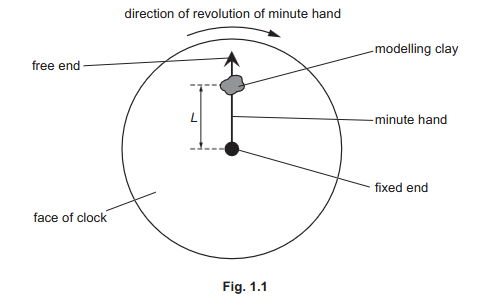
Calculate the angular speed \(\omega\) of the minute hand. (2 marks)
\(\omega=\) __________________________________ \( \mathrm{rad\,s^{-1}} \)
(c) During a time interval of \(1400\,\mathrm{s}\), the centre of gravity of the piece of modelling clay in Fig. 1.1 moves through a distance of \(0.44\,\mathrm{m}\).
(i) Calculate the angle through which the minute hand moves in this time interval. (1 mark)
angle = __________________________________ \( \mathrm{rad} \)
(ii) Determine distance \(L\). (2 marks)
\(L=\) __________________________________ \( \mathrm{m} \)
(iii) Calculate the magnitude of the centripetal acceleration of the piece of modelling clay. (2 marks)
centripetal acceleration = __________________________ \( \mathrm{m\,s^{-2}} \)
(d) Use your answer in (c)(iii) to explain why the variation with time of the magnitude of the force exerted by the minute hand on the piece of modelling clay is negligible as the minute hand undergoes one full revolution. (2 marks)
____________________________
Syllabus Topic Codes (Cambridge International AS & A Level Physics 9702 Paper 4):
• 12.2: Centripetal acceleration — parts (c)(iii) and (d)
▶️ Answer/Explanation
(a) Definition of the radian [1 mark]
One radian is the angle subtended at the centre of a circle by an arc whose length is equal to the radius of the circle.
Answer: \( \boxed{\text{angle subtended at the centre when arc length = radius}} \)
(b) Angular speed of the minute hand [2 marks]
Angular speed is given by
\( \omega=\frac{2\pi}{T} \)
The minute hand completes one revolution in \(60\,\mathrm{min}=3600\,\mathrm{s}\).
\( \omega=\frac{2\pi}{3600} \)
\( \omega=1.745\times10^{-3}\,\mathrm{rad\,s^{-1}} \)
Answer: \( \boxed{1.7\times10^{-3}\,\mathrm{rad\,s^{-1}}} \)
(c)(i) Angle moved through [1 mark]
Using
\( \theta=\omega t \)
\( \theta=(1.745\times10^{-3})(1400) \)
\( \theta=2.44\,\mathrm{rad} \)
Answer: \( \boxed{2.4\,\mathrm{rad}} \)
(c)(ii) Distance \(L\) [2 marks]
For circular motion, the arc length is
\( s=L\theta \)
Therefore,
\( L=\frac{s}{\theta} \)
\( L=\frac{0.44}{2.44} \)
\( L=0.180\,\mathrm{m} \)
Answer: \( \boxed{0.18\,\mathrm{m}} \)
(c)(iii) Centripetal acceleration [2 marks]
For uniform circular motion,
\( a=r\omega^2 \)
Here, \(r=L=0.18\,\mathrm{m}\), so
\( a=(0.18)(1.745\times10^{-3})^2 \)
\( a=5.5\times10^{-7}\,\mathrm{m\,s^{-2}} \)
Answer: \( \boxed{5.5\times10^{-7}\,\mathrm{m\,s^{-2}}} \)
(d) Variation of force during one revolution [2 marks]
The centripetal acceleration of the modelling clay is only \(5.5\times10^{-7}\,\mathrm{m\,s^{-2}}\), which is negligible compared with the acceleration due to gravity, \(9.81\,\mathrm{m\,s^{-2}}\).
Therefore, the resultant force required for the circular motion is negligible compared with the weight of the modelling clay.
Hence, the force exerted by the minute hand is approximately equal and opposite to the weight of the modelling clay, so its magnitude shows negligible variation during the revolution.
Answer: \( \boxed{\text{The centripetal acceleration is negligible compared with }g,\text{ so the force is approximately constant.}} \)
Question 2
(a)
(i) Define gravitational potential at a point. (2 marks)
______________________________________________
______________________________________________
(ii) The Moon may be considered to be an isolated uniform sphere of mass \(7.3\times10^{22}\,\mathrm{kg}\) and radius \(1.7\times10^6\,\mathrm{m}\).
Calculate the gravitational potential at the surface of the Moon. Give a unit with your answer. (2 marks)
gravitational potential = __________________ unit __________________
(b) An isolated uniform spherical planet has gravitational potential \(\phi\) at its surface.
A particle of mass \(m\) is projected vertically upwards from the surface. The particle is given just enough energy to travel to an infinite distance away from the planet, escaping from the gravitational pull of the planet, without any additional work being done on it.
(i) Determine an expression, in terms of \(m\) and \(\phi\), for the gravitational potential energy \(E_{\mathrm{P}}\) of the particle at the surface of the planet. (1 mark)
\(E_{\mathrm{P}}=\) __________________________________________
(ii) Show that the speed \(v\) at which the particle is projected upwards from the surface of the planet is given by
\(v=\sqrt{-2\phi}\).
(2 marks)
(c) A particle is moving upwards at the surface of the Moon.
Use your answer in (a)(ii) and the expression in (b)(ii) to determine the minimum speed of this particle that will result in it escaping from the gravitational pull of the Moon. (1 mark)
speed = __________________________ \( \mathrm{m\,s^{-1}} \)
(d) Hydrogen may be assumed to be an ideal gas.
The mass of a hydrogen molecule is \(3.3\times10^{-27}\,\mathrm{kg}\).
Calculate the root-mean-square (r.m.s.) speed of a hydrogen molecule in hydrogen gas that is at a temperature of \(400\,\mathrm{K}\). (3 marks)
r.m.s. speed = __________________________ \( \mathrm{m\,s^{-1}} \)
(e) The surface of the Moon reaches temperatures of approximately \(400\,\mathrm{K}\) when in direct sunlight.
Use your answers in (c) and (d) to suggest a reason why the Moon does not have an atmosphere consisting of hydrogen. (1 mark)
______________________________________________
______________________________________________
Syllabus Topic Codes (Cambridge International AS & A Level Physics 9702 Paper 4):
• 15.3: Kinetic theory of gases — parts (d) and (e)
▶️ Answer/Explanation
(a)(i) Definition of gravitational potential [2 marks]
Gravitational potential at a point is the work done per unit mass in moving a small mass from infinity to that point.
Answer: \( \boxed{\text{work done per unit mass in moving a mass from infinity to the point}} \)
(a)(ii) Gravitational potential at the surface of the Moon [2 marks]
The gravitational potential at the surface of a spherical mass is
\( \phi=-\frac{GM}{r} \)
Using \(G=6.67\times10^{-11}\,\mathrm{N\,m^2\,kg^{-2}}\), \(M=7.3\times10^{22}\,\mathrm{kg}\) and \(r=1.7\times10^6\,\mathrm{m}\):
\( \phi=-\frac{(6.67\times10^{-11})(7.3\times10^{22})}{1.7\times10^6} \)
\( \phi=-2.9\times10^6\,\mathrm{J\,kg^{-1}} \)
Answer: \( \boxed{-2.9\times10^6\,\mathrm{J\,kg^{-1}}} \)
(b)(i) Gravitational potential energy [1 mark]
Gravitational potential energy is related to gravitational potential by
\( E_{\mathrm{P}}=m\phi \)
Answer: \( \boxed{E_{\mathrm{P}}=m\phi} \)
(b)(ii) Escape speed [2 marks]
At the surface, the total energy of the particle is just sufficient for it to reach infinity with zero kinetic energy.
Taking the gravitational potential energy at infinity as zero,
\( \frac{1}{2}mv^2+m\phi=0 \)
Dividing by \(m\),
\( \frac{1}{2}v^2+\phi=0 \)
\( \frac{1}{2}v^2=-\phi \)
Therefore,
\( v^2=-2\phi \)
\( v=\sqrt{-2\phi} \)
Answer: \( \boxed{v=\sqrt{-2\phi}} \)
(c) Escape speed from the Moon [1 mark]
Using \(\phi=-2.9\times10^6\,\mathrm{J\,kg^{-1}}\),
\( v=\sqrt{-2\phi} \)
\( v=\sqrt{2(2.9\times10^6)} \)
\( v=2.4\times10^3\,\mathrm{m\,s^{-1}} \)
Answer: \( \boxed{2400\,\mathrm{m\,s^{-1}}} \)
(d) r.m.s. speed of hydrogen molecules [3 marks]
From kinetic theory,
\( \frac{1}{2}m\langle c^2\rangle=\frac{3}{2}kT \)
The r.m.s. speed is \(c_{\mathrm{r.m.s.}}=\sqrt{\langle c^2\rangle}\), so
\( m c_{\mathrm{r.m.s.}}^2=3kT \)
Using \(m=3.3\times10^{-27}\,\mathrm{kg}\), \(k=1.38\times10^{-23}\,\mathrm{J\,K^{-1}}\) and \(T=400\,\mathrm{K}\):
\( (3.3\times10^{-27})c_{\mathrm{r.m.s.}}^2=3(1.38\times10^{-23})(400) \)
\( c_{\mathrm{r.m.s.}}=2.24\times10^3\,\mathrm{m\,s^{-1}} \)
Answer: \( \boxed{2.2\times10^3\,\mathrm{m\,s^{-1}}} \)
(e) Why the Moon does not retain hydrogen [1 mark]
The r.m.s. speed is an average speed, so there is a distribution of molecular speeds. Many hydrogen molecules will have speeds greater than the Moon’s escape speed.
Answer: \( \boxed{\text{Some hydrogen molecules have speeds greater than the escape speed and escape from the Moon.}} \)
Question 3
(a) State what is meant by the internal energy of a system. (2 marks)
____________________
(b) Use the first law of thermodynamics to explain what happens to the internal energy:
(i) of a spring when it is stretched at constant temperature within its elastic limit. (3 marks)
____________________
(ii) of a sample of water when it evaporates from a rain puddle on a hot day. (3 marks)
_____________________
Syllabus Topic Codes (Cambridge International AS & A Level Physics 9702 Paper 4):
• 16.2: The first law of thermodynamics — parts (b)(i) and (b)(ii)
▶️ Answer/Explanation
(a) Internal energy [2 marks]
Internal energy is the sum of the potential energy and kinetic energy of the particles in a system.
It is the total energy associated with the random motion and interactions of the particles.
Answer: \( \boxed{\text{sum of the potential energy and kinetic energy of the particles}} \)
(b)(i) Spring stretched at constant temperature [3 marks]
At constant temperature, there is no thermal energy transferred.
Work is done on the spring as it is stretched. This increases the potential energy of its particles.
Therefore, the internal energy of the spring increases.
Answer: \( \boxed{\Delta U>0} \)
(b)(ii) Evaporation of water [3 marks]
Thermal energy is transferred to the water from the surroundings.
As the water evaporates, the water does work by expanding against the atmosphere.
The thermal energy transferred is greater than the work done, so the internal energy of the water increases.
Answer: \( \boxed{\text{The internal energy increases because the thermal energy transferred is greater than the work done.}} \)
Question 4
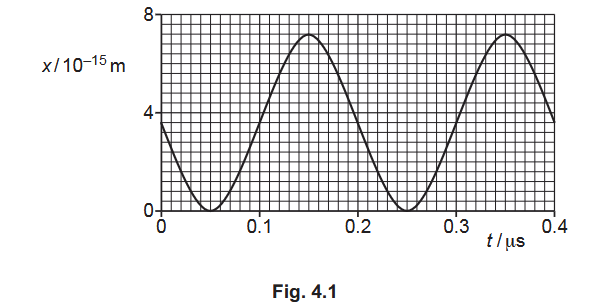
An electron in a metal rod moves randomly about a mean position. When an alternating voltage is applied to the ends of the rod, the mean position can be considered to oscillate with simple harmonic motion along the axis of the rod. Fig. 4.1 shows the variation with time \(t\) of the displacement \(x\) of the mean position from a fixed point on the axis of the rod.
(a)
(i) Determine the amplitude of the oscillations. (1 mark)
amplitude = __________________________________ \( \mathrm{m} \)
(ii) Determine the angular frequency of the oscillations. (1 mark)
angular frequency = __________________________ \( \mathrm{rad\,s^{-1}} \)
(iii) Use your answers in (a)(i) and (a)(ii) to show that the maximum drift speed \(v_0\) of the electron is \(1.1\times10^{-7}\,\mathrm{m\,s^{-1}}\). (2 marks)
______________________________________________
______________________________________________
(b) The rod has a cross-sectional area of \(4.3\,\mathrm{cm^2}\) and contains a number density of conduction electrons (charge carriers) of \(8.5\times10^{28}\,\mathrm{m^{-3}}\).
All of the conduction electrons in the rod may be assumed to be oscillating in phase with, and with the same amplitude as, the oscillation shown in Fig. 4.1.
(i) Use the information in (a)(iii) to calculate the magnitude \(I_0\) of the maximum current in the rod. (2 marks)
\(I_0=\) __________________________________ \( \mathrm{A} \)
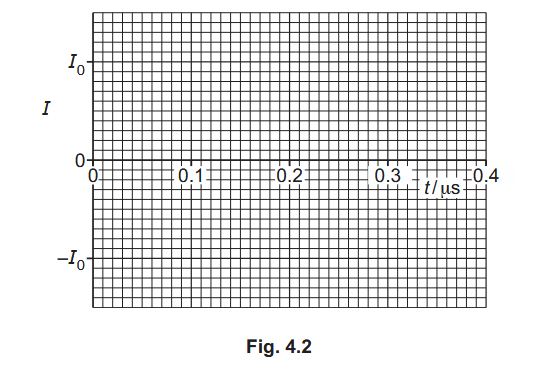
(ii) On Fig. 4.2, sketch the variation of the current \(I\) in the rod with time \(t\) between \(t=0\) and \(t=0.40\,\mathrm{\mu s}\). (2 marks)
(iii) Use your answers in (a)(ii) and (b)(i) to determine an expression for \(I\) in terms of \(t\), where \(I\) is in A and \(t\) is in s. (2 marks)
\(I=\) __________________________________________
(iv) Determine the root-mean-square (r.m.s.) current in the rod. (1 mark)
r.m.s. current = ______________________________ \( \mathrm{A} \)
Syllabus Topic Codes (Cambridge International AS & A Level Physics 9702 Paper 4):
• 20.1: Electric current — parts (b)(i), (b)(ii), (b)(iii) and (b)(iv)
▶️ Answer/Explanation
(a)(i) Amplitude of the oscillations [1 mark]
From Fig. 4.1, the maximum displacement is approximately \(7.2\times10^{-15}\,\mathrm{m}\) and the minimum displacement is approximately \(0\).
The amplitude is half the peak-to-peak displacement:
\( x_0=\frac{1}{2}(7.2\times10^{-15}) \)
\( x_0=3.6\times10^{-15}\,\mathrm{m} \)
Answer: \( \boxed{3.6\times10^{-15}\,\mathrm{m}} \)
(a)(ii) Angular frequency [1 mark]
From Fig. 4.1, the period is
\( T=0.20\,\mathrm{\mu s}=0.20\times10^{-6}\,\mathrm{s} \)
Angular frequency is
\( \omega=\frac{2\pi}{T} \)
\( \omega=\frac{2\pi}{0.20\times10^{-6}} \)
\( \omega=3.1\times10^7\,\mathrm{rad\,s^{-1}} \)
Answer: \( \boxed{3.1\times10^7\,\mathrm{rad\,s^{-1}}} \)
(a)(iii) Maximum drift speed [2 marks]
For simple harmonic motion,
\( v_0=\omega x_0 \)
Therefore,
\( v_0=(3.1\times10^7)(3.6\times10^{-15}) \)
\( v_0=1.1\times10^{-7}\,\mathrm{m\,s^{-1}} \)
Answer: \( \boxed{1.1\times10^{-7}\,\mathrm{m\,s^{-1}}} \)
(b)(i) Maximum current [2 marks]
The current due to moving charge carriers is
\( I_0=nAv_0e \)
The cross-sectional area is
\( A=4.3\,\mathrm{cm^2}=4.3\times10^{-4}\,\mathrm{m^2} \)
Using \(n=8.5\times10^{28}\,\mathrm{m^{-3}}\), \(v_0=1.1\times10^{-7}\,\mathrm{m\,s^{-1}}\) and \(e=1.60\times10^{-19}\,\mathrm{C}\):
\( I_0=(8.5\times10^{28})(4.3\times10^{-4})(1.1\times10^{-7})(1.60\times10^{-19}) \)
\( I_0=0.64\,\mathrm{A} \)
Answer: \( \boxed{0.64\,\mathrm{A}} \)
(b)(ii) Variation of current with time [2 marks]
The current varies sinusoidally with the same period as the electron oscillations.
Since the period is \(0.20\,\mathrm{\mu s}\), the graph from \(0\) to \(0.40\,\mathrm{\mu s}\) contains two complete cycles.
At \(t=0\), the current is at its maximum positive value, \(I=+I_0\).
Answer: Sketch a sinusoidal curve of amplitude \(I_0\) and period \(0.20\,\mathrm{\mu s}\), starting at \(I=+I_0\) when \(t=0\).
(b)(iii) Expression for current [2 marks]
Since the current starts at its maximum positive value, a cosine expression is appropriate:
\( I=I_0\cos\omega t \)
Substituting \(I_0=0.64\,\mathrm{A}\) and \(\omega=3.1\times10^7\,\mathrm{rad\,s^{-1}}\):
\( I=0.64\cos(3.1\times10^7t) \)
Answer: \( \boxed{I=0.64\cos(3.1\times10^7t)} \)
(b)(iv) r.m.s. current [1 mark]
For a sinusoidal current,
\( I_{\mathrm{r.m.s.}}=\frac{I_0}{\sqrt{2}} \)
\( I_{\mathrm{r.m.s.}}=\frac{0.64}{\sqrt{2}} \)
\( I_{\mathrm{r.m.s.}}=0.45\,\mathrm{A} \)
Answer: \( \boxed{0.45\,\mathrm{A}} \)
Question 5
(a) State Coulomb’s law. (2 marks)
______________________________________________
______________________________________________
(b) Two identical oil droplets are in a vacuum. The centres of the droplets are a distance of \(3.8\times10^{-6}\,\mathrm{m}\) apart. The droplets have equal charge and exert an electric force on each other of magnitude \(6.3\times10^{-17}\,\mathrm{N}\).
Determine the magnitude of the charge on each droplet. (2 marks)
charge = ______________________________ \( \mathrm{C} \)
(c) One of the oil droplets in (b) is now placed between two horizontal metal plates, as shown in Fig. 5.1.
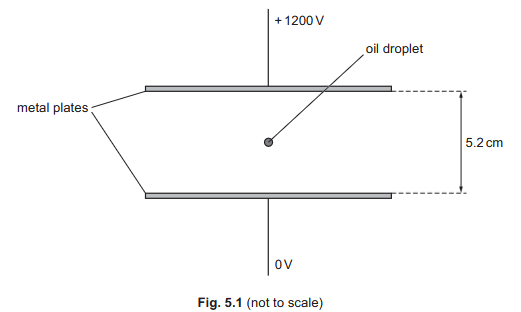
A potential difference (p.d.) of \(1200\,\mathrm{V}\) is applied between the plates, with the top plate at the higher potential. The oil droplet is stationary and in equilibrium.
(i) State the sign of the charge on the oil droplet. (1 mark)
______________________________________________
(ii) On Fig. 5.1, draw four lines to represent the electric field between the plates. (3 marks)
(iii) The distance between the plates is \(5.2\,\mathrm{cm}\).
Determine the mass of the oil droplet. (3 marks)
mass = ______________________________ \( \mathrm{kg} \)
Syllabus Topic Codes (Cambridge International AS & A Level Physics 9702 Paper 4):
• 18.2: Electric field strength — parts (c)(ii) and (c)(iii)
▶️ Answer/Explanation
(a) Coulomb’s law [2 marks]
The electric force between two point charges is directly proportional to the product of their charges and inversely proportional to the square of their separation.
The magnitude of the force is given by
\( F=\frac{Q_1Q_2}{4\pi\varepsilon_0r^2} \)
Answer: \( \boxed{F\propto\frac{Q_1Q_2}{r^2}} \)
(b) Charge on each oil droplet [2 marks]
Since the droplets have equal charge, \(Q_1=Q_2=Q\).
Using Coulomb’s law,
\( F=\frac{Q^2}{4\pi\varepsilon_0r^2} \)
Rearranging,
\( Q=\sqrt{4\pi\varepsilon_0Fr^2} \)
\( Q=\sqrt{4\pi(8.85\times10^{-12})(6.3\times10^{-17})(3.8\times10^{-6})^2} \)
\( Q=3.2\times10^{-19}\,\mathrm{C} \)
Answer: \( \boxed{3.2\times10^{-19}\,\mathrm{C}} \)
(c)(i) Sign of the charge [1 mark]
The top plate is at higher potential, so the electric field is directed downwards, from the positive plate to the negative plate.
The droplet is stationary, so its electric force must act upwards to balance its weight. A negative charge experiences a force opposite to the electric field direction.
Answer: \( \boxed{\text{negative}} \)
(c)(ii) Electric field between the plates [3 marks]
The electric field between parallel plates is uniform. Therefore, draw four straight, parallel and equally spaced lines perpendicular to the plates.
The arrows should point downwards, from the positive top plate towards the negative bottom plate.
Answer: \( \boxed{\text{Four equally spaced vertical field lines with arrows directed downwards.}} \)
(c)(iii) Mass of the oil droplet [3 marks]
The electric field strength between the plates is
\( E=\frac{V}{d} \)
Using \(V=1200\,\mathrm{V}\) and \(d=5.2\,\mathrm{cm}=0.052\,\mathrm{m}\):
\( E=\frac{1200}{0.052} \)
For the droplet to be in equilibrium, the electric force balances its weight:
\( |q|E=mg \)
Therefore,
\( m=\frac{|q|E}{g} \)
\( m=\frac{(3.2\times10^{-19})(1200)}{(9.81)(0.052)} \)
\( m=7.5\times10^{-16}\,\mathrm{kg} \)
Answer: \( \boxed{7.5\times10^{-16}\,\mathrm{kg}} \)
Question 6
A capacitor \(C\) is charged so that the potential difference (p.d.) \(V\) across its terminals is \(8.0\,\mathrm{V}\). The capacitor is connected into the circuit of Fig. 6.1.
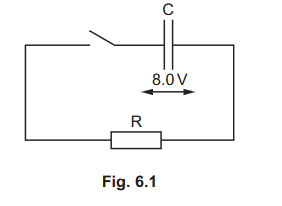
The switch is initially open. The switch is closed at time \(t=0\).
(a) Fig. 6.2 shows the variation of \(V\) with the charge \(Q\) on the plates of capacitor \(C\) as the capacitor discharges.
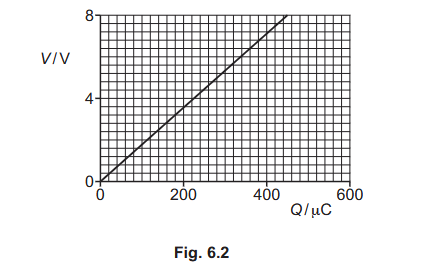
(i) Show that the energy stored in capacitor \(C\) at time \(t=0\) is \(1.8\,\mathrm{mJ}\). (2 marks)
______________________________________________
______________________________________________
(ii) Determine the capacitance of capacitor \(C\). Give a unit with your answer. (2 marks)
capacitance = __________________ unit __________
(b) Fig. 6.3 shows the variation with \(t\) of \( -\ln\left(\frac{V}{8.0\,\mathrm{V}}\right) \).
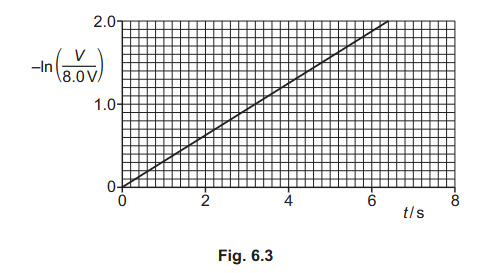
(i) Show that, when \(t\) is equal to one time constant, the value of \( -\ln\left(\frac{V}{8.0\,\mathrm{V}}\right) \) is equal to \(1.0\). (2 marks)
______________________________________________
______________________________________________
(ii) Determine the time constant \(\tau\) of the circuit in Fig. 6.1. (1 mark)
\(\tau=\) __________________________________ \( \mathrm{s} \)
(iii) Calculate the resistance of resistor \(R\). (2 marks)
resistance = ______________________________ \( \Omega \)
Syllabus Topic Codes (Cambridge International AS & A Level Physics 9702 Paper 4):
• 19.2: Energy stored in a capacitor — part (a)(i)
• 19.3: Discharging a capacitor — parts (b)(i), (b)(ii) and (b)(iii)
▶️ Answer/Explanation
(a)(i) Energy stored in the capacitor [2 marks]
The energy stored is equal to the area under the \(V\)-\(Q\) graph.
The graph is a triangle, so
\( E=\frac{1}{2}QV \)
From Fig. 6.2, \(Q=450\,\mathrm{\mu C}\) and \(V=8.0\,\mathrm{V}\).
\( E=\frac{1}{2}(450\times10^{-6})(8.0) \)
\( E=1.8\times10^{-3}\,\mathrm{J} \)
Answer: \( \boxed{1.8\,\mathrm{mJ}} \)
(a)(ii) Capacitance [2 marks]
Capacitance is given by
\( C=\frac{Q}{V} \)
Using \(Q=450\times10^{-6}\,\mathrm{C}\) and \(V=8.0\,\mathrm{V}\):
\( C=\frac{450\times10^{-6}}{8.0} \)
\( C=5.6\times10^{-5}\,\mathrm{F} \)
Answer: \( \boxed{5.6\times10^{-5}\,\mathrm{F}} \)
(b)(i) One time constant [2 marks]
For a discharging capacitor,
\( V=V_0\exp\left(-\frac{t}{RC}\right) \)
The time constant is
\( \tau=RC \)
Hence,
\( V=V_0\exp\left(-\frac{t}{\tau}\right) \)
At \(t=\tau\),
\( V=V_0e^{-1} \)
Since \(V_0=8.0\,\mathrm{V}\),
\( \frac{V}{8.0}=e^{-1} \)
Therefore,
\( -\ln\left(\frac{V}{8.0}\right)=1.0 \)
Answer: \( \boxed{-\ln\left(\frac{V}{8.0\,\mathrm{V}}\right)=1.0} \)
(b)(ii) Time constant [1 mark]
From Fig. 6.3, the value \(1.0\) corresponds to
\( t=3.2\,\mathrm{s} \)
Therefore,
Answer: \( \boxed{\tau=3.2\,\mathrm{s}} \)
(b)(iii) Resistance of resistor \(R\) [2 marks]
The time constant is related to resistance and capacitance by
\( \tau=RC \)
Therefore,
\( R=\frac{\tau}{C} \)
\( R=\frac{3.2}{5.6\times10^{-5}} \)
\( R=5.7\times10^4\,\Omega \)
Answer: \( \boxed{5.7\times10^4\,\Omega} \)
Question 7
(a) A Hall probe containing a thin slice of semiconducting material is placed in a uniform magnetic field of flux density \(B\). The largest faces of the slice are perpendicular to the magnetic field, as shown in Fig. 7.1.
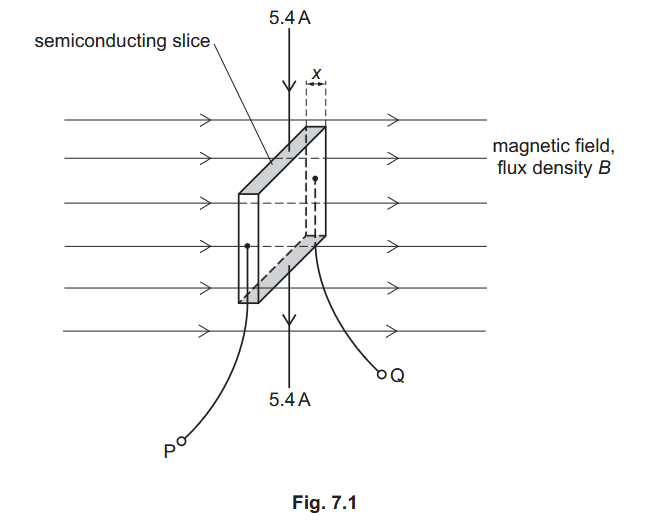
The thickness \(x\) of the slice is \(1.8\,\mathrm{mm}\). The number density of charge carriers in the semiconducting material is \(1.5\times10^{16}\,\mathrm{m^{-3}}\).
A constant current of \(5.4\,\mathrm{A}\) is passed through the slice between the shaded faces. The Hall voltage \(V_{\mathrm{H}}\) that is developed between the terminals \(PQ\) is recorded.
Fig. 7.2 shows the variation with time \(t\) of \(B\).
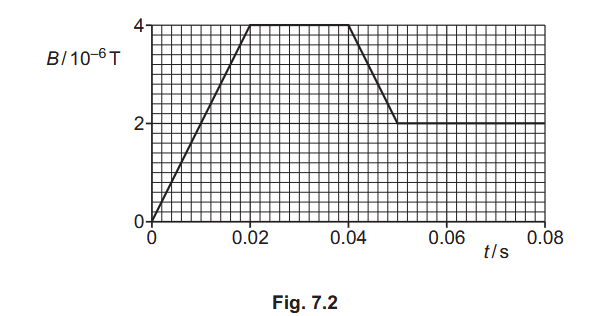
(i) Show that, when \(B\) is equal to \(4.0\times10^{-6}\,\mathrm{T}\), the magnitude of \(V_{\mathrm{H}}\) is \(5.0\,\mathrm{V}\). (1 mark)
______________________________________________
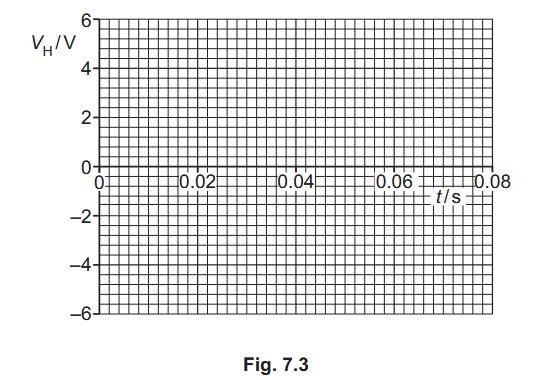
(ii) On Fig. 7.3, sketch the variation of \(V_{\mathrm{H}}\) with \(t\) between \(t=0\) and \(t=0.080\,\mathrm{s}\). (3 marks)
______________________________________________
(b) The Hall probe in (a) is replaced with a small flat coil that has 3000 turns. The cross-sectional area of the coil is \(3.4\times10^{-4}\,\mathrm{m^2}\). The plane of the coil is perpendicular to the magnetic field. The electromotive force (e.m.f.) \(E\) induced between the terminals of the coil is recorded as \(B\) varies as shown in Fig. 7.2.
(i) Show that the magnitude of \(E\) at \(t=0.010\,\mathrm{s}\) is \(2.0\times10^{-4}\,\mathrm{V}\). (3 marks)
______________________________________________
______________________________________________
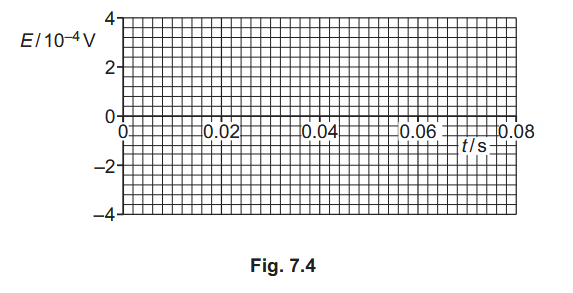
(ii) On Fig. 7.4, sketch the variation of \(E\) with \(t\) between \(t=0\) and \(t=0.080\,\mathrm{s}\). (4 marks)
______________________________________________
Syllabus Topic Codes (Cambridge International AS & A Level Physics 9702 Paper 4):
• 20.5: Electromagnetic induction — parts (b)(i) and (b)(ii)
▶️ Answer/Explanation
(a)(i) Hall voltage [1 mark]
For a Hall probe,
\( V_{\mathrm{H}}=\frac{BI}{ntq} \)
Using \(B=4.0\times10^{-6}\,\mathrm{T}\), \(I=5.4\,\mathrm{A}\), \(n=1.5\times10^{16}\,\mathrm{m^{-3}}\), \(t=1.8\times10^{-3}\,\mathrm{m}\) and \(q=1.60\times10^{-19}\,\mathrm{C}\):
\( V_{\mathrm{H}}=\frac{(4.0\times10^{-6})(5.4)}{(1.5\times10^{16})(1.8\times10^{-3})(1.60\times10^{-19})} \)
\( V_{\mathrm{H}}=5.0\,\mathrm{V} \)
Answer: \( \boxed{5.0\,\mathrm{V}} \)
(a)(ii) Variation of Hall voltage with time [3 marks]
Since \(V_{\mathrm{H}}\propto B\), the Hall voltage has the same shape as the variation of \(B\) with time.
From Fig. 7.2:
\(0\leq t\leq0.020\,\mathrm{s}\): \(V_{\mathrm{H}}\) increases linearly from \(0\) to \(5.0\,\mathrm{V}\).
\(0.020\leq t\leq0.040\,\mathrm{s}\): \(V_{\mathrm{H}}=5.0\,\mathrm{V}\).
\(0.040\leq t\leq0.050\,\mathrm{s}\): \(V_{\mathrm{H}}\) decreases linearly to \(2.5\,\mathrm{V}\).
\(0.050\leq t\leq0.080\,\mathrm{s}\): \(V_{\mathrm{H}}=2.5\,\mathrm{V}\).
Answer: \( \boxed{\text{Sketch with the four sections described above.}} \)
(b)(i) Induced e.m.f. [3 marks]
Faraday’s law states that the magnitude of the induced e.m.f. is equal to the rate of change of magnetic flux linkage:
\( E=N\frac{\Delta\Phi}{\Delta t} \)
Since \( \Phi=BA \),
\( E=NA\frac{\Delta B}{\Delta t} \)
At \(t=0.010\,\mathrm{s}\), the gradient of the \(B\)-\(t\) graph is
\( \frac{\Delta B}{\Delta t}=\frac{4.0\times10^{-6}}{0.020} \)
Therefore,
\( E=(3000)(3.4\times10^{-4})\left(\frac{4.0\times10^{-6}}{0.020}\right) \)
\( E=2.0\times10^{-4}\,\mathrm{V} \)
Answer: \( \boxed{2.0\times10^{-4}\,\mathrm{V}} \)
(b)(ii) Variation of induced e.m.f. with time [4 marks]
The induced e.m.f. depends on the gradient of the \(B\)-\(t\) graph:
\( E\propto-\frac{\mathrm{d}B}{\mathrm{d}t} \)
From \(t=0\) to \(0.020\,\mathrm{s}\), \(B\) increases at a constant rate, so \(E\) is constant and non-zero.
From \(t=0.020\) to \(0.040\,\mathrm{s}\), \(B\) is constant, so \(E=0\).
From \(t=0.040\) to \(0.050\,\mathrm{s}\), \(B\) decreases at a constant rate. The induced e.m.f. is constant and has the opposite sign to the first section.
From \(t=0.050\) to \(0.080\,\mathrm{s}\), \(B\) is constant, so \(E=0\).
The magnitude of \(E\) in both non-zero sections is \(2.0\times10^{-4}\,\mathrm{V}\).
Answer: \( \boxed{\text{constant }E\text{ from }0\text{ to }0.020\,\mathrm{s},\ E=0\text{ from }0.020\text{ to }0.040\,\mathrm{s},\text{ opposite-sign constant }E\text{ from }0.040\text{ to }0.050\,\mathrm{s},\text{ then }E=0} \)
Question 8
(a) State what is meant by a photon. (2 marks)
__________________
(b) When the surface of a metal plate is illuminated with electromagnetic radiation, electrons are sometimes emitted from the metal.
(i) State the name of this phenomenon. (1 mark)
__________________
(ii) It is observed that this phenomenon occurs only when the frequency of the electromagnetic radiation is greater than a certain minimum value, regardless of the intensity of the radiation.
Explain how this observation provides evidence for the existence of photons. (3 marks)
_____________________
(c) Fig. 8.1 shows the variation of the maximum kinetic energy of the emitted electrons in (b) with the frequency of the incident radiation.
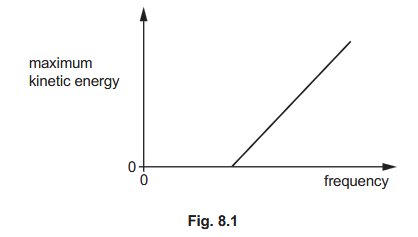
State the name of the quantity represented by:
(i) the gradient of the line in Fig. 8.1. (1 mark)
____________________
(ii) the y-intercept of the extrapolated line in Fig. 8.1. (1 mark)
_____________________
Syllabus Topic Codes (Cambridge International AS & A Level Physics 9702 Paper 4):
▶️ Answer/Explanation
(a) Meaning of a photon [2 marks]
A photon is a packet or quantum of energy of electromagnetic radiation.
The energy of a photon is given by
\( E=hf \)
Answer: \( \boxed{\text{a packet or quantum of energy of electromagnetic radiation}} \)
(b)(i) Phenomenon [1 mark]
Answer: \( \boxed{\text{photoelectric effect}} \)
(b)(ii) Evidence for photons [3 marks]
An electron requires a minimum amount of energy to escape from the metal surface.
The energy of each photon is determined by its frequency, according to
\( E=hf \)
Therefore, if the frequency is below the threshold frequency, each photon has insufficient energy to release an electron, regardless of the intensity.
Increasing the intensity increases the number of photons arriving per unit time, but does not increase the energy of each photon.
Answer: \( \boxed{\text{The observation supports the idea that electromagnetic radiation transfers energy in discrete packets called photons.}} \)
(c)(i) Gradient of the graph [1 mark]
Using the photoelectric equation,
\( E_{\mathrm{K,max}}=hf-\phi \)
Comparing this with \(y=mx+c\), the gradient is \(h\).
Answer: \( \boxed{\text{Planck constant}} \)
(c)(ii) y-intercept of the extrapolated line [1 mark]
From
\( E_{\mathrm{K,max}}=hf-\phi \)
the y-intercept is \(-\phi\), where \(\phi\) is the work function of the metal.
Answer: \( \boxed{-\text{work function (energy)}} \)
Question 9
Fluorine-18 \(\left(^{18}_{9}\mathrm{F}\right)\) is a radioactive nuclide that is used as a tracer in positron emission tomography (PET scanning). Fluorine-18 decays to a nuclide of oxygen (O) according to
\( ^{18}_{9}\mathrm{F}\rightarrow{}^{P}_{Q}X+{}^{R}_{8}\mathrm{O} \)
(a)
(i) State what is meant by a tracer. (1 mark)
______________________________________________
(ii) State the symbol of the particle that is represented by \(X\) and the values of \(P\), \(Q\) and \(R\).
\(X:\) ____________________________ \(P:\) ____________________________
\(Q:\) ____________________________ \(R:\) ____________________________
(2 marks)
(b)
(i) Explain how the radioactive decay of fluorine-18 results in the emission from the body of the gamma-ray photons that are detected during a PET scan. (2 marks)
___________________
(ii) Explain how the detection of the gamma-ray photons is used to produce an image of the tissue being examined. (2 marks)
___________________
(c) The half-life of fluorine-18 is \(T\). A patient is injected with amount of substance \(n\) of fluorine-18.
(i) Determine an expression for the initial value \(R_0\) of the rate \(R\) of production of gamma-ray photons by the tracer, in terms of \(n\), \(T\) and the Avogadro constant \(N_{\mathrm{A}}\). (3 marks)
\(R_0=\) __________________________________________
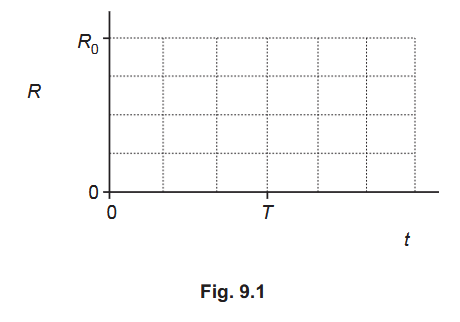
(ii) On Fig. 9.1, sketch the variation with time \(t\) of \(R\). (2 marks)
Syllabus Topic Codes (Cambridge International AS & A Level Physics 9702 Paper 4):
▶️ Answer/Explanation
(a)(i) Meaning of a tracer [1 mark]
A tracer is a material introduced into the body that can be detected or absorbed by the tissue being studied.
Answer: \( \boxed{\text{material introduced into the body that can be detected or absorbed by the tissue being studied}} \)
(a)(ii) Identifying the particle and values of \(P\), \(Q\) and \(R\) [2 marks]
Fluorine-18 undergoes beta-plus decay. Therefore, the emitted particle is a positron:
\( X=\beta^+ \)
In beta-plus decay, the nucleon number is unchanged and the proton number decreases by 1.
Therefore,
\( P=1,\quad Q=0,\quad R=18 \)
Answer: \( \boxed{X=\beta^+,\ P=1,\ Q=0,\ R=18} \)
(b)(i) Production of gamma-ray photons [2 marks]
The positrons emitted during the decay travel through the body and encounter electrons.
The positron and electron annihilate, converting their mass into energy in the form of gamma-ray photons.
Answer: \( \boxed{\text{Positrons annihilate with electrons, producing gamma-ray photons.}} \)
(b)(ii) Formation of the PET image [2 marks]
The arrival times of the gamma-ray photons are detected and processed.
This information is used to determine the distribution or concentration of the tracer in the tissue and hence produce an image.
Answer: \( \boxed{\text{Photon arrival data are processed to determine the tracer concentration in the tissue and form an image.}} \)
(c)(i) Initial rate of production of gamma-ray photons [3 marks]
The activity of the sample is
\( A=\lambda N \)
The decay constant is related to the half-life by
\( \lambda=\frac{\ln 2}{T} \)
The initial number of fluorine-18 nuclei is
\( N=nN_{\mathrm{A}} \)
Each beta-plus decay produces two gamma-ray photons following positron-electron annihilation.
Therefore,
\( R_0=2\lambda nN_{\mathrm{A}} \)
Substituting \( \lambda=\frac{\ln2}{T} \):
\( R_0=\frac{2nN_{\mathrm{A}}\ln2}{T} \)
Answer: \( \boxed{R_0=\frac{2nN_{\mathrm{A}}\ln2}{T}} \)
(c)(ii) Variation of \(R\) with time [2 marks]
Radioactive activity decreases exponentially with time:
\( R=R_0e^{-\lambda t} \)
After one half-life, \(t=T\), the rate is
\( R=\frac{R_0}{2} \)
After two half-lives, \(t=2T\),
\( R=\frac{R_0}{4} \)
Answer: \( \boxed{\text{An exponential decay curve starting at }(0,R_0)\text{ and passing through }(T,R_0/2)\text{ and }(2T,R_0/4).} \)
Question 10
(a) State Wien’s displacement law. Identify any symbols that you use. (2 marks)
______________________________________________
______________________________________________
(b) A cosmology student observes the electromagnetic radiation received from a star in a galaxy.
The student uses Wien’s law to estimate the surface temperature of the star, a standard candle to estimate the distance to the galaxy, and the Stefan-Boltzmann law to estimate the radius of the star.
The student observes that the radiation from the star is redshifted.
(i) State what is meant by a standard candle. (1 mark)
______________________________________________
(ii) State the reason why the radiation from the star is redshifted. (1 mark)
______________________________________________
(iii) The true values of the quantities observed or estimated are those that are corrected to allow for redshift. However, the student does not correct for redshift.
By placing one tick (✓) in each row, complete Table 10.1 to indicate how the observations and estimates made by the student compare with the true values.
Table 10.1
| student’s uncorrected value | |||
|---|---|---|---|
| too low | the same | too high | |
| wavelength of radiation | |||
| surface temperature of star | |||
| distance to star | |||
| radius of star | |||
(4 marks)
Syllabus Topic Codes (Cambridge International AS & A Level Physics 9702 Paper 4):
• 25.2: Stellar radii • part (a), surface temperature and radius in (b)(iii)
• 25.3: Hubble’s law and the Big Bang theory • part (b)(ii) and wavelength/redshift in (b)(iii)
▶️ Answer/Explanation
(a) Wien’s displacement law [2 marks]
Wien’s displacement law states that the wavelength \(\lambda_{\mathrm{max}}\) at which the intensity of radiation emitted by a black body is maximum is inversely proportional to its thermodynamic temperature \(T\).
The relationship is
\( \lambda_{\mathrm{max}}T=b \)
where \(\lambda_{\mathrm{max}}\) is the wavelength of maximum emission, \(T\) is the thermodynamic temperature of the surface and \(b\) is Wien’s displacement constant.
Answer: \( \boxed{\lambda_{\mathrm{max}}T=b} \)
(b)(i) Standard candle [1 mark]
A standard candle is an astronomical object whose luminosity is known.
Answer: \( \boxed{\text{an astronomical object of known luminosity}} \)
(b)(ii) Reason for redshift [1 mark]
The star or galaxy is moving away from the observer, so the observed wavelengths are shifted towards the red end of the spectrum.
Answer: \( \boxed{\text{the star/galaxy is moving away from the student}} \)
(b)(iii) Effect of not correcting for redshift [4 marks]
| Quantity | Student’s uncorrected value |
|---|---|
| wavelength of radiation | too high |
| surface temperature of star | too low |
| distance to star | the same |
| radius of star | too high |
The observed redshift makes the measured wavelength larger than the true wavelength. From
\( T=\frac{b}{\lambda_{\mathrm{max}}} \)
a wavelength that is too high gives a surface temperature that is too low.
The standard candle’s luminosity is known, so the distance estimate is unaffected by the wavelength redshift.
Using the Stefan-Boltzmann law,
\( L=4\pi r^2\sigma T^4 \)
If the temperature is underestimated while the luminosity remains fixed, the calculated radius is too high.
Answer: \( \boxed{\text{wavelength: too high; temperature: too low; distance: the same; radius: too high}} \)