
Question 1
Topic: 4.1 Turning effects of forces.png)
What are the SI base units for the moment of a force?
(B) \( \mathrm{kg\,s^{-2}} \)
(C) \( \mathrm{kg\,m\,s^{-2}} \)
(D) \( \mathrm{kg\,m^{2}\,s^{-2}} \)
▶️ Answer/Explanation
Correct Answer: \( \boxed{\mathrm{D}} \)
Moment of a force is given by \( \mathrm{Force \times Distance} \).
The SI base units are \( \mathrm{(kg\,m\,s^{-2}) \times m = kg\,m^{2}\,s^{-2}} \).
Therefore, the correct answer is (D).
Question 2
Topic: 1.4 Scalars and vectors
Which statement about vector quantities is correct?
(B) Temperature in \(^{\circ}\mathrm{C}\) is a vector quantity because it can be positive or negative.
(C) Time is a vector quantity because it can only go in the forwards direction.
(D) Weight is a vector quantity because it has a direction.
▶️ Answer/Explanation
Correct Answer: \( \boxed{\mathrm{D}} \)
A vector quantity has both magnitude and direction.
Acceleration is a vector because it has direction, not merely because its magnitude is constant. Temperature and time are scalar quantities.
Weight is a force that always acts towards the centre of the Earth, so it has both magnitude and direction.
Therefore, the correct answer is (D).
Question 3
Topic: 1.3 Errors and uncertainties
The density of the material of a rectangular block is determined by measuring the mass and linear dimensions of the block. The list shows the results obtained, together with their uncertainties.
mass \(= (25.0 \pm 0.1)\,\mathrm{g}\)
length \(= (5.00 \pm 0.01)\,\mathrm{cm}\)
width \(= (2.00 \pm 0.01)\,\mathrm{cm}\)
height \(= (1.00 \pm 0.01)\,\mathrm{cm}\)
The density is calculated to be \(2.50\,\mathrm{g\,cm^{-3}}\).
What is the uncertainty in this result?
(B) \( \pm 0.02\,\mathrm{g\,cm^{-3}} \)
(C) \( \pm 0.05\,\mathrm{g\,cm^{-3}} \)
(D) \( \pm 0.13\,\mathrm{g\,cm^{-3}} \)
▶️ Answer/Explanation
Correct Answer: \( \boxed{\mathrm{C}} \)
For quantities multiplied or divided, percentage uncertainties are added.
Percentage uncertainty in mass \(= \dfrac{0.1}{25.0}\times100 = 0.4\%\).
Percentage uncertainty in length \(= \dfrac{0.01}{5.00}\times100 = 0.2\%\).
Percentage uncertainty in width \(= \dfrac{0.01}{2.00}\times100 = 0.5\%\).
Percentage uncertainty in height \(= \dfrac{0.01}{1.00}\times100 = 1.0\%\).
Total percentage uncertainty \(= 0.4 + 0.2 + 0.5 + 1.0 = 2.1\%\).
Absolute uncertainty \(= \dfrac{2.1}{100}\times2.50 = 0.0525 \approx 0.05\,\mathrm{g\,cm^{-3}}\).
Therefore, the correct answer is (C).
Question 4
Topic: 1.2 SI units.png)
What is a reasonable estimate of the volume of one page from this examination paper?
(B) \(600\,\mathrm{mm^3}\)
(C) \(6000\,\mathrm{mm^3}\)
(D) \(60\,000\,\mathrm{mm^3}\)
▶️ Answer/Explanation
Correct Answer: \( \boxed{\mathrm{C}} \)
A typical examination page is about \(300\,\mathrm{mm}\times210\,\mathrm{mm}\) with a thickness of approximately \(0.1\,\mathrm{mm}\).
Its volume is approximately \(300\times210\times0.1=6300\,\mathrm{mm^3}\), which is closest to \(6000\,\mathrm{mm^3}\).
Therefore, the correct answer is (C).
Question 5
Topic: 2.1 Equations of motion
An object is projected from horizontal ground at a velocity of magnitude \(u\) and angle \( \theta \) to the horizontal. It hits the ground at a time \(t\) after it is projected. Assume air resistance is negligible.

Which statement does not describe the motion of this object?
(B) The horizontal distance travelled by the object is \(tu\cos\theta\).
(C) The time taken for the object to reach maximum height is \( \dfrac{t}{2} \).
(D) The vertical component of the object’s velocity is constant and has the value \(u\sin\theta\).
▶️ Answer/Explanation
Correct Answer: \( \boxed{\mathrm{D}} \)
In projectile motion without air resistance, the horizontal velocity remains constant at \(u\cos\theta\).
The vertical velocity changes continuously due to the constant downward acceleration \(g\), so it is not constant.
For a projectile that lands at the same height, the time to reach maximum height is half the total flight time, \( \dfrac{t}{2} \).
Therefore, the correct answer is (D).
Question 6
Topic: 2.1 Equations of motion.png)
A person, travelling on a motorway a total distance of \(200\,\mathrm{km}\), travels the first \(90\,\mathrm{km}\) at an average speed of \(80\,\mathrm{km\,h^{-1}}\).
Which average speed must be obtained for the rest of the journey if the person is to reach the destination in a total time of \(2\) hours \(0\) minutes?
(B) \(120\,\mathrm{km\,h^{-1}}\)
(C) \(122\,\mathrm{km\,h^{-1}}\)
(D) \(126\,\mathrm{km\,h^{-1}}\)
▶️ Answer/Explanation
Correct Answer: \( \boxed{\mathrm{D}} \)
Time for the first \(90\,\mathrm{km}\) is \( \dfrac{90}{80}=1.125\,\mathrm{h} \).
Remaining time \(=2.000-1.125=0.875\,\mathrm{h}\).
Remaining distance \(=200-90=110\,\mathrm{km}\).
Required speed \(=\dfrac{110}{0.875}=125.7\approx126\,\mathrm{km\,h^{-1}}\).
Therefore, the correct answer is (D).
Question 7
Topic: 3.3 Linear momentum and its conservation
A car of mass \(1200\,\mathrm{kg}\) has momentum \(18\,000\,\mathrm{kg\,m\,s^{-1}}\).
What is the kinetic energy of the car?
(B) \(6.57\,\mathrm{kJ}\)
(C) \(135\,\mathrm{kJ}\)
(D) \(270\,\mathrm{kJ}\)
▶️ Answer/Explanation
Correct Answer: \( \boxed{\mathrm{C}} \)
Using \(p=mv\), the speed is \(v=\dfrac{18\,000}{1200}=15\,\mathrm{m\,s^{-1}}\).
The kinetic energy is \(KE=\dfrac{1}{2}mv^2=\dfrac{1}{2}\times1200\times15^2=135\,000\,\mathrm{J}=135\,\mathrm{kJ}\).
Therefore, the correct answer is (C).
Question 8
Topic: 4.2 Equilibrium of forces
A ladder is positioned on icy (frictionless) ground and is leant against a rough wall. At the instant of release it begins to slide.
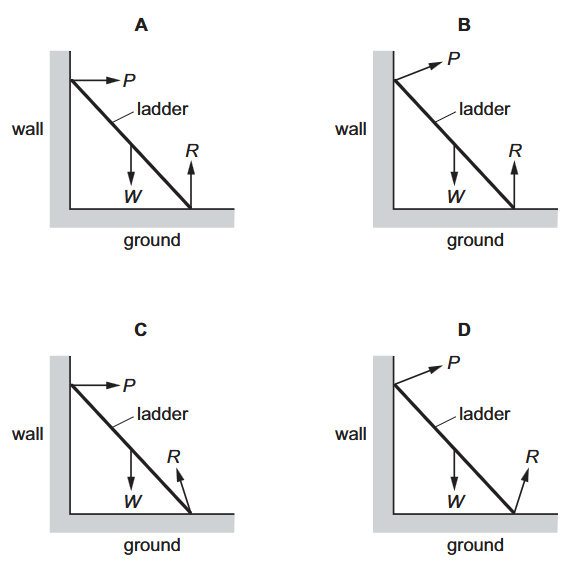
Which diagram shows the directions of the forces \(P\), \(W\) and \(R\) acting on the ladder as it slides?
(B) Diagram B
(C) Diagram C
(D) Diagram D
▶️ Answer/Explanation
Correct Answer: \( \boxed{\mathrm{B}} \)
The ground is frictionless, so the ground exerts only a vertical normal reaction \(R\).
The wall is rough, so the contact force \(P\) is the resultant of the horizontal normal reaction and the upward frictional force that opposes the downward motion of the top of the ladder.
The weight \(W\) acts vertically downward through the centre of mass.
Therefore, the correct answer is (B).
Question 9
Topic: 3.2 Non-uniform motion.png)
A toy parachute is dropped from a bridge and falls vertically through the air.
The graph shows the distance travelled by the parachute against time.
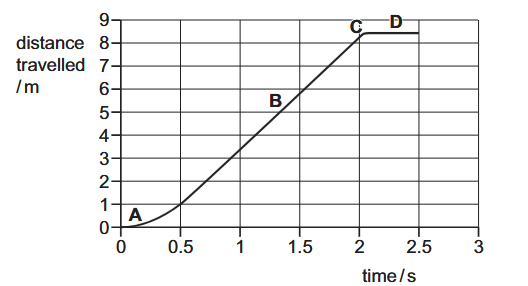
Which region of the graph shows when the parachute is at terminal velocity?
(B) Region B
(C) Region C
(D) Region D
▶️ Answer/Explanation
Correct Answer: \( \boxed{\mathrm{B}} \)
Terminal velocity occurs when the object’s speed is constant, so the distance-time graph has a constant gradient.
Region B is a straight line with constant slope, indicating constant velocity.
Therefore, the correct answer is (B).
Question 10
Topic: 3.1 Momentum and Newton’s laws of motion
A lift (elevator) consists of a passenger car supported by a cable that runs over a light, frictionless pulley to a counterbalance. The counterbalance falls as the passenger car rises.
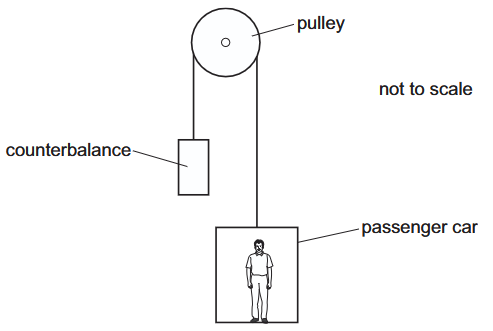
Some masses are shown in the table.
Passenger car \(=520\,\mathrm{kg}\)
Counterbalance \(=640\,\mathrm{kg}\)
Passenger \(=80\,\mathrm{kg}\)
What is the magnitude of the acceleration of the car when carrying just one passenger and when the pulley is free to rotate?
(B) \(0.32\,\mathrm{m\,s^{-2}}\)
(C) \(0.61\,\mathrm{m\,s^{-2}}\)
(D) \(0.65\,\mathrm{m\,s^{-2}}\)
▶️ Answer/Explanation
Correct Answer: \( \boxed{\mathrm{B}} \)
The total mass of the passenger car is \(520+80=600\,\mathrm{kg}\).
The driving force is \((640-600)g=40g\).
The total moving mass is \(640+600=1240\,\mathrm{kg}\).
Using \(F=ma\),
\(a=\dfrac{40g}{1240}\approx0.32\,\mathrm{m\,s^{-2}}\).
Therefore, the correct answer is (B).
Question 11
Topic: 3.3 Linear momentum and its conservation.png)
A stationary ball of mass \(m\) is hit by a bat. The ball leaves the bat with velocity \(v\).
The bat is in contact with the ball for a short time \(\Delta t\).
What is the average force of the bat on the ball?
(B) \( \dfrac{mv}{\Delta t} \)
(C) \( \dfrac{1}{2}mv^{2}\Delta t \)
(D) \( \dfrac{\frac{1}{2}mv^{2}}{\Delta t} \)
▶️ Answer/Explanation
Correct Answer: \( \boxed{\mathrm{B}} \)
Average force equals the rate of change of momentum.
Since the ball starts from rest, the change in momentum is \(mv\).
Hence, \(F_{\mathrm{avg}}=\dfrac{\Delta p}{\Delta t}=\dfrac{mv}{\Delta t}\).
Therefore, the correct answer is (B).
Question 12
Topic: 3.3 Linear momentum and its conservation
A disc of mass \(M\) is moving across a horizontal frictionless surface with constant velocity \(u\). It collides with a stationary disc of mass \(4M\).
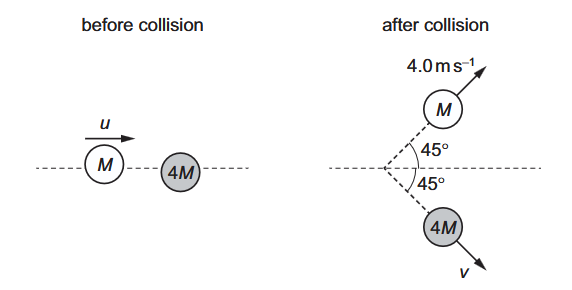
The diagram shows the view from above of the motion of the two discs before and after the collision.
What is the initial velocity \(u\) of the disc of mass \(M\)?
(B) \(1.4\,\mathrm{m\,s^{-1}}\)
(C) \(3.5\,\mathrm{m\,s^{-1}}\)
(D) \(5.7\,\mathrm{m\,s^{-1}}\)
▶️ Answer/Explanation
Correct Answer: \( \boxed{\mathrm{D}} \)
Resolve momentum into horizontal and vertical components.
From vertical momentum conservation, \(M(4.0)\sin45^\circ=4Mv\sin45^\circ\), giving \(v=1.0\,\mathrm{m\,s^{-1}}\).
From horizontal momentum conservation, \(Mu=M(4.0)\cos45^\circ+4M(1.0)\cos45^\circ\).
Thus, \(u=\dfrac{8}{\sqrt{2}}=5.66\approx5.7\,\mathrm{m\,s^{-1}}\).
Therefore, the correct answer is (D).
Question 13
Topic: 2.1 Equations of motion
An object is dropped from rest on the Earth from a height of \(2.0\,\mathrm{m}\).
The same object is dropped from rest on the Moon from twice the height.
The acceleration of free fall on the Moon is approximately \(16\%\) of the value on the Earth.
Assume that there are no resistive forces acting on the object.
What is the ratio \( \dfrac{\text{speed of the object just before hitting the surface on the Earth}}{\text{speed of the object just before hitting the surface on the Moon}} \)?
(B) \(2.5\)
(C) \(3.1\)
(D) \(3.5\)
▶️ Answer/Explanation
Correct Answer: \( \boxed{\mathrm{A}} \)
Using \(v^2=2gh\):
Earth: \(v_E=\sqrt{2g(2)}=\sqrt{4g}\).
Moon: \(v_M=\sqrt{2(0.16g)(4)}=\sqrt{1.28g}\).
Hence, \( \dfrac{v_E}{v_M}=\sqrt{\dfrac{4}{1.28}}=\sqrt{3.125}\approx1.77\approx1.8\).
Therefore, the correct answer is (A).
Question 14
Topic: 3.2 Non-uniform motion.png)
The graph shows how velocity \(v\) varies with time \(t\) for a bungee jumper.
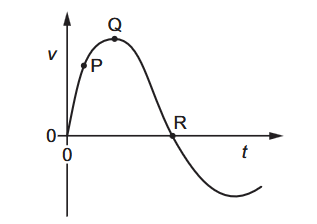
At which point is the bungee jumper momentarily at rest and at which point does she have zero acceleration?
| jumper at rest | jumper with zero acceleration | |
|---|---|---|
| A | Q | P |
| B | Q | R |
| C | R | Q |
| D | R | R |
▶️ Answer/Explanation
Correct Answer: \( \boxed{\mathrm{C}} \)
The jumper is momentarily at rest when the velocity is zero, which occurs at point \(R\).
Acceleration is the gradient of the velocity-time graph. It is zero where the tangent is horizontal, at point \(Q\).
Therefore, the correct answer is (C).
Question 15
Topic: 4.3 Density and pressure
A solid sphere, which is less dense than water, is held completely immersed in water a few metres below the surface. The density of the water is uniform.
The sphere is released. Immediately after release, the sphere rises.
Which row describes the changes in the magnitudes of the upthrust on the sphere and the resultant force on the sphere as it rises?
| upthrust on the sphere | resultant force on the sphere | |
|---|---|---|
| A | constant | decreasing |
| B | constant | increasing |
| C | decreasing | decreasing |
| D | decreasing | increasing |
▶️ Answer/Explanation
Correct Answer: \( \boxed{\mathrm{A}} \)
Since the sphere remains fully immersed in water of uniform density, the displaced volume and fluid density remain constant. Hence, the upthrust is constant.
As the sphere speeds up while rising, the resistive force of the water increases, reducing the resultant upward force.
Therefore, the correct answer is (A).
Question 16
Topic: 4.1 Turning effects of forces.png)
A uniform bar of weight \(200\,\mathrm{N}\) and length \(4.0\,\mathrm{m}\) is freely hinged on a wall at one end. The bar is horizontal and is held in equilibrium by a cable attached at a distance of \(0.50\,\mathrm{m}\) from the other end. The cable is at an angle of \(35^\circ\) to the horizontal.
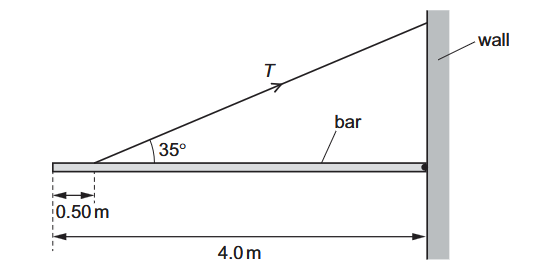
What is the tension \(T\) in the cable?
(B) \(170\,\mathrm{N}\)
(C) \(200\,\mathrm{N}\)
(D) \(400\,\mathrm{N}\)
▶️ Answer/Explanation
Correct Answer: \( \boxed{\mathrm{C}} \)
Take moments about the hinge.
The cable acts \(3.5\,\mathrm{m}\) from the hinge, so
\(T\sin35^\circ\times3.5=200\times2.0\).
Hence, \(T=\dfrac{400}{3.5\sin35^\circ}\approx199\,\mathrm{N}\approx200\,\mathrm{N}\).
Therefore, the correct answer is (C).
Question 17
Topic: 4.1 Turning effects of forces
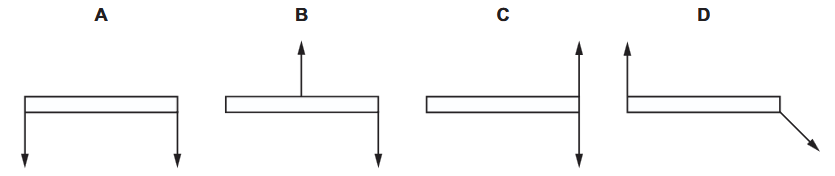
The diagrams all show a pair of equal forces acting on a metre rule.
Which diagram shows forces that provide a couple and zero resultant force?
(B) Diagram B
(C) Diagram C
(D) Diagram D
▶️ Answer/Explanation
Correct Answer: \( \boxed{\mathrm{B}} \)
A couple consists of two equal and opposite parallel forces acting along different lines of action.
The resultant force is zero, but the turning moment is non-zero.
Only Diagram B satisfies these conditions.
Therefore, the correct answer is (B).
Question 18
Topic: 5.2 Gravitational potential energy and kinetic energy
A ball of mass \(m\) is thrown up to height \(h\) in air with an initial velocity \(v\), as shown.
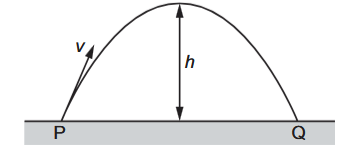
Air resistance is negligible. The acceleration of free fall is \(g\).
What is the total work done by the gravitational force on the ball during its flight from \(P\) to \(Q\)?
(B) \( \dfrac{1}{2}mv^2 \)
(C) \(mgh\)
(D) \(2mgh\)
▶️ Answer/Explanation
Correct Answer: \( \boxed{\mathrm{A}} \)
Gravity is a conservative force, so the work it does depends only on the change in height.
The ball starts and finishes at the same vertical level, so the net change in gravitational potential energy is zero.
Hence, the total work done by gravity over the complete journey from \(P\) to \(Q\) is \(0\).
Therefore, the correct answer is (A).
Question 19
Topic: 6.1 Stress and strain.png)
A spring of spring constant \(30\,\mathrm{N\,m^{-1}}\) is suspended vertically from its top. The spring obeys Hooke’s law. Initially the spring is not compressed and not stretched. A mass of \(0.50\,\mathrm{kg}\) is attached to the bottom of the spring. The mass is released from rest and falls.
Frictional effects are negligible.
In the motion that follows, what is the maximum extension of the spring?
(B) \(0.033\,\mathrm{m}\)
(C) \(0.16\,\mathrm{m}\)
(D) \(0.33\,\mathrm{m}\)
▶️ Answer/Explanation
Correct Answer: \( \boxed{\mathrm{D}} \)
At maximum extension, all the lost gravitational potential energy is stored as elastic potential energy.
\(mgx=\dfrac{1}{2}kx^2\).
Hence, \(x=\dfrac{2mg}{k}=\dfrac{2(0.50)(9.8)}{30}\approx0.33\,\mathrm{m}\).
Therefore, the correct answer is (D).
Question 20
Topic: 6.1 Stress and strain
A wire has original length \(L\) and cross-sectional area \(A\). A tensile force \(F\) is applied to the wire which causes it to have extension \(x\). The wire obeys Hooke’s law.
What is an expression for the Young modulus of the material from which the wire is made?
(B) \( \dfrac{FL}{Ax} \)
(C) \( \dfrac{Fx}{AL} \)
(D) \( \dfrac{\mathrm{strain}}{\mathrm{stress}} \)
▶️ Answer/Explanation
Correct Answer: \( \boxed{\mathrm{B}} \)
Young modulus is defined as
\(E=\dfrac{\mathrm{stress}}{\mathrm{strain}}\).
Using \( \mathrm{stress}=\dfrac{F}{A}\) and \( \mathrm{strain}=\dfrac{x}{L}\),
\(E=\dfrac{F/A}{x/L}=\dfrac{FL}{Ax}\).
Therefore, the correct answer is (B).
Question 21
Topic: 6.2 Elastic and plastic behaviour
A wire is stretched by a gradually increasing force. The force-extension graph for the wire is shown.
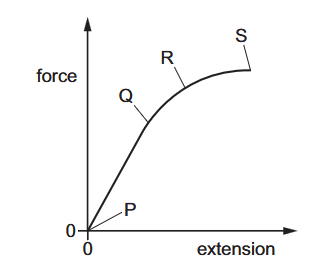
Which statement must be correct?
(B) Point \(R\) is the limit of proportionality.
(C) The area under the graph from \(P\) to \(S\) is the elastic potential energy stored in the wire.
(D) The area under the graph from \(P\) to \(S\) is the work done in stretching the wire.
▶️ Answer/Explanation
Correct Answer: \( \boxed{\mathrm{D}} \)
The area under a force-extension graph is the work done in stretching the wire.
It is only equal to elastic potential energy if the deformation is entirely elastic.
The graph alone does not identify the elastic limit or limit of proportionality.
Therefore, the correct answer is (D).
Question 22
Topic: 6.1 Stress and strain
A spring has an unstretched length of \(0.30\,\mathrm{m}\) and a spring constant of \(400\,\mathrm{N\,m^{-1}}\). An object is suspended from the spring and the spring is deformed within its limit of proportionality. The new length of the spring is \(0.50\,\mathrm{m}\).
What is the elastic potential energy stored in the spring?
(B) \(16\,\mathrm{J}\)
(C) \(40\,\mathrm{J}\)
(D) \(50\,\mathrm{J}\)
▶️ Answer/Explanation
Correct Answer: \( \boxed{\mathrm{A}} \)
The extension is \(x=0.50-0.30=0.20\,\mathrm{m}\).
Elastic potential energy is
\(E=\dfrac{1}{2}kx^2=\dfrac{1}{2}\times400\times(0.20)^2=8.0\,\mathrm{J}\).
Therefore, the correct answer is (A).
Question 23
Topic: 6.1 Stress and strain.png)
A wire consists of a \(3.0\,\mathrm{m}\) length of metal \(X\) joined to a \(1.0\,\mathrm{m}\) length of metal \(Y\).
The cross-sectional area of the wire is uniform.
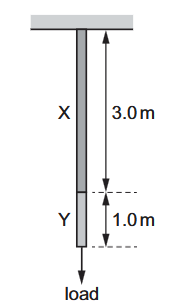
A load hung from the wire causes metal \(X\) to extend by \(1.5\,\mathrm{mm}\) and metal \(Y\) to extend by \(1.0\,\mathrm{mm}\).
The same load is then hung from a second wire of the same cross-sectional area, consisting of a \(1.0\,\mathrm{m}\) length of metal \(X\) and a \(3.0\,\mathrm{m}\) length of metal \(Y\).
Both wires are extended within their limit of proportionality.
What is the total extension of this second wire?
(B) \(3.5\,\mathrm{mm}\)
(C) \(4.8\,\mathrm{mm}\)
(D) \(5.0\,\mathrm{mm}\)
▶️ Answer/Explanation
Correct Answer: \( \boxed{\mathrm{B}} \)
Extension is proportional to length for the same material, load and cross-sectional area.
For metal \(X\): \(3.0\,\mathrm{m}\rightarrow1.5\,\mathrm{mm}\), so \(1.0\,\mathrm{m}\rightarrow0.5\,\mathrm{mm}\).
For metal \(Y\): \(1.0\,\mathrm{m}\rightarrow1.0\,\mathrm{mm}\), so \(3.0\,\mathrm{m}\rightarrow3.0\,\mathrm{mm}\).
Total extension \(=0.5+3.0=3.5\,\mathrm{mm}\).
Therefore, the correct answer is (B).
Question 24
Topic: 7.1 Progressive waves
The graph shows the variation of the displacement with distance for a progressive wave at one instant in time.
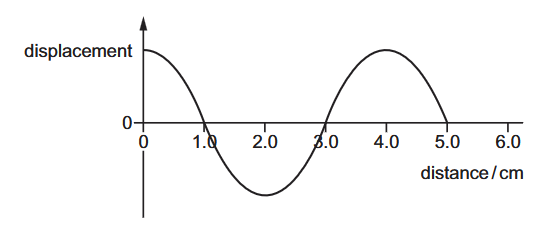
The period of the wave is \(91\,\mathrm{ms}\).
What can be determined about the wave?
(B) It has a velocity of \(0.55\,\mathrm{m\,s^{-1}}\) and a wavelength of \(5.0\,\mathrm{cm}\).
(C) It is longitudinal and has a frequency of \(11\,\mathrm{Hz}\).
(D) It is transverse and has a wavelength of \(4.0\,\mathrm{cm}\).
▶️ Answer/Explanation
Correct Answer: \( \boxed{\mathrm{A}} \)
From the graph, the wavelength is \(4.0\,\mathrm{cm}=0.040\,\mathrm{m}\).
The frequency is \(f=\dfrac{1}{T}=\dfrac{1}{0.091}\approx11\,\mathrm{Hz}\).
The wave speed is \(v=f\lambda=11\times0.040\approx0.44\,\mathrm{m\,s^{-1}}\).
The graph alone does not determine whether the wave is transverse or longitudinal.
Therefore, the correct answer is (A).
Question 25
Topic: 7.4 Electromagnetic spectrum.png)
Which group of electromagnetic waves is arranged in order from shortest wavelength to longest wavelength?
(B) visible light \(\rightarrow\) microwaves \(\rightarrow\) infrared
(C) visible light \(\rightarrow\) ultraviolet \(\rightarrow\) X-rays
(D) X-rays \(\rightarrow\) infrared \(\rightarrow\) microwaves
▶️ Answer/Explanation
Correct Answer: \( \boxed{\mathrm{D}} \)
The electromagnetic spectrum in order of increasing wavelength is: gamma rays, X-rays, ultraviolet, visible light, infrared, microwaves and radio waves.
Hence, X-rays \(\rightarrow\) infrared \(\rightarrow\) microwaves is in the correct order.
Therefore, the correct answer is (D).
Question 26
Topic: 7.1 Progressive waves
A wave has a frequency of \(5\,\mathrm{GHz}\).
What is the period of the wave?
(B) \(2\,\mathrm{ns}\)
(C) \(20\,\mathrm{ns}\)
(D) \(20\,000\,\mathrm{\mu s}\)
▶️ Answer/Explanation
Correct Answer: \( \boxed{\mathrm{A}} \)
The period is \(T=\dfrac{1}{f}\).
\(T=\dfrac{1}{5\times10^9}=2.0\times10^{-10}\,\mathrm{s}=200\,\mathrm{ps}\).
Therefore, the correct answer is (A).
Question 27
Topic: 7.1 Progressive waves
Three statements about two progressive waves are listed.
1. The waves have the same frequency.
2. The waves have the same amplitude.
3. The waves are emitted with a constant phase difference.
Which statements must be correct for the two waves to be coherent?
(B) 1 and 2 only
(C) 1 and 3 only
(D) 2 and 3 only
▶️ Answer/Explanation
Correct Answer: \( \boxed{\mathrm{C}} \)
Coherent waves must have the same frequency and maintain a constant phase difference.
They do not need to have the same amplitude.
Therefore, the correct answer is (C).
Question 28
Topic: 8.3 Interference
Waves \(P\) and \(Q\) have the same amplitude. The waves meet in phase at point \(X\) and interfere to give a resultant wave with intensity \(I\).
The amplitude of wave \(P\) is doubled.
What is the new intensity of the resultant wave at \(X\), in terms of \(I\)?
(B) \(1.5I\)
(C) \(2.3I\)
(D) \(3.0I\)
▶️ Answer/Explanation
Correct Answer: \( \boxed{\mathrm{C}} \)
Initially, the resultant amplitude is \(2A\), so \(I\propto(2A)^2=4A^2\).
After doubling the amplitude of wave \(P\), the resultant amplitude is \(3A\), so the new intensity is proportional to \(9A^2\).
Hence, \(\dfrac{I_{\mathrm{new}}}{I}=\dfrac{9}{4}=2.25\approx2.3\).
Therefore, the correct answer is (C).
Question 29
Topic: 7.2 Transverse and longitudinal waves
Radio waves can be polarised, but sound waves cannot be polarised.
Which statement gives the reason for this?
(B) Radio waves are transverse waves, but sound waves are longitudinal waves.
(C) Radio waves can travel through a vacuum, but sound waves cannot travel through a vacuum.
(D) Radio waves travel at a much higher speed than sound waves.
▶️ Answer/Explanation
Correct Answer: \( \boxed{\mathrm{B}} \)
Only transverse waves can be polarised because their oscillations are perpendicular to the direction of propagation.
Radio waves are transverse electromagnetic waves, whereas sound waves are longitudinal mechanical waves.
Therefore, the correct answer is (B).
Question 30
Topic: 8.4 The diffraction grating.png)
Light of wavelength \( \lambda \) is incident normally on a diffraction grating with a total number of \(N\) lines in width \(w\).
A second order maximum is observed at an angle of diffraction \( \theta \).
What is \(N\)?
(B) \( \dfrac{2w\lambda}{\sin\theta} \)
(C) \( \dfrac{w\sin\theta}{2\lambda} \)
(D) \( \dfrac{w\sin\theta}{\lambda} \)
▶️ Answer/Explanation
Correct Answer: \( \boxed{\mathrm{C}} \)
For a diffraction grating, \(d\sin\theta=n\lambda\).
Here \(d=\dfrac{w}{N}\) and \(n=2\).
Hence, \(\dfrac{w}{N}\sin\theta=2\lambda\), giving \(N=\dfrac{w\sin\theta}{2\lambda}\).
Therefore, the correct answer is (C).
Question 31
Topic: 10.2 Kirchhoff’s laws
Kirchhoff’s second law is a consequence of a basic principle.
What is this principle?
(B) The energy in an electric circuit is conserved.
(C) The sum of the electric currents entering a point in an electric circuit is equal to the sum of the electric currents leaving that point.
(D) The sum of the potential differences in an electric circuit is equal to the sum of the products of the current and resistance.
▶️ Answer/Explanation
Correct Answer: \( \boxed{\mathrm{B}} \)
Kirchhoff’s second law states that the algebraic sum of the potential differences around any closed loop is zero.
This follows directly from the principle of conservation of energy.
Therefore, the correct answer is (B).
Question 32
Topic: 10.3 Potential dividers
The diagram shows a circuit with a light-dependent resistor (LDR).
The ammeter reads zero current.
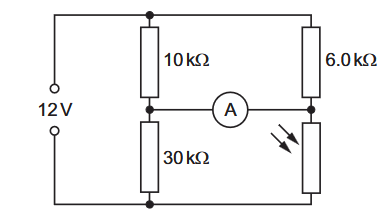
What is the resistance of the LDR?
(B) \(18\,\mathrm{k\Omega}\)
(C) \(26\,\mathrm{k\Omega}\)
(D) \(30\,\mathrm{k\Omega}\)
▶️ Answer/Explanation
Correct Answer: \( \boxed{\mathrm{B}} \)
Zero current through the ammeter means the bridge is balanced.
Hence, \( \dfrac{10}{30}=\dfrac{6}{R_{\mathrm{LDR}}} \).
Therefore, \(R_{\mathrm{LDR}}=\dfrac{30\times6}{10}=18\,\mathrm{k\Omega}\).
Therefore, the correct answer is (B).
Question 33
Topic: 9.2 Potential difference and power
A torch uses three lamps connected in parallel and is powered by a cell of electromotive force (e.m.f.) \(3.0\,\mathrm{V}\) and negligible internal resistance. Each lamp dissipates \(0.60\,\mathrm{W}\) of power.
What is the current in the cell?
(B) \(0.20\,\mathrm{A}\)
(C) \(0.60\,\mathrm{A}\)
(D) \(0.83\,\mathrm{A}\)
▶️ Answer/Explanation
Correct Answer: \( \boxed{\mathrm{C}} \)
Total power supplied is \(3\times0.60=1.80\,\mathrm{W}\).
Using \(P=VI\),
\(I=\dfrac{1.80}{3.0}=0.60\,\mathrm{A}\).
Therefore, the correct answer is (C).
Question 34
Topic: 9.2 Potential difference and power.png)
A cell with internal resistance is connected to a light-dependent resistor (LDR), a fixed resistor and a voltmeter, as shown.
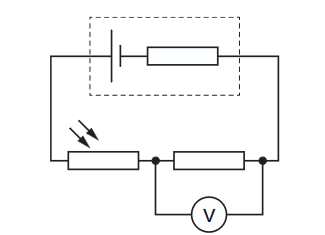
The voltmeter reading increases.
Which quantity decreases as the voltmeter reading increases?
(B) the energy transferred to the fixed resistor per unit charge
(C) the intensity of the light incident on the LDR
(D) the terminal potential difference across the cell
▶️ Answer/Explanation
Correct Answer: \( \boxed{\mathrm{D}} \)
The voltmeter measures the potential difference across the fixed resistor. If this reading increases, the circuit current increases.
With internal resistance, the terminal potential difference of the cell is \(V=\mathcal{E}-Ir\).
As the current increases, the lost volts \(Ir\) increase, so the terminal potential difference decreases.
Therefore, the correct answer is (D).
Question 35
Topic: 9.2 Potential difference and power
The circuit shown contains a cell with negligible internal resistance.
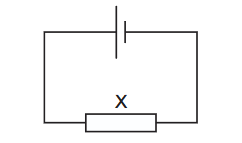
The energy transferred per unit charge in driving charge around the complete circuit is \(E\). The potential difference (p.d.) across \(X\) is \(V\).
The cell is then replaced with a different cell of the same electromotive force (e.m.f.) that has significant internal resistance.
What is the effect on \(E\) and \(V\)?
| effect on \(E\) | effect on \(V\) | |
|---|---|---|
| A | decreases | decreases |
| B | decreases | increases |
| C | no change | decreases |
| D | no change | increases |
▶️ Answer/Explanation
Correct Answer: \( \boxed{\mathrm{C}} \)
The electromotive force \(E\) is the energy supplied per unit charge by the cell, so it remains unchanged because the e.m.f. is the same.
Introducing internal resistance causes some energy to be dissipated inside the cell, reducing the terminal potential difference across the external resistor \(X\).
Hence, the potential difference \(V\) across \(X\) decreases.
Therefore, the correct answer is (C).
Question 36
Topic: 10.1 Practical circuits.png)
In the circuits shown, the batteries are identical and all have negligible internal resistance. All of the resistors have the same resistance. The diodes have zero resistance when conducting and infinite resistance when not conducting.
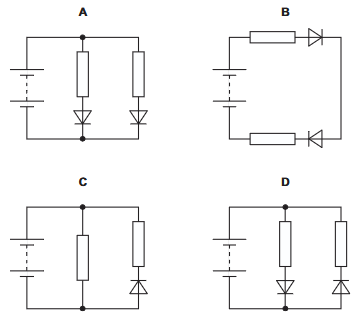
In which circuit is the current in the battery greatest?
(B) Circuit B
(C) Circuit C
(D) Circuit D
▶️ Answer/Explanation
Correct Answer: \( \boxed{\mathrm{A}} \)
A conducting diode behaves as a wire, while a reverse-biased diode acts as an open circuit.
In circuit A, both diodes conduct, so the two identical resistors are connected in parallel. The equivalent resistance is \( \dfrac{R}{2} \), giving the largest current from the battery.
The other circuits have either only one conducting path or an open branch, resulting in a larger equivalent resistance and a smaller battery current.
Therefore, the correct answer is (A).
Question 37
Topic: 10.3 Potential dividers.png)
A potentiometer circuit is used to determine the electromotive force (e.m.f.) \(E\) of a cell. The circuit includes a second cell of e.m.f. \(1.5\,\mathrm{V}\) and internal resistance \(0.50\,\Omega\) that is connected to a uniform resistance wire \(XY\), as shown.
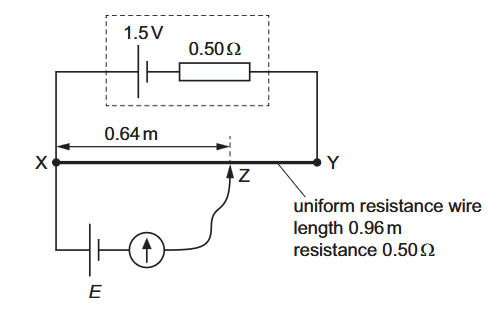
The resistance wire \(XY\) has a length of \(0.96\,\mathrm{m}\) and a resistance of \(0.50\,\Omega\).
The movable connection \(Z\) is moved along wire \(XY\). The galvanometer reading is zero when length \(XZ\) is \(0.64\,\mathrm{m}\).
What is the value of e.m.f. \(E\)?
(B) \(0.75\,\mathrm{V}\)
(C) \(1.0\,\mathrm{V}\)
(D) \(1.1\,\mathrm{V}\)
▶️ Answer/Explanation
Correct Answer: \( \boxed{\mathrm{A}} \)
Current in the primary circuit is \(I=\dfrac{1.5}{0.50+0.50}=1.5\,\mathrm{A}\).
The potential difference across the wire is \(V=IR=1.5\times0.50=0.75\,\mathrm{V}\).
Since the wire is uniform, the balance potential is \(E=0.75\times\dfrac{0.64}{0.96}=0.50\,\mathrm{V}\).
Therefore, the correct answer is (A).
Question 38
Topic: 11.2 Fundamental particles
Which particle is not a fundamental particle?
(B) electron
(C) neutrino
(D) neutron
▶️ Answer/Explanation
Correct Answer: \( \boxed{\mathrm{D}} \)
Quarks, electrons and neutrinos are fundamental particles in the Standard Model.
A neutron is a baryon composed of three quarks \((udd)\), so it is not fundamental.
Therefore, the correct answer is (D).
Question 39
Topic: 11.1 Atoms, nuclei and radiation
The isotope fluorine-18, \(^{18}_{9}\mathrm{F}\), undergoes \(\beta^{+}\) decay to form a stable isotope.
How many neutrons are there in a nucleus of the stable isotope?
(B) 8
(C) 9
(D) 10
▶️ Answer/Explanation
Correct Answer: \( \boxed{\mathrm{D}} \)
In \(\beta^{+}\) decay, a proton changes into a neutron, so the atomic number decreases by 1 while the mass number remains unchanged.
Thus, \(^{18}_{9}\mathrm{F}\rightarrow{}^{18}_{8}\mathrm{O}\).
The number of neutrons is \(18-8=10\).
Therefore, the correct answer is (D).
Question 40
Topic: 11.2 Fundamental particles
Which statement is correct?
(B) A meson is a hadron and consists of 3 quarks.
(C) An electron is a fundamental particle and is a lepton.
(D) A neutrino is a fundamental particle and is a hadron.
▶️ Answer/Explanation
Correct Answer: \( \boxed{\mathrm{C}} \)
Electrons are fundamental particles belonging to the lepton family.
Baryons contain three quarks, mesons contain one quark and one antiquark, and neutrinos are leptons, not hadrons.
Therefore, the correct answer is (C).