
Question 1
Topic: 1.2 SI units.png)
A physical quantity consists of a magnitude and a unit.
Which row does not show a correct combination of a quantity and its unit?
| quantity | unit | |
|---|---|---|
| A | mass | gram |
| B | length | metre |
| C | charge | ampere |
| D | temperature | kelvin |
▶️ Answer/Explanation
Correct Answer: \( \boxed{\mathrm{C}} \)
The SI unit of electric charge is the coulomb \((\mathrm{C})\), not the ampere.
The ampere is the SI unit of electric current.
Therefore, the correct answer is (C).
Question 2
Topic: 5.2 Gravitational potential energy and kinetic energy
A small car travels in a town.
What is a reasonable estimate of the kinetic energy of the car?
(B) \(5\times10^{7}\,\mathrm{J}\)
(C) \(5\times10^{10}\,\mathrm{J}\)
(D) \(5\times10^{13}\,\mathrm{J}\)
▶️ Answer/Explanation
Correct Answer: \( \boxed{\mathrm{A}} \)
A typical small car has a mass of about \(1000\,\mathrm{kg}\) and travels at about \(10\,\mathrm{m\,s^{-1}}\) to \(15\,\mathrm{m\,s^{-1}}\) in a town.
Using \(KE=\dfrac{1}{2}mv^2\), the kinetic energy is of the order of \(5\times10^{4}\,\mathrm{J}\).
Therefore, the correct answer is (A).
Question 3
Topic: 1.3 Errors and uncertainties
A solid bar has a square cross-section. Its length is measured as \(50.0\pm0.2\,\mathrm{cm}\) and its width is measured as \(2.00\pm0.01\,\mathrm{cm}\).
These values are used to calculate the volume of the bar.
What is the percentage uncertainty in the calculated volume?
(B) \(\pm0.22\%\)
(C) \(\pm0.90\%\)
(D) \(\pm1.4\%\)
▶️ Answer/Explanation
Correct Answer: \( \boxed{\mathrm{D}} \)
The volume is \(V=lw^2\).
Percentage uncertainty in length \(=\dfrac{0.2}{50.0}\times100=0.4\%\).
Percentage uncertainty in width \(=\dfrac{0.01}{2.00}\times100=0.5\%\).
Since the width is squared, its contribution is \(2\times0.5\%=1.0\%\).
Total percentage uncertainty \(=0.4+1.0=1.4\%\).
Therefore, the correct answer is (D).
Question 4
Topic: 2.2 Motion graphs.png)
The graph shows how the acceleration of an object moving in a straight line varies with time.
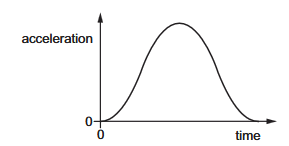
The object starts from rest.
Which graph shows the variation with time of the velocity of the object over the same time interval?
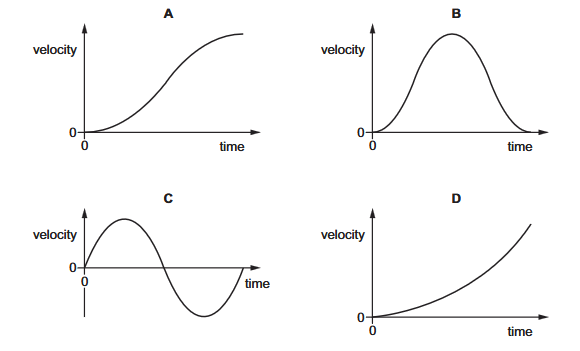
(B) Graph B
(C) Graph C
(D) Graph D
▶️ Answer/Explanation
Correct Answer: \( \boxed{\mathrm{A}} \)
Acceleration is the gradient of the velocity-time graph.
Since the acceleration is always positive, the velocity must increase continuously. The gradient starts at zero, increases to a maximum and then decreases back to zero, so the velocity curve changes from concave up to concave down and gradually levels off.
Therefore, the correct answer is (A).
Question 5
Topic: 2.1 Equations of motion
A stone falls vertically from rest. Air resistance is negligible.
What is the speed of the stone when it has fallen through a distance of \(0.40\,\mathrm{m}\)?
(B) \(2.8\,\mathrm{m\,s^{-1}}\)
(C) \(3.9\,\mathrm{m\,s^{-1}}\)
(D) \(7.8\,\mathrm{m\,s^{-1}}\)
▶️ Answer/Explanation
Correct Answer: \( \boxed{\mathrm{B}} \)
Use the equation \(v^2=u^2+2as\).
With \(u=0\), \(a=g=9.8\,\mathrm{m\,s^{-2}}\) and \(s=0.40\,\mathrm{m}\),
\(v=\sqrt{2\times9.8\times0.40}=\sqrt{7.84}=2.8\,\mathrm{m\,s^{-1}}\).
Therefore, the correct answer is (B).
Question 6
Topic: 2.1 Projectile motion.png)
A ball is thrown horizontally off a tall building. The ground is horizontal. Air resistance is negligible.
Which statement about the motion of the ball is correct?
(B) The ball follows a circular path until it hits the ground.
(C) The ball has constant acceleration.
(D) The ball’s time in the air is proportional to the velocity at which the ball is thrown.
▶️ Answer/Explanation
Correct Answer: \( \boxed{\mathrm{C}} \)
With negligible air resistance, the only force acting on the ball is gravity.
Hence, the acceleration is constant and equal to \(g\), acting vertically downward throughout the motion.
Therefore, the correct answer is (C).
Question 7
Topic: 3.3 Linear momentum and its conservation
A moving object strikes a stationary object. The collision is inelastic. The objects move off together.
Assume that the two objects form an isolated system.
Which row shows the possible values of total momentum and total kinetic energy for the system before and after the collision?
| total momentum before collision / \( \mathrm{kg\,m\,s^{-1}} \) | total momentum after collision / \( \mathrm{kg\,m\,s^{-1}} \) | total kinetic energy before collision / \( \mathrm{J} \) | total kinetic energy after collision / \( \mathrm{J} \) | |
|---|---|---|---|---|
| A | 6 | 2 | 90 | 30 |
| B | 6 | 6 | 30 | 90 |
| C | 6 | 6 | 90 | 30 |
| D | 6 | 6 | 90 | 90 |
▶️ Answer/Explanation
Correct Answer: \( \boxed{\mathrm{C}} \)
For an isolated system, total momentum is conserved, so the momentum before and after the collision must be the same.
In an inelastic collision, some kinetic energy is converted into other forms of energy, so the total kinetic energy decreases.
Only row C satisfies both conditions.
Therefore, the correct answer is (C).
Question 8
The graph shows how a quantity \(Y\) varies with a quantity \(X\) for an object falling vertically at its terminal velocity towards the surface of the Earth.
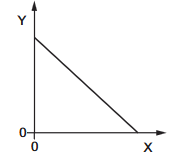
Which quantities could \(X\) and \(Y\) represent?
| \(X\) | \(Y\) | |
|---|---|---|
| A | time | acceleration |
| B | time | height above surface |
| C | distance moved | kinetic energy |
| D | distance moved | velocity |
▶️ Answer/Explanation
Correct Answer: \( \boxed{\mathrm{B}} \)
At terminal velocity, the speed and acceleration are constant.
The height above the ground decreases uniformly with time because the object moves with constant speed.
Hence, a straight line with negative gradient represents height against time.
Therefore, the correct answer is (B).
Question 9
Topic: 3.3 Linear momentum and its conservation
A ball of mass \(2.0\,\mathrm{kg}\) travels horizontally with a speed of \(4.0\,\mathrm{m\,s^{-1}}\). The ball collides with a wall and rebounds in the opposite direction with a speed of \(2.8\,\mathrm{m\,s^{-1}}\). The time of the collision is \(150\,\mathrm{ms}\).
What is the average force exerted on the wall?
(B) \(37\,\mathrm{N}\)
(C) \(53\,\mathrm{N}\)
(D) \(91\,\mathrm{N}\)
▶️ Answer/Explanation
Correct Answer: \( \boxed{\mathrm{D}} \)
Take the initial direction as positive.
\(\Delta p = m(v-u)=2.0(-2.8-4.0)=-13.6\,\mathrm{kg\,m\,s^{-1}}\).
Average force magnitude \(=\dfrac{|\Delta p|}{\Delta t}=\dfrac{13.6}{0.150}\approx90.7\,\mathrm{N}\).
By Newton’s third law, the wall experiences the same magnitude of force.
Therefore, the correct answer is (D).
Question 10
Topic: 3.3 Linear momentum and its conservation
Two train carriages each of mass \(5000\,\mathrm{kg}\) roll toward one another on a horizontal frictionless track. One is travelling at \(2.00\,\mathrm{m\,s^{-1}}\) and the other at \(1.00\,\mathrm{m\,s^{-1}}\), as shown.
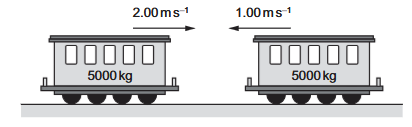
They collide and join together.
What is the kinetic energy lost during the collision?
(B) \(7500\,\mathrm{J}\)
(C) \(11250\,\mathrm{J}\)
(D) \(12500\,\mathrm{J}\)
▶️ Answer/Explanation
Correct Answer: \( \boxed{\mathrm{C}} \)
Initial momentum \(=5000(2.00)+5000(-1.00)=5000\,\mathrm{kg\,m\,s^{-1}}\).
Final velocity \(=\dfrac{5000}{10000}=0.50\,\mathrm{m\,s^{-1}}\).
Initial kinetic energy \(=\dfrac12(5000)(2.00)^2+\dfrac12(5000)(1.00)^2=12500\,\mathrm{J}\).
Final kinetic energy \(=\dfrac12(10000)(0.50)^2=1250\,\mathrm{J}\).
Kinetic energy lost \(=12500-1250=11250\,\mathrm{J}\).
Therefore, the correct answer is (C).
Question 11
Topic: 4.2 Equilibrium of forces.png)
Which single condition must apply for an object to be in equilibrium?
(B) The object is stationary.
(C) There are no forces acting on the object.
(D) The resultant force acting on the object is zero.
▶️ Answer/Explanation
Correct Answer: \( \boxed{\mathrm{D}} \)
An object is in equilibrium when the resultant force acting on it is zero, so its acceleration is zero according to Newton’s second law.
An object in equilibrium may be stationary or moving with constant velocity, so it does not have to be stationary.
Forces can act on the object provided they balance each other.
Therefore, the correct answer is (D).
Question 12
Topic: 4.2 Equilibrium of forces
A kite is in equilibrium at the end of a string, as shown.
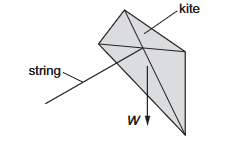
The kite has three forces acting on it: the weight \(W\), the tension \(T\) in the string, and the force \(F\) from the wind.
Which vector diagram represents the forces acting on the kite?

(B) B
(C) C
(D) D
▶️ Answer/Explanation
Correct Answer: \( \boxed{\mathrm{A}} \)
Since the kite is in equilibrium, the three forces must form a closed vector triangle when placed head-to-tail.
The weight \(W\) acts vertically downward, the tension \(T\) acts along the string toward the flyer, and the wind force \(F\) balances these two forces.
Only diagram (A) shows the three vectors with the correct directions forming a closed triangle.
Therefore, the correct answer is (A).
Question 13
Topic: 4.1 Turning effects of forces.png)
Four forces act about a point \(P\), as shown.
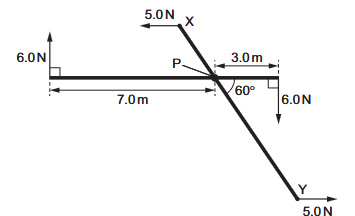
The forces act in the same plane and produce no resultant moment about point \(P\).
What is the length \(XY\)?
(B) \(12\,\mathrm{m}\)
(C) \(14\,\mathrm{m}\)
(D) \(24\,\mathrm{m}\)
▶️ Answer/Explanation
Correct Answer: \( \boxed{\mathrm{C}} \)
The two vertical forces produce clockwise moments about point \(P\):
Left force:
\(M_1=6.0\times7.0=42\,\mathrm{N\,m}\)
Right force:
\(M_2=6.0\times3.0=18\,\mathrm{N\,m}\)
Total clockwise moment:
\(42+18=60\,\mathrm{N\,m}\)
The two horizontal \(5.0\,\mathrm{N}\) forces form a couple. Their perpendicular separation is the vertical distance between \(X\) and \(Y\):
\(d=XY\sin60^\circ\)
Since there is no resultant moment,
\(5(XY\sin60^\circ)=60\)
\(XY=\dfrac{60}{5\sin60^\circ}\)
\(=\dfrac{60}{5\times0.866}=13.9\,\mathrm{m}\approx14\,\mathrm{m}\)
Therefore, the correct answer is (C).
Question 14
Topic: 4.3 Density and pressure
A rectangular block of lead of density \(1.13\times10^{4}\,\mathrm{kg\,m^{-3}}\) has sides of length \(12.0\,\mathrm{cm}\), \(15.0\,\mathrm{cm}\) and \(10.0\,\mathrm{cm}\).
What is the maximum pressure the block can exert when resting on a table?
(B) \(1.70\,\mathrm{kPa}\)
(C) \(11.1\,\mathrm{kPa}\)
(D) \(16.6\,\mathrm{kPa}\)
▶️ Answer/Explanation
Correct Answer: \( \boxed{\mathrm{D}} \)
Volume of the block:
\(V=0.12\times0.15\times0.10=1.8\times10^{-3}\,\mathrm{m^3}\)
Mass:
\(m=\rho V=(1.13\times10^{4})(1.8\times10^{-3})=20.34\,\mathrm{kg}\)
Weight:
\(W=mg=20.34\times9.81=199.6\,\mathrm{N}\)
The smallest face has area
\(A=0.12\times0.10=0.012\,\mathrm{m^2}\)
Maximum pressure:
\(P=\dfrac{F}{A}=\dfrac{199.6}{0.012}=1.663\times10^{4}\,\mathrm{Pa}=16.6\,\mathrm{kPa}\)
Therefore, the correct answer is (D).
Question 15
Topic: 5.1 Energy conservation.png)
What is the definition of power?
(B) Work done in unit time.
(C) Work done per second.
(D) Work done per unit time.
▶️ Answer/Explanation
Correct Answer: \( \boxed{\mathrm{D}} \)
Power is defined as the rate at which work is done or energy is transferred.
Mathematically, \(P=\dfrac{W}{t}\).
Therefore, the correct answer is (D).
Question 16
Topic: 9.2 Potential difference and power
A model car travels at a constant velocity of \(12\,\mathrm{m\,s^{-1}}\) in a straight horizontal line. The input power to the engine of the car is \(800\,\mathrm{W}\). The efficiency of the engine is \(60\%\).
What is the total horizontal resistive force on the car?
(B) \(40\,\mathrm{N}\)
(C) \(67\,\mathrm{N}\)
(D) \(110\,\mathrm{N}\)
▶️ Answer/Explanation
Correct Answer: \( \boxed{\mathrm{B}} \)
Useful output power is \(0.60 \times 800 = 480\,\mathrm{W}\).
At constant speed, \(P=Fv\), so \(F=\dfrac{480}{12}=40\,\mathrm{N}\).
Therefore, the correct answer is (B).
Question 17
Topic: 5.1 Energy conservation.png)
Which statement represents the principle of conservation of energy?
(B) The supply of energy is limited, so energy must be conserved.
(C) The total energy in a closed system is constant.
(D) The total energy input to a system is equal to the useful energy output.
▶️ Answer/Explanation
Correct Answer: \( \boxed{\mathrm{C}} \)
The principle of conservation of energy states that energy cannot be created or destroyed, only transferred or transformed.
Hence, the total energy in a closed system remains constant.
Therefore, the correct answer is (C).
Question 18
Topic: 5.2 Gravitational potential energy and kinetic energy
A barrel of mass \(50\,\mathrm{kg}\) is loaded onto the back of a lorry \(1.6\,\mathrm{m}\) high by pushing it up a frictionless plank \(3.4\,\mathrm{m}\) long.
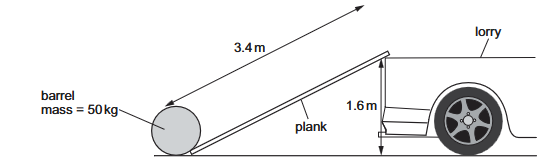
What is the minimum work done?
(B) \(170\,\mathrm{J}\)
(C) \(780\,\mathrm{J}\)
(D) \(1700\,\mathrm{J}\)
▶️ Answer/Explanation
Correct Answer: \( \boxed{\mathrm{C}} \)
For a frictionless plank, the minimum work done equals the gain in gravitational potential energy.
\(W=mgh\)
\(=50\times9.8\times1.6\)
\(=784\,\mathrm{J}\approx780\,\mathrm{J}\)
Therefore, the correct answer is (C).
Question 19
Topic: 6.1 Stress and strain
What is a unit for stress?
(B) \(\mathrm{kg\,m^{-2}\,s^{-2}}\)
(C) \(\mathrm{N\,m^{-1}}\)
(D) \(\mathrm{N\,m}\)
▶️ Answer/Explanation
Correct Answer: \( \boxed{\mathrm{A}} \)
Stress is force per unit area.
\(1\,\mathrm{Pa}=1\,\mathrm{N\,m^{-2}}\)
Since \(1\,\mathrm{N}=1\,\mathrm{kg\,m\,s^{-2}}\),
\(1\,\mathrm{Pa}=1\,\mathrm{kg\,m^{-1}\,s^{-2}}\).
Therefore, the correct answer is (A).
Question 20
Topic: 6.1 Stress and strain.png)
The graph shows the relationship between stress and strain for three wires of the same linear dimensions but made from different materials.
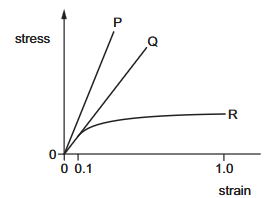
Which statements are correct?
1 The extension of P is approximately twice that of Q for the same stress.
2 The ratio of the Young modulus for P to that of Q is approximately two.
3 For strain less than \(0.1\), R obeys Hooke’s law.
(B) 1 and 3 only
(C) 2 and 3 only
(D) 2 only
▶️ Answer/Explanation
Correct Answer: \( \boxed{\mathrm{C}} \)
Young modulus is the gradient of the stress-strain graph.
P has approximately twice the gradient of Q, so statement 2 is correct.
For the same stress, P has a smaller strain (and extension) than Q, so statement 1 is false.
R is approximately linear for strain less than \(0.1\), so it obeys Hooke’s law in this region.
Therefore, the correct answer is (C).
Question 21
Topic: 6.1 Stress and strain
Four solid steel rods equally support an object weighing \(10\,\mathrm{kN}\). Each rod is of length \(2.0\,\mathrm{m}\) and cross-sectional area \(250\,\mathrm{mm^2}\). The rods obey Hooke’s law.
The weight of the object causes the rods to contract by \(0.10\,\mathrm{mm}\).
What is the Young modulus of steel?
(B) \(2.0\times10^{11}\,\mathrm{N\,m^{-2}}\)
(C) \(8.0\times10^{8}\,\mathrm{N\,m^{-2}}\)
(D) \(8.0\times10^{11}\,\mathrm{N\,m^{-2}}\)
▶️ Answer/Explanation
Correct Answer: \( \boxed{\mathrm{B}} \)
Force on each rod:
\(F=\dfrac{10000}{4}=2500\,\mathrm{N}\)
Area \(A=250\,\mathrm{mm^2}=2.5\times10^{-4}\,\mathrm{m^2}\), \(\Delta L=0.10\,\mathrm{mm}=1.0\times10^{-4}\,\mathrm{m}\)
\(E=\dfrac{FL}{A\Delta L}=\dfrac{2500\times2.0}{(2.5\times10^{-4})(1.0\times10^{-4})}=2.0\times10^{11}\,\mathrm{N\,m^{-2}}\)
Therefore, the correct answer is (B).
Question 22
Topic: 6.1 Stress and strain.png)
The graph shows how the length of a spring varies with the force applied to it. Two areas P and Q are labelled.
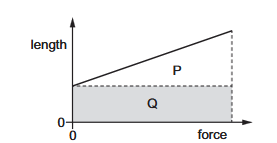
Which area represents the work done in stretching the spring?
(B) Area Q
(C) Area P + Area Q
(D) Area Q − Area P
▶️ Answer/Explanation
Correct Answer: \( \boxed{\mathrm{A}} \)
The work done is the area under the force-extension graph.
Since the graph is plotted as length against force, the extension is the increase in length above the original length.
Therefore, only the triangular region P represents the work done in stretching the spring.
Therefore, the correct answer is (A).
Question 23
Topic: 7.5 Polarisation
A horizontal beam of vertically polarised light of amplitude \(A\) is incident normally on a polarising filter. The transmission axis of the filter is at an angle of \(50^\circ\) to the vertical.
What is the amplitude of the light in the beam after it has passed through the filter?
(B) \(0.41A\)
(C) \(0.64A\)
(D) \(0.80A\)
▶️ Answer/Explanation
Correct Answer: \( \boxed{\mathrm{C}} \)
The transmitted amplitude is
\(A’=A\cos\theta\)
\(=A\cos50^\circ\)
\(=0.643A\approx0.64A\)
Therefore, the correct answer is (C).
Question 24
Topic: 7.2 Transverse and longitudinal waves.png)
A progressive longitudinal sound wave moves through air. The diagram shows the positions of the air particles along part of the wave at one instant.

Point \(Q\) is a distance \(x\) from point \(P\).
Which graph shows the variation of the displacement of the air particles with distance from \(P\) along the wave?
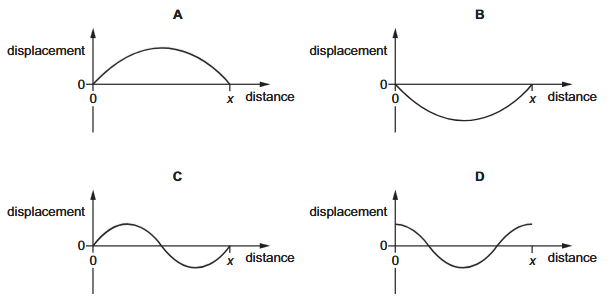
(B) B
(C) C
(D) D
▶️ Answer/Explanation
Correct Answer: \( \boxed{\mathrm{C}} \)
Particle displacement in a longitudinal wave varies sinusoidally with distance.
At \(P\), the displacement is zero, and between \(P\) and \(Q\) the displacement changes from positive to negative before returning to zero.
Only graph C shows this variation correctly.
Therefore, the correct answer is (C).
Question 25
Topic: 7.4 Electromagnetic spectrum
An electromagnetic wave in free space has a frequency of \(3.0\times10^{16}\,\mathrm{Hz}\).
Which row gives the principal region of this wave and an example of an electromagnetic wave with a lower frequency?
| Option | Principal Region | Wave with Lower Frequency |
|---|---|---|
| A | Infrared | Visible light |
| B | Infrared | X-rays |
| C | Ultraviolet | Visible light |
| D | Ultraviolet | X-rays |
▶️ Answer/Explanation
Correct Answer: \( \boxed{\mathrm{C}} \)
A frequency of \(3.0\times10^{16}\,\mathrm{Hz}\) lies in the ultraviolet region of the electromagnetic spectrum.
Visible light has a lower frequency than ultraviolet, whereas X-rays have a higher frequency.
Therefore, the correct answer is (C).
Question 26
Topic: 7.3 Doppler effect for sound waves.png)
A source of sound emits waves of a constant frequency. The source moves at a constant speed in a straight line relative to a stationary observer.
Which velocity of the source gives the smallest observed frequency?
| Option | Speed / \(\mathrm{m\,s^{-1}}\) | Direction |
|---|---|---|
| A | 5 | Away from observer |
| B | 10 | Away from observer |
| C | 15 | Towards observer |
| D | 20 | Towards observer |
▶️ Answer/Explanation
Correct Answer: \( \boxed{\mathrm{B}} \)
The observed frequency decreases when the source moves away from the observer.
A greater speed away produces a larger Doppler shift and hence the smallest observed frequency.
Therefore, the correct answer is (B).
Question 27
Topic: 8.3 Interference
What could describe the time-base of a cathode-ray oscilloscope (CRO)?
(B) The number of divisions on the screen per unit frequency.
(C) The number of divisions on the screen per unit time.
(D) The time per division on the screen.
▶️ Answer/Explanation
Correct Answer: \( \boxed{\mathrm{D}} \)
The time-base setting of a CRO specifies the horizontal scale as the time represented by each division on the screen.
Therefore, the correct answer is (D).
Question 28
Topic: 8.3 Interference
What happens when two waves superpose at a point?
(B) Their displacements are added together.
(C) Their frequencies are added together.
(D) Their velocities are added together.
▶️ Answer/Explanation
Correct Answer: \( \boxed{\mathrm{B}} \)
According to the principle of superposition, the resultant displacement at any point is the algebraic sum of the individual displacements.
Therefore, the correct answer is (B).
Question 29
Topic: 8.2 Diffraction
An electromagnetic wave is diffracted as it passes through a single slit. The width of the slit is larger than the wavelength of the wave.
Which change will decrease the amount of diffraction of the wave?
(B) Decrease the time period of the wave.
(C) Decrease the width of the slit.
(D) Increase the wavelength of the wave.
▶️ Answer/Explanation
Correct Answer: \( \boxed{\mathrm{B}} \)
Decreasing the time period increases the frequency.
Since \(c=f\lambda\), increasing \(f\) decreases the wavelength.
A smaller wavelength compared with the slit width produces less diffraction.
Therefore, the correct answer is (B).
Question 30
Topic: 8.4 The diffraction grating.png)
The diagram shows visible light incident normally on a diffraction grating.
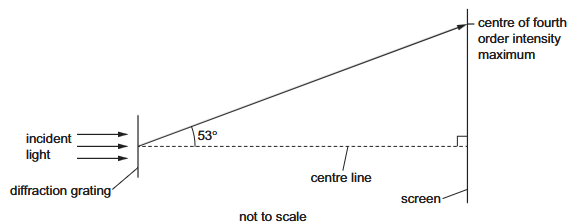
A pattern of intensity maxima forms on the screen. A line connecting the centre of the fourth-order intensity maximum with the centre of the diffraction grating forms an angle of \(53^\circ\) with the centre line.
The grating has a line spacing of \(2.7\times10^{-6}\,\mathrm{m}\).
What is the wavelength of the incident light?
(B) \(5.4\times10^{-7}\,\mathrm{m}\)
(C) \(1.6\times10^{-6}\,\mathrm{m}\)
(D) \(2.2\times10^{-6}\,\mathrm{m}\)
▶️ Answer/Explanation
Correct Answer: \( \boxed{\mathrm{B}} \)
Use the diffraction grating equation:
\(d\sin\theta=n\lambda\)
\(\lambda=\dfrac{2.7\times10^{-6}\times\sin53^\circ}{4}\)
\(=\dfrac{2.7\times10^{-6}\times0.799}{4}=5.4\times10^{-7}\,\mathrm{m}\)
Therefore, the correct answer is (B).
Question 31
Topic: 8.1 Stationary waves
A horizontal glass tube, closed at one end, has a layer of dust laid inside it on its lower side. Sound is emitted from a loudspeaker placed near the open end of the tube.
The frequency of the sound is varied and, at one frequency, a stationary wave is formed inside the tube so that the dust forms small heaps.
The distance between four heaps of dust is \(30\,\mathrm{cm}\).

The speed of sound in the air in the tube is \(330\,\mathrm{m\,s^{-1}}\).
What is the frequency of the sound emitted by the loudspeaker?
(B) \(2200\,\mathrm{Hz}\)
(C) \(3300\,\mathrm{Hz}\)
(D) \(6600\,\mathrm{Hz}\)
▶️ Answer/Explanation
Correct Answer: \( \boxed{\mathrm{A}} \)
Adjacent dust heaps are separated by \(\dfrac{\lambda}{2}\).
Four heaps span three gaps, so
\(3\left(\dfrac{\lambda}{2}\right)=0.30\)
\(\lambda=0.20\,\mathrm{m}\)
\(f=\dfrac{v}{\lambda}=\dfrac{330}{0.20}=1650\,\mathrm{Hz}\)
Therefore, the correct answer is (A).
Question 32
Topic: 9.1 Electric current.png)
There is a current in a resistor for a short time interval.
Which statement about the total charge that passes through the resistor is correct?
(B) It is an integer multiple of the elementary charge.
(C) It is the elementary charge.
(D) It is the rate of flow of the current.
▶️ Answer/Explanation
Correct Answer: \( \boxed{\mathrm{B}} \)
Electric charge is carried by electrons, each having charge \(e=1.60\times10^{-19}\,\mathrm{C}\).
Hence the total charge transferred is always an integer multiple of the elementary charge.
Therefore, the correct answer is (B).
Question 33
Topic: 9.3 Resistance and resistivity
The potential difference \(V\) across a filament lamp is slowly raised from zero to its normal operating value.
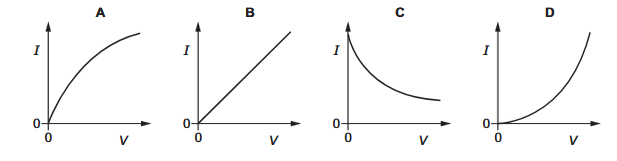
Which graph represents the variation of \(I\) with \(V\) of the current in the lamp?
(B) B
(C) C
(D) D
▶️ Answer/Explanation
Correct Answer: \( \boxed{\mathrm{A}} \)
As the filament heats up, its resistance increases.
Therefore, the current increases less rapidly with increasing potential difference, giving a curve with a decreasing gradient.
Therefore, the correct answer is (A).
Question 34
Topic: 9.1 Electric current
An electric current of \(12\,\mathrm{A}\) is in a wire of length \(0.35\,\mathrm{m}\).
The average drift speed of the free electrons (charge carriers) in the wire is \(5.0\times10^{-4}\,\mathrm{m\,s^{-1}}\).
How many free electrons are in the wire?
(B) \(5.3\times10^{22}\)
(C) \(1.5\times10^{23}\)
(D) \(4.3\times10^{23}\)
▶️ Answer/Explanation
Correct Answer: \( \boxed{\mathrm{B}} \)
Current is the charge passing a point each second:
\(I=\dfrac{Nev}{L}\)
\(N=\dfrac{IL}{ev}=\dfrac{12\times0.35}{(1.60\times10^{-19})(5.0\times10^{-4})}\)
\(=5.25\times10^{22}\approx5.3\times10^{22}\)
Therefore, the correct answer is (B).
Question 35
Topic: 10.1 Practical circuits.png)
Three resistors are connected to a cell of negligible internal resistance.
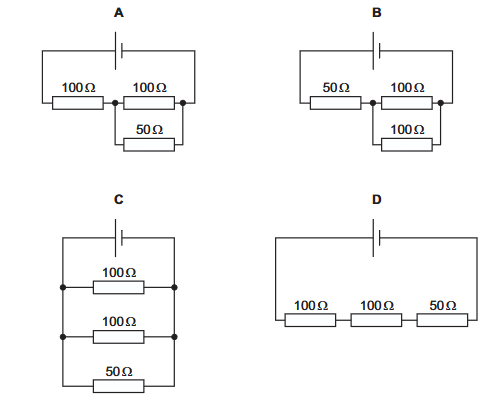
Which circuit has a combined resistance of \(100\,\Omega\)?
(B) B
(C) C
(D) D
▶️ Answer/Explanation
Correct Answer: \( \boxed{\mathrm{B}} \)
For circuit B:
\(R=50+\left(\dfrac{100\times100}{100+100}\right)\)
\(=50+50=100\,\Omega\)
Therefore, the correct answer is (B).
Question 36
Topic: 10.2 Kirchhoff’s laws
Each of Kirchhoff’s laws is a statement based on the conservation of a physical quantity.
Which quantity is conserved in each law?
| Option | Kirchhoff’s First Law | Kirchhoff’s Second Law |
|---|---|---|
| A | Charge | Energy |
| B | Energy | Current |
| C | Power | Charge |
| D | Resistance | Power |
▶️ Answer/Explanation
Correct Answer: \( \boxed{\mathrm{A}} \)
Kirchhoff’s first law is based on the conservation of charge, so the total current entering a junction equals the total current leaving it.
Kirchhoff’s second law is based on the conservation of energy, so the total emf equals the total potential drops around a closed loop.
Therefore, the correct answer is (A).
Question 37
Topic: 10.1 Practical circuits.png)
A cell with electromotive force (e.m.f.) \(1.50\,\mathrm{V}\) delivers a current of \(0.26\,\mathrm{A}\) to a resistor of resistance \(5.0\,\Omega\) connected between its terminals.
What is the internal resistance of the cell?
(B) \(0.20\,\Omega\)
(C) \(0.39\,\Omega\)
(D) \(0.77\,\Omega\)
▶️ Answer/Explanation
Correct Answer: \( \boxed{\mathrm{D}} \)
Use \(E=I(R+r)\).
\(r=\dfrac{E}{I}-R=\dfrac{1.50}{0.26}-5.0\)
\(=5.77-5.0=0.77\,\Omega\)
Therefore, the correct answer is (D).
Question 38
Topic: 11.2 Fundamental particles
What is not a quark flavour?
(B) Meson
(C) Strange
(D) Up
▶️ Answer/Explanation
Correct Answer: \( \boxed{\mathrm{B}} \)
The six quark flavours are up, down, charm, strange, top and bottom.
A meson is not a quark flavour; it is a hadron made of a quark and an antiquark.
Therefore, the correct answer is (B).
Question 39
Topic: 11.2 Fundamental particles.png)
How many down quarks are in a nucleus of hydrogen-3, \(^{3}_{1}\mathrm{H}\)?
(B) 3
(C) 4
(D) 5
▶️ Answer/Explanation
Correct Answer: \( \boxed{\mathrm{D}} \)
A hydrogen-3 nucleus contains \(1\) proton and \(2\) neutrons.
Proton: \(uud\) → \(1\) down quark.
Each neutron: \(udd\) → \(2\) down quarks.
Total down quarks \(=1+2+2=5\).
Therefore, the correct answer is (D).
Question 40
Topic: 11.1 Atoms, nuclei and radiation
An isotope of boron decays to beryllium by \(\beta^{+}\) emission.
Which particle is emitted in addition to the \(\beta^{+}\) particle?
(B) Electron
(C) Neutrino
(D) Neutron
▶️ Answer/Explanation
Correct Answer: \( \boxed{\mathrm{C}} \)
In \(\beta^{+}\) decay, a proton changes into a neutron:
\(p \rightarrow n+\beta^{+}+\nu_e\)
Thus, a neutrino is emitted together with the positron.
Therefore, the correct answer is (C).