
Question 1
Topic: 1.1 Physical quantities.png)
Which statement about physical quantities is correct?
(B) A physical quantity must always have a magnitude but does not always have a unit.
(C) A physical quantity must always have a unit but does not always have a magnitude.
(D) A physical quantity must always have a magnitude and a unit.
▶️ Answer/Explanation
Correct Answer: \( \boxed{\mathrm{D}} \)
A physical quantity is a measurable property that is expressed by a numerical magnitude together with an appropriate unit.
For example, a length may be written as \(5.0\,\mathrm{m}\), where \(5.0\) is the magnitude and \(\mathrm{m}\) is the unit.
Therefore, the correct answer is (D).
Question 2
Topic: 1.2 SI units
What is a reasonable estimate of the mass of a solid sphere of copper that has a diameter of \(60\,\mathrm{cm}\)?
(B) \(10\,\mathrm{kg}\)
(C) \(1000\,\mathrm{kg}\)
(D) \(100\,000\,\mathrm{kg}\)
▶️ Answer/Explanation
Correct Answer: \( \boxed{\mathrm{C}} \)
The radius of the sphere is \(r=0.30\,\mathrm{m}\).
Its volume is approximately
\(V=\dfrac{4}{3}\pi r^3=\dfrac{4}{3}\pi(0.30)^3\approx0.113\,\mathrm{m^3}\).
Using the density of copper, \(\rho\approx8.9\times10^3\,\mathrm{kg\,m^{-3}}\), the mass is
\(m=\rho V\approx(8.9\times10^3)(0.113)\approx1.0\times10^3\,\mathrm{kg}\).
Therefore, the correct answer is (C).
Question 3
Topic: 1.2 SI units
The power output \(P\) of a star can be modelled with the equation
\(P=\sigma AT^4\)
where \(\sigma\) is a constant, \(A\) is the surface area of the star and \(T\) is the surface temperature of the star.
What are the SI base units of \(\sigma\)?
(B) \(\mathrm{kg\,s^{-3}\,K^{-4}}\)
(C) \(\mathrm{kg\,m^{-1}\,s^{-2}\,K^{-4}}\)
(D) \(\mathrm{kg\,m^{-1}\,s^{-3}\,K^{-4}}\)
▶️ Answer/Explanation
Correct Answer: \( \boxed{\mathrm{B}} \)
Rearrange the equation:
\(\sigma=\dfrac{P}{AT^4}\)
The SI base units are:
\(P:\mathrm{kg\,m^2\,s^{-3}}\)
\(A:\mathrm{m^2}\)
\(T:\mathrm{K}\)
Hence,
\(\sigma=\dfrac{\mathrm{kg\,m^2\,s^{-3}}}{\mathrm{m^2\,K^4}}=\mathrm{kg\,s^{-3}\,K^{-4}}\)
Therefore, the correct answer is (B).
Question 4
Topic: 2.1 Equations of motion.png)
A boy throws a stone with a horizontal velocity of \(10\,\mathrm{m\,s^{-1}}\) from the top of a building. The height of the building is \(8.0\,\mathrm{m}\). The stone travels along a curved path until it hits the horizontal ground, as shown.
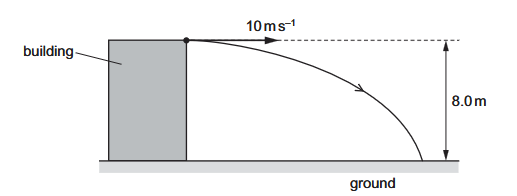
Air resistance is negligible.
How long does it take the stone to reach the ground?
(B) \(0.80\,\mathrm{s}\)
(C) \(1.3\,\mathrm{s}\)
(D) \(1.6\,\mathrm{s}\)
▶️ Answer/Explanation
Correct Answer: \( \boxed{\mathrm{C}} \)
The horizontal motion does not affect the time taken to fall.
Using vertical motion,
\(s=\dfrac{1}{2}gt^2\)
\(8.0=\dfrac{1}{2}(9.81)t^2\)
\(t=\sqrt{\dfrac{2\times8.0}{9.81}}\approx1.28\,\mathrm{s}\)
Hence, \(t\approx1.3\,\mathrm{s}\).
Therefore, the correct answer is (C).
Question 5
Topic: 4.3 Density and pressure.png)
Four cuboids with identical lengths, breadths and heights are immersed in water. The cuboids are held at the same depth and in identical orientations by vertical rods, as shown.
Water has density \(\rho\).
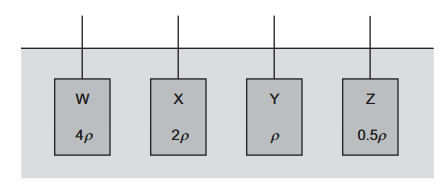
Cuboid W is made of material of density \(4\rho\).
Cuboid X is made of material of density \(2\rho\).
Cuboid Y is made of material of density \(\rho\).
Cuboid Z is made of material of density \(0.5\rho\).
Which statement is correct?
(B) The upthrust of the water on W is twice the upthrust of the water on X.
(C) The upthrust of the water on X is twice the upthrust of the water on W.
(D) The upthrust of the water on Y is zero.
▶️ Answer/Explanation
Correct Answer: \( \boxed{\mathrm{A}} \)
The upthrust (buoyant force) on a fully immersed object is given by
\(F_{\mathrm{b}}=\rho_{\mathrm{water}}Vg\).
All four cuboids have the same volume, are immersed in the same liquid, and are at the same depth.
Therefore, each cuboid displaces the same volume of water, so the upthrust on each cuboid is identical regardless of its own density.
Therefore, the correct answer is (A).
Question 6
Topic: 4.2 Equilibrium of forces
In which example is it not possible for the underlined object to be in equilibrium?
(B) An aeroplane tows a glider at a constant altitude.
(C) A speedboat changes direction at a constant speed.
(D) Two boats tow a ship into harbour.
▶️ Answer/Explanation
Correct Answer: \( \boxed{\mathrm{C}} \)
An object is in equilibrium when the resultant force acting on it is zero, so its acceleration is zero.
A speedboat that changes direction, even at constant speed, has a changing velocity.
A change in velocity means there is an acceleration, so a resultant force must act on the speedboat. Therefore, it cannot be in equilibrium.
Therefore, the correct answer is (C).
Question 7
Topic: 3.2 Non-uniform motion
Two identical balls are projected vertically upwards from ground level with the same initial velocity. Ball X is in a vacuum and ball Y is in air.
Which statement about the motion of the balls is correct?
(B) Ball X reaches a greater maximum height and in a shorter time than ball Y.
(C) Ball Y reaches a greater maximum height and in a longer time than ball X.
(D) Ball Y reaches a greater maximum height and in a shorter time than ball X.
▶️ Answer/Explanation
Correct Answer: \( \boxed{\mathrm{A}} \)
In a vacuum, only gravity acts on ball X, so its acceleration is constant at \(g\).
For ball Y, air resistance acts downward as it rises, increasing the downward resultant force and making its deceleration greater than \(g\).
As a result, ball Y loses speed more quickly, reaches a lower maximum height, and takes less time to reach its highest point.
Therefore, the correct answer is (A).
Question 8
Topic: 3.2 Non-uniform motion.png)
The graph shows the variation of velocity with time for a stone that falls from a bridge into a lake and sinks to the bottom of the lake.
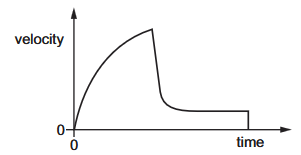
What can be deduced about the motion of the stone?
(B) The acceleration in air was decreasing with increasing time.
(C) The distance travelled in water was greater than the distance travelled in air.
(D) The rate of change of velocity in air was constant.
▶️ Answer/Explanation
Correct Answer: \( \boxed{\mathrm{B}} \)
The gradient of a velocity-time graph represents acceleration.
While the stone is falling through air, the graph becomes less steep with time, showing that the gradient is decreasing.
This occurs because air resistance increases as the speed increases, reducing the resultant force and hence the acceleration.
Therefore, the correct answer is (B).
Question 9
Topic: 3.1 Momentum and Newton’s laws of motion
The graph shows the variation of momentum \(p\) with time \(t\) for a car.
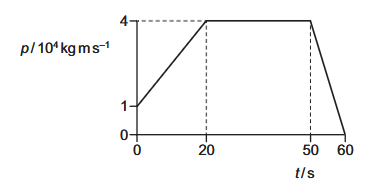
What is the resultant force on the car at \(t=10\,\mathrm{s}\)?
(B) \(1500\,\mathrm{N}\)
(C) \(2000\,\mathrm{N}\)
(D) \(4000\,\mathrm{N}\)
▶️ Answer/Explanation
Correct Answer: \( \boxed{\mathrm{B}} \)
The resultant force is the rate of change of momentum:
\(F=\dfrac{\Delta p}{\Delta t}\)
From \(t=0\) to \(20\,\mathrm{s}\), the momentum increases from \(1\times10^{4}\) to \(4\times10^{4}\,\mathrm{kg\,m\,s^{-1}}\).
\(F=\dfrac{(4-1)\times10^{4}}{20}=\dfrac{3\times10^{4}}{20}=1.5\times10^{3}\,\mathrm{N}\)
\(F=1500\,\mathrm{N}\).
Therefore, the correct answer is (B).
Question 10
Topic: 3.3 Linear momentum and its conservation
Two objects X and Y form an isolated system. X and Y collide and then separate. The mass of X is greater than the mass of Y.
Which statement about the collision is correct?
(B) The force on Y is greater than the force on X.
(C) The forces that X and Y exert on each other act for the same length of time.
(D) The forces that X and Y exert on each other are gravitational forces only.
▶️ Answer/Explanation
Correct Answer: \( \boxed{\mathrm{C}} \)
During a collision, Newton’s third law states that the forces the two objects exert on each other are equal in magnitude, opposite in direction, and act over the same time interval.
Hence, the impulses on the two objects are equal in magnitude and opposite in direction, so their changes in momentum are equal and opposite.
Therefore, options (A), (B), and (D) are incorrect.
Therefore, the correct answer is (C).
Question 11
Topic: 3.3 Linear momentum and its conservation.png)
Which row states whether total momentum and total kinetic energy are conserved in an inelastic collision in which there are no external forces?
| Total momentum | Total kinetic energy | |
|---|---|---|
| (A) | Conserved | Conserved |
| (B) | Conserved | Not conserved |
| (C) | Not conserved | Conserved |
| (D) | Not conserved | Not conserved |
▶️ Answer/Explanation
Correct Answer: \( \boxed{\mathrm{B}} \)
In an isolated system with no external forces, the total momentum is always conserved.
In an inelastic collision, some kinetic energy is transformed into other forms of energy such as heat, sound, or deformation, so total kinetic energy is not conserved.
Therefore, the correct answer is (B).
Question 12
Topic: 3.2 Non-uniform motion
A tennis ball is thrown vertically upwards. The tennis ball reaches its highest point and then falls back down to the point from which it was thrown.
Air resistance is significant.
At which position on the path of the tennis ball is the resultant force on the tennis ball greatest?
(B) When the tennis ball is halfway to its highest point on the way up.
(C) When the tennis ball is at its highest point.
(D) When the tennis ball is halfway from its highest point on the way down.
▶️ Answer/Explanation
Correct Answer: \( \boxed{\mathrm{A}} \)
The resultant force is the vector sum of the weight and air resistance.
Just after release, the ball has its greatest upward speed, so the air resistance is at its maximum and acts downward together with the weight.
Hence, the resultant downward force is greatest immediately after the ball is released.
Therefore, the correct answer is (A).
Question 13
Topic: 4.1 Turning effects of forces.png)
Which statement correctly describes a couple?
(B) A couple is a pair of forces that act on the centre of gravity of an object.
(C) A couple is a pair of forces that act to produce a resultant force.
(D) A couple is a pair of forces that act to produce rotation only.
▶️ Answer/Explanation
Correct Answer: \( \boxed{\mathrm{D}} \)
A couple consists of two equal and opposite parallel forces acting along different lines of action.
The resultant force is zero, but the pair of forces produces a turning effect (moment), causing rotation without translation.
Therefore, the correct answer is (D).
Question 14
Topic: 4.2 Equilibrium of forces
A uniform beam of mass \(1.4\,\mathrm{kg}\) is pivoted at \(P\), as shown. The beam has a length of \(0.60\,\mathrm{m}\) and \(P\) is a distance of \(0.20\,\mathrm{m}\) from one end. Loads of \(3.0\,\mathrm{kg}\) and \(6.0\,\mathrm{kg}\) are suspended at distances of \(0.35\,\mathrm{m}\) and \(0.15\,\mathrm{m}\) from the pivot, as shown.
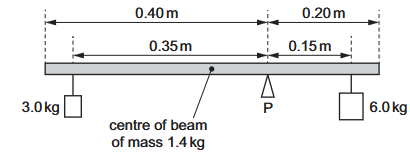
What is the torque that must be applied to the beam in order to maintain it in equilibrium?
(B) \(0.10\,\mathrm{N\,m}\)
(C) \(0.29\,\mathrm{N\,m}\)
(D) \(2.8\,\mathrm{N\,m}\)
▶️ Answer/Explanation
Correct Answer: \( \boxed{\mathrm{D}} \)
Take moments about the pivot \(P\).
Anticlockwise moment due to the \(3.0\,\mathrm{kg}\) load:
\(M_{\mathrm{ACW}}=3.0\times9.81\times0.35=10.30\,\mathrm{N\,m}\)
The beam’s centre of mass is \(0.10\,\mathrm{m}\) to the left of the pivot, so its weight provides an anticlockwise moment:
\(M_{\mathrm{beam}}=1.4\times9.81\times0.10=1.37\,\mathrm{N\,m}\)
Clockwise moment due to the \(6.0\,\mathrm{kg}\) load:
\(M_{\mathrm{CW}}=6.0\times9.81\times0.15=8.83\,\mathrm{N\,m}\)
Net anticlockwise moment:
\(10.30+1.37-8.83=2.84\,\mathrm{N\,m}\)
An equal clockwise torque of approximately \(2.8\,\mathrm{N\,m}\) must be applied to maintain equilibrium.
Therefore, the correct answer is (D).
Question 15
Topic: 4.2 Equilibrium of forces.png)
The diagrams show three rigid objects P, Q and R being subjected to different combinations of forces.
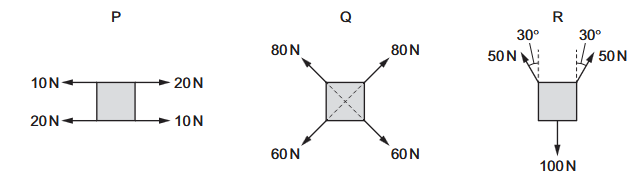
Which objects are in equilibrium?
(B) P and R
(C) Q and R
(D) None of them
▶️ Answer/Explanation
Correct Answer: \( \boxed{\mathrm{D}} \)
For an object to be in equilibrium, both the resultant force and the resultant moment must be zero.
Object P has zero resultant force but the forces form a couple, producing a non-zero moment.
Object Q has balanced horizontal forces, but the vertical forces are unbalanced \((160\,\mathrm{N}\) upward and \(120\,\mathrm{N}\) downward).
For object R, the upward vertical components are \(2(50\cos30^\circ)=86.6\,\mathrm{N}\), which do not balance the \(100\,\mathrm{N}\) downward force.
Therefore, none of the three objects is in equilibrium, so the correct answer is (D).
Question 16
Topic: 4.3 Density and pressure
The diagram shows two liquids, labelled P and Q, that do not mix. The liquids are in equilibrium in an open U-tube. Three equal distances \(x\) are labelled.
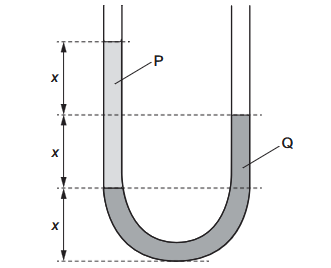
What is the ratio \(\dfrac{\text{density of P}}{\text{density of Q}}\)?
(B) \(\dfrac{2}{3}\)
(C) \(\dfrac{3}{2}\)
(D) \(2\)
▶️ Answer/Explanation
Correct Answer: \( \boxed{\mathrm{A}} \)
At the same horizontal level in a liquid, the pressure is equal.
At the interface between the liquids, the pressure due to liquid P equals the pressure due to liquid Q.
The height of liquid P above the interface is \(2x\), while the height of liquid Q above the same level is \(x\).
Therefore,
\(\rho_{\mathrm{P}}g(2x)=\rho_{\mathrm{Q}}g(x)\)
\(\dfrac{\rho_{\mathrm{P}}}{\rho_{\mathrm{Q}}}=\dfrac{1}{2}\)
Therefore, the correct answer is (A).
Question 17
Topic: 5.2 Gravitational potential energy and kinetic energy
A stone of mass \(0.30\,\mathrm{kg}\) is thrown vertically downwards with a speed of \(20\,\mathrm{m\,s^{-1}}\) from a height of \(12\,\mathrm{m}\) above the ground. The stone falls vertically until it hits the ground. Air resistance is negligible.
What is the kinetic energy of the stone just before it hits the ground?
(B) \(35\,\mathrm{J}\)
(C) \(60\,\mathrm{J}\)
(D) \(95\,\mathrm{J}\)
▶️ Answer/Explanation
Correct Answer: \( \boxed{\mathrm{D}} \)
With negligible air resistance, mechanical energy is conserved.
Initial kinetic energy:
\(KE_i=\dfrac{1}{2}mv^2=\dfrac{1}{2}(0.30)(20)^2=60\,\mathrm{J}\)
Loss of gravitational potential energy:
\(\Delta PE=mgh=(0.30)(9.81)(12)=35.3\,\mathrm{J}\)
Final kinetic energy:
\(KE_f=60+35.3=95.3\,\mathrm{J}\approx95\,\mathrm{J}\)
Therefore, the correct answer is (D).
Question 18
Topic: 5.1 Energy conservation.png)
A student can run or walk up the stairs to her classroom.
Which statement describes the power required and the gravitational potential energy gained while running up the stairs compared to walking up them?
(B) Running provides more gravitational potential energy and uses the same power.
(C) Running provides the same gravitational potential energy and uses more power.
(D) Running provides the same gravitational potential energy and uses the same power.
▶️ Answer/Explanation
Correct Answer: \( \boxed{\mathrm{C}} \)
The gravitational potential energy gained depends only on the vertical height climbed:
\(\Delta E_{\mathrm{p}}=mgh\)
Since the same student climbs the same height, the gain in gravitational potential energy is the same whether walking or running.
Power is the rate of doing work:
\(P=\dfrac{W}{t}\)
Running takes less time, so the same amount of work is done in a shorter time, requiring more power.
Therefore, the correct answer is (C).
Question 19
Topic: 5.2 Gravitational potential energy and kinetic energy
A weight \(W\) hangs from a trolley that runs along a rail. The trolley moves horizontally through a distance \(p\) and simultaneously raises the weight through a height \(q\).
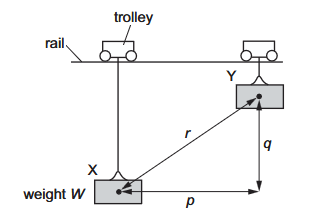
As a result, the weight moves through a distance \(r\) from X to Y. It starts and finishes at rest.
How much work is done on the weight during this process?
(B) \(W(p+q)\)
(C) \(Wq\)
(D) \(Wr\)
▶️ Answer/Explanation
Correct Answer: \( \boxed{\mathrm{C}} \)
The weight starts and finishes at rest, so its change in kinetic energy is zero.
The work done on the weight is equal to the increase in its gravitational potential energy.
Since the weight rises vertically through a height \(q\),
\(\Delta E_{\mathrm{p}}=Wq\)
The horizontal displacement \(p\) does not affect the gravitational potential energy.
Therefore, the correct answer is (C).
Question 20
Topic: 5.2 Gravitational potential energy and kinetic energy
The equation for kinetic energy \(E_{\mathrm{k}}\) can be derived using the equations of motion.
Four equations relating to motion are listed.
1. \(W=Fs\)
2. \(F=ma\)
3. \(v^2=u^2+2as\)
4. \(P=\dfrac{W}{t}\)
Which three equations can be used to derive the equation for \(E_{\mathrm{k}}\)?
(B) 1, 2 and 4
(C) 1, 3 and 4
(D) 2, 3 and 4
▶️ Answer/Explanation
Correct Answer: \( \boxed{\mathrm{A}} \)
Use the equations
\(W=Fs,\qquad F=ma,\qquad v^2=u^2+2as\)
Substitute \(F=ma\) into \(W=Fs\):
\(W=mas\)
From \(v^2=u^2+2as\),
\(as=\dfrac{v^2-u^2}{2}\)
Hence,
\(W=m\left(\dfrac{v^2-u^2}{2}\right)=\dfrac{1}{2}mv^2-\dfrac{1}{2}mu^2\)
This is the work-energy theorem, giving \(E_{\mathrm{k}}=\dfrac{1}{2}mv^2\).
Therefore, the correct answer is (A).
Question 21
Topic: 6.2 Elastic and plastic behaviour.png)
The force-extension graph of a metal wire is shown.
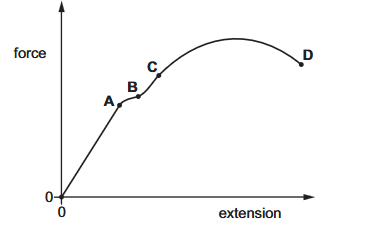
At which point on the graph does the metal wire stop obeying Hooke’s law?
(B) B
(C) C
(D) D
▶️ Answer/Explanation
Correct Answer: \( \boxed{\mathrm{A}} \)
Hooke’s law states that force is directly proportional to extension, so the force-extension graph must be a straight line.
The wire stops obeying Hooke’s law at the limit of proportionality, which is where the graph first begins to deviate from a straight line.
On the graph, this occurs at point A.
Therefore, the correct answer is (A).
Question 22
Topic: 6.1 Stress and strain
A uniform wire is made of a metal that has a Young modulus of \(1.3\times10^{11}\,\mathrm{Pa}\).
The wire is \(2.4\,\mathrm{m}\) long and has a spring constant of \(2.7\times10^{4}\,\mathrm{N\,m^{-1}}\).
What is the volume of the wire?
(B) \(6.3\times10^{-8}\,\mathrm{m^3}\)
(C) \(5.0\times10^{-7}\,\mathrm{m^3}\)
(D) \(1.2\times10^{-6}\,\mathrm{m^3}\)
▶️ Answer/Explanation
Correct Answer: \( \boxed{\mathrm{D}} \)
For a wire,
\(k=\dfrac{YA}{L}\)
where \(Y\) is Young modulus, \(A\) is the cross-sectional area, and \(L\) is the length.
Hence,
\(A=\dfrac{kL}{Y}=\dfrac{(2.7\times10^{4})(2.4)}{1.3\times10^{11}}=4.98\times10^{-7}\,\mathrm{m^2}\)
The volume is
\(V=AL=(4.98\times10^{-7})(2.4)=1.20\times10^{-6}\,\mathrm{m^3}\)
Therefore, the correct answer is (D).
Question 23
Topic: 6.2 Elastic and plastic behaviour
A rubber cord hangs from a rigid support. A weight attached to its lower end is gradually increased from zero, and then gradually reduced to zero.
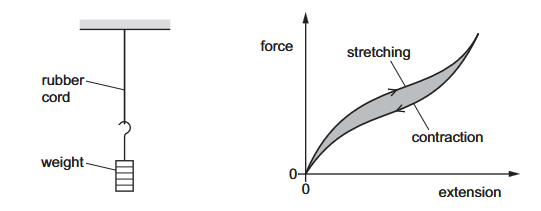
The force-extension curve for contraction is below the force-extension curve for stretching.
What does the shaded area between the curves represent?
(B) The thermal energy dissipated in the rubber cord.
(C) The work done by the rubber cord during contraction.
(D) The work done on the rubber cord during stretching.
▶️ Answer/Explanation
Correct Answer: \( \boxed{\mathrm{B}} \)
The area under a force-extension graph represents the work done.
Because the loading and unloading curves are different, the material exhibits hysteresis.
The shaded area between the two curves is the energy lost during one loading-unloading cycle, which is dissipated as thermal energy within the rubber.
Therefore, the correct answer is (B).
Question 24
Topic: 7.3 Doppler effect for sound waves.png)
A source of sound waves of constant frequency is travelling as shown.
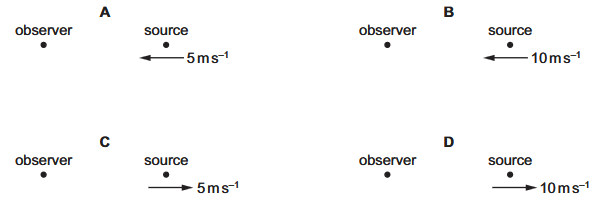
In which situation would the stationary observer detect a sound with the lowest frequency?
(B) B
(C) C
(D) D
▶️ Answer/Explanation
Correct Answer: \( \boxed{\mathrm{D}} \)
The Doppler effect causes the observed frequency to decrease when the source moves away from the observer.
The faster the source moves away, the greater the decrease in the observed frequency.
In situation D, the source is moving away from the observer at \(10\,\mathrm{m\,s^{-1}}\), giving the largest Doppler shift to a lower frequency.
Therefore, the correct answer is (D).
Question 25
Topic: 7.4 Electromagnetic spectrum
Each of the principal radiations of the electromagnetic spectrum has a range of wavelengths.
Which wavelength is correctly linked to its radiation?
| Wavelength / \(\mathrm{m}\) | Radiation | |
|---|---|---|
| (A) | \(10^{-9}\) | Gamma ray |
| (B) | \(10^{-5}\) | Microwave |
| (C) | \(10^{-8}\) | Ultraviolet |
| (D) | \(10^{-14}\) | X-ray |
▶️ Answer/Explanation
Correct Answer: \( \boxed{\mathrm{C}} \)
Ultraviolet radiation has wavelengths approximately in the range \(10^{-8}\,\mathrm{m}\) to \(4\times10^{-7}\,\mathrm{m}\).
Gamma rays have much shorter wavelengths than \(10^{-9}\,\mathrm{m}\), microwaves have wavelengths much longer than \(10^{-5}\,\mathrm{m}\), and X-rays typically have wavelengths around \(10^{-11}\) to \(10^{-8}\,\mathrm{m}\).
Therefore, the correct answer is (C).
Question 26
Topic: 7.1 Progressive waves
A transverse water wave has a frequency of \(15\,\mathrm{Hz}\), a wavelength of \(0.12\,\mathrm{m}\) and an amplitude of \(4.0\,\mathrm{mm}\).
P is a water particle that is initially at the peak of the wave, as shown.
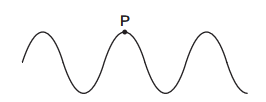
What is the total vertical distance travelled by P in a time of \(0.5\,\mathrm{s}\)?
(B) \(60\,\mathrm{mm}\)
(C) \(120\,\mathrm{mm}\)
(D) \(900\,\mathrm{mm}\)
▶️ Answer/Explanation
Correct Answer: \( \boxed{\mathrm{C}} \)
The number of oscillations completed in \(0.5\,\mathrm{s}\) is
\(N=ft=15\times0.5=7.5\)
In one complete oscillation, the particle travels a total vertical distance of \(4A\).
Distance travelled in one oscillation:
\(4A=4\times4.0=16\,\mathrm{mm}\)
Total vertical distance:
\(7.5\times16=120\,\mathrm{mm}\)
Therefore, the correct answer is (C).
Question 27
Topic: 7.1 Progressive waves.png)
A wave is formed on a string.
A student plots a graph of the variation of displacement \(d\) with time \(t\) for a point on the string.
The student marks two points, X and Y, on the graph.
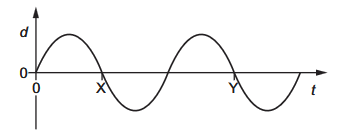
Which property of the wave is represented by the distance along the horizontal axis between X and Y?
(B) Frequency
(C) Period
(D) Wavelength
▶️ Answer/Explanation
Correct Answer: \( \boxed{\mathrm{C}} \)
The graph is a displacement-time graph for a single point on the string.
Points X and Y are successive points in the same phase of the motion, so the horizontal distance between them is the time taken for one complete oscillation.
This time interval is the period of the wave.
Therefore, the correct answer is (C).
Question 28
Topic: 8.1 Stationary waves
A stationary wave is set up in a stretched string.
Which distance is equal to the wavelength of the wave?
(B) Half the distance between adjacent nodes.
(C) The distance between adjacent antinodes.
(D) The distance between a node and an adjacent antinode.
▶️ Answer/Explanation
Correct Answer: \( \boxed{\mathrm{A}} \)
In a stationary wave, the distance between two adjacent nodes or two adjacent antinodes is \(\dfrac{\lambda}{2}\).
Therefore, twice the distance between adjacent antinodes is
\(2\times\dfrac{\lambda}{2}=\lambda\).
Also, the distance between a node and the adjacent antinode is \(\dfrac{\lambda}{4}\).
Therefore, the correct answer is (A).
Question 29
Topic: 8.3 Interference.png)
A source of coherent light is incident on two slits, P and Q, which are placed \(80\,\mathrm{mm}\) apart. The light has a single frequency of \(1.5\times10^{12}\,\mathrm{Hz}\). The light from the slits meets on a screen that is a distance of \(4.0\,\mathrm{m}\) from the slits. The screen is parallel to a line joining the slits.
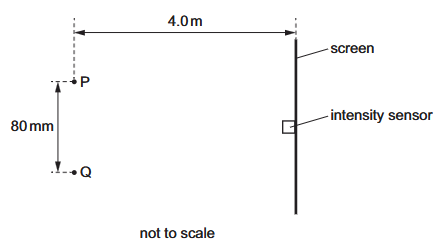
An intensity sensor is placed on the screen at the midpoint of the interference pattern such that the intensity reading is a maximum. The intensity sensor is moved along the screen.
The sensor travels through two intensity minima, two intensity maxima and stops in the middle of the third intensity minimum.
Which distance does the sensor move through?
(B) \(10\,\mathrm{mm}\)
(C) \(25\,\mathrm{mm}\)
(D) \(50\,\mathrm{mm}\)
▶️ Answer/Explanation
Correct Answer: \( \boxed{\mathrm{C}} \)
The wavelength is
\(\lambda=\dfrac{c}{f}=\dfrac{3.0\times10^8}{1.5\times10^{12}}=2.0\times10^{-4}\,\mathrm{m}\)
Fringe spacing:
\(w=\dfrac{\lambda D}{a}=\dfrac{(2.0\times10^{-4})(4.0)}{0.080}=0.010\,\mathrm{m}=10\,\mathrm{mm}\)
Starting at the central maximum, the third minimum is located at
\(\dfrac{5}{2}w=2.5\times10=25\,\mathrm{mm}\)
Therefore, the correct answer is (C).
Question 30
Topic: 8.2 Diffraction
A vibrating bar produces surface water waves in a ripple tank.
The wavelength of the waves is \(5.0\,\mathrm{cm}\) and they pass through a gap of width \(20\,\mathrm{cm}\).
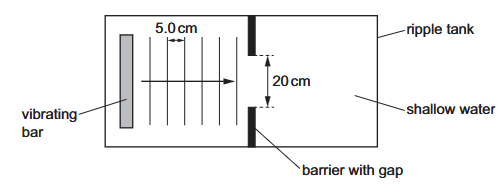
Which change will increase the amount of diffraction that is observed?
(B) Decreasing the frequency of the wave.
(C) Increasing the amplitude of the wave.
(D) Increasing the width of the gap.
▶️ Answer/Explanation
Correct Answer: \( \boxed{\mathrm{B}} \)
Diffraction increases when the wavelength becomes larger relative to the width of the gap.
For water waves in the same depth, the wave speed is approximately constant, so
\(v=f\lambda\)
Decreasing the frequency increases the wavelength, producing greater diffraction.
Changing the amplitude or the distance from the source to the gap does not increase diffraction, and increasing the gap width reduces diffraction.
Therefore, the correct answer is (B).
Question 31
Topic: 9.1 Electric current.png)
What is an electric current?
(B) A flow of energy.
(C) An electron.
(D) The charge on a particle.
▶️ Answer/Explanation
Correct Answer: \( \boxed{\mathrm{A}} \)
An electric current is the rate of flow of electric charge through a conductor.
Current is produced by the movement of charge carriers, such as electrons in metals or ions in electrolytes.
It is defined by
\(I=\dfrac{Q}{t}\)
Therefore, the correct answer is (A).
Question 32
Topic: 9.1 Electric current
A wire of diameter \(d\) is connected into an electric circuit. There is a current \(I\) in the wire and the charge carriers have an average drift speed \(v\).
The wire is replaced by a new wire of the same material but with a diameter \(0.5d\).
The current is adjusted so that the charge carriers in the new wire have an average drift speed \(3v\).
What is the current in the new wire?
(B) \(1.5I\)
(C) \(6I\)
(D) \(12I\)
▶️ Answer/Explanation
Correct Answer: \( \boxed{\mathrm{A}} \)
The current is given by
\(I=nAvq\)
where \(n\) and \(q\) remain unchanged because the new wire is made of the same material.
The diameter is halved, so the cross-sectional area becomes
\(A’=\left(\dfrac{1}{2}\right)^2A=\dfrac{A}{4}\)
The drift speed becomes \(v’=3v\).
Hence,
\(I’=nA’v’q=n\left(\dfrac{A}{4}\right)(3v)q=\dfrac{3}{4}I=0.75I\)
Therefore, the correct answer is (A).
Question 33
Topic: 9.2 Potential difference and power
A fixed resistor and a diode are combined by connecting them in series. The total potential difference \(V\) across the combination is varied and the corresponding current \(I\) is measured.
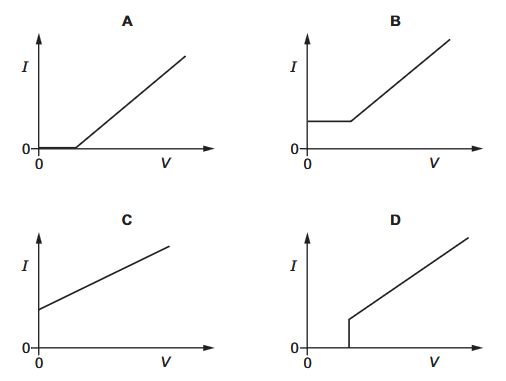
Which graph could represent the variation of \(I\) with \(V\)?
(B) B
(C) C
(D) D
▶️ Answer/Explanation
Correct Answer: \( \boxed{\mathrm{A}} \)
A diode conducts negligible current until its forward threshold (turn-on) voltage is reached.
Beyond this threshold, the diode conducts and the fixed resistor causes the current to increase approximately linearly with increasing potential difference.
Therefore, the graph shows little or no current initially, followed by a straight-line increase in current.
Therefore, the correct answer is (A).
Question 34
Topic: 9.2 Potential difference and power.png)
The potential difference (p.d.) across a fixed resistor is \(V\). The power dissipated in the resistor is \(5.0\,\mathrm{W}\).
The p.d. across the resistor then changes to a new value. With the new p.d. the energy transferred to the resistor in a time of \(2.25\,\mathrm{s}\) is \(45.0\,\mathrm{J}\).
What is the new p.d. across the resistor?
(B) \(2V\)
(C) \(3V\)
(D) \(4V\)
▶️ Answer/Explanation
Correct Answer: \( \boxed{\mathrm{B}} \)
The new power is
\(P=\dfrac{E}{t}=\dfrac{45.0}{2.25}=20\,\mathrm{W}\)
For a fixed resistor,
\(P=\dfrac{V^2}{R}\)
Since the resistance is constant,
\(\dfrac{P_2}{P_1}=\dfrac{V_2^2}{V_1^2}=\dfrac{20}{5}=4\)
Hence,
\(V_2=2V_1=2V\)
Therefore, the correct answer is (B).
Question 35
Topic: 10.3 Potential dividers
The diagram shows part of a circuit that uses a potentiometer wire to measure a potential difference (p.d.) in an external circuit.
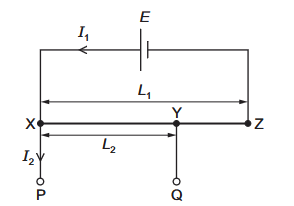
The potentiometer wire XZ has length \(L_1\). It is connected to a cell of known electromotive force (e.m.f.) \(E\) that has negligible internal resistance.
Terminals P and Q are connected to the external p.d. to be measured. The length of the potentiometer wire between points X and Y is \(L_2\).
The ratio of the lengths \(L_1\) and \(L_2\) is used to determine the p.d. between P and Q in terms of \(E\).
Which condition must be met in order to determine this p.d.?
(B) The current \(I_2\) must be zero.
(C) The p.d. across YZ must be zero.
(D) The resistance of the external circuit must be zero.
▶️ Answer/Explanation
Correct Answer: \( \boxed{\mathrm{B}} \)
A potentiometer measures a potential difference by using the null method.
At the balance point, the potential difference between X and Y is exactly equal to the external p.d. being measured.
At this point, no current flows through the external circuit connected between P and Q.
Hence,
\(I_2=0\)
This ensures that the external circuit is not loaded and the measured p.d. is accurate.
Therefore, the correct answer is (B).
Question 36
Topic: 9.2 Potential difference and power.png)
The diagram shows a circuit.
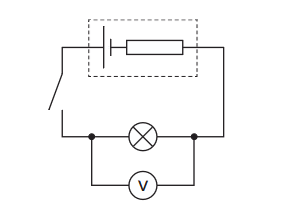
Which statement about the circuit is not correct?
(B) Energy is transferred from chemical potential energy in the cell to other forms when the switch is closed.
(C) The electromotive force of the cell is greater than the terminal potential difference when the switch is closed.
(D) When the switch is open, the voltmeter measures the electromotive force of the cell.
▶️ Answer/Explanation
Correct Answer: \( \boxed{\mathrm{D}} \)
The voltmeter is connected across the lamp, not directly across the cell.
When the switch is open, no current flows through the lamp, so the potential difference across the lamp is zero.
Although the terminal potential difference of the cell equals its e.m.f. when no current flows, the voltmeter is not connected across the cell and therefore does not measure the e.m.f.
Therefore, the correct answer is (D).
Question 37
Topic: 10.1 Practical circuits
A circuit contains a battery of electromotive force \(E\) and internal resistance \(r\) connected to two resistors each of resistance \(2.5\,\Omega\).
The resistors are connected in parallel as shown.
The current in one of the resistors is \(0.80\,\mathrm{A}\).
Which expression, where \(E\) is in volts and \(r\) is in ohms, gives the internal resistance \(r\)?
(B) \(\dfrac{E-4.0}{0.80}\)
(C) \(\dfrac{E-2.0}{1.6}\)
(D) \(\dfrac{E-2.0}{0.80}\)
▶️ Answer/Explanation
Correct Answer: \( \boxed{\mathrm{C}} \)
The potential difference across each \(2.5\,\Omega\) resistor is
\(V=IR=(0.80)(2.5)=2.0\,\mathrm{V}\)
The total current supplied by the battery is
\(I=0.80+0.80=1.6\,\mathrm{A}\)
Using
\(E=V+Ir\)
gives
\(r=\dfrac{E-2.0}{1.6}\)
Therefore, the correct answer is (C).
Question 38
Topic: 11.2 Fundamental particles.png)
What is the rest mass of a beta-particle?
(B) \(9.11\times10^{-31}\,\mathrm{kg}\)
(C) \(1.66\times10^{-27}\,\mathrm{kg}\)
(D) \(1.67\times10^{-27}\,\mathrm{kg}\)
▶️ Answer/Explanation
Correct Answer: \( \boxed{\mathrm{B}} \)
A beta-particle is an electron (\(\beta^{-}\)) or a positron (\(\beta^{+}\)).
Both have the same rest mass as an electron:
\(m_{\mathrm{e}}=9.11\times10^{-31}\,\mathrm{kg}\)
Therefore, the correct answer is (B).
Question 39
Topic: 11.2 Fundamental particles
What is the name of the group (class) of particles containing mesons, and the name of the group (class) of particles containing baryons?
| Group (class) of particles containing mesons | Group (class) of particles containing baryons | |
|---|---|---|
| (A) | Hadrons | Hadrons |
| (B) | Hadrons | Leptons |
| (C) | Leptons | Hadrons |
| (D) | Leptons | Leptons |
▶️ Answer/Explanation
Correct Answer: \( \boxed{\mathrm{A}} \)
Mesons and baryons are both composite particles made of quarks.
Particles made of quarks are classified as hadrons.
Leptons are a separate class of fundamental particles that includes electrons, muons, taus, and neutrinos.
Therefore, the correct answer is (A).
Question 40
Topic: 11.3 Radioactive decay
A magnesium nucleus \(^{23}_{12}\mathrm{Mg}\) decays by emitting two particles.
The resulting nucleus is sodium \(^{23}_{11}\mathrm{Na}\).
Which two particles are emitted?
(B) \(\beta^{+}\) particle, antineutrino
(C) \(\beta^{-}\) particle, neutrino
(D) \(\beta^{+}\) particle, neutrino
▶️ Answer/Explanation
Correct Answer: \( \boxed{\mathrm{D}} \)
The mass number remains unchanged:
\(23 \rightarrow 23\)
The atomic number decreases from \(12\) to \(11\), indicating that a proton changes into a neutron.
This is \(\beta^{+}\) decay, described by
\(p \rightarrow n+\beta^{+}+\nu\)
where \(\nu\) is a neutrino.
Therefore, the correct answer is (D).