
Question 1
(a) Define density. (1 mark)
________________
(b) Fig. 1.1 shows a cuboidal glass block.
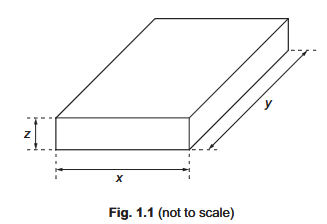
A student measures the mass \(m\) of the block and the side lengths \(x\), \(y\) and \(z\). The measurements are shown in Table 1.1.
Table 1.1
| quantity | measurement |
|---|---|
| \(m\) | \((0.243 \pm 0.001)\,\mathrm{kg}\) |
| \(x\) | \((5.41 \pm 0.01)\,\mathrm{cm}\) |
| \(y\) | \((11.09 \pm 0.01)\,\mathrm{cm}\) |
| \(z\) | \((1.62 \pm 0.01)\,\mathrm{cm}\) |
(i) Determine the density of the glass. (2 marks)
density = __________________________________________ \( \mathrm{kg\,m^{-3}} \)
(ii) Calculate the percentage uncertainty in the density. (3 marks)
percentage uncertainty = ______________ \(\%\)
(c) The true value of the density of the glass is different from the answer in (b)(i) because of a systematic error in the measurements.
Suggest one possible cause of this systematic error. (1 mark)
_________________________
Syllabus Topic Codes (Cambridge International AS & A Level Physics 9702):
• 1.3: Errors and uncertainties — part (b)(ii) and part (c)
▶️ Answer/Explanation
(a)
Density is the mass per unit volume.
Answer: \( \boxed{\text{mass per unit volume}} \)
(b)(i) Density of the glass [2 marks]
For a cuboid, the volume is
\( V=xyz \)
Convert the dimensions from centimetres to metres:
\(x=5.41\,\mathrm{cm}=0.0541\,\mathrm{m}\)
\(y=11.09\,\mathrm{cm}=0.1109\,\mathrm{m}\)
\(z=1.62\,\mathrm{cm}=0.0162\,\mathrm{m}\)
Therefore,
\( V=(0.0541)(0.1109)(0.0162) \)
\( V=9.72\times10^{-5}\,\mathrm{m^3} \)
Density is given by
\( \rho=\frac{m}{V} \)
\( \rho=\frac{0.243}{(0.0541)(0.1109)(0.0162)} \)
\( \rho\approx2500\,\mathrm{kg\,m^{-3}} \)
Answer: \( \boxed{2500\,\mathrm{kg\,m^{-3}}} \)
(b)(ii)
For \( \rho=\frac{m}{xyz} \), the fractional uncertainties are added:
\( \frac{\Delta\rho}{\rho}=\frac{\Delta m}{m}+\frac{\Delta x}{x}+\frac{\Delta y}{y}+\frac{\Delta z}{z} \)
Substituting the values:
\( \frac{\Delta\rho}{\rho}=\frac{0.001}{0.243}+\frac{0.01}{5.41}+\frac{0.01}{11.09}+\frac{0.01}{1.62} \)
\( \frac{\Delta\rho}{\rho}\approx0.013 \)
Therefore, percentage uncertainty is
\( \text{percentage uncertainty}=0.013\times100 \)
\( \text{percentage uncertainty}=1.3\% \)
Answer: \( \boxed{1.3\%} \)
(c)
A systematic error could be caused by a zero error in the measuring instrument, such as the calipers or balance.
Another acceptable answer is incorrect calibration of the calipers or balance.
Answer: \( \boxed{\text{zero error in the calipers or balance}} \)
Question 2
(a) Define linear momentum. (1 mark)
_____________________
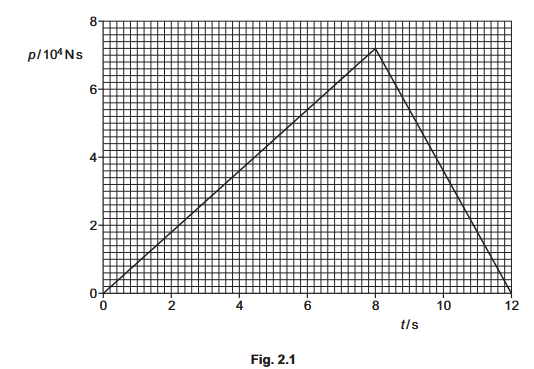
(b) A car of mass \(1800\,\mathrm{kg}\) is moving in a straight line. Fig. 2.1 shows the variation with time \(t\) of the momentum \(p\) of the car.
(i) Calculate the maximum speed reached by the car. (1 mark)
maximum speed = _______________ \( \mathrm{m\,s^{-1}} \)
(ii) Calculate the maximum kinetic energy of the car. (2 marks)
maximum kinetic energy = _____________\( \mathrm{J} \)
(iii) Show that the acceleration of the car at time \(t=4.0\,\mathrm{s}\) is \(5.0\,\mathrm{m\,s^{-2}}\). (2 marks)
________________________
(iv) Determine the distance travelled by the car between times \(t=0\) and \(t=12.0\,\mathrm{s}\). (2 marks)
distance = __________________________________________ \( \mathrm{m} \)
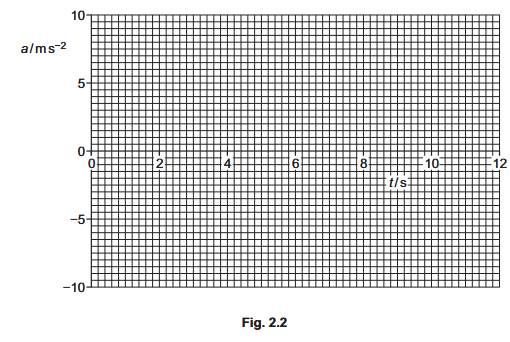
(c) On Fig. 2.2, sketch the variation with time \(t\) of the acceleration of the car in (b) from \(t=0\) to \(t=12.0\,\mathrm{s}\). (3 marks)
Syllabus Topic Codes (Cambridge International AS & A Level Physics 9702):
• 2.1: Equations of motion — parts (b)(iii), (b)(iv) and (c)
▶️ Answer/Explanation
(a)
Linear momentum is the product of mass and velocity.
Answer: \( \boxed{\text{product of mass and velocity}} \)
(b)(i)
The maximum momentum is \(7.2\times10^4\,\mathrm{N\,s}\).
Using \(p=mv\),
\( v=\frac{p}{m} \)
\( v=\frac{7.2\times10^4}{1800} \)
\( v=40\,\mathrm{m\,s^{-1}} \)
Answer: \( \boxed{40\,\mathrm{m\,s^{-1}}} \)
(b)(ii)
The maximum kinetic energy occurs when the speed is maximum.
\( E_{\mathrm{K}}=\frac{1}{2}mv^2 \)
\( E_{\mathrm{K}}=\frac{1}{2}(1800)(40)^2 \)
\( E_{\mathrm{K}}=1.44\times10^6\,\mathrm{J} \)
Answer: \( \boxed{1.4\times10^6\,\mathrm{J}} \)
(b)(iii)
The force is the rate of change of momentum:
\( F=\frac{\Delta p}{\Delta t} \)
From \(t=0\) to \(t=4.0\,\mathrm{s}\), the momentum changes from \(0\) to \(3.6\times10^4\,\mathrm{N\,s}\).
\( F=\frac{3.6\times10^4}{4.0}=9.0\times10^3\,\mathrm{N} \)
Using \(F=ma\),
\( a=\frac{F}{m} \)
\( a=\frac{9.0\times10^3}{1800} \)
\( a=5.0\,\mathrm{m\,s^{-2}} \)
Answer: \( \boxed{5.0\,\mathrm{m\,s^{-2}}} \)
(b)(iv)
The distance travelled is the area under the velocity-time graph. Since \(v=\frac{p}{m}\), the distance can be found from the area under the momentum-time graph divided by the mass.
The graph consists of two triangles:
\( \text{distance}=\frac{1}{2}(40)(8+4) \)
\( \text{distance}=240\,\mathrm{m} \)
Answer: \( \boxed{240\,\mathrm{m}} \)
(c)
Acceleration is proportional to the gradient of the momentum-time graph because
\( a=\frac{1}{m}\frac{\Delta p}{\Delta t} \)
From \(t=0\) to \(t=8.0\,\mathrm{s}\), the momentum-time graph has a constant positive gradient, giving
\( a=+5.0\,\mathrm{m\,s^{-2}} \)
From \(t=8.0\,\mathrm{s}\) to \(t=12.0\,\mathrm{s}\), the momentum-time graph has a constant negative gradient, giving
\( a=-10\,\mathrm{m\,s^{-2}} \)
Therefore, the acceleration-time graph is a stepped graph: a horizontal line at \(+5.0\,\mathrm{m\,s^{-2}}\) from \(0\) to \(8.0\,\mathrm{s}\), followed by a horizontal line at \(-10\,\mathrm{m\,s^{-2}}\) from \(8.0\) to \(12.0\,\mathrm{s}\).
Answer: \( \boxed{a=+5.0\,\mathrm{m\,s^{-2}}\text{ for }0\leq t<8.0\,\mathrm{s},\quad a=-10\,\mathrm{m\,s^{-2}}\text{ for }8.0<t\leq12.0\,\mathrm{s}} \)
Question 3
(a) State what is meant by the work done by a force. (1 mark)
________________________
(b) A block of mass \(m\) is raised vertically at constant speed. The vertical height gained by the block is \(\Delta h\), as shown in Fig. 3.1.
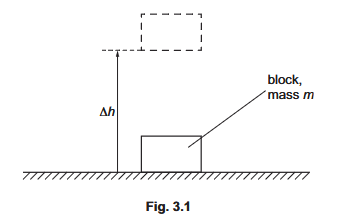
Derive an expression, in terms of \(m\) and \(\Delta h\), for the change in gravitational potential energy \(\Delta E_{\mathrm{P}}\) of the block. State the meaning of any other symbols you use. (2 marks)
________________________
(c) An electric motor has an input power of \(900\,\mathrm{W}\). The motor takes \(1.0\,\mathrm{minute}\) to lift a load of weight \(240\,\mathrm{N}\) at constant speed through a vertical height of \(150\,\mathrm{m}\). Resistive forces are negligible.
(i) Show that the work done by the motor on the load in \(1.0\,\mathrm{minute}\) is \(36\,\mathrm{kJ}\). (1 mark)
________________________
(ii) Determine the useful output power of the motor. (2 marks)
power = __________________________ \( \mathrm{W} \)
(iii) Use your answer in (c)(ii) to determine the efficiency of the motor. (2 marks)
efficiency = __________________________
(iv) Some of the power wasted in the motor is dissipated by the resistance of its coil. This dissipated power is \(280\,\mathrm{W}\).
The coil of the motor is made from wire of total length \(23\,\mathrm{m}\). The wire has a cross-sectional area of \(2.6\times10^{-8}\,\mathrm{m^2}\) and is made from metal of resistivity \(1.7\times10^{-8}\,\Omega\mathrm{m}\).
Calculate the current in the coil. (3 marks)
current = __________________________ \( \mathrm{A} \)
Syllabus Topic Codes (Cambridge International AS & A Level Physics 9702):
• 5.2: Gravitational potential energy and kinetic energy — part (b)
• 9.2: Potential difference and power — parts (c)(ii), (c)(iii) and (c)(iv)
• 9.3: Resistance and resistivity — part (c)(iv)
▶️ Answer/Explanation
(a)
The work done by a force is the product of the force and the displacement in the direction of the force.
Answer: \( \boxed{\text{force}\times\text{displacement in the direction of the force}} \)
(b)
The block is raised at constant speed, so the upward force is equal to the weight of the block.
\( F=mg \)
The work done in raising the block is
\( W=F\Delta h \)
Therefore,
\( \Delta E_{\mathrm{P}}=mg\Delta h \)
where \(g\) is the acceleration of free fall.
Answer: \( \boxed{\Delta E_{\mathrm{P}}=mg\Delta h} \)
(c)(i)
The work done in lifting the load is
\( W=F s \)
\( W=(240)(150) \)
\( W=36000\,\mathrm{J} \)
\( W=36\,\mathrm{kJ} \)
Answer: \( \boxed{36\,\mathrm{kJ}} \)
(c)(ii)
Useful output power is the useful work done per unit time.
\( P=\frac{W}{t} \)
The time is \(1.0\,\mathrm{minute}=60\,\mathrm{s}\).
\( P=\frac{36000}{60} \)
\( P=600\,\mathrm{W} \)
Answer: \( \boxed{600\,\mathrm{W}} \)
(c)(iii)
Efficiency is given by
\( \text{efficiency}=\frac{\text{useful output power}}{\text{total input power}} \)
\( \text{efficiency}=\frac{600}{900} \)
\( \text{efficiency}=0.67 \)
Answer: \( \boxed{0.67} \)
(c)(iv)
The power dissipated in the coil is
\( P=I^2R \)
The resistance of the wire is
\( R=\frac{\rho L}{A} \)
Therefore,
\( 280=I^2\left(\frac{(1.7\times10^{-8})(23)}{2.6\times10^{-8}}\right) \)
Solving for \(I\),
\( I=4.3\,\mathrm{A} \)
Answer: \( \boxed{4.3\,\mathrm{A}} \)
Question 4
(a) Define the Young modulus of a material. (1 mark)
________________________
(b) A metal wire P that obeys Hooke’s law is stretched within its limit of proportionality.
(i) On Fig. 4.1, sketch the variation of tensile force \(F\) in the wire with its extension \(x\). (1 mark)
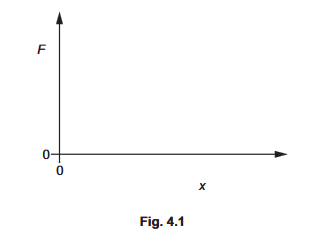
(ii) State the name of the quantity represented by the gradient of the line in Fig. 4.1. (1 mark)
________________________
(iii) State the name of the quantity represented by the area under the line in Fig. 4.1. (1 mark)
________________________
(c) Another wire Q is made from a metal that has twice the Young modulus of the metal of wire P in (b). Wire Q has the same volume as wire P but has double the cross-sectional area of wire P.
The two wires are extended by equal tensile forces within their limits of proportionality.
State and explain how the extension of wire Q compares with the extension of wire P. (3 marks)
________________________
________________________
________________________
Syllabus Topic Codes (Cambridge International AS & A Level Physics 9702):
• 6.2: Elastic and plastic behaviour — parts (b)(i) and (c)
▶️ Answer/Explanation
(a)
The Young modulus is the stress per unit strain.
Answer: \( \boxed{\text{stress per unit strain}} \)
(b)(i)
Since the wire obeys Hooke’s law, the tensile force is directly proportional to the extension.
Therefore, the graph is a straight line with a positive gradient passing through the origin.
Answer: \( \boxed{\text{straight line with positive gradient through the origin}} \)
(b)(ii)
The gradient of a force-extension graph is the spring constant \(k\), since
\( F=kx \)
Answer: \( \boxed{\text{spring constant}} \)
(b)(iii)
The area under a force-extension graph represents the work done in stretching the wire. This energy is stored as elastic potential energy.
Answer: \( \boxed{\text{elastic potential energy}} \)
(c)
For a wire,
\( E=\frac{FL}{Ax} \)
Rearranging gives
\( x=\frac{FL}{AE} \)
The two wires have the same volume, so
\( A_{\mathrm{P}}L_{\mathrm{P}}=A_{\mathrm{Q}}L_{\mathrm{Q}} \)
Since \(A_{\mathrm{Q}}=2A_{\mathrm{P}}\),
\( L_{\mathrm{Q}}=\frac{1}{2}L_{\mathrm{P}} \)
Also, \(E_{\mathrm{Q}}=2E_{\mathrm{P}}\) and the tensile forces are equal.
Therefore,
\( \frac{x_{\mathrm{Q}}}{x_{\mathrm{P}}}=\frac{L_{\mathrm{Q}}}{L_{\mathrm{P}}}\frac{A_{\mathrm{P}}}{A_{\mathrm{Q}}}\frac{E_{\mathrm{P}}}{E_{\mathrm{Q}}} \)
\( \frac{x_{\mathrm{Q}}}{x_{\mathrm{P}}}=\frac{1}{2}\times\frac{1}{2}\times\frac{1}{2}=\frac{1}{8} \)
Hence, the extension of wire Q is one-eighth of the extension of wire P.
Answer: \( \boxed{x_{\mathrm{Q}}=\frac{1}{8}x_{\mathrm{P}}} \)
Question 5
(a) Potassium-40 \(\left(^{40}_{19}\mathrm{K}\right)\) undergoes \(\beta^-\) decay to form a nuclide of element X. Particle Z is emitted during the decay. The equation for the decay is shown below.
\(^{40}_{19}\mathrm{K}\rightarrow{}^{P}_{Q}\mathrm{X}+{}^{R}_{S}\beta+Z\)
(i) State the values of \(P\), \(Q\), \(R\) and \(S\). [2 marks]
\(P=\) ____________________________ \(R=\) ____________________________
\(Q=\) ____________________________ \(S=\) ____________________________
(ii) State the name of particle Z. [1 mark]
____________________________________________________________
(iii) State the name of the class of fundamental particle to which both the \(\beta^-\) particle and particle Z belong. [1 mark]
____________________________________________________________
(b) Determine the quark composition of an alpha-particle. [3 marks]
quark composition = __________________________________________
Syllabus Topic Codes (Cambridge International AS & A Level Physics 9702):
• 11.2: Fundamental particles — parts (a)(ii), (a)(iii) and (b)
▶️ Answer/Explanation
(a)(i) [2 marks]
In \(\beta^-\) decay, a neutron changes into a proton, so the nucleon number remains unchanged while the proton number increases by \(1\).
Therefore, the decay equation is
\(^{40}_{19}\mathrm{K}\rightarrow{}^{40}_{20}\mathrm{X}+{}^{0}_{-1}\beta+\bar{\nu}_{e}\)
Hence,
\(P=40\) and \(Q=20\)
\(R=0\) and \(S=-1\)
Answer: \( \boxed{P=40,\ Q=20,\ R=0,\ S=-1} \)
(a)(ii) [1 mark]
Particle Z is emitted to conserve lepton number during \(\beta^-\) decay.
Answer: \( \boxed{\text{electron antineutrino}} \)
(a)(iii) [1 mark]
Both the \(\beta^-\) particle, which is an electron, and the electron antineutrino belong to the class of fundamental particles called leptons.
Answer: \( \boxed{\text{leptons}} \)
(b) [3 marks]
An alpha-particle consists of two protons and two neutrons.
A proton has quark composition \(uud\).
A neutron has quark composition \(udd\).
Therefore, for two protons and two neutrons:
\(2(uud)+2(udd)\)
\(=6u+6d\)
Answer: \( \boxed{6\text{ up quarks and }6\text{ down quarks}} \)
Question 6
Two coherent sources \(X\) and \(Y\) of microwaves of frequency \(2.5\times10^{10}\,\mathrm{Hz}\) are a distance \(0.18\,\mathrm{m}\) apart in a vacuum, as shown in Fig. 6.1.
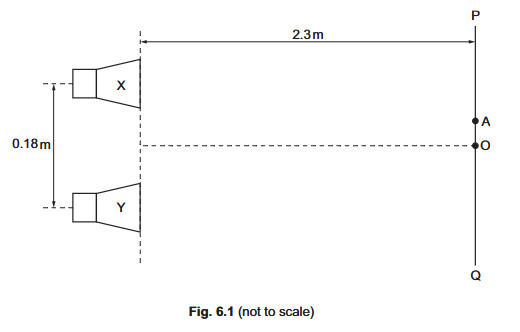
There is a phase difference of \(90^\circ\) between the waves emitted by the two sources.
A microwave detector moves along the line \(PQ\), which is parallel to the line joining the two sources and \(2.3\,\mathrm{m}\) away from it.
Point \(O\) is the position on the line \(PQ\) that is equidistant from the two sources.
Point \(A\) is the position on line \(PQ\) where the intensity of the microwaves is the greatest.
(a)
(i) Explain why the position of greatest intensity is not at point \(O\). [2 marks]
______________________________________________________________________
______________________________________________________________________
______________________________________________________________________
(ii) On Fig. 6.1, draw a cross \((\times)\) to show the position of the point on line \(PQ\) where the intensity is minimum that is closest to point \(O\). Label this point \(B\). [2 marks]
(b)
(i) Show that the wavelength of the microwaves is \(0.012\,\mathrm{m}\). [2 marks]
______________________________________________________________________
(ii) For point \(A\) on line \(PQ\), determine the difference in the distances \(\Delta x\) travelled by the microwaves from \(X\) and the microwaves from \(Y\). [1 mark]
\(\Delta x=\) __________________________ \(\mathrm{m}\)
(iii) Use the formula for the double-slit interference of light to calculate the distance between adjacent intensity maxima on line \(PQ\). [2 marks]
distance = __________________________ \(\mathrm{m}\)
Syllabus Topic Codes (Cambridge International AS & A Level Physics 9702):
• 7.1: Progressive waves — part (b)(i), wavelength and wave speed relationship
▶️ Answer/Explanation
(a)(i) [2 marks]
For maximum intensity, the two waves must arrive at the detector in phase.
At point \(O\), the two sources are equidistant from the detector, so there is no path difference. However, the waves are emitted with a phase difference of \(90^\circ\), so they are still \(90^\circ\) out of phase at \(O\).
Therefore, the waves are not in phase at \(O\), so the intensity is not maximum there.
Answer: \( \boxed{\text{The waves must be in phase for maximum intensity, but at }O\text{ they have a }90^\circ\text{ phase difference.}} \)
(a)(ii) [2 marks]
At \(O\), the waves have a phase difference of \(90^\circ\).
The nearest minimum occurs when the total phase difference is \(180^\circ\). Therefore, an additional phase difference of \(90^\circ\) is required.
A \(90^\circ\) phase difference corresponds to a path difference of \(\lambda/4\).
Hence point \(B\) is positioned on \(PQ\), below \(O\), at a position such that \(OB=OA\).
Answer: \( \boxed{B\text{ is labelled below }O,\text{ with }OB=OA} \)
(b)(i) [2 marks]
The wave equation is
\(v=f\lambda\)
In a vacuum, \(v=3.00\times10^8\,\mathrm{m\,s^{-1}}\).
Therefore,
\(\lambda=\frac{v}{f}\)
\(\lambda=\frac{3.00\times10^8}{2.5\times10^{10}}\)
\(\lambda=0.012\,\mathrm{m}\)
Answer: \( \boxed{0.012\,\mathrm{m}} \)
(b)(ii) [1 mark]
At point \(A\), the waves are in phase. Since they start with a phase difference of \(90^\circ\), the path difference must correspond to a quarter of a wavelength.
\(\Delta x=\frac{\lambda}{4}\)
\(\Delta x=\frac{0.012}{4}\)
\(\Delta x=0.0030\,\mathrm{m}\)
Answer: \( \boxed{0.0030\,\mathrm{m}} \)
(b)(iii) [2 marks]
For double-slit interference, the fringe spacing is given by
\(\lambda=\frac{ax}{D}\)
Hence,
\(x=\frac{\lambda D}{a}\)
Here, \(\lambda=0.012\,\mathrm{m}\), \(D=2.3\,\mathrm{m}\), and \(a=0.18\,\mathrm{m}\).
\(x=\frac{0.012\times2.3}{0.18}\)
\(x=0.153\ldots\,\mathrm{m}\approx0.15\,\mathrm{m}\)
Answer: \( \boxed{0.15\,\mathrm{m}} \)
Question 7
(a) Fig. 7.1 shows two resistors connected in series with a cell of electromotive force (e.m.f.) \(1.50\,\mathrm{V}\) and internal resistance \(0.28\,\Omega\).
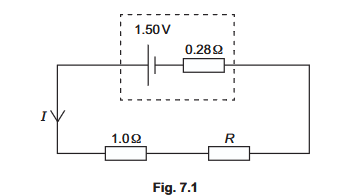
One of the resistors has resistance \(1.0\,\Omega\). The other resistor has resistance \(R\).
The terminal potential difference (p.d.) across the cell is \(1.36\,\mathrm{V}\).
(i) Show that the current \(I\) in the circuit is \(0.50\,\mathrm{A}\). [2 marks]
______________________________________________________________________
(ii) Calculate the combined resistance of the two resistors. [2 marks]
resistance = ______________________________ \(\Omega\)
(iii) Use your answer in (a)(ii) to determine resistance \(R\). [1 mark]
\(R=\) ______________________________ \(\Omega\)
(b) The circuit in Fig. 7.1 is disconnected and the two resistors are reconnected to the cell, now in parallel with each other.
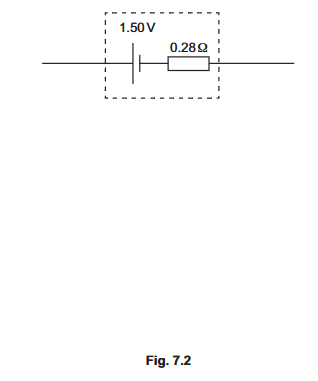
(i) On Fig. 7.2, complete the circuit diagram to show this arrangement. [1 mark]
[Draw the two resistors in parallel across the cell, with no other components.]
(ii) Explain, without calculation, whether the terminal p.d. across the cell is now less than, equal to or greater than \(1.36\,\mathrm{V}\). [2 marks]
_________________________________________
Syllabus Topic Codes (Cambridge International AS & A Level Physics 9702):
• 9.3: Resistance and resistivity — parts (a)(ii), (a)(iii) and (b)(i)
▶️ Answer/Explanation
(a)(i) [2 marks]
The loss of potential difference across the internal resistance is
\(V=\mathcal{E}-V_{\mathrm{terminal}}\)
\(V=1.50-1.36\)
\(V=0.14\,\mathrm{V}\)
Using \(V=Ir\),
\(I=\frac{V}{r}\)
\(I=\frac{0.14}{0.28}\)
\(I=0.50\,\mathrm{A}\)
Answer: \( \boxed{0.50\,\mathrm{A}} \)
(a)(ii) [2 marks]
The terminal p.d. is across the two external resistors, so
\(V=IR\)
Therefore,
\(R_{\mathrm{combined}}=\frac{V}{I}\)
\(R_{\mathrm{combined}}=\frac{1.36}{0.50}\)
\(R_{\mathrm{combined}}=2.7\,\Omega\)
Answer: \( \boxed{2.7\,\Omega} \)
(a)(iii) [1 mark]
The two resistors are connected in series, so their resistances add:
\(1.0+R=2.7\)
\(R=2.7-1.0\)
\(R=1.7\,\Omega\)
Answer: \( \boxed{1.7\,\Omega} \)
(b)(i) [1 mark]
The two resistors should be connected in parallel across the cell.
Answer: \( \boxed{\text{Two resistors correctly shown in parallel with the cell}} \)
(b)(ii) [2 marks]
When the resistors are connected in parallel, the external resistance is smaller than when they were connected in series.
Therefore, the total resistance of the circuit decreases and the current supplied by the cell increases.
The greater current produces a greater potential difference across the internal resistance of the cell. Since \(V_{\mathrm{terminal}}=\mathcal{E}-Ir\), the terminal p.d. decreases.
Answer: \( \boxed{\text{The terminal p.d. is less than }1.36\,\mathrm{V}} \)