
Question 1
(a) State what is meant by a vector quantity. [1 mark]
______________________________________
(b) A sphere falls vertically through a liquid that has density \(830\,\mathrm{kg\,m^{-3}}\). The sphere has radius \(r\) and constant velocity \(v\), as shown in Fig. 1.1.
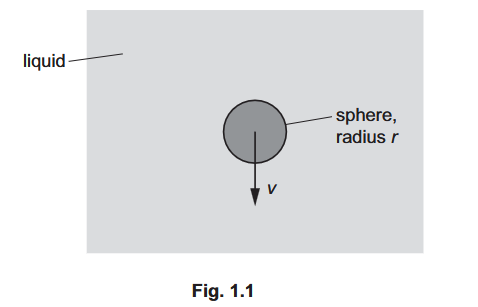
(i) The drag force \(D\) acting on the sphere is given by
\(D=6\pi\eta rv\)
where \(\eta\) is a property of the liquid.
Determine the SI base units of \(\eta\). [3 marks]
SI base units = __________________________________________
(ii) State an equation showing the relationship between the magnitudes of the weight, \(W\), drag force \(D\) and upthrust \(U\) acting on the sphere. [1 mark]
______________________________________________________________________
(iii) The volume of the sphere is \(4.6\,\mathrm{cm^3}\). The drag force \(D\) is \(0.32\,\mathrm{N}\).
Calculate the weight of the sphere. [2 marks]
weight = ______________________________ \(\mathrm{N}\)
Syllabus Topic Codes (Cambridge International AS & A Level Physics 9702):
• 1.2: SI units — part (b)(i)
• 3.2: Non-uniform motion — part (b)(ii), constant velocity and resultant force
• 4.3: Density and pressure — part (b)(iii), density and upthrust
▶️ Answer/Explanation
(a) [1 mark]
A vector quantity is a quantity that has both magnitude and direction.
Answer: \( \boxed{\text{a quantity with magnitude and direction}} \)
(b)(i) [3 marks]
The drag force is
\(D=6\pi\eta rv\)
Therefore,
\(\eta=\frac{D}{6\pi rv}\)
The SI base units of force are
\(\mathrm{kg\,m\,s^{-2}}\)
The SI base units of \(r\) are \(\mathrm{m}\), and those of \(v\) are \(\mathrm{m\,s^{-1}}\).
Hence,
\(\eta=\frac{\mathrm{kg\,m\,s^{-2}}}{\mathrm{m}\times\mathrm{m\,s^{-1}}}\)
\(\eta=\mathrm{kg\,m^{-1}\,s^{-1}}\)
Answer: \( \boxed{\mathrm{kg\,m^{-1}\,s^{-1}}} \)
(b)(ii) [1 mark]
The sphere is moving with constant velocity, so its acceleration is zero and the resultant force is zero.
The upward forces are the upthrust \(U\) and the drag force \(D\), while the weight \(W\) acts downward.
Therefore,
\(W=U+D\)
Answer: \( \boxed{W=U+D} \)
(b)(iii) [2 marks]
The upthrust is given by
\(U=\rho Vg\)
Convert the volume into \(\mathrm{m^3}\):
\(V=4.6\,\mathrm{cm^3}=4.6\times10^{-6}\,\mathrm{m^3}\)
Therefore,
\(U=830\times9.81\times4.6\times10^{-6}\)
\(U\approx0.037\,\mathrm{N}\)
From part (b)(ii),
\(W=U+D\)
\(W=0.037+0.32\)
\(W\approx0.36\,\mathrm{N}\)
Answer: \( \boxed{0.36\,\mathrm{N}} \)
Question 2
(a) Define momentum. [1 mark]
______________________
(b) A child stands on a scooter on horizontal ground. The combined mass of the child and the scooter is \(16\,\mathrm{kg}\).
The child starts from rest and pushes once on the ground with her foot which causes her to accelerate. The push lasts for a time of \(1.1\,\mathrm{s}\). The speed of the child and the scooter after the push is \(0.60\,\mathrm{m\,s^{-1}}\).
Determine the average resultant force acting horizontally on the child and the scooter during the push.
average force = ______________________________ \(\mathrm{N}\) [2 marks]
(c) Later, the child in (b) travels down a slope at a constant angle to the horizontal, as shown in Fig. 2.1.
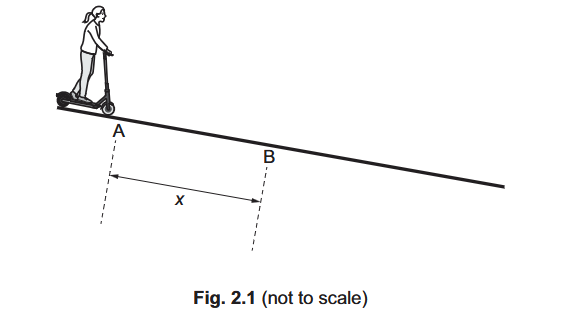
At point A her speed is \(0.60\,\mathrm{m\,s^{-1}}\). She has a constant acceleration of \(0.85\,\mathrm{m\,s^{-2}}\) parallel to the slope. After a time of \(3.7\,\mathrm{s}\), she reaches point B.
Calculate the distance \(x\) travelled by the child along the slope from A to B.
\(x=\) ______________________________ \(\mathrm{m}\) [2 marks]
(d) At point B, the child in (c) applies the brake with a constant force to maintain a constant velocity. Point C is \(18\,\mathrm{m}\) from point B, as shown in Fig. 2.2.
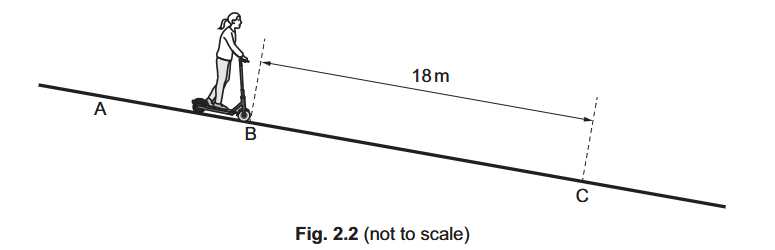
The work done by the braking force between B and C is \(250\,\mathrm{J}\).
(i) Determine the magnitude of the braking force. [2 marks]
force = ______________________________ \(\mathrm{N}\)
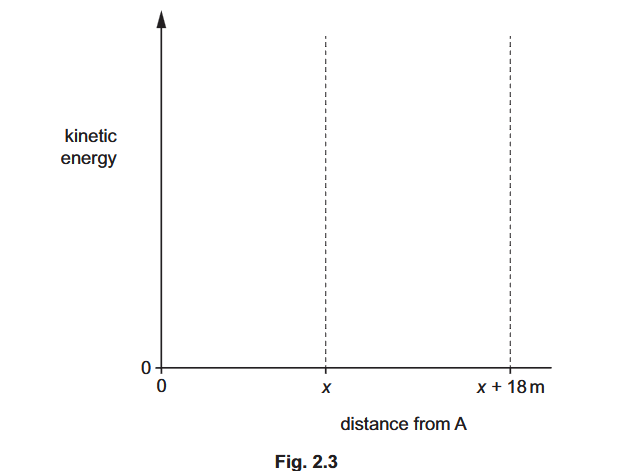
(ii) On Fig. 2.3, sketch the variation of the kinetic energy of the child and scooter with distance travelled from point A to point C. Numerical values for kinetic energy are not required. [3 marks]
Syllabus Topic Codes (Cambridge International AS & A Level Physics 9702):
• 3.3: Linear momentum and its conservation — part (b), change in momentum and average force
• 2.1: Equations of motion — part (c)
• 5.1: Energy conservation — part (d)(ii)
• 5.2: Gravitational potential energy and kinetic energy — parts (d)(i) and (d)(ii)
▶️ Answer/Explanation
(a) [1 mark]
Momentum is the product of mass and velocity.
\(p=mv\)
Answer: \( \boxed{\text{product of mass and velocity}} \)
(b) [2 marks]
The average resultant force is related to the change in momentum by
\(F=\frac{\Delta p}{\Delta t}=\frac{m\Delta v}{\Delta t}\)
The child and scooter start from rest, so \(\Delta v=0.60\,\mathrm{m\,s^{-1}}\).
\(F=\frac{16\times0.60}{1.1}\)
\(F=8.7\,\mathrm{N}\)
Answer: \( \boxed{8.7\,\mathrm{N}} \)
(c) [2 marks]
Use the equation
\(x=ut+\frac{1}{2}at^2\)
Here, \(u=0.60\,\mathrm{m\,s^{-1}}\), \(a=0.85\,\mathrm{m\,s^{-2}}\) and \(t=3.7\,\mathrm{s}\).
\(x=(0.60)(3.7)+\frac{1}{2}(0.85)(3.7)^2\)
\(x=2.22+5.82\)
\(x=8.0\,\mathrm{m}\)
Answer: \( \boxed{8.0\,\mathrm{m}} \)
(d)(i) [2 marks]
Work done by a constant force is
\(W=Fs\)
Therefore,
\(F=\frac{W}{s}\)
\(F=\frac{250}{18}\)
\(F=14\,\mathrm{N}\)
Answer: \( \boxed{14\,\mathrm{N}} \)
(d)(ii) [3 marks]
From A to B, the child accelerates, so her speed increases. Since \(E_{\mathrm{k}}=\frac{1}{2}mv^2\), the kinetic energy increases.
Because the acceleration is constant, the kinetic energy increases with a positive gradient that becomes steeper as the distance increases. Thus the graph from \(0\) to \(x\) is a curved line with increasing gradient.
From B to C, the child moves at constant velocity. Therefore, the kinetic energy remains constant, so the graph is horizontal from \(x\) to \(x+18\,\mathrm{m}\).
The graph therefore starts at distance \(0\) with zero kinetic energy, rises as a curve to \(x\), and then continues horizontally from \(x\) to \(x+18\,\mathrm{m}\).
Answer: \( \boxed{\text{Increasing curved line from }0\text{ to }x,\text{ followed by a horizontal line from }x\text{ to }x+18\,\mathrm{m}} \)
Question 3
(a) The variation of stress with strain for a metal P is shown in Fig. 3.1.
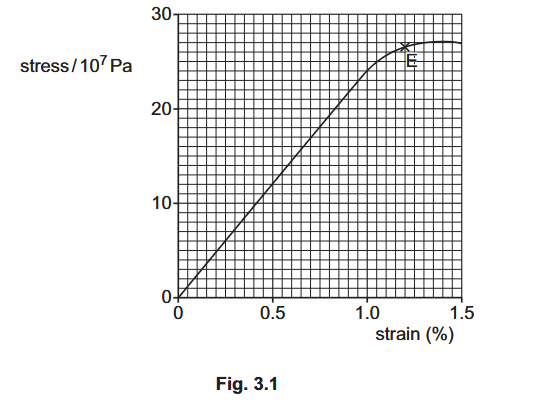
Point E is the elastic limit of the metal.
(i) Use Fig. 3.1 to determine the Young modulus for P. [2 marks]
Young modulus = ______________________________ \(\mathrm{Pa}\)
(ii) On the line in Fig. 3.1, draw a cross \((\times)\) to show the limit of proportionality. Label this point Q. [1 mark]
[Mark point Q on the stress-strain graph at the end of the straight-line region.]
(b) State the conditions necessary for an object to be in equilibrium. [2 marks]
______________________________________________________________________
______________________________________________________________________
(c) A wire is used to hold a uniform shelf AB horizontally in equilibrium as shown in Fig. 3.2.
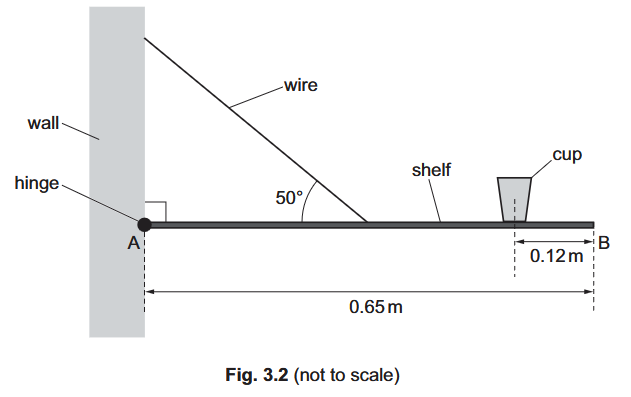
The wire is connected to the midpoint of shelf AB at an angle of \(50^\circ\) to the horizontal. The wire is attached to a wall by a hinge at A. The length of shelf AB is \(0.65\,\mathrm{m}\) and its weight is \(33\,\mathrm{N}\).
A cup of weight \(1.5\,\mathrm{N}\) rests on the shelf with its centre of gravity at a horizontal distance \(0.12\,\mathrm{m}\) from B.
(i) By taking moments about A, determine the tension in the wire. [3 marks]
tension = ______________________________ \(\mathrm{N}\)
(ii) The stress in the wire is \(1.5\times10^7\,\mathrm{Pa}\).
Determine the radius of the wire. [2 marks]
radius = ______________________________ \(\mathrm{m}\)
(iii) More items are added to the shelf, doubling the stress in the wire. The wire is made of the metal P from (a).
Use Fig. 3.1 to state and explain whether the wire will behave plastically or elastically as the stress doubles. [2 marks]
_____________________________________________
Syllabus Topic Codes (Cambridge International AS & A Level Physics 9702):
• 6.2: Elastic and plastic behaviour — part (c)(iii)
• 4.1: Turning effects of forces — part (c)(i), moments about A
• 4.2: Equilibrium of forces — part (b) and part (c)
▶️ Answer/Explanation
(a)(i) [2 marks]
Young modulus is the ratio of stress to strain:
\(E=\frac{\sigma}{\varepsilon}\)
Young modulus is also equal to the gradient of the straight-line section of the stress-strain graph.
From Fig. 3.1, a suitable point on the straight section is approximately \(\sigma=12\times10^7\,\mathrm{Pa}\) at \(\varepsilon=0.0050\).
\(E=\frac{12\times10^7}{0.0050}\)
\(E=2.4\times10^{10}\,\mathrm{Pa}\)
Answer: \( \boxed{2.4\times10^{10}\,\mathrm{Pa}} \)
(a)(ii) [1 mark]
The limit of proportionality is the point where the stress-strain graph first stops being a straight line.
Point Q should therefore be placed at approximately \(\varepsilon=1.0\%\) and \(\sigma=24\times10^7\,\mathrm{Pa}\).
Answer: \( \boxed{Q\text{ at the end of the straight-line section}} \)
(b) [2 marks]
For an object to be in equilibrium:
1. The resultant force must be zero.
2. The resultant moment or torque about any point must be zero.
Answer: \( \boxed{\text{resultant force}=0\text{ and resultant moment}=0} \)
(c)(i) [3 marks]
Take moments about the hinge at A. For equilibrium, the sum of clockwise moments equals the sum of anticlockwise moments.
The weight of the shelf acts at its midpoint:
\(\text{clockwise moment due to shelf}=33\times\frac{0.65}{2}\)
The cup is \(0.12\,\mathrm{m}\) from B, so its distance from A is \(0.65-0.12=0.53\,\mathrm{m}\).
\(\text{clockwise moment due to cup}=1.5(0.65-0.12)\)
The tension acts at the midpoint of the shelf. Its perpendicular component is \(T\sin50^\circ\).
Therefore,
\(33\left(\frac{0.65}{2}\right)+1.5(0.65-0.12)=T\sin50^\circ\left(\frac{0.65}{2}\right)\)
\(T\approx46\,\mathrm{N}\)
Answer: \( \boxed{46\,\mathrm{N}} \)
(c)(ii) [2 marks]
Stress is given by
\(\sigma=\frac{F}{A}\)
For a wire of radius \(r\),
\(A=\pi r^2\)
Hence,
\(1.5\times10^7=\frac{46}{\pi r^2}\)
\(r=\sqrt{\frac{46}{\pi(1.5\times10^7)}}\)
\(r=9.9\times10^{-4}\,\mathrm{m}\)
Answer: \( \boxed{9.9\times10^{-4}\,\mathrm{m}} \)
(c)(iii) [2 marks]
The original stress is \(1.5\times10^7\,\mathrm{Pa}\). Doubling the stress gives
\(\sigma_{\mathrm{new}}=3.0\times10^7\,\mathrm{Pa}\)
From Fig. 3.1, this new stress is still below the elastic limit at point E.
Therefore, the elastic limit is not reached and the wire will behave elastically.
Answer: \( \boxed{\text{The wire behaves elastically because the new stress is below the elastic limit.}} \)
Question 4
(a) With reference to the direction of transfer of energy, compare the oscillations of transverse and longitudinal progressive waves. [2 marks]
________________________________
(b) A pipe is open at one end and closed at the other end with a piston. The piston can slide freely and is at a distance of \(4.5\times10^{-2}\,\mathrm{m}\) from the open end of the pipe.
A loudspeaker is positioned near the open end of the pipe and emits a sound wave of a single constant frequency. A stationary wave is formed in the pipe, as illustrated in Fig. 4.1.
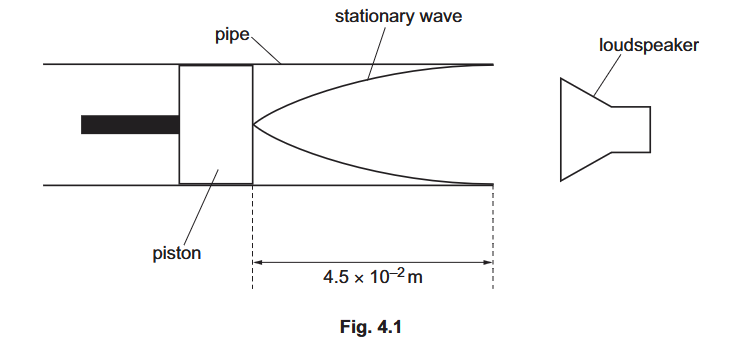
(i) On Fig. 4.1, draw a letter A at the position of an antinode. [1 mark]
(ii) The speed of sound in air is \(340\,\mathrm{m\,s^{-1}}\).
Determine the frequency of the sound wave. [3 marks]
frequency = ______________________________ \(\mathrm{Hz}\)
(iii) The piston is moved to the left. The frequency of the sound wave emitted by the loudspeaker is then changed so that a stationary wave is formed with the same number of antinodes as in Fig. 4.1.
State and explain the change that is made to the frequency of the sound wave. [2 marks]
_____________________________
Syllabus Topic Codes (Cambridge International AS & A Level Physics 9702):
• 8.1: Stationary waves — parts (b)(i), (b)(ii) and (b)(iii)
▶️ Answer/Explanation
(a) [2 marks]
In a longitudinal wave, the oscillations of the particles are parallel to the direction of transfer of energy.
In a transverse wave, the oscillations of the particles are perpendicular to the direction of transfer of energy.
Answer: \( \boxed{\text{Longitudinal: parallel; transverse: perpendicular to the direction of energy transfer.}} \)
(b)(i) [1 mark]
At the open end of a pipe, there is an antinode.
Answer: \( \boxed{\text{A is placed at the open end of the pipe.}} \)
(b)(ii) [3 marks]
The pipe is closed at one end and open at the other. From Fig. 4.1, the distance between the closed end and the open end corresponds to \(\frac{3\lambda}{4}\).
Therefore,
\(4.5\times10^{-2}=\frac{3\lambda}{4}\)
\(\lambda=\frac{4(4.5\times10^{-2})}{3}\)
\(\lambda=6.0\times10^{-2}\,\mathrm{m}\)
Using
\(v=f\lambda\)
\(f=\frac{v}{\lambda}\)
\(f=\frac{340}{6.0\times10^{-2}}\)
\(f\approx5.7\times10^3\,\mathrm{Hz}\)
Answer: \( \boxed{5.7\times10^3\,\mathrm{Hz}} \)
(b)(iii) [2 marks]
The piston is moved to the left, so the length of the pipe increases.
The same number of antinodes means that the same stationary-wave mode is required. Therefore, the node-antinode spacing must increase, so the wavelength of the wave is longer.
Since the speed of sound in air remains constant,
\(v=f\lambda\)
A longer wavelength therefore means a lower frequency.
Answer: \( \boxed{\text{The frequency is decreased because the longer pipe requires a longer wavelength for the same number of antinodes.}} \)
Question 5
(a) Define electric potential difference (p.d.). [1 mark]
____________________________
(b) A power supply, three resistors and a component X are connected in the circuit shown in Fig. 5.1.
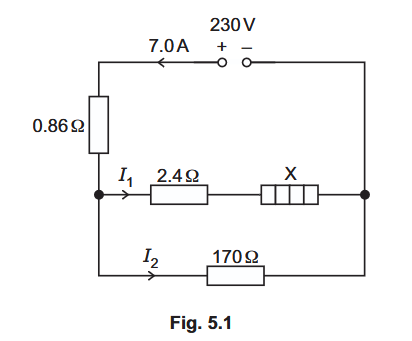
The power supply has an electromotive force (e.m.f.) of \(230\,\mathrm{V}\) and negligible internal resistance. The current in the power supply is \(7.0\,\mathrm{A}\).
(i) Identify component X. [1 mark]
___________________________
(ii) Show that the p.d. across the resistor of resistance \(0.86\,\Omega\) is \(6.0\,\mathrm{V}\). [1 mark]
_________________________
(iii) Determine the current \(I_1\). [2 marks]
\(I_1=\) ______________________________ \(\mathrm{A}\)
(iv) Calculate the p.d. across component X. [2 marks]
p.d. = ______________________________ \(\mathrm{V}\)
(v) Calculate the power dissipated in component X. [2 marks]
power = ______________________________ \(\mathrm{W}\)
(vi) The purpose of the circuit is to provide power to component X.
Determine the percentage efficiency of the circuit. [2 marks]
efficiency = ______________________________ \(\%\)
(vii) The resistor of resistance \(170\,\Omega\) is removed, leaving an open circuit in the lower branch of the circuit. There is no change to the resistance of component X.
State whether the current in the power supply increases, decreases or remains the same. [1 mark]
_______________________
Syllabus Topic Codes (Cambridge International AS & A Level Physics 9702):
• 10.1: Practical circuits — parts (b)(i), (b)(iii) and (b)(vii)
• 9.3: Resistance and resistivity — parts (b)(iii), (b)(iv) and (b)(vii)
▶️ Answer/Explanation
(a) [1 mark]
Electric potential difference is the energy transferred per unit charge.
\(V=\frac{W}{Q}\)
Answer: \( \boxed{\text{energy transferred per unit charge}} \)
(b)(i) [1 mark]
Component X is a heater.
Answer: \( \boxed{\text{heater}} \)
(b)(ii) [1 mark]
The current through the \(0.86\,\Omega\) resistor is \(7.0\,\mathrm{A}\).
Using \(V=IR\),
\(V=7.0\times0.86\)
\(V=6.0\,\mathrm{V}\)
Answer: \( \boxed{6.0\,\mathrm{V}} \)
(b)(iii) [2 marks]
The p.d. across the \(170\,\Omega\) resistor is
\(V=230-6.0=224\,\mathrm{V}\)
Hence,
\(I_2=\frac{224}{170}=1.3\,\mathrm{A}\)
At the junction,
\(7.0=I_1+I_2\)
\(I_1=7.0-1.3\)
\(I_1=5.7\,\mathrm{A}\)
Answer: \( \boxed{5.7\,\mathrm{A}} \)
(b)(iv) [2 marks]
The p.d. across the \(2.4\,\Omega\) resistor is
\(V=I_1R=(5.7)(2.4)=13.68\,\mathrm{V}\)
Applying Kirchhoff’s loop rule to the upper branch,
\(V_X=230-6.0-(5.7\times2.4)\)
\(V_X\approx210\,\mathrm{V}\)
Answer: \( \boxed{210\,\mathrm{V}} \)
(b)(v) [2 marks]
Electrical power is
\(P=IV\)
Therefore,
\(P=5.7\times210\)
\(P\approx1200\,\mathrm{W}\)
Answer: \( \boxed{1200\,\mathrm{W}} \)
(b)(vi) [2 marks]
Percentage efficiency is
\(\%\text{ efficiency}=\frac{\text{useful power output}}{\text{total power input}}\times100\)
The useful power output is the power supplied to component X:
\(P_{\mathrm{useful}}=1200\,\mathrm{W}\)
The total input power is
\(P_{\mathrm{input}}=230\times7.0=1610\,\mathrm{W}\)
\(\%\text{ efficiency}=\frac{1200}{230\times7.0}\times100\)
\(\%\text{ efficiency}\approx75\%\)
Answer: \( \boxed{75\%} \)
(b)(vii) [1 mark]
Removing the \(170\,\Omega\) resistor opens the lower branch. The total external resistance therefore increases.
With the supply voltage unchanged, the total current decreases.
Answer: \( \boxed{\text{decreases}} \)
Question 6
(a) Compare an \(\alpha\)-particle with a \(\beta^+\) particle in terms of their masses and charges. [3 marks]
______________________________
(b) Nucleus P undergoes \(\alpha\)-decay to form nucleus Q. Nucleus Q then undergoes a further decay to form nucleus R. The proton and nucleon numbers of P and R are shown in Fig. 6.1.
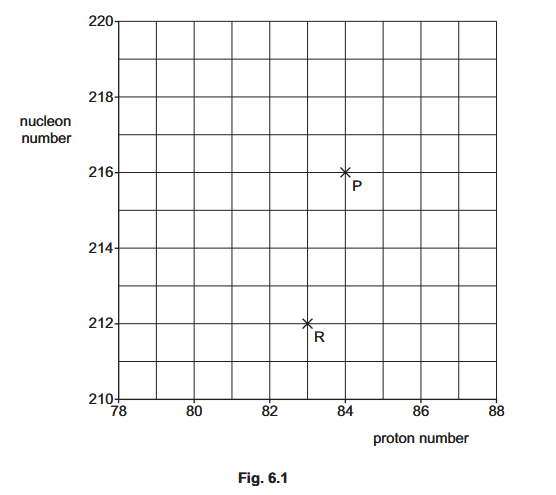
(i) On Fig. 6.1, draw a cross \((\times)\) to show the proton number and nucleon number of Q. Label your cross Q. [1 mark]
[Place Q at proton number \(82\) and nucleon number \(212\).]
(ii) State the names of the particles emitted as Q decays to form R. [2 marks]
___________________________
(c) Before the \(\alpha\)-decay, P is travelling at a constant velocity. After the decay, Q has a velocity of \(1.3\times10^5\,\mathrm{m\,s^{-1}}\) at an angle of \(68^\circ\) to the original path of P. The \(\alpha\)-particle has a velocity of \(150\times10^5\,\mathrm{m\,s^{-1}}\) at an angle of \(\theta\) to the original path of P, as shown in Fig. 6.2.
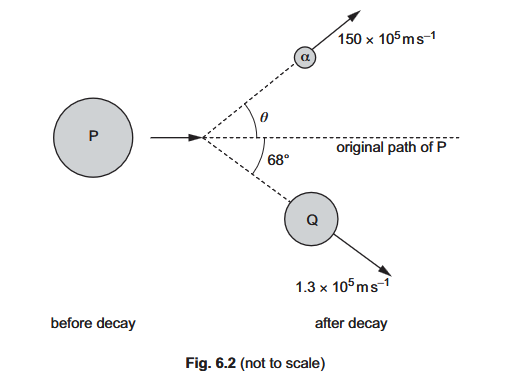
(i) Use the principle of conservation of momentum to determine \(\theta\). [3 marks]
\(\theta=\) ______________________________ \(^{\circ}\)
(ii) Calculate the kinetic energy of the \(\alpha\)-particle. [2 marks]
kinetic energy = ______________________________ \(\mathrm{J}\)
Syllabus Topic Codes (Cambridge International AS & A Level Physics 9702):
• 11.1: Atoms, nuclei and radiation — parts (b)(i) and (b)(ii)
• 3.3: Linear momentum and its conservation — part (c)(i)
• 5.2: Gravitational potential energy and kinetic energy — part (c)(ii)
▶️ Answer/Explanation
(a) [3 marks]
An \(\alpha\)-particle is a helium nucleus consisting of two protons and two neutrons, whereas a \(\beta^+\) particle is a positron.
The mass of an \(\alpha\)-particle is much greater than the mass of a \(\beta^+\) particle.
Both particles are positively charged, but the magnitude of the charge on an \(\alpha\)-particle is twice that of a \(\beta^+\) particle.
Answer: \( \boxed{\text{\(\alpha\)-particle: much greater mass and charge \(+2e\); \(\beta^+\): much smaller mass and charge \(+e\).}} \)
(b)(i) [1 mark]
In \(\alpha\)-decay, the nucleon number decreases by \(4\) and the proton number decreases by \(2\).
For P at \((84,216)\):
proton number of Q \(=84-2=82\)
nucleon number of Q \(=216-4=212\)
Answer: \( \boxed{Q=(82,212)} \)
(b)(ii) [2 marks]
Q has proton number \(82\) and R has proton number \(83\), while their nucleon numbers are both \(212\).
Therefore, the decay is \(\beta^-\) decay. A \(\beta^-\) decay emits an electron and an electron antineutrino.
Answer: \( \boxed{\text{electron and electron antineutrino}} \)
(c)(i) [3 marks]
Momentum is conserved in the direction perpendicular to the original path of P.
The initial perpendicular momentum is zero, so the perpendicular components of the two final momenta must be equal and opposite.
The mass of Q is \(212u\), and the mass of the \(\alpha\)-particle is \(4u\).
Therefore,
\(212u(1.3\times10^5)\sin68^\circ=4u(150\times10^5)\sin\theta\)
Cancelling \(u\),
\(\sin\theta=\frac{212(1.3\times10^5)\sin68^\circ}{4(150\times10^5)}\)
\(\sin\theta\approx0.426\)
\(\theta\approx25^\circ\)
Answer: \( \boxed{25^\circ} \)
(c)(ii) [2 marks]
The kinetic energy of the \(\alpha\)-particle is
\(E_{\mathrm{k}}=\frac{1}{2}mv^2\)
The mass of an \(\alpha\)-particle is approximately \(4u\), where \(u=1.66\times10^{-27}\,\mathrm{kg}\).
\(E_{\mathrm{k}}=\frac{1}{2}(4\times1.66\times10^{-27})(150\times10^5)^2\)
\(E_{\mathrm{k}}\approx7.5\times10^{-13}\,\mathrm{J}\)
Answer: \( \boxed{7.5\times10^{-13}\,\mathrm{J}} \)