
Question 1
(a) Define acceleration. [1 mark]
______________________________
(b) A small aircraft is flying horizontally at a speed of \(42\,\mathrm{m\,s^{-1}}\) at a height of \(63\,\mathrm{m}\) above horizontal ground, as shown in Fig. 1.1.
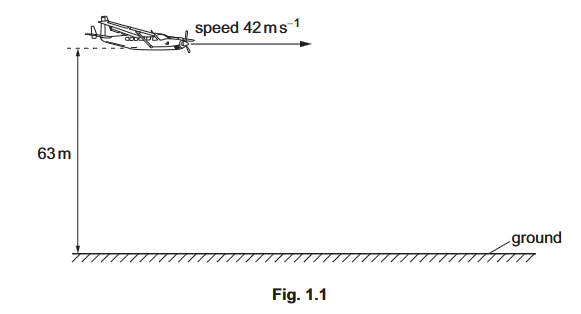
The aircraft drops a small parcel. The parcel is released from the aircraft at the instant shown in Fig. 1.1. Air resistance is negligible.
(i) On Fig. 1.1, draw a line to show the path of the parcel as it falls from the aircraft to the ground. [1 mark]
[The path should be a curved path starting horizontally at the aircraft and becoming increasingly steep as it approaches the ground.]
(ii) Calculate the time taken from the instant of release to the instant the parcel reaches the ground. [2 marks]
time = ______________________________ \(\mathrm{s}\)
(iii) Calculate the vertical component of the velocity of the parcel immediately before it reaches the ground. [1 mark]
vertical component of velocity = ______________________________ \(\mathrm{m\,s^{-1}}\)
(iv) Determine the speed at which the parcel reaches the ground. [2 marks]
speed = ______________________________ \(\mathrm{m\,s^{-1}}\)
Syllabus Topic Codes (Cambridge International AS & A Level Physics 9702):
▶️ Answer/Explanation
(a) [1 mark]
Acceleration is the rate of change of velocity.
\(a=\frac{\Delta v}{\Delta t}\)
Answer: \( \boxed{\text{rate of change of velocity}} \)
(b)(i) [1 mark]
The parcel retains the horizontal velocity of the aircraft when it is released. At the same time, gravity gives the parcel a constant downward acceleration.
Therefore, its horizontal displacement continues while its downward velocity increases, producing a curved path.
Answer: \( \boxed{\text{A curved path from the aircraft to the ground, becoming increasingly steep.}} \)
(b)(ii) [2 marks]
Consider the vertical motion of the parcel. Its initial vertical velocity is zero:
\(u=0\)
Using
\(s=ut+\frac{1}{2}at^2\)
\(63=0+\frac{1}{2}(9.81)t^2\)
\(t^2=\frac{126}{9.81}\)
\(t\approx3.58\,\mathrm{s}\)
\(t\approx3.6\,\mathrm{s}\)
Answer: \( \boxed{3.6\,\mathrm{s}} \)
(b)(iii) [1 mark]
Using
\(v^2=u^2+2as\)
\(v^2=0+2(9.81)(63)\)
\(v=\sqrt{2(9.81)(63)}\)
\(v\approx35\,\mathrm{m\,s^{-1}}\)
Answer: \( \boxed{35\,\mathrm{m\,s^{-1}}\text{ downward}} \)
(b)(iv) [2 marks]
The horizontal component of velocity remains \(42\,\mathrm{m\,s^{-1}}\), since air resistance is negligible.
The vertical component immediately before impact is approximately \(35\,\mathrm{m\,s^{-1}}\).
The resultant speed is therefore
\(v=\sqrt{42^2+35^2}\)
\(v\approx55\,\mathrm{m\,s^{-1}}\)
Answer: \( \boxed{55\,\mathrm{m\,s^{-1}}} \)
Question 2
(a) State the principle of conservation of momentum. [2 marks]
___________________________
(b) A ball X has mass \(240\,\mathrm{g}\) and moves in a straight line on a horizontal frictionless surface with an initial speed of \(16\,\mathrm{m\,s^{-1}}\). The ball collides with a stationary ball Y that has mass \(480\,\mathrm{g}\). After the collision, ball X is stationary, as shown in Fig. 2.1.
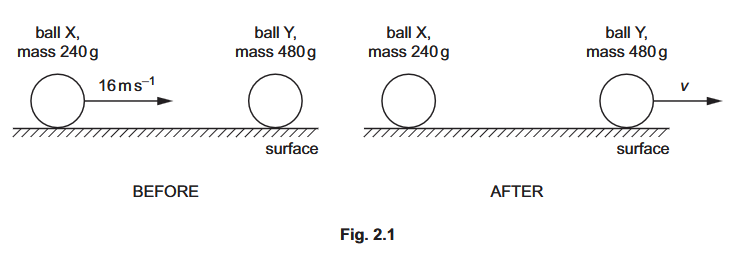
(i) Show that the speed \(v\) of ball Y after the collision is \(8.0\,\mathrm{m\,s^{-1}}\). [1 mark]
\(v=\) ______________________________ \(\mathrm{m\,s^{-1}}\)
(ii) Calculate the change in the total kinetic energy \(\Delta E_{\mathrm{k}}\) of the balls due to the collision. [3 marks]
\(\Delta E_{\mathrm{k}}=\) ______________________________ \(\mathrm{J}\)
(c) The collision in (b) lasts for a time of \(2.0\,\mathrm{ms}\). Assume that the contact force between the balls is constant during this time.
(i) Determine the magnitude and direction of the force exerted on ball X by ball Y during the collision. [3 marks]
magnitude = ______________________________ \(\mathrm{N}\)
direction = ______________________________
(ii) Compare the magnitude and direction of the force exerted on ball Y by ball X during the collision with the answers in (c)(i). No further calculations are required. [2 marks]
_________________________________
Syllabus Topic Codes (Cambridge International AS & A Level Physics 9702):
• 3.1: Change in Momentum and Impulse — part (c)(i)
▶️ Answer/Explanation
(a) [2 marks]
The principle of conservation of momentum states that the total momentum of an isolated system remains constant.
Therefore,
\(\text{total momentum before}=\text{total momentum after}\)
Answer: \( \boxed{\text{Total momentum is constant for an isolated system.}} \)
(b)(i) [1 mark]
Since the surface is frictionless, momentum is conserved.
Before the collision, only ball X has momentum:
\(p_{\mathrm{before}}=0.240\times16\)
After the collision, ball X is stationary, so all the momentum is carried by ball Y:
\(0.240\times16=0.480v\)
\(v=\frac{0.240\times16}{0.480}\)
\(v=8.0\,\mathrm{m\,s^{-1}}\)
Answer: \( \boxed{8.0\,\mathrm{m\,s^{-1}}} \)
(b)(ii) [3 marks]
The kinetic energy of a body is
\(E_{\mathrm{k}}=\frac{1}{2}mv^2\)
Initial total kinetic energy:
\(E_{\mathrm{k,initial}}=\frac{1}{2}(0.24)(16)^2\)
\(E_{\mathrm{k,initial}}=30.72\,\mathrm{J}\)
Final total kinetic energy:
\(E_{\mathrm{k,final}}=\frac{1}{2}(0.48)(8.0)^2\)
\(E_{\mathrm{k,final}}=15.36\,\mathrm{J}\)
Hence,
\(\Delta E_{\mathrm{k}}=E_{\mathrm{k,initial}}-E_{\mathrm{k,final}}\)
\(\Delta E_{\mathrm{k}}=30.72-15.36\)
\(\Delta E_{\mathrm{k}}\approx15\,\mathrm{J}\)
Answer: \( \boxed{15\,\mathrm{J}} \)
(c)(i) [3 marks]
The impulse on ball X is equal to its change in momentum:
\(F\Delta t=\Delta p\)
Ball X changes velocity from \(16\,\mathrm{m\,s^{-1}}\) to \(0\), so
\(F=\frac{0.24(16)}{2.0\times10^{-3}}\)
\(F=1900\,\mathrm{N}\)
The force on X acts opposite to its initial direction of motion.
Answer: \( \boxed{1900\,\mathrm{N}} \), to the left.
(c)(ii) [2 marks]
By Newton’s third law, the force exerted by ball X on ball Y has the same magnitude as the force exerted by ball Y on ball X.
The two forces act in opposite directions.
Answer: \( \boxed{\text{same magnitude, opposite direction}} \)
Question 3
(a) State the principle of moments. [1 mark]
___________________________
(b) A rigid uniform beam rests on a pivot at its centre, as shown in Fig. 3.1.
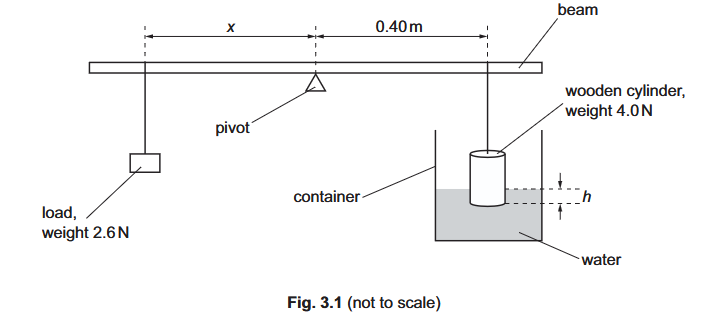
A load of weight \(2.6\,\mathrm{N}\) is suspended from the beam at distance \(x\) from the pivot.
A wooden cylinder of weight \(4.0\,\mathrm{N}\) is suspended from the beam at a distance of \(0.40\,\mathrm{m}\) from the pivot on the opposite side of the pivot to the load. The cylinder rests in a container of water. The lower part of the cylinder is immersed in the water to depth \(h\).
Initially, \(h\) is equal to \(0.10\,\mathrm{m}\) and \(x\) is equal to \(0.40\,\mathrm{m}\). The system is in equilibrium.
(i) Use the principle of moments to show that the upthrust \(U\) exerted by the water on the cylinder is \(1.4\,\mathrm{N}\). [2 marks]
\(U=\) ______________________________ \(\mathrm{N}\)
(ii) The density of the water is \(1.0\times10^3\,\mathrm{kg\,m^{-3}}\).
Calculate the area \(A\) of the circular cross-section of the cylinder. [3 marks]
\(A=\) ______________________________ \(\mathrm{m^2}\)
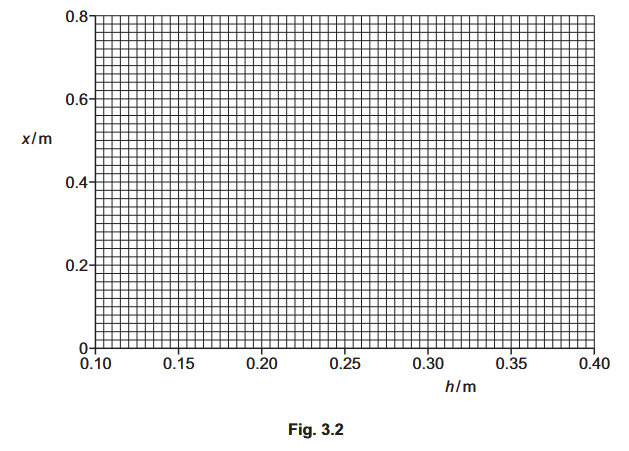
(c) More water is gradually added to the container in (b), so that depth \(h\) gradually increases. The length \(x\) is continuously adjusted so that the system remains in equilibrium.
On Fig. 3.2, sketch the variation of \(x\) with \(h\). Use the space below for any working.
Syllabus Topic Codes (Cambridge International AS & A Level Physics 9702):
• 4.2: Equilibrium — parts (a), (b)(i) and (c)
• 4.3: Density and pressure — part (b)(ii), upthrust and fluid pressure
▶️ Answer/Explanation
(a) [1 mark]
For a system in equilibrium, the sum of the clockwise moments about a point equals the sum of the anticlockwise moments about the same point.
Answer: \( \boxed{\text{sum of clockwise moments}=\text{sum of anticlockwise moments}} \)
(b)(i) [2 marks]
Take moments about the pivot. The load produces a clockwise moment:
\(\text{clockwise moment}=2.6\times0.40\)
The effective downward force due to the cylinder is \(4.0-U\), producing an anticlockwise moment.
Since the system is in equilibrium,
\(2.6\times0.40=(4.0-U)\times0.40\)
Dividing by \(0.40\),
\(2.6=4.0-U\)
\(U=4.0-2.6\)
\(U=1.4\,\mathrm{N}\)
Answer: \( \boxed{1.4\,\mathrm{N}} \)
(b)(ii) [3 marks]
The upthrust on an immersed object is
\(U=\rho gV\)
The immersed volume of the cylinder is
\(V=Ah\)
Therefore,
\(U=\rho gAh\)
Rearranging,
\(A=\frac{U}{\rho gh}\)
Substituting the values,
\(A=\frac{1.4}{(1.0\times10^3)(9.81)(0.10)}\)
\(A=1.4\times10^{-3}\,\mathrm{m^2}\)
Answer: \( \boxed{1.4\times10^{-3}\,\mathrm{m^2}} \)
(c) [3 marks]
As \(h\) increases, the immersed volume increases. Since
\(U=\rho gAh\)
the upthrust \(U\) increases linearly with \(h\).
Taking moments about the pivot,
\(2.6x=(4.0-U)(0.40)\)
Therefore,
\(x=\frac{(4.0-U)(0.40)}{2.6}\)
Since \(U\) increases as \(h\) increases, \(x\) decreases linearly with \(h\).
The graph starts at \((h,x)=(0.10,0.40)\).
When \(x=0\), the required upthrust is \(4.0\,\mathrm{N}\). Using \(U=\rho gAh\),
\(4.0=(1.0\times10^3)(9.81)(1.4\times10^{-3})h\)
\(h\approx0.29\,\mathrm{m}\)
Therefore, the graph is a straight line with negative gradient, starting at \((0.10,0.40)\) and ending at approximately \((0.29,0)\).
Answer: \( \boxed{\text{straight line with negative gradient from }(0.10,0.40)\text{ to }(0.29,0)} \)
Question 4
(a) Define:
(i) stress [1 mark]
_____________________________
(ii) strain. [1 mark]
_____________________________
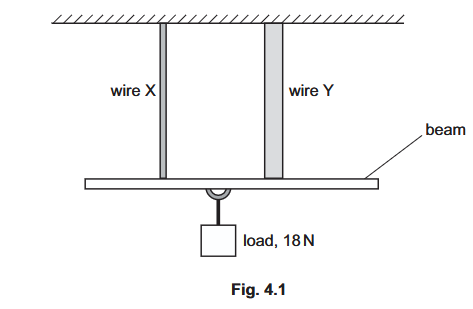
(b) Two wires X and Y, with equal unstretched lengths of \(0.84\,\mathrm{m}\), are suspended from fixed points that are at the same horizontal level. The lower ends of the wires are attached to a beam of negligible mass. The beam is horizontal and in equilibrium, as shown in Fig. 4.1.
Wire X is made from a metal that has a Young modulus of \(1.9\times10^9\,\mathrm{Pa}\).
Wire Y is made from a different metal.
A load of weight \(18\,\mathrm{N}\) is suspended from the beam at a point that is equidistant from the two wires. This load causes both wires to extend by \(0.47\,\mathrm{mm}\).
(i) Determine the cross-sectional area of wire X. [3 marks]
cross-sectional area = ______________________________ \(\mathrm{m^2}\)
(ii) Wire Y has a greater diameter than wire X.
Explain, without calculation, whether the Young modulus of the metal from which wire Y is made is less than, the same as or greater than \(1.9\times10^9\,\mathrm{Pa}\). [2 marks]
_________________________________
Syllabus Topic Codes (Cambridge International AS & A Level Physics 9702):
• 6.2: Young modulus — parts (b)(i) and (b)(ii)
• 4.1: Turning effects of forces — part (b), equilibrium of the beam
▶️ Answer/Explanation
(a)(i) Stress [1 mark]
Stress is the normal force per unit cross-sectional area.
\(\sigma=\frac{F}{A}\)
Answer: \( \boxed{\text{normal force per unit cross-sectional area}} \)
(a)(ii) Strain [1 mark]
Strain is the extension per unit unstretched length.
\(\varepsilon=\frac{\Delta L}{L}\)
Answer: \( \boxed{\text{extension per unit unstretched length}} \)
(b)(i) [3 marks]
Since the load is equidistant from the two wires and the beam is in equilibrium, the load is shared equally between the two wires.
Therefore, the tension in wire X is
\(F=\frac{18}{2}=9.0\,\mathrm{N}\)
The Young modulus is
\(E=\frac{FL}{A\Delta L}\)
Rearranging,
\(A=\frac{FL}{E\Delta L}\)
The extension is \(0.47\,\mathrm{mm}=0.47\times10^{-3}\,\mathrm{m}\).
Hence,
\(A=\frac{(9.0)(0.84)}{(1.9\times10^9)(0.47\times10^{-3})}\)
\(A\approx8.5\times10^{-6}\,\mathrm{m^2}\)
Answer: \( \boxed{8.5\times10^{-6}\,\mathrm{m^2}} \)
(b)(ii) [2 marks]
Both wires have the same extension and the same unstretched length, so they have the same strain.
The load is equidistant from the wires, so the tension force in each wire is also the same.
Wire Y has a greater diameter, so its cross-sectional area \(A\) is greater.
Since \(E=\frac{\text{stress}}{\text{strain}}\) and \(\text{stress}=\frac{F}{A}\), the larger cross-sectional area gives a smaller stress for the same force. Since the strain is the same, the Young modulus of Y is therefore smaller.
Answer: \( \boxed{\text{less than }1.9\times10^9\,\mathrm{Pa}} \
Question 5
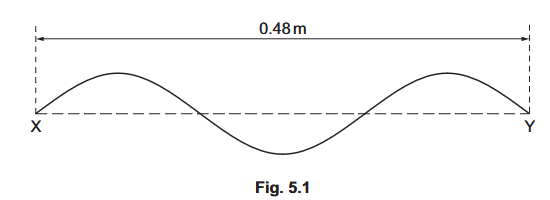
(a) A stationary wave is formed on a string \(XY\) that has a length of \(0.48\,\mathrm{m}\). Fig. 5.1 shows the string at one instant in time.
The speed of the wave on the string is \(1400\,\mathrm{m\,s^{-1}}\).
(i) On Fig. 5.1, draw a cross (×) at one position that is a node and another cross at one position that is an antinode. Label the node N and the antinode A. [1 mark]
______________________________________________________________________
(ii) Show that the wavelength of the wave produced is \(0.32\,\mathrm{m}\). Explain your reasoning. [1 mark]
______________________________________________________________________
(iii) Calculate the frequency of the wave. [2 marks]
frequency = ______________________________ \(\mathrm{Hz}\)
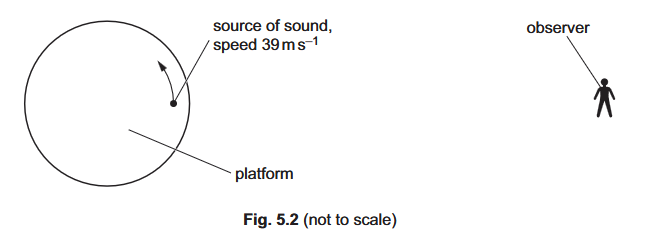
(b) A source of sound waves of frequency \(780\,\mathrm{Hz}\) is on a rotating platform. The speed of the source is \(39\,\mathrm{m\,s^{-1}}\). The sound is detected by an observer that is a large distance from the rotating platform, as shown in Fig. 5.2.
(i) The speed of sound in air is \(320\,\mathrm{m\,s^{-1}}\).
Calculate the maximum frequency of the sound detected by the observer. [2 marks]
maximum frequency = ______________________________ \(\mathrm{Hz}\)
(ii) At time \(t=0\), the observer detects the sound emitted by the source when it was in the position shown in Fig. 5.2.
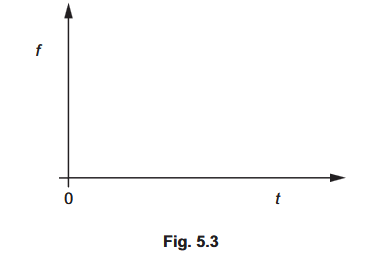
On Fig. 5.3, sketch the variation with \(t\) of the frequency of the sound detected by the observer for one complete rotation of the platform. Calculations are not required. [2 marks]
Syllabus Topic Codes (Cambridge International AS & A Level Physics 9702):
• 7.1: Progressive waves — part (a)(iii), using \(v=f\lambda\)
• 7.3: Doppler effect for sound waves — parts (b)(i) and (b)(ii)
▶️ Answer/Explanation
(a)(i) [1 mark]
A node is a point that remains stationary, so it occurs where the solid and dashed wave profiles intersect. An antinode occurs at a peak or trough where the amplitude is maximum.
A suitable node is at \(X\) or \(Y\), or at an intersection of the solid and dashed lines. A suitable antinode is at any peak or trough.
Answer: \( \boxed{\text{N at a node and A at a peak or trough}} \)
(a)(ii) [1 mark]
The string contains \(1.5\) wavelengths over its length of \(0.48\,\mathrm{m}\).
Therefore,
\(0.48=1.5\lambda\)
\(\lambda=\frac{0.48}{1.5}\)
\(\lambda=0.32\,\mathrm{m}\)
Answer: \( \boxed{0.32\,\mathrm{m}} \)
(a)(iii) [2 marks]
Use the wave equation
\(v=f\lambda\)
Rearranging,
\(f=\frac{v}{\lambda}\)
\(f=\frac{1400}{0.32}\)
\(f=4375\,\mathrm{Hz}\approx4.4\times10^3\,\mathrm{Hz}\)
Answer: \( \boxed{4.4\times10^3\,\mathrm{Hz}} \)
(b)(i) [2 marks]
The maximum frequency occurs when the source is moving directly towards the stationary observer.
For a moving source,
\(f_{\mathrm{o}}=\frac{f_{\mathrm{s}}v}{v-v_{\mathrm{s}}}\)
Substituting the values,
\(f_{\mathrm{o}}=\frac{(780)(320)}{320-39}\)
\(f_{\mathrm{o}}\approx888\,\mathrm{Hz}\)
\(f_{\mathrm{o}}\approx890\,\mathrm{Hz}\)
Answer: \( \boxed{890\,\mathrm{Hz}} \)
(b)(ii) [2 marks]
As the source rotates, its velocity component towards the observer varies continuously from maximum towards the observer, through zero, to maximum away from the observer.
Hence the observed frequency varies smoothly above and below the source frequency of \(780\,\mathrm{Hz}\).
At \(t=0\), the source is moving perpendicular to the direction of the observer, so its velocity component towards the observer is zero. Therefore the graph starts at the mean frequency \(780\,\mathrm{Hz}\), falls to a minimum, rises to a maximum, and returns to \(780\,\mathrm{Hz}\) after one complete rotation.
Answer: \( \boxed{\text{a smooth periodic curve about }780\,\mathrm{Hz}\text{, starting at the mean value}} \)
Question 6
(a) Define resistance. [1 mark]
_______________________
(b) A cylindrical metal wire of length \(2.4\,\mathrm{m}\) and cross-sectional area \(8.0\times10^{-6}\,\mathrm{m^2}\) has a resistance of \(0.33\,\Omega\). There is a current in the wire of \(4.7\,\mathrm{A}\).
(i) Determine the resistivity of the metal from which the wire is made. [2 marks]
resistivity = ______________________________ \(\mathrm{\Omega\,m}\)
(ii) Calculate the charge that passes through the wire in a time of \(5.0\) minutes. [2 marks]
charge = ______________________________ \(\mathrm{C}\)
(iii) The free electrons (charge carriers) in the wire have an average drift speed of \(0.16\,\mathrm{mm\,s^{-1}}\).
Determine the number density of charge carriers in the metal. [2 marks]
number density = ______________________________ \(\mathrm{m^{-3}}\)
(c) The wire in (b) may be considered to be a fixed resistor. It is connected in series with a thermistor to a battery that has negligible internal resistance.
(i) Use circuit symbols to complete Fig. 6.1 to show the circuit diagram of this arrangement. [1 mark]
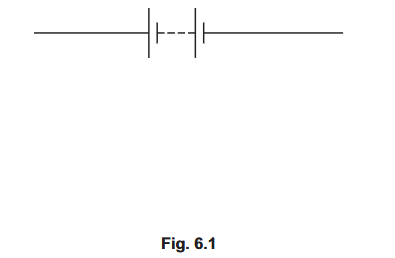
(ii) Explain, without calculation, how the power dissipated in the wire changes as the temperature of the thermistor is increased. [2 marks]
___________________________
Syllabus Topic Codes (Cambridge International AS & A Level Physics 9702, 2025–2027):
• 9.1: Electric current — parts (b)(ii) and (b)(iii)
• 10.1: Practical circuits — part (c)(i)
▶️ Answer/Explanation
(a) [1 mark]
Resistance is the potential difference per unit current.
\(R=\frac{V}{I}\)
Answer: \( \boxed{\text{potential difference per unit current}} \)
(b)(i) Resistivity [2 marks]
The resistance of a uniform wire is related to its resistivity by
\(R=\frac{\rho L}{A}\)
Rearranging,
\(\rho=\frac{RA}{L}\)
\(\rho=\frac{(0.33)(8.0\times10^{-6})}{2.4}\)
\(\rho=1.1\times10^{-6}\,\mathrm{\Omega\,m}\)
Answer: \( \boxed{1.1\times10^{-6}\,\mathrm{\Omega\,m}} \)
(b)(ii) Charge [2 marks]
Charge is related to current by
\(Q=It\)
Convert \(5.0\) minutes into seconds:
\(t=5.0\times60=300\,\mathrm{s}\)
Therefore,
\(Q=(4.7)(300)\)
\(Q=1410\,\mathrm{C}\)
\(Q\approx1400\,\mathrm{C}\)
Answer: \( \boxed{1400\,\mathrm{C}} \)
(b)(iii) Number density [2 marks]
For a current-carrying conductor,
\(I=Anvq\)
Rearranging for number density \(n\),
\(n=\frac{I}{Avq}\)
The drift speed is \(0.16\,\mathrm{mm\,s^{-1}}=0.16\times10^{-3}\,\mathrm{m\,s^{-1}}\).
Taking the magnitude of the electron charge as \(q=1.60\times10^{-19}\,\mathrm{C}\),
\(n=\frac{4.7}{(8.0\times10^{-6})(0.16\times10^{-3})(1.60\times10^{-19})}\)
\(n\approx2.3\times10^{28}\,\mathrm{m^{-3}}\)
Answer: \( \boxed{2.3\times10^{28}\,\mathrm{m^{-3}}} \)
(c)(i) [1 mark]
The fixed resistor and thermistor should be connected in series with the battery.
Answer: \( \boxed{\text{battery, fixed resistor and thermistor connected in series}} \)
(c)(ii) [2 marks]
As the temperature of the thermistor increases, its resistance decreases because it is a negative-temperature-coefficient thermistor.
Therefore, the total resistance of the series circuit decreases, so the current in the circuit increases.
Since the wire is a fixed resistor, its power is
\(P=I^2R\)
The current increases while the resistance of the wire remains constant, so the power dissipated in the wire increases.
Answer: \( \boxed{\text{The power dissipated in the wire increases.}} \)
Question 7
(a) Complete Table 7.1 to show the charges, in terms of the elementary charge, \(e\), on each of the quarks and antiquark.
Table 7.1
| flavour | charge/\(e\) | |
|---|---|---|
| quark | antiquark | |
| up | \( +\frac{2}{3} \) | \( -\frac{2}{3} \) |
| down | \( -\frac{1}{3} \) | \( +\frac{1}{3} \) |
| strange | \( -\frac{1}{3} \) | \( +\frac{1}{3} \) |
[3 marks]
(b)
(i) State the name of the class (group) of fundamental particles to which baryons and mesons belong. [1 mark]
_______________________________________
(ii) Compare baryons and mesons in terms of their constituent particles. [2 marks]
___________________________________________
(c) Describe \(\beta^+\) decay in terms of the fundamental particles involved. [2 marks]
____________________________________________________
Syllabus Topic Codes (Cambridge International AS & A Level Physics 9702, 2025–2027):
▶️ Answer/Explanation
(a) [3 marks]
The charges of the three quark flavours are:
up quark: \(+\frac{2}{3}e\)
down quark: \(-\frac{1}{3}e\)
strange quark: \(-\frac{1}{3}e\)
An antiquark has the opposite charge to its corresponding quark.
| flavour | quark charge/\(e\) | antiquark charge/\(e\) |
|---|---|---|
| up | \(+\frac{2}{3}\) | \(-\frac{2}{3}\) |
| down | \(-\frac{1}{3}\) | \(+\frac{1}{3}\) |
| strange | \(-\frac{1}{3}\) | \(+\frac{1}{3}\) |
Answer: \( \boxed{\text{up: }+\frac{2}{3}e,\ \text{down: }-\frac{1}{3}e,\ \text{strange: }-\frac{1}{3}e} \), with antiquarks having the opposite charges.
(b)(i) [1 mark]
Baryons and mesons are both types of hadrons.
Answer: \( \boxed{\text{hadrons}} \)
(b)(ii) [2 marks]
A baryon is composed of three quarks or three antiquarks.
A meson is composed of one quark and one antiquark.
Answer: \( \boxed{\text{baryon: 3 quarks; meson: 1 quark + 1 antiquark}} \)
(c) [2 marks]
In \(\beta^+\) decay, an up quark changes into a down quark.
At the particle level, this change results in the emission of a positron and an electron neutrino.
The quark-level change can be represented as
\(u\rightarrow d+e^++\nu_e\)
Answer: \( \boxed{u\rightarrow d+e^++\nu_e} \)