
Question 1
(a) State Newton’s law of gravitation. (2 marks)
______________________________________________
______________________________________________
(b) A planet may be considered as a uniform sphere.
A satellite is in circular orbit of period \(T\) around the planet at a height \(h\) above the surface. The height of the orbit can be adjusted by use of the satellite’s rocket engines.
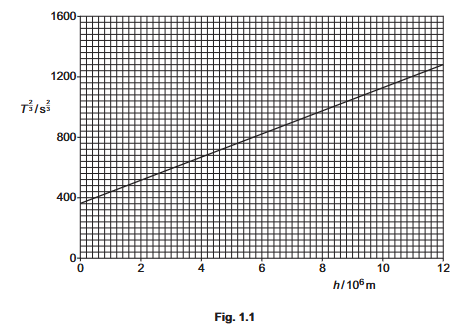
Fig. 1.1 shows the variation with \(h\) of \(T^{\frac{2}{3}}\).
(i) By reference to forces, explain why the orbit of the satellite is circular. (2 marks)
______________________________________________
______________________________________________
(ii) Use Newton’s law of gravitation to show that \(h\) and \(T\) are related by
\( (h+B)^3=\frac{GA}{4\pi^2}T^2 \)
where \(G\) is the gravitational constant and \(A\) and \(B\) are constants that depend on the properties of the planet. (3 marks)
______________________________________________
______________________________________________
______________________________________________
(iii) Use the gradient and intercept of the line in Fig. 1.1 to determine values for \(A\) and \(B\). Give units with your answers. (5 marks)
\(A=\) __________________________ \( \mathrm{unit} \)
\(B=\) __________________________ \( \mathrm{unit} \)
Syllabus Topic Codes (Cambridge International AS & A Level Physics 9702 Paper 4):
• 13.3: Gravitational field of a point mass — part (b)(ii)
• 12.1: Kinematics of uniform circular motion — part (b)(i)
• 12.2: Centripetal acceleration — part (b)(i)
▶️ Answer/Explanation
(a)
Newton’s law of gravitation states that the gravitational force between two point masses is directly proportional to the product of their masses and inversely proportional to the square of their separation.
Thus,
\( F=\frac{Gm_1m_2}{r^2} \)
Answer: \( \boxed{F\propto\frac{m_1m_2}{r^2}} \)
(b)(i)
The gravitational force acting on the satellite is directed towards the centre of the planet.
This force therefore acts perpendicular to the instantaneous direction of motion and provides the centripetal force required to keep the satellite moving in a circular path.
Answer: The gravitational force provides the centripetal acceleration and is always directed towards the centre of the circular orbit.
(b)(ii)
Let the mass of the satellite be \(m\) and the mass of the planet be \(A\). The radius of the satellite’s orbit is
\( r=h+B \)
where \(B\) is the radius of the planet.
From Newton’s law of gravitation,
\( F=\frac{GAm}{(h+B)^2} \)
For circular motion, the gravitational force provides the centripetal force:
\( F=m\omega^2r \)
Since \( \omega=\frac{2\pi}{T} \),
\( \frac{GAm}{(h+B)^2}=m\left(\frac{2\pi}{T}\right)^2(h+B) \)
Cancelling \(m\),
\( \frac{GA}{(h+B)^2}=\frac{4\pi^2(h+B)}{T^2} \)
Rearranging,
\( (h+B)^3=\frac{GA}{4\pi^2}T^2 \)
Answer: \( \boxed{(h+B)^3=\frac{GA}{4\pi^2}T^2} \)
(b)(iii)
Taking the cube root of the equation from part (b)(ii),
\( T^{\frac{2}{3}}=\left(\frac{4\pi^2}{GA}\right)^{\frac{1}{3}}(h+B) \)
This has the form \(y=mx+c\), where the gradient is
\( \text{gradient}=\left(\frac{4\pi^2}{GA}\right)^{\frac{1}{3}} \)
From the graph, using two convenient points approximately \((0,360)\) and \((12,1280)\),
\( \text{gradient}=\frac{1280-360}{12\times10^6} \)
\( \text{gradient}=7.67\times10^{-5}\,\mathrm{s^{2/3}\,m^{-1}} \)
Therefore,
\( 7.67\times10^{-5}=\left(\frac{4\pi^2}{GA}\right)^{\frac{1}{3}} \)
Cubing and rearranging gives
\( A=\frac{4\pi^2}{G(7.67\times10^{-5})^3} \)
Using \(G=6.67\times10^{-11}\,\mathrm{N\,m^2\,kg^{-2}}\),
\( A\approx1.3\times10^{24}\,\mathrm{kg} \)
The \(y\)-intercept is approximately \(360\,\mathrm{s^{2/3}}\).
Since
\( \text{intercept}=\text{gradient}\times B \)
then
\( B=\frac{360}{7.67\times10^{-5}} \)
\( B\approx4.7\times10^6\,\mathrm{m} \)
Answers:
\( \boxed{A=1.3\times10^{24}\,\mathrm{kg}} \)
\( \boxed{B=4.7\times10^6\,\mathrm{m}} \)
Question 2
(a) Define specific heat capacity. (2 marks)
______________________________________________
______________________________________________
(b) Two solid blocks X and Y are made from different metals. The blocks have different initial temperatures. Block Y is initially at room temperature.
The blocks are placed in direct thermal contact with each other at time \(t=0\). Fig. 2.1 shows the variation with \(t\) of the temperatures of the two blocks.
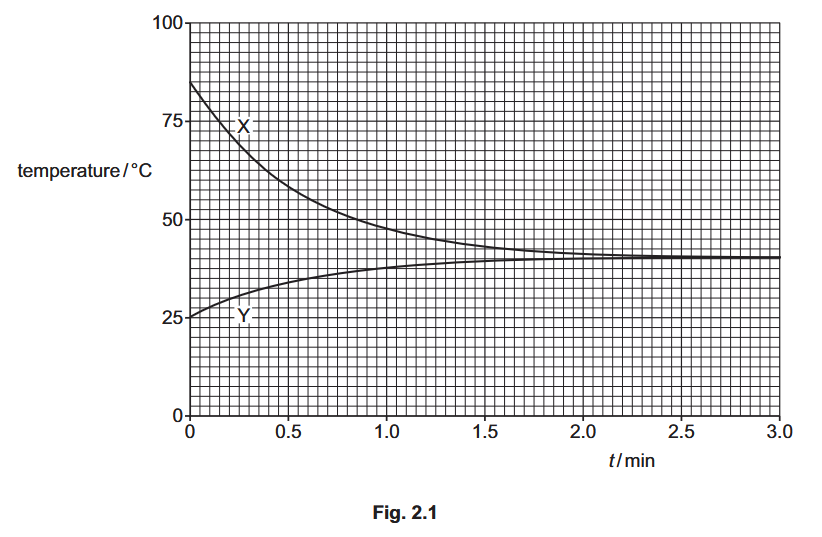
(i) State three conclusions that may be drawn from Fig. 2.1. The conclusions may be qualitative or quantitative. (3 marks)
1. ______________________________________________
2. ______________________________________________
3. ______________________________________________
(ii) The ratio
\( \frac{\text{mass of block Y}}{\text{mass of block X}}=1.3 \)
The metal in block Y has a specific heat capacity of \(901\,\mathrm{J\,kg^{-1}\,K^{-1}}\).
Determine the specific heat capacity of the metal in block X. (3 marks)
specific heat capacity = __________________________ \( \mathrm{J\,kg^{-1}\,K^{-1}} \)
Syllabus Topic Codes (Cambridge International AS & A Level Physics 9702 Paper 4):
• 14.1: Thermal equilibrium — part (b)(i)
▶️ Answer/Explanation
(a)
Specific heat capacity is the thermal energy required per unit mass per unit change in temperature.
It is given by
\( c=\frac{q}{m\Delta T} \)
Answer: \( \boxed{\text{thermal energy required per unit mass per unit temperature change}} \)
(b)(i)
Three valid conclusions from the graph are:
• The two blocks eventually reach thermal equilibrium at approximately \(40^\circ\mathrm{C}\).
• The initial temperature of X is approximately \(85^\circ\mathrm{C}\), while the initial temperature of Y is approximately \(25^\circ\mathrm{C}\).
• The temperature change of X is approximately \(45^\circ\mathrm{C}\), while the temperature change of Y is approximately \(15^\circ\mathrm{C}\).
Other valid conclusions include that the temperature change of X is approximately three times the temperature change of Y, and that there is no net heat transfer to the surroundings.
Answer: Any three valid conclusions from the graph.
(b)(ii)
At thermal equilibrium, the magnitude of thermal energy lost by X equals the thermal energy gained by Y.
Therefore,
\( m_Xc_X\Delta T_X=m_Yc_Y\Delta T_Y \)
From the graph,
\( \Delta T_X=45^\circ\mathrm{C} \)
and
\( \Delta T_Y=15^\circ\mathrm{C} \)
Also,
\( \frac{m_Y}{m_X}=1.3 \)
so
\( m_Y=1.3m_X \)
Substituting \(c_Y=901\,\mathrm{J\,kg^{-1}\,K^{-1}}\),
\( m_Xc_X(45)=1.3m_X(901)(15) \)
Cancel \(m_X\):
\( c_X(45)=1.3(901)(15) \)
Therefore,
\( c_X=\frac{1.3(901)(15)}{45} \)
\( c_X=390.43\,\mathrm{J\,kg^{-1}\,K^{-1}} \)
To an appropriate number of significant figures,
Answer: \( \boxed{390\,\mathrm{J\,kg^{-1}\,K^{-1}}} \)
Question 3
(a) (i) State what is meant by the Avogadro constant. (1 mark)
______________________________________________
______________________________________________
(ii) State the relationship between the Avogadro constant \(N_{\mathrm{A}}\), the molar gas constant \(R\) and the Boltzmann constant \(k\). (1 mark)
______________________________________________
(b) Two samples X and Y of ideal gases are both at thermodynamic temperature \(T\).
Sample X has volume \(V\) and consists of \(N\) molecules, each of mass \(m\).
Sample Y has volume \(2V\) and consists of \(2N\) molecules, each of mass \(2m\).
(i) Complete Table 3.1 by giving expressions, in terms of some or all of \(N\), \(m\), \(T\), \(V\) and the constants in (a)(i), for the quantities indicated. (4 marks)
| Sample X | Sample Y | |
|---|---|---|
| pressure | ||
| amount of substance | ||
| mean-square speed of molecules | ||
| internal energy |
(ii) The temperature of sample X is now varied.
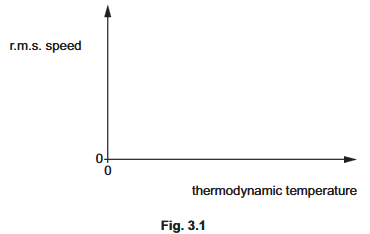
On Fig. 3.1, sketch the variation with thermodynamic temperature of the root-mean-square speed of the molecules of the gas. (2 marks)
Syllabus Topic Codes (Cambridge International AS & A Level Physics 9702 Paper 4):
• 15.2: Equation of state — part (b)(i)
• 15.3: Kinetic theory of gases — parts (b)(i) and (b)(ii)
▶️ Answer/Explanation
(a)(i)
The Avogadro constant is the number of particles per unit amount of substance.
Answer: \( \boxed{\text{number of particles per unit amount of substance}} \)
(a)(ii)
The relationship between the Avogadro constant, molar gas constant and Boltzmann constant is
\( N_{\mathrm{A}}=\frac{R}{k} \)
Answer: \( \boxed{N_{\mathrm{A}}=\frac{R}{k}} \)
(b)(i)
Pressure:
For an ideal gas,
\( pV=NkT \)
For sample X,
\( p_X=\frac{NkT}{V} \)
For sample Y,
\( p_Y=\frac{(2N)kT}{2V}=\frac{NkT}{V} \)
Therefore, both samples have the same pressure.
Amount of substance:
The amount of substance is
\( n=\frac{N}{N_{\mathrm{A}}} \)
For sample X,
\( n_X=\frac{N}{N_{\mathrm{A}}} \)
For sample Y,
\( n_Y=\frac{2N}{N_{\mathrm{A}}} \)
Mean-square speed:
From kinetic theory,
\( \frac{1}{2}m\langle c^2\rangle=\frac{3}{2}kT \)
Therefore,
\( \langle c^2\rangle=\frac{3kT}{m} \)
For sample X,
\( \boxed{\langle c_X^2\rangle=\frac{3kT}{m}} \)
For sample Y, each molecule has mass \(2m\), so
\( \boxed{\langle c_Y^2\rangle=\frac{3kT}{2m}} \)
Internal energy:
For an ideal gas, the internal energy is
\( U=\frac{3}{2}NkT \)
For sample X,
\( \boxed{U_X=\frac{3}{2}NkT} \)
For sample Y, there are \(2N\) molecules, so
\( U_Y=\frac{3}{2}(2N)kT \)
\( \boxed{U_Y=3NkT} \)
| Quantity | Sample X | Sample Y |
|---|---|---|
| Pressure | \( \frac{NkT}{V} \) | \( \frac{NkT}{V} \) |
| Amount of substance | \( \frac{N}{N_{\mathrm{A}}} \) | \( \frac{2N}{N_{\mathrm{A}}} \) |
| Mean-square speed | \( \frac{3kT}{m} \) | \( \frac{3kT}{2m} \) |
| Internal energy | \( \frac{3}{2}NkT \) | \( 3NkT \) |
(b)(ii)
From kinetic theory, the root-mean-square speed is related to thermodynamic temperature by
\( c_{\mathrm{rms}}=\sqrt{\frac{3kT}{m}} \)
Hence,
\( c_{\mathrm{rms}}\propto\sqrt{T} \)
Therefore, the graph starts at the origin and increases with a positive but decreasing gradient.
Answer: \( \boxed{c_{\mathrm{rms}}\propto\sqrt{T}} \), giving a curve passing through the origin with positive decreasing gradient.
Question 4
(a) State what is meant by simple harmonic motion. (2 marks)
______________________________________________
______________________________________________
(b) A block is suspended from a spring, as shown in Fig. 4.1.
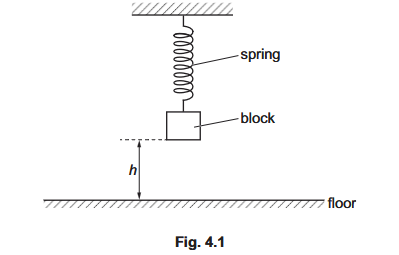
The block is pulled down and released at time \(t=0\). It then oscillates vertically with simple harmonic motion.
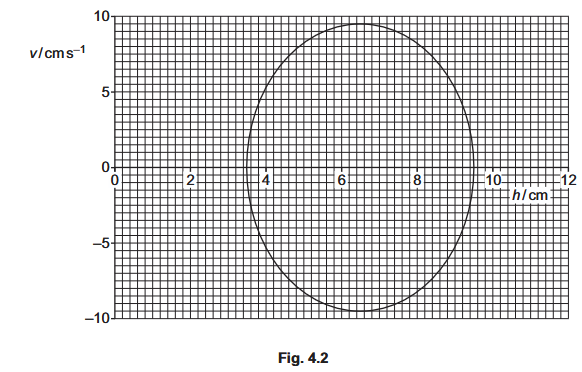
Fig. 4.2 shows the variation of the velocity \(v\) of the block with height \(h\) of the base of the block above the floor.
(i) Determine the amplitude, in cm, of the oscillations. (1 mark)
amplitude = __________________________ \( \mathrm{cm} \)
(ii) Show that the angular frequency of the oscillations is \(3.2\,\mathrm{rad\,s^{-1}}\). (2 marks)
______________________________________________
______________________________________________
(iii) Calculate the period \(T\) of the oscillations. (2 marks)
\(T=\) __________________________ \( \mathrm{s} \)
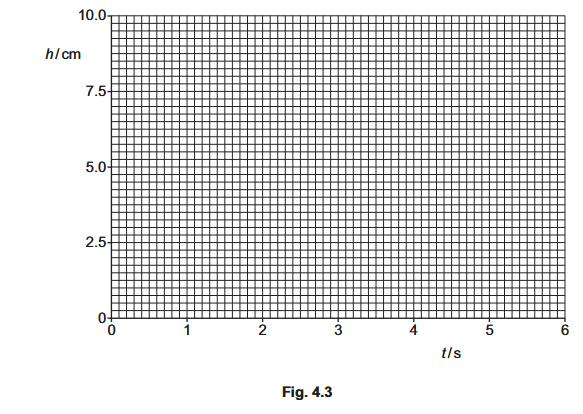
(iv) On Fig. 4.3, sketch the variation of \(h\) with time \(t\) from \(t=0\) to \(t=6.0\,\mathrm{s}\). (4 marks)
Syllabus Topic Codes (Cambridge International AS & A Level Physics 9702 Paper 4):
▶️ Answer/Explanation
(a)
Simple harmonic motion is motion in which the acceleration is directly proportional to the displacement from a fixed point and is always directed towards the fixed point.
Thus,
\( a\propto -x \)
Answer: \( \boxed{\text{acceleration is directly proportional to displacement and opposite in direction}} \)
(b)(i)
From Fig. 4.2, the maximum height is approximately \(9.5\,\mathrm{cm}\) and the minimum height is approximately \(3.5\,\mathrm{cm}\).
The amplitude is half the total range of displacement:
\( A=\frac{h_{\max}-h_{\min}}{2} \)
\( A=\frac{9.5-3.5}{2} \)
\( A=3.0\,\mathrm{cm} \)
Answer: \( \boxed{3.0\,\mathrm{cm}} \)
(b)(ii)
For simple harmonic motion, the maximum speed is related to amplitude and angular frequency by
\( v_0=\omega x_0 \)
From the graph, the maximum speed is approximately \(9.5\,\mathrm{cm\,s^{-1}}\), and the amplitude is \(3.0\,\mathrm{cm}\).
Therefore,
\( \omega=\frac{v_0}{x_0} \)
\( \omega=\frac{9.5}{3.0} \)
\( \omega=3.17\,\mathrm{rad\,s^{-1}} \)
To an appropriate number of significant figures,
Answer: \( \boxed{\omega=3.2\,\mathrm{rad\,s^{-1}}} \)
(b)(iii)
The angular frequency and period are related by
\( \omega=\frac{2\pi}{T} \)
Rearranging,
\( T=\frac{2\pi}{\omega} \)
\( T=\frac{2\pi}{3.2} \)
\( T=1.96\,\mathrm{s} \)
Answer: \( \boxed{T=2.0\,\mathrm{s}} \)
(b)(iv)
At \(t=0\), the block is released from its lowest position, so the height is at its minimum:
\( h=3.5\,\mathrm{cm} \)
The maximum height is
\( h=9.5\,\mathrm{cm} \)
The period is \(2.0\,\mathrm{s}\), so the height-time graph is sinusoidal with a period of \(2.0\,\mathrm{s}\).
Therefore, from \(t=0\) to \(6.0\,\mathrm{s}\), there are three complete oscillations.
The curve:
• starts at the minimum height \(3.5\,\mathrm{cm}\) at \(t=0\),
• reaches \(9.5\,\mathrm{cm}\) at \(t=1.0\,\mathrm{s}\),
• returns to \(3.5\,\mathrm{cm}\) at \(t=2.0\,\mathrm{s}\),
• and repeats this pattern with period \(2.0\,\mathrm{s}\) up to \(t=6.0\,\mathrm{s}\).
Answer: A sinusoidal curve of period \(2.0\,\mathrm{s}\), starting at \(h=3.5\,\mathrm{cm}\), with all peaks at \(h=9.5\,\mathrm{cm}\) and all troughs at \(h=3.5\,\mathrm{cm}\).
Question 5
(a) State the relationship between electric field and electric potential. (2 marks)
______________________________________________
______________________________________________
(b) Two charged isolated insulating spheres X and Y are near to each other, as shown in Fig. 5.1.
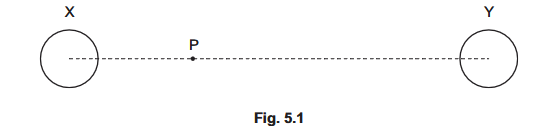
P is a point on the line joining the centres of the spheres.
Explain why it is not possible for the total electric potential and the resultant electric field to be zero at point P. (3 marks)
______________________________________________
______________________________________________
______________________________________________
______________________________________________
(c) The magnitudes of the charges on spheres X and Y in Fig. 5.1 are \(Q\) and \(2Q\) respectively. The spheres may be considered as point charges at their centres.
Point P is a distance \(x\) from the centre of sphere X.
The electric potential at point P is zero.
(i) Show that the distance \(y\) of point P from the centre of sphere Y is equal to \(2x\). (2 marks)
______________________________________________
______________________________________________
(ii) State an expression, in terms of \(Q\), \(x\) and the permittivity of free space \(\varepsilon_0\), for the electric field strength \(E_X\) at P due to sphere X. (1 mark)
\(E_X=\) __________________________________________
(iii) Determine an expression, in terms of \(Q\), \(x\) and \(\varepsilon_0\), for the resultant electric field strength \(E\) at point P due to the two spheres. (2 marks)
\(E=\) __________________________________________
Syllabus Topic Codes (Cambridge International AS & A Level Physics 9702 Paper 4):
• 18.3: Electric force between point charges — part (c)
• 18.4: Electric field of a point charge — parts (c)(ii) and (c)(iii)
• 18.5: Electric potential — parts (a), (b), (c)(i) and (c)(iii)
▶️ Answer/Explanation
(a)
The electric field strength is equal to the negative potential gradient.
Thus,
\( E=-\frac{\Delta V}{\Delta x} \)
Answer: \( \boxed{E=-\frac{\Delta V}{\Delta x}} \)
(b)
For the total electric potential to be zero, the potentials due to X and Y must have opposite signs. Therefore, the charges on X and Y must have opposite signs.
For the resultant electric field to be zero, the electric fields due to X and Y must be equal in magnitude and opposite in direction. This requires the two charges to have the same sign at a point between them.
Therefore, the charge signs cannot simultaneously be both the same and opposite.
Answer: It is not possible because zero potential requires opposite charge signs, whereas zero resultant electric field at P requires the charges to have the same sign.
(c)(i)
The electric potential due to a point charge is
\( V=\frac{Q}{4\pi\varepsilon_0r} \)
Since the total potential at P is zero, the charges must be opposite in sign. Therefore,
\( V_X+V_Y=0 \)
\( \frac{Q}{4\pi\varepsilon_0x}-\frac{2Q}{4\pi\varepsilon_0y}=0 \)
Cancelling \( \frac{Q}{4\pi\varepsilon_0} \),
\( \frac{1}{x}=\frac{2}{y} \)
Therefore,
\( y=2x \)
Answer: \( \boxed{y=2x} \)
(c)(ii)
The electric field strength due to a point charge is
\( E=\frac{Q}{4\pi\varepsilon_0r^2} \)
For sphere X, \(r=x\), so
\( \boxed{E_X=\frac{Q}{4\pi\varepsilon_0x^2}} \)
(c)(iii)
For sphere Y, the charge has magnitude \(2Q\) and its distance from P is \(2x\).
Therefore, the magnitude of its electric field at P is
\( E_Y=\frac{2Q}{4\pi\varepsilon_0(2x)^2} \)
\( E_Y=\frac{Q}{8\pi\varepsilon_0x^2} \)
Because the charges are opposite in sign, the two electric fields at P act in the same direction. Hence, their magnitudes add:
\( E=E_X+E_Y \)
\( E=\frac{Q}{4\pi\varepsilon_0x^2}+\frac{Q}{8\pi\varepsilon_0x^2} \)
\( E=\frac{2Q}{8\pi\varepsilon_0x^2}+\frac{Q}{8\pi\varepsilon_0x^2} \)
Answer: \( \boxed{E=\frac{3Q}{8\pi\varepsilon_0x^2}} \)
Question 6
(a) (i) State what is meant by rectification of an alternating voltage. (1 mark)
______________________________________________
______________________________________________
(ii) State the difference between half-wave rectification and full-wave rectification. (2 marks)
______________________________________________
______________________________________________
______________________________________________
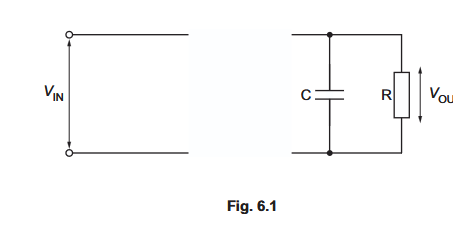
(b) (i) Complete Fig. 6.1 to show a circuit that produces half-wave rectification of an alternating input voltage \(V_{\mathrm{IN}}\) to produce output voltage \(V_{\mathrm{OUT}}\) across the resistor \(R\). (2 marks)
(ii) State the purpose of the capacitor \(C\) in the circuit of Fig. 6.1. (1 mark)
______________________________________________
(c) The input voltage \(V_{\mathrm{IN}}\) in Fig. 6.1 is a square wave. Fig. 6.2 shows the variation of \(V_{\mathrm{IN}}\) with time \(t\).
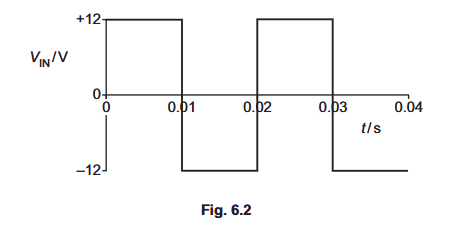
Fig. 6.3 shows the variation of \(V_{\mathrm{OUT}}\) with \(t\).
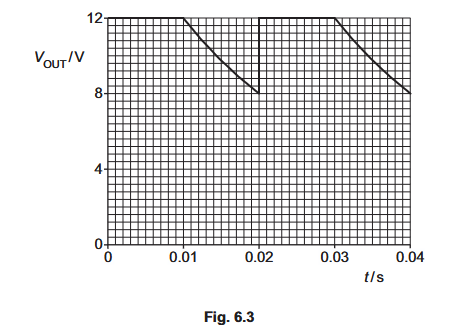
The maximum energy stored in the capacitor is \(0.041\,\mathrm{J}\).
(i) Show that the capacitance of \(C\) is \(570\,\mu\mathrm{F}\). (2 marks)
______________________________________________
______________________________________________
(ii) Determine the resistance \(R\). (3 marks)
resistance = __________________________ \( \Omega \)
Syllabus Topic Codes (Cambridge International AS & A Level Physics 9702 Paper 4):
• 21.2: Rectification and smoothing — parts (a)(i), (a)(ii), (b)(i) and (b)(ii)
• 19.2: Energy stored in a capacitor — part (c)(i)
• 19.3: Discharging a capacitor — part (c)(ii)
▶️ Answer/Explanation
(a)(i)
Rectification is the conversion of an alternating voltage into a unidirectional voltage.
Answer: \( \boxed{\text{conversion of a.c. to d.c.}} \)
(a)(ii)
In half-wave rectification, one half-cycle of the alternating voltage is removed, so the output voltage is present only during one half of each cycle.
In full-wave rectification, the half-cycle in the opposite direction is reversed so that both half-cycles produce an output in the same direction.
Answer: Half-wave removes one half-cycle, whereas full-wave reverses the opposite half-cycle so that both half-cycles are used.
(b)(i)
A single diode must be connected in one of the gaps in the input circuit, while the other connection is made directly.
The diode allows current to pass during only one half-cycle of the alternating input, producing half-wave rectification.
Answer: A single diode connected with the correct polarity in series with the input circuit.
(b)(ii)
The capacitor charges when the diode conducts and then discharges through the resistor when the diode is not conducting.
This reduces the variation in output voltage and provides smoothing.
Answer: \( \boxed{\text{to smooth the rectified output voltage}} \)
(c)(i)
The maximum energy stored in a capacitor is
\( E=\frac{1}{2}CV^2 \)
From Fig. 6.3, the maximum voltage across the capacitor is \(12\,\mathrm{V}\).
Therefore,
\( 0.041=\frac{1}{2}C(12)^2 \)
Rearranging,
\( C=\frac{2(0.041)}{12^2} \)
\( C=5.69\times10^{-4}\,\mathrm{F} \)
Since \(1\,\mu\mathrm{F}=10^{-6}\,\mathrm{F}\),
\( C\approx570\,\mu\mathrm{F} \)
Answer: \( \boxed{C=570\,\mu\mathrm{F}} \)
(c)(ii)
When the diode is not conducting, the capacitor discharges through the resistor. The voltage during discharge is given by
\( V=V_0e^{-t/RC} \)
From Fig. 6.3, the capacitor voltage falls from \(12\,\mathrm{V}\) to \(8.0\,\mathrm{V}\) over \(0.010\,\mathrm{s}\).
Therefore,
\( 8.0=12.0e^{-0.010/(RC)} \)
Dividing by \(12.0\),
\( \frac{8.0}{12.0}=e^{-0.010/(RC)} \)
Taking natural logarithms,
\( \ln\left(\frac{8.0}{12.0}\right)=-\frac{0.010}{RC} \)
Using \(C=5.7\times10^{-4}\,\mathrm{F}\),
\( R=\frac{-0.010}{(5.7\times10^{-4})\ln(8.0/12.0)} \)
\( R\approx43.3\,\Omega \)
Answer: \( \boxed{R=43\,\Omega} \)
Question 7
(a) Define magnetic flux density. (2 marks)
______________________________________________
______________________________________________
(b) A long, straight wire carries a current into the page, as shown in Fig. 7.1.
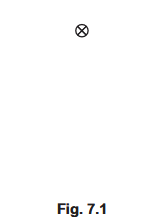
On Fig. 7.1, draw four field lines to represent the magnetic field around the wire due to the current in it. (3 marks)
______________________________________________
______________________________________________
(c) Two identical wires X and Y are placed parallel to each other. The wires both carry current into the page, as shown in Fig. 7.2.
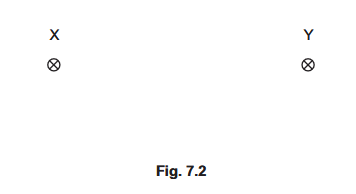
(i) Explain why the two wires exert a magnetic force on each other. (2 marks)
______________________________________________
______________________________________________
______________________________________________
(ii) On Fig. 7.2, draw an arrow to show the direction of the magnetic force exerted on wire X. Label your arrow \(F\). (1 mark)
______________________________________________
(iii) The current in X is double the current in Y.
State how the magnetic force exerted on wire Y compares with the magnetic force exerted on wire X. (2 marks)
______________________________________________
______________________________________________
(iv) The direction of the current in both wires is now reversed.
State, with a reason, the effect of this change on the direction of the force on wire X. (1 mark)
______________________________________________
______________________________________________
Syllabus Topic Codes (Cambridge International AS & A Level Physics 9702 Paper 4):
• 20.2: Force on a current-carrying conductor — parts (a), (c)(i), (c)(ii), (c)(iii) and (c)(iv)
• 20.4: Magnetic fields due to currents — parts (b), (c)(i) and (c)(iv)
▶️ Answer/Explanation
(a)
Magnetic flux density is the force per unit length per unit current when the current-carrying conductor is perpendicular to the magnetic field.
It is given by
\( B=\frac{F}{IL} \)
Answer: \( \boxed{B=\frac{F}{IL}} \)
(b)
The magnetic field around a long, straight current-carrying wire consists of concentric circles centred on the wire.
Since the current is into the page, the right-hand grip rule shows that the magnetic field direction is clockwise.
The field lines become more widely spaced as the distance from the wire increases.
Answer: Four concentric circular field lines centred on the wire, with arrows in the clockwise direction and increasing spacing away from the wire.
(c)(i)
Each wire produces a magnetic field around itself because it carries a current.
The other wire is located within this magnetic field. Its current is perpendicular to the magnetic field produced by the other wire, so a magnetic force acts on it.
Answer: Each wire lies in the magnetic field produced by the other, and the current in each wire experiences a magnetic force in the field of the other wire.
(c)(ii)
Both wires carry currents in the same direction. Parallel currents in the same direction attract each other.
Therefore, the force on wire X is directed towards wire Y.
Answer: \( \boxed{F\text{ points from X towards Y}} \)
(c)(iii)
The force per unit length between two parallel current-carrying wires is proportional to the product of their currents:
\( \frac{F}{L}=\frac{\mu_0 I_XI_Y}{2\pi d} \)
If \(I_X=2I_Y\), the force magnitude is determined by the same product \(I_XI_Y\) for both wires.
By Newton’s third law, the forces exerted by the two wires on each other have equal magnitudes and opposite directions.
Answer: \( \boxed{\text{The forces on X and Y have equal magnitudes and opposite directions.}} \)
(c)(iv)
Reversing the current in both wires reverses the direction of the magnetic field produced by Y and also reverses the current in X.
Since both the current and the magnetic field reverse, the direction of the force on X remains unchanged.
Answer: \( \boxed{\text{No change in the direction of the force on X.}} \)
Question 8
A polished sheet of magnesium in a vacuum emits electrons when it is illuminated by ultraviolet radiation.
(a) State the name of this phenomenon. (1 mark)
______________________________________________
(b) For emission of electrons to occur, the frequency of the ultraviolet radiation must be at least \(8.8\times10^{14}\,\mathrm{Hz}\).
(i) Calculate the work function energy of magnesium. (2 marks)
work function energy = __________________________ \( \mathrm{J} \)
(ii) For ultraviolet radiation with a frequency of \(11\times10^{14}\,\mathrm{Hz}\), calculate the maximum speed of the emitted electrons. (3 marks)
maximum speed = __________________________ \( \mathrm{m\,s^{-1}} \)
(c) The frequency of the ultraviolet radiation incident on the magnesium sheet is varied between \(8.0\times10^{14}\,\mathrm{Hz}\) and \(11\times10^{14}\,\mathrm{Hz}\).
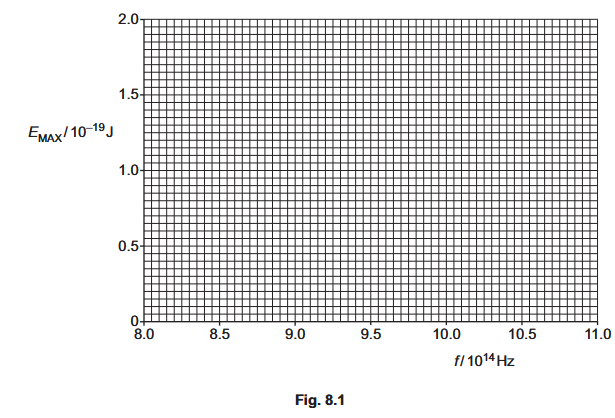
On Fig. 8.1, sketch the variation with \(f\) of the maximum kinetic energy \(E_{\mathrm{MAX}}\) of the emitted electrons. Use the space below for any working that you need. (3 marks)
Syllabus Topic Codes (Cambridge International AS & A Level Physics 9702 Paper 4):
• 22.2: Photoelectric effect — parts (a), (b)(i), (b)(ii) and (c)
▶️ Answer/Explanation
(a)
The phenomenon is the photoelectric effect.
Answer: \( \boxed{\text{photoelectric effect}} \)
(b)(i)
At the threshold frequency, the photon energy is equal to the work function energy:
\( \phi=hf_0 \)
Using \(h=6.63\times10^{-34}\,\mathrm{J\,s}\) and \(f_0=8.8\times10^{14}\,\mathrm{Hz}\),
\( \phi=(6.63\times10^{-34})(8.8\times10^{14}) \)
\( \phi=5.83\times10^{-19}\,\mathrm{J} \)
To an appropriate number of significant figures,
Answer: \( \boxed{\phi=5.8\times10^{-19}\,\mathrm{J}} \)
(b)(ii)
The photoelectric equation is
\( hf=\phi+\frac{1}{2}m_{\mathrm{e}}v_{\mathrm{MAX}}^2 \)
Therefore,
\( (6.63\times10^{-34})(11\times10^{14})=(5.8\times10^{-19})+\frac{1}{2}(9.11\times10^{-31})v_{\mathrm{MAX}}^2 \)
Rearranging,
\( \frac{1}{2}(9.11\times10^{-31})v_{\mathrm{MAX}}^2=7.49\times10^{-19}-5.8\times10^{-19} \)
\( \frac{1}{2}(9.11\times10^{-31})v_{\mathrm{MAX}}^2=1.69\times10^{-19} \)
Hence,
\( v_{\mathrm{MAX}}=\sqrt{\frac{2(1.69\times10^{-19})}{9.11\times10^{-31}}} \)
\( v_{\mathrm{MAX}}\approx6.1\times10^5\,\mathrm{m\,s^{-1}} \)
Answer: \( \boxed{v_{\mathrm{MAX}}\approx6.1\times10^5\,\mathrm{m\,s^{-1}}} \)
(c)
The maximum kinetic energy is given by
\( E_{\mathrm{MAX}}=hf-\phi \)
At frequencies below the threshold frequency \(8.8\times10^{14}\,\mathrm{Hz}\), no electrons are emitted. Therefore,
\( E_{\mathrm{MAX}}=0 \)
for \(f=8.0\times10^{14}\,\mathrm{Hz}\) to \(8.8\times10^{14}\,\mathrm{Hz}\).
At \(f=8.8\times10^{14}\,\mathrm{Hz}\), the maximum kinetic energy is zero.
For frequencies above \(8.8\times10^{14}\,\mathrm{Hz}\), \(E_{\mathrm{MAX}}\) increases linearly with \(f\), because
\( E_{\mathrm{MAX}}=hf-\phi \)
At \(f=11\times10^{14}\,\mathrm{Hz}\),
\( E_{\mathrm{MAX}}=(6.63\times10^{-34})(11\times10^{14})-5.8\times10^{-19} \)
\( E_{\mathrm{MAX}}\approx1.5\times10^{-19}\,\mathrm{J} \)
Therefore, the graph should be horizontal along \(E_{\mathrm{MAX}}=0\) from \(8.0\) to \(8.8\) on the frequency axis, followed by a straight line with positive gradient from \((8.8,0)\) to approximately \((11,1.45)\).
Answer: \( \boxed{E_{\mathrm{MAX}}=0\text{ below the threshold frequency, followed by a straight line of positive gradient above the threshold frequency.}} \)
Question 9
Fluorine-18 (\(^{18}\mathrm{F}\)) decays by beta-plus (\(\beta^+\)) emission with a half-life of 110 minutes.
(a) (i) State the name of the beta-plus particle. (1 mark)
______________________________________________
(ii) Show that the decay constant of fluorine-18 is \(1.05\times10^{-4}\,\mathrm{s^{-1}}\). (1 mark)
______________________________________________
(iii) Determine the activity of \(2.1\times10^{-12}\,\mathrm{kg}\) of fluorine-18. (3 marks)
activity = __________________________ \( \mathrm{Bq} \)
(b) A small sample of fluorine-18 injected into the body acts as a tracer for use in medical imaging.
(i) Describe how the interaction of a \(\beta^+\) particle with an electron in the body enables the formation of an image. (3 marks)
______________________________________________
______________________________________________
______________________________________________
______________________________________________
(ii) Suggest why 110 minutes is a suitable half-life for a nuclide used as a tracer in medical diagnosis. (2 marks)
______________________________________________
______________________________________________
Syllabus Topic Codes (Cambridge International AS & A Level Physics 9702 Paper 4):
• 24.3: PET scanning — parts (b)(i) and (b)(ii)
▶️ Answer/Explanation
(a)(i)
The beta-plus particle is a positron.
Answer: \( \boxed{\text{positron}} \)
(a)(ii)
The decay constant is related to the half-life by
\( \lambda=\frac{\ln 2}{T_{1/2}} \)
The half-life is \(110\) minutes, so it must be converted to seconds:
\( T_{1/2}=110\times60=6600\,\mathrm{s} \)
Therefore,
\( \lambda=\frac{\ln2}{6600} \)
\( \lambda=1.05\times10^{-4}\,\mathrm{s^{-1}} \)
Answer: \( \boxed{\lambda=1.05\times10^{-4}\,\mathrm{s^{-1}}} \)
(a)(iii)
The activity is
\( A=\lambda N \)
The mass of one \(^{18}\mathrm{F}\) nucleus is approximately
\( 18\times1.66\times10^{-27}\,\mathrm{kg} \)
Hence, the number of nuclei is
\( N=\frac{2.1\times10^{-12}}{18\times1.66\times10^{-27}} \)
\( N\approx7.0\times10^{13} \)
Therefore,
\( A=(1.05\times10^{-4})(7.0\times10^{13}) \)
\( A=7.35\times10^9\,\mathrm{Bq} \)
To an appropriate number of significant figures,
Answer: \( \boxed{A=7.4\times10^9\,\mathrm{Bq}} \)
(b)(i)
The emitted positron interacts with an electron in the body.
The positron and electron undergo annihilation, converting their mass into energy.
Two gamma-ray photons are produced and travel in approximately opposite directions.
The detection of these gamma photons and processing of their arrival times allows the location of the tracer to be determined, producing an image.
Answer: The positron annihilates with an electron, producing two gamma photons travelling in opposite directions. Detection of the photons allows the position of the tracer to be determined and an image to be formed.
(b)(ii)
A half-life of 110 minutes is short enough that the tracer will almost completely decay after the medical test, reducing the radiation dose to the patient.
However, it is sufficiently long for the tracer to remain active for long enough to allow the imaging procedure to be completed.
Answer: \( \boxed{\text{The half-life is long enough for imaging but short enough to limit unnecessary radiation exposure.}} \)
Question 10
(a) Explain how redshift leads to the idea that the Universe is expanding. (3 marks)
______________________________________________
______________________________________________
______________________________________________
(b) Stars in a distant galaxy emit radiation. The total luminosity of the stars in the galaxy is \(1.90\times10^{36}\,\mathrm{W}\).
The emission spectrum of the radiation contains a line X at a wavelength of \(658\,\mathrm{nm}\).
Radiation from the galaxy is observed on the Earth. The observed radiation has a radiant flux of \(8.42\times10^{-16}\,\mathrm{W\,m^{-2}}\). In the observed emission spectrum, line X is at a wavelength of \(726\,\mathrm{nm}\).
Determine:
(i) the distance \(d\) of the galaxy from the Earth. (2 marks)
\(d=\) __________________________ \( \mathrm{m} \)
(ii) the speed \(v\) of the galaxy relative to the Earth. (2 marks)
\(v=\) __________________________ \( \mathrm{m\,s^{-1}} \)
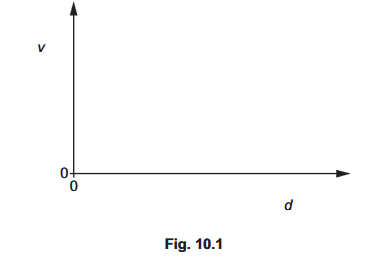
(c) Observations of many galaxies, such as the one in (b), lead to many pairs of values of \(d\) and \(v\). Plotting these values reveals a trend.
(i) On Fig. 10.1, sketch the variation of \(v\) with \(d\). (2 marks)
(ii) State the name of the quantity represented by the gradient of the line in Fig. 10.1. (1 mark)
______________________________________________
Syllabus Topic Codes (Cambridge International AS & A Level Physics 9702 Paper 4):
• 25.3: Hubble’s law and the Big Bang theory — parts (a), (b)(ii), (c)(i) and (c)(ii)
▶️ Answer/Explanation
(a)
Redshift is an increase in the observed wavelength, or a decrease in observed frequency, of radiation from a source moving away from the observer.
Radiation from distant galaxies is observed to be redshifted, showing that the galaxies are moving away from the Earth.
If galaxies are moving apart from one another, this indicates that the Universe is expanding.
Answer: \( \boxed{\text{Redshift shows that distant galaxies are moving away, indicating that the Universe is expanding.}} \)
(b)(i)
The radiant flux \(F\) from a source is related to its luminosity \(L\) and distance \(d\) by
\( F=\frac{L}{4\pi d^2} \)
Rearranging,
\( d=\sqrt{\frac{L}{4\pi F}} \)
Substituting \(L=1.90\times10^{36}\,\mathrm{W}\) and \(F=8.42\times10^{-16}\,\mathrm{W\,m^{-2}}\),
\( d=\sqrt{\frac{1.90\times10^{36}}{4\pi(8.42\times10^{-16})}} \)
\( d=1.34\times10^{25}\,\mathrm{m} \)
Answer: \( \boxed{d=1.34\times10^{25}\,\mathrm{m}} \)
(b)(ii)
For a source moving at speed \(v\), the Doppler redshift relationship for small speeds is
\( \frac{\Delta\lambda}{\lambda}=\frac{v}{c} \)
The change in wavelength is
\( \Delta\lambda=726-658=68\,\mathrm{nm} \)
Therefore,
\( \frac{726-658}{658}=\frac{v}{3.00\times10^8} \)
Rearranging,
\( v=3.00\times10^8\left(\frac{68}{658}\right) \)
\( v=3.10\times10^7\,\mathrm{m\,s^{-1}} \)
Answer: \( \boxed{v=3.1\times10^7\,\mathrm{m\,s^{-1}}} \)
(c)(i)
Hubble’s law states that the recessional speed of a galaxy is directly proportional to its distance from the Earth:
\( v=H_0d \)
Therefore, the graph of \(v\) against \(d\) is a straight line passing through the origin with a positive gradient.
Answer: A straight line through the origin with positive gradient.
(c)(ii)
From Hubble’s law,
\( v=H_0d \)
Comparing this with \(y=mx+c\), the gradient is \(H_0\).
Answer: \( \boxed{\text{Hubble constant }H_0} \)