
Question 1
Topic: 1.2 SI units.png)
What is a reasonable estimate of the weight of an adult human?
(B) \( 7\times10^{2}\,\mathrm{N} \)
(C) \( 7\times10^{4}\,\mathrm{N} \)
(D) \( 7\times10^{6}\,\mathrm{N} \)
▶️ Answer/Explanation
Correct Answer: \( \boxed{\mathrm{B}} \)
The weight of an adult human is typically about \(70\,\mathrm{kg}\).
Using \(W=mg\), \(W\approx70\times9.8\approx686\,\mathrm{N}\), which is approximately \(7\times10^{2}\,\mathrm{N}\).
Therefore, the correct answer is (B).
Question 2
Topic: 1.3 Errors and uncertainties
What describes a set of data with a high precision?
(B) data that is close to the accepted value
(C) data with each value having a low uncertainty
(D) data with repeats that are close to each other
▶️ Answer/Explanation
Correct Answer: \( \boxed{\mathrm{D}} \)
Precision refers to how closely repeated measurements agree with one another.
Accurate data is close to the accepted value, whereas precise data has repeated values that are close together.
Therefore, the correct answer is (D).
Question 3
Topic: 1.2 SI units.png)
Which physical quantity could have units of \( \mathrm{Ns^{2}\,m^{-1}} \)?
(B) force
(C) mass
(D) momentum
▶️ Answer/Explanation
Correct Answer: \( \boxed{\mathrm{C}} \)
Since \( \mathrm{N=kg\,m\,s^{-2}} \),
\( \mathrm{Ns^{2}\,m^{-1}=kg\,m\,s^{-2}\times s^{2}\times m^{-1}=kg} \).
The derived unit is the SI unit of mass.
Therefore, the correct answer is (C).
Question 4
Topic: 1.3 Errors and uncertainties
A ball is released from rest. The distance the ball falls and the time the ball takes to fall that distance are both measured.
The percentage uncertainty in the measured distance is negligible. The percentage uncertainty in the measured time is \(4\%\).
The distance and the time are then used to calculate the acceleration of free fall.
Air resistance is negligible.
What is the percentage uncertainty in the calculated value of the acceleration of free fall?
(B) \(4\%\)
(C) \(8\%\)
(D) \(16\%\)
▶️ Answer/Explanation
Correct Answer: \( \boxed{\mathrm{C}} \)
Using \( s=\dfrac{1}{2}gt^{2} \),
\( g=\dfrac{2s}{t^{2}} \).
The uncertainty in \(s\) is negligible, while \(t\) is squared, so the percentage uncertainty doubles.
Percentage uncertainty in \(g=2\times4\%=8\%\).
Therefore, the correct answer is (C).
Question 5
Topic: 2.1 Equations of motion
A car has an initial velocity \(u\). The car then moves with constant acceleration \(a\) in a straight line through a displacement \(d\). The car reaches a final velocity \(v\).
Which expression gives the initial velocity \(u\) of the car?
(B) \(\sqrt{v^{2}-2ad}\)
(C) \(v+ad\)
(D) \(v-\dfrac{1}{2}ad^{2}\)
▶️ Answer/Explanation
Correct Answer: \( \boxed{\mathrm{B}} \)
Use the equation of motion
\(v^{2}=u^{2}+2ad\).
Rearranging gives
\(u=\sqrt{v^{2}-2ad}\).
Therefore, the correct answer is (B).
Question 6
Topic: 2.1 Equations of motion
A bicycle brakes so that it undergoes uniform deceleration from a speed of \(8\,\mathrm{m\,s^{-1}}\) to \(6\,\mathrm{m\,s^{-1}}\) over a distance of \(7\,\mathrm{m}\).
The deceleration of the bicycle remains constant.
Which further distance will the bicycle travel before coming to rest?
(B) \(9\,\mathrm{m}\)
(C) \(16\,\mathrm{m}\)
(D) \(21\,\mathrm{m}\)
▶️ Answer/Explanation
Correct Answer: \( \boxed{\mathrm{B}} \)
From \(v^{2}=u^{2}+2as\),
\(6^{2}=8^{2}+2a(7)\Rightarrow a=-2\,\mathrm{m\,s^{-2}}\).
For the remaining motion,
\(0=6^{2}+2(-2)s\Rightarrow s=9\,\mathrm{m}\).
Therefore, the correct answer is (B).
Question 7
Topic: 2.1 Equations of motion.png)
The velocity–time graph for an object is shown.
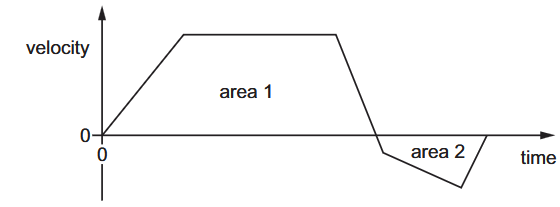
Which expression gives the total displacement of the object?
(B) \(\dfrac{\text{area }1+\text{area }2}{2}\)
(C) area \(1+\) area \(2\)
(D) area \(2-\) area \(1\)
▶️ Answer/Explanation
Correct Answer: \( \boxed{\mathrm{A}} \)
Displacement is the signed area under a velocity–time graph.
Area \(1\) is above the time axis and is positive, while area \(2\) is below the time axis and is negative.
Hence, the total displacement is \( \text{area }1-\text{area }2 \).
Therefore, the correct answer is (A).
Question 8
Topic: 3.1 Momentum and Newton’s laws of motion
Which statement describes the weight of an object?
(B) It is equal to the resultant force when the object falls at terminal (constant) velocity.
(C) It is the force acting on the object due to a gravitational field.
(D) It is the property of the object that resists change in motion.
▶️ Answer/Explanation
Correct Answer: \( \boxed{\mathrm{C}} \)
Weight is the gravitational force acting on an object.
It is given by \(W=mg\), where \(m\) is the mass and \(g\) is the gravitational field strength.
Therefore, the correct answer is (C).
Question 9
Topic: 3.3 Linear momentum and its conservation
What is a statement of the principle of conservation of momentum?
(B) Momentum is the product of mass and velocity.
(C) The force acting on a body is proportional to its rate of change of momentum.
(D) The momentum of an isolated system is constant.
▶️ Answer/Explanation
Correct Answer: \( \boxed{\mathrm{D}} \)
The principle of conservation of momentum states that the total momentum of an isolated system remains constant provided no external resultant force acts on the system.
This applies to all types of collisions, not just elastic collisions.
Therefore, the correct answer is (D).
Question 10
Topic: 3.3 Linear momentum and its conservation.png)
The diagram shows the view from above of two balls moving along a horizontal frictionless surface before they collide. The momentum of each ball is also shown.
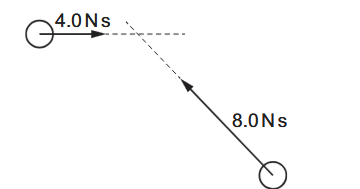
The balls stick together during the collision.
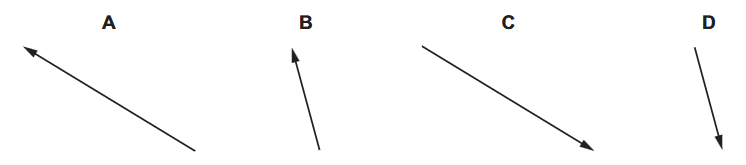
Which vector diagram represents the combined momentum of the balls after the collision?
(B) B
(C) C
(D) D
▶️ Answer/Explanation
Correct Answer: \( \boxed{\mathrm{B}} \)
Momentum is conserved because no external horizontal force acts on the system.
The final momentum is the vector sum of the two initial momenta. Adding the \(4.0\,\mathrm{Ns}\) horizontal momentum to the \(8.0\,\mathrm{Ns}\) diagonal momentum gives a resultant directed upward and slightly to the left.
Therefore, the correct answer is (B).
Question 11
Topic: 3.2 Non-uniform motion
A skydiver is falling at constant velocity. She then opens her parachute. The graph shows the variation with time of her velocity.
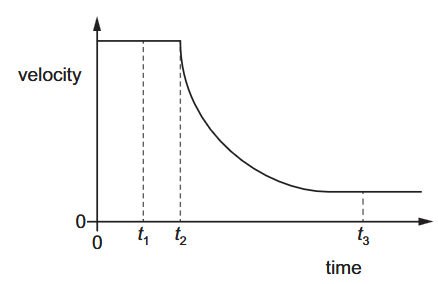
Which statements about the motion of the skydiver are correct?
1 The magnitude of the acceleration is maximum at time \(t_2\).
2 The magnitude of the drag force at time \(t_1\) equals the magnitude of the drag force at time \(t_3\).
3 The magnitude of the drag force is maximum at time \(t_1\).
(B) 1 and 3
(C) 2 only
(D) 3 only
▶️ Answer/Explanation
Correct Answer: \( \boxed{\mathrm{A}} \)
The acceleration is the gradient of the velocity–time graph, and its magnitude is greatest immediately after the parachute opens at \(t_2\).
At both \(t_1\) and \(t_3\), the skydiver is moving at terminal velocity, so the drag force equals the weight in each case.
The drag force is not maximum at \(t_1\); it is greatest just after the parachute opens when the speed is still high and the parachute greatly increases air resistance.
Therefore, the correct answer is (A).
Question 12
Topic: 3.3 Linear momentum and its conservation.png)
Two different blocks, P and Q, slide towards each other on a horizontal frictionless surface. The blocks have an elastic collision.
The diagram shows the velocities of the two blocks immediately after the collision.
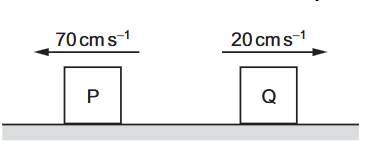
Which row gives possible velocities of the two blocks immediately before the collision?
| Velocity of P | Velocity of Q | |
|---|---|---|
| (A) | \(10\,\mathrm{cm\,s^{-1}}\) to the right | \(60\,\mathrm{cm\,s^{-1}}\) to the left |
| (B) | \(50\,\mathrm{cm\,s^{-1}}\) to the right | zero |
| (C) | \(20\,\mathrm{cm\,s^{-1}}\) to the left | \(70\,\mathrm{cm\,s^{-1}}\) to the right |
| (D) | \(60\,\mathrm{cm\,s^{-1}}\) to the right | \(30\,\mathrm{cm\,s^{-1}}\) to the left |
▶️ Answer/Explanation
Correct Answer: \( \boxed{\mathrm{D}} \)
In an elastic collision, both momentum and kinetic energy are conserved.
The relative speed of approach equals the relative speed of separation.
Only option (D) is consistent with these conservation laws and the given velocities after the collision.
Therefore, the correct answer is (D).
Question 13
Topic: 4.1 Turning effects of forces
Which diagram shows a couple?
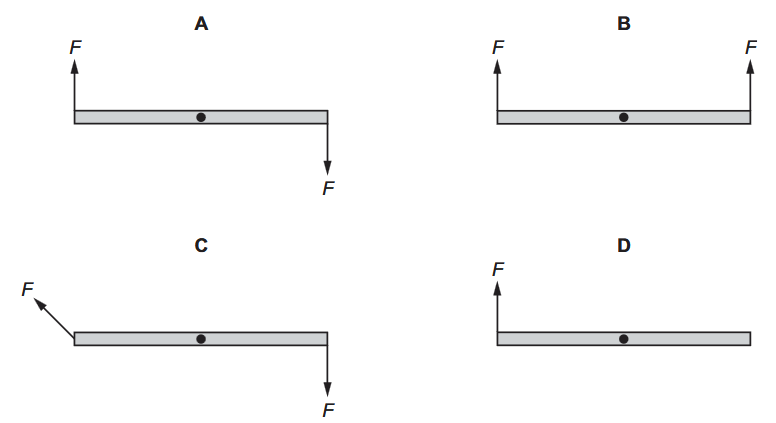
(B) B
(C) C
(D) D
▶️ Answer/Explanation
Correct Answer: \( \boxed{\mathrm{A}} \)
A couple consists of two equal and opposite parallel forces acting along different lines of action.
A couple produces a turning effect (moment) but no resultant force.
Only diagram (A) shows two equal, opposite and parallel forces separated by a perpendicular distance.
Therefore, the correct answer is (A).
Question 14
Topic: 4.1 Turning effects of forces.png)
The diagram shows a uniform bar of mass \(M\) and length \(L\) resting on a pivot at a distance \(x\) from end X.
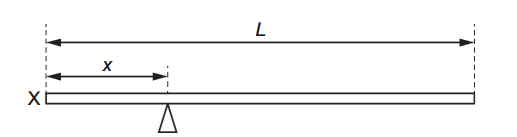
An object of mass \(m\) is placed on the bar at distance \(y\) from the pivot so that the bar is in equilibrium.
What is an expression for \(y\)?
(B) \(\dfrac{M}{m}(L-x)\)
(C) \(\dfrac{M}{2m}(L-2x)\)
(D) \(\dfrac{1}{m}(Lm-xM)\)
▶️ Answer/Explanation
Correct Answer: \( \boxed{\mathrm{C}} \)
For equilibrium, clockwise moment equals anticlockwise moment.
The weight of the bar acts at its centre, a distance \(\dfrac{L}{2}-x\) from the pivot.
Hence, \(mgy=Mg\left(\dfrac{L}{2}-x\right)\).
Therefore, \(y=\dfrac{M}{2m}(L-2x)\), so the correct answer is (C).
Question 15
Topic: 4.3 Density and pressure
The mass and volume of an object are varied.
Which two changes, when made together, must increase the density of the object?
| Mass | Volume | |
|---|---|---|
| (A) | decrease | decrease |
| (B) | decrease | increase |
| (C) | increase | decrease |
| (D) | increase | increase |
▶️ Answer/Explanation
Correct Answer: \( \boxed{\mathrm{C}} \)
Density is given by \( \rho=\dfrac{m}{V} \).
Increasing the mass while decreasing the volume must increase the value of \( \dfrac{m}{V} \).
Therefore, the correct answer is (C).
Question 16
Topic: 4.3 Density and pressure.png)
On Earth, a solid object that is fully submerged in a liquid experiences an upthrust \(U_{\mathrm{E}}\).
On Mars, the same object, fully submerged in the same liquid, experiences an upthrust \(U_{\mathrm{M}}\).
The acceleration of free fall on Mars is \(3.7\,\mathrm{m\,s^{-2}}\).
Assume that the liquid’s density and the object’s volume have the same values on Earth and Mars.
What is the ratio \( \dfrac{U_{\mathrm{M}}}{U_{\mathrm{E}}} \)?
(B) \(1.0\)
(C) \(2.7\)
(D) \(3.6\)
▶️ Answer/Explanation
Correct Answer: \( \boxed{\mathrm{A}} \)
Upthrust is given by \(U=\rho Vg\).
Since the liquid density and displaced volume are unchanged,
\(\dfrac{U_{\mathrm{M}}}{U_{\mathrm{E}}}=\dfrac{g_{\mathrm{M}}}{g_{\mathrm{E}}}=\dfrac{3.7}{9.8}\approx0.38\).
Therefore, the correct answer is (A).
Question 17
Topic: 5.2 Gravitational potential energy and kinetic energy
A student attempts to derive the formula for kinetic energy \(E_{\mathrm{k}}\). She begins by considering an object of mass \(m\) that is initially at rest. A constant force \(F\) applied to the object causes it to accelerate to final velocity \(v\) in displacement \(s\). The kinetic energy gained by the object is equal to the work done on the object by the force \(F\).
Which equation does the student not need in order to derive the formula for \(E_{\mathrm{k}}\)?
(B) \(W=Fs\)
(C) \(E=\dfrac{1}{2}Fs\)
(D) \(v^{2}=u^{2}+2as\)
▶️ Answer/Explanation
Correct Answer: \( \boxed{\mathrm{C}} \)
To derive \(E_{\mathrm{k}}=\dfrac{1}{2}mv^{2}\), use \(F=ma\), \(W=Fs\), and \(v^{2}=u^{2}+2as\).
With \(u=0\), \(a=\dfrac{v^{2}}{2s}\), so
\(E_{\mathrm{k}}=W=Fs=m\left(\dfrac{v^{2}}{2s}\right)s=\dfrac{1}{2}mv^{2}\).
Equation \(E=\dfrac{1}{2}Fs\) is not required.
Therefore, the correct answer is (C).
Question 18
Topic: 5.2 Gravitational potential energy and kinetic energy.png)
A ball falls towards the ground from point X. Point X is \(2.4\,\mathrm{m}\) above the ground.
The ball rebounds from the ground and rises to point Y. Point Y is \(1.8\,\mathrm{m}\) above the ground.
A single value of the change in height \(\Delta h\) is used to calculate the change in gravitational potential energy of the ball from X to Y.
What is the magnitude of \(\Delta h\)?
(B) \(1.8\,\mathrm{m}\)
(C) \(2.4\,\mathrm{m}\)
(D) \(4.2\,\mathrm{m}\)
▶️ Answer/Explanation
Correct Answer: \( \boxed{\mathrm{A}} \)
The change in height is the difference between the initial and final heights.
\(\Delta h=2.4-1.8=0.6\,\mathrm{m}\).
Therefore, the magnitude of \(\Delta h\) is \(0.6\,\mathrm{m}\).
Therefore, the correct answer is (A).
Question 19
Topic: 5.1 Energy conservation
The diagram shows a block on a slope.
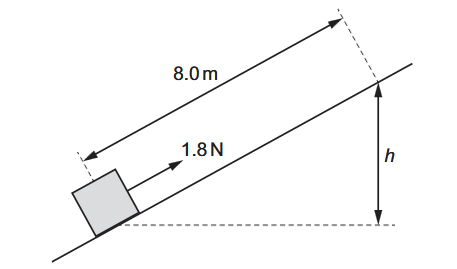
A constant force of \(1.8\,\mathrm{N}\) in a direction parallel to the slope is exerted on the block. This causes the block to move along the slope at a constant speed.
The block moves a distance of \(8.0\,\mathrm{m}\) along the slope and gains height \(h\). The work done against the frictional force acting on the block is \(4.8\,\mathrm{J}\).
The weight of the block is \(4.0\,\mathrm{N}\).
What is the value of \(h\)?
(B) \(2.4\,\mathrm{m}\)
(C) \(3.6\,\mathrm{m}\)
(D) \(4.8\,\mathrm{m}\)
▶️ Answer/Explanation
Correct Answer: \( \boxed{\mathrm{B}} \)
Work done by the applied force is
\(W=Fs=1.8\times8.0=14.4\,\mathrm{J}\).
Since the speed is constant,
\(14.4=4.8+4.0h\).
Hence, \(4.0h=9.6\) and \(h=2.4\,\mathrm{m}\).
Therefore, the correct answer is (B).
Question 20
Topic: 5.1 Energy conservation
The motor of a crane lifts a load of mass \(600\,\mathrm{kg}\). The load rises vertically at a constant speed of \(12\,\mathrm{m}\) per minute.
What is the useful power output of the motor?
(B) \(1.2\,\mathrm{kW}\)
(C) \(7.2\,\mathrm{kW}\)
(D) \(71\,\mathrm{kW}\)
▶️ Answer/Explanation
Correct Answer: \( \boxed{\mathrm{B}} \)
Convert the speed to SI units:
\(v=\dfrac{12}{60}=0.20\,\mathrm{m\,s^{-1}}\).
Power is \(P=Fv=mgv=600\times9.8\times0.20\approx1176\,\mathrm{W}\approx1.2\,\mathrm{kW}\).
Therefore, the correct answer is (B).
Question 21
Topic: 6.1 Stress and strain.png)
A platform is supported by a spring. A box is placed onto the platform. The diagram shows the spring before and after the box is placed onto it.
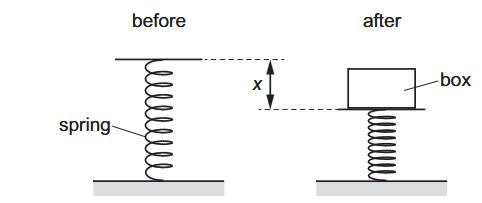
What is the term for the quantity marked as \(x\)?
(B) load
(C) strain
(D) stress
▶️ Answer/Explanation
Correct Answer: \( \boxed{\mathrm{A}} \)
The quantity \(x\) is the decrease in the spring’s length after the load is applied.
This decrease in length is called the compression of the spring.
Therefore, the correct answer is (A).
Question 22
Topic: 6.1 Stress and strain
A copper wire has length \(1.7\,\mathrm{m}\) and uniform diameter \(0.64\,\mathrm{mm}\).
The Young modulus of copper is \(1.2\times10^{11}\,\mathrm{Pa}\).
What is the spring constant of the wire?
(B) \(9.1\times10^{4}\,\mathrm{N\,m^{-1}}\)
(C) \(4.5\times10^{7}\,\mathrm{N\,m^{-1}}\)
(D) \(7.1\times10^{7}\,\mathrm{N\,m^{-1}}\)
▶️ Answer/Explanation
Correct Answer: \( \boxed{\mathrm{A}} \)
For a wire,
\(k=\dfrac{EA}{L}\).
Using \(E=1.2\times10^{11}\,\mathrm{Pa}\), \(L=1.7\,\mathrm{m}\), and \(A=\pi\left(0.32\times10^{-3}\right)^2\,\mathrm{m^2}\),
\(k\approx2.3\times10^{4}\,\mathrm{N\,m^{-1}}\).
Therefore, the correct answer is (A).
Question 23
Topic: 6.2 Elastic and plastic behaviour
The graph shows how the extension of a spring varies with the force used to stretch it.
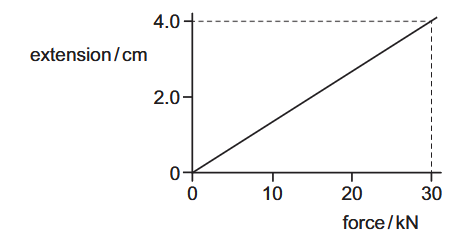
What is the elastic potential energy of the spring when the extension is \(4.0\,\mathrm{cm}\)?
(B) \(120\,\mathrm{J}\)
(C) \(600\,\mathrm{J}\)
(D) \(1200\,\mathrm{J}\)
▶️ Answer/Explanation
Correct Answer: \( \boxed{\mathrm{C}} \)
The elastic potential energy equals the area under the force-extension graph.
At an extension of \(4.0\,\mathrm{cm}=0.040\,\mathrm{m}\), the force is \(30\,\mathrm{kN}=3.0\times10^{4}\,\mathrm{N}\).
\(E=\dfrac{1}{2}Fx=\dfrac{1}{2}\times3.0\times10^{4}\times0.040=600\,\mathrm{J}\).
Therefore, the correct answer is (C).
Question 24
Topic: 7.1 Progressive waves.png)
Which row describes a progressive longitudinal wave?
| transfers energy in a direction parallel to the oscillations | requires a medium to travel through | always travels at the same speed | |
|---|---|---|---|
| (A) | false | false | true |
| (B) | false | true | true |
| (C) | true | false | false |
| (D) | true | true | false |
▶️ Answer/Explanation
Correct Answer: \( \boxed{\mathrm{D}} \)
A progressive longitudinal wave transfers energy in the same direction as the oscillations.
Mechanical longitudinal waves require a material medium to travel through.
The speed of a wave depends on the properties of the medium, so it is not always the same.
Therefore, the correct answer is (D).
Question 25
Topic: 7.1 Progressive waves
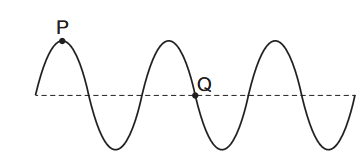
What is the phase difference between points P and Q on the progressive wave shown in the diagram?
(B) \(450^\circ\)
(C) \(540^\circ\)
(D) \(720^\circ\)
▶️ Answer/Explanation
Correct Answer: \( \boxed{\mathrm{B}} \)
Point P is at a crest. Point Q is at the next downward equilibrium crossing after one complete cycle.
The phase difference is one full cycle plus one-quarter cycle:
\(360^\circ+90^\circ=450^\circ\).
Therefore, the correct answer is (B).
Question 26
Topic: 7.1 Progressive waves.png)
The graph shows the variation of displacement with distance for two progressive waves X and Y of the same type in the same medium.
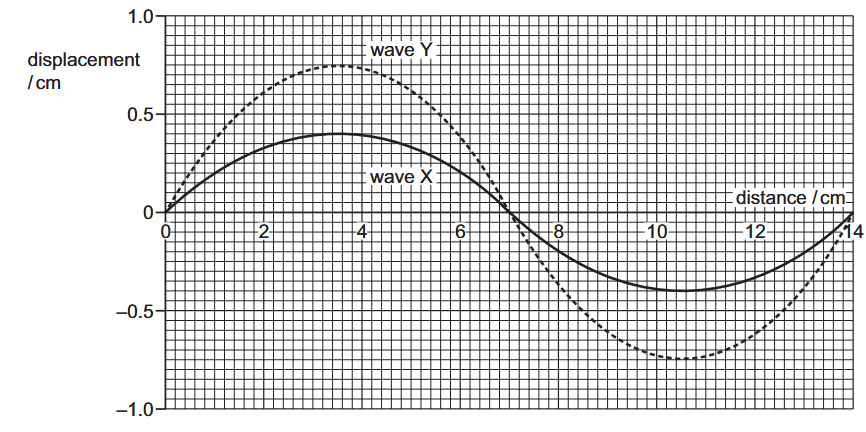
The intensity of wave X is \(I\).
What is the intensity of wave Y?
(B) \(0.53I\)
(C) \(1.9I\)
(D) \(3.5I\)
▶️ Answer/Explanation
Correct Answer: \( \boxed{\mathrm{D}} \)
For waves of the same type in the same medium, intensity is proportional to the square of the amplitude.
\(I\propto A^{2}\).
From the graph, the amplitude of wave X is approximately \(0.40\,\mathrm{cm}\) and the amplitude of wave Y is approximately \(0.75\,\mathrm{cm}\).
Hence, \(\dfrac{I_Y}{I_X}=\left(\dfrac{0.75}{0.40}\right)^2\approx3.5\).
Therefore, the intensity of wave Y is \(3.5I\), so the correct answer is (D).
Question 27
Topic: 7.3 Doppler effect for sound waves.png)
A moving source emits sound of frequency \(1200\,\mathrm{Hz}\).
A stationary observer hears sound of frequency \(960\,\mathrm{Hz}\). The speed of sound is \(340\,\mathrm{m\,s^{-1}}\).
What could be the velocity of the source?
(B) \(68\,\mathrm{m\,s^{-1}}\) directly towards the observer
(C) \(85\,\mathrm{m\,s^{-1}}\) directly away from the observer
(D) \(85\,\mathrm{m\,s^{-1}}\) directly towards the observer
▶️ Answer/Explanation
Correct Answer: \( \boxed{\mathrm{C}} \)
Since the observed frequency is lower than the emitted frequency, the source is moving away from the observer.
Using \(f’=\dfrac{vf}{v+v_s}\),
\(960=\dfrac{340\times1200}{340+v_s}\).
Solving gives \(v_s=85\,\mathrm{m\,s^{-1}}\).
Therefore, the correct answer is (C).
Question 28
Topic: 8.2 Diffraction
A light wave passes through a single slit and a diffraction pattern forms.
What happens to the frequency and the speed of the wave when it is diffracted?
| frequency | speed | |
|---|---|---|
| (A) | decreases | increases |
| (B) | increases | decreases |
| (C) | no change | decreases |
| (D) | no change | no change |
▶️ Answer/Explanation
Correct Answer: \( \boxed{\mathrm{D}} \)
Diffraction changes only the direction of propagation of the wave.
Since the light remains in the same medium, both its frequency and speed remain unchanged.
Therefore, the correct answer is (D).
Question 29
Topic: 8.4 The diffraction grating.png)
The equation \(n\lambda=d\sin\theta\) can be used with a diffraction grating to find the wavelength of visible light.
Which quantity is not correct for use in this equation?
| symbol | quantity | |
|---|---|---|
| (A) | \(d\) | distance from grating to screen |
| (B) | \(\lambda\) | wavelength of light |
| (C) | \(n\) | order of intensity maximum |
| (D) | \(\theta\) | diffraction angle of intensity maximum |
▶️ Answer/Explanation
Correct Answer: \( \boxed{\mathrm{A}} \)
In the equation \(n\lambda=d\sin\theta\), \(d\) is the spacing between adjacent lines of the diffraction grating, not the distance from the grating to the screen.
The other quantities are correctly defined.
Therefore, the correct answer is (A).
Question 30
Topic: 8.1 Stationary waves
Two progressive sound waves move in opposite directions and superpose to form a stationary wave.
Which statement describes an antinode of this stationary wave?
(B) a position where the phase difference between the two waves is always \(180^\circ\)
(C) a position where the stationary wave has maximum amplitude
(D) a position where the stationary wave has minimum amplitude
▶️ Answer/Explanation
Correct Answer: \( \boxed{\mathrm{C}} \)
An antinode is a point on a stationary wave where the oscillation amplitude is greatest.
Nodes have zero amplitude, while antinodes have maximum amplitude.
Therefore, the correct answer is (C).
Question 31
Topic: 8.3 Interference.png)
A student connects two loudspeakers to a signal generator.
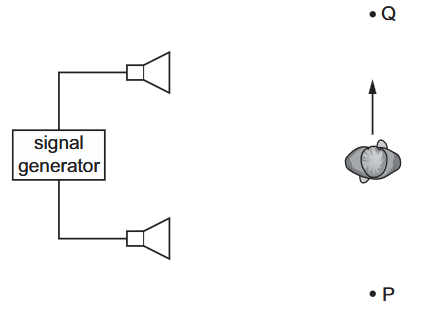
As the student walks from P to Q, he notices that the loudness of the sound rises and falls repeatedly.
What causes the loudness of the sound to vary?
(B) Doppler shift of the sound waves
(C) interference of the sound waves
(D) reflection of the sound waves
▶️ Answer/Explanation
Correct Answer: \( \boxed{\mathrm{C}} \)
The two loudspeakers act as coherent sources, producing regions of constructive and destructive interference.
As the student moves, the path difference changes, so the sound alternates between loud and quiet.
Therefore, the correct answer is (C).
Question 32
Topic: 9.2 Potential difference and power
The current in a resistor of constant resistance is \(8.0\,\mathrm{mA}\). The power dissipated by the resistor is \(P\).
The current in the resistor is increased to \(12.0\,\mathrm{mA}\).
What is the new power dissipated by the resistor?
(B) \(0.67P\)
(C) \(1.5P\)
(D) \(2.3P\)
▶️ Answer/Explanation
Correct Answer: \( \boxed{\mathrm{D}} \)
For a constant resistance, \(P=I^{2}R\).
Therefore,
\(\dfrac{P_{\mathrm{new}}}{P}=\left(\dfrac{12}{8}\right)^{2}=\left(\dfrac{3}{2}\right)^{2}=\dfrac{9}{4}=2.25\approx2.3.\)
Hence, the new power is \(2.3P\).
Therefore, the correct answer is (D).
Question 33
Topic: 9.3 Resistance and resistivity.png)
A piece of wire X has resistivity \(\rho\), length \(L\) and cross-sectional area \(A\). Wire X has a resistance \(R\).
A second piece of wire Y is made of a different metal. It has the same resistance as X but has twice the length of X.
Which row gives possible values for the resistivity and the cross-sectional area of Y?
| resistivity | cross-sectional area | |
|---|---|---|
| (A) | \(\dfrac{1}{2}\rho\) | \(\dfrac{1}{2}A\) |
| (B) | \(\dfrac{1}{2}\rho\) | \(A\) |
| (C) | \(\rho\) | \(\dfrac{1}{2}A\) |
| (D) | \(2\rho\) | \(A\) |
▶️ Answer/Explanation
Correct Answer: \( \boxed{\mathrm{B}} \)
Resistance is given by \(R=\dfrac{\rho L}{A}\).
For wire Y, \(L\) doubles while the resistance remains unchanged.
Using \(\rho_Y=\dfrac{1}{2}\rho\) and \(A_Y=A\),
\(R_Y=\dfrac{\left(\frac{1}{2}\rho\right)(2L)}{A}=\dfrac{\rho L}{A}=R\).
Therefore, the correct answer is (B).
Question 34
Topic: 9.2 Potential difference and power
A cell of electromotive force (e.m.f.) \(E\) delivers a charge \(Q\) to an external circuit.
Which statement is correct?
(B) The energy dissipated within the cell is \(EQ\).
(C) The external resistance is \(EQ\).
(D) The total energy dissipated in the cell and the external circuit is \(EQ\).
▶️ Answer/Explanation
Correct Answer: \( \boxed{\mathrm{D}} \)
The e.m.f. is the energy supplied by the cell per unit charge.
Hence, the total energy supplied by the cell is \(EQ\).
This energy is shared between the external circuit and the internal resistance of the cell.
Therefore, the correct answer is (D).
Question 35
Topic: 10.3 Potential dividers
The diagram shows a circuit with a battery of electromotive force (e.m.f.) \(60\,\mathrm{V}\) and negligible internal resistance, a \(20\,\mathrm{k\Omega}\) resistor, a thermistor and a voltmeter. The resistance of the thermistor is \(20\,\mathrm{k\Omega}\).
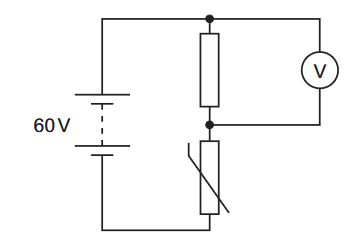
The temperature of the thermistor decreases, and this causes its resistance to change by \(50\%\).
After this change, what is the reading on the voltmeter?
(B) \(24\,\mathrm{V}\)
(C) \(36\,\mathrm{V}\)
(D) \(40\,\mathrm{V}\)
▶️ Answer/Explanation
Correct Answer: \( \boxed{\mathrm{B}} \)
A thermistor has a negative temperature coefficient, so when its temperature decreases, its resistance increases by \(50\%\) to \(30\,\mathrm{k\Omega}\).
The voltmeter is across the \(20\,\mathrm{k\Omega}\) resistor.
Using the potential divider equation,
\(V=60\times\dfrac{20}{20+30}=24\,\mathrm{V}\).
Therefore, the correct answer is (B).
Question 36
Topic: 10.3 Potential dividers.png)
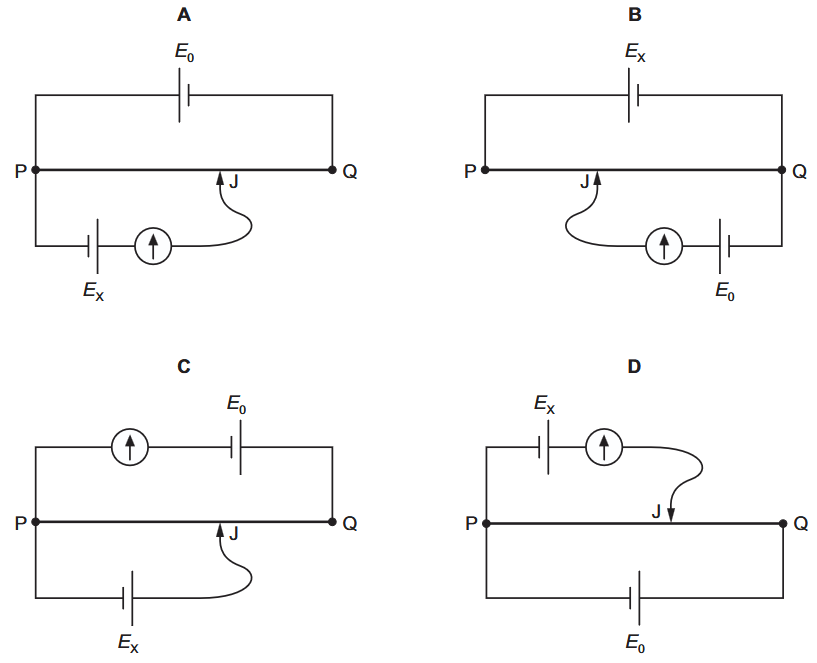
A potentiometer circuit is used to determine the electromotive force (e.m.f.) \(E_x\) of a cell. The circuit includes a second cell of known e.m.f. \(E_0\) and negligible internal resistance, and a uniform resistance wire \(PQ\) of known length.
\(E_x\) is less than \(E_0\).
The movable connection \(J\) can be positioned anywhere along the length of the resistance wire.
Which circuit is suitable for determining \(E_x\)?
(B) B
(C) C
(D) D
▶️ Answer/Explanation
Correct Answer: \( \boxed{\mathrm{D}} \)
The known cell \(E_0\) provides the potential gradient along the uniform wire.
The unknown cell \(E_x\) and galvanometer must be connected so that a null point can be found by moving the contact \(J\).
Only circuit (D) has the correct arrangement for potentiometer operation.
Therefore, the correct answer is (D).
Question 37
Topic: 10.2 Kirchhoff’s laws
The principles of conservation of which two quantities are associated with Kirchhoff’s first and second laws?
| first law | second law | |
|---|---|---|
| (A) | charge | energy |
| (B) | charge | voltage |
| (C) | energy | charge |
| (D) | voltage | charge |
▶️ Answer/Explanation
Correct Answer: \( \boxed{\mathrm{A}} \)
Kirchhoff’s first law is based on the conservation of charge.
Kirchhoff’s second law is based on the conservation of energy.
Therefore, the correct answer is (A).
Question 38
Topic: 11.2 Fundamental particles.png)
An up quark in a hadron changes to a down quark.
The elementary charge is \(e\).
What is the magnitude of the change in the charge of the hadron?
(B) \(\dfrac{2}{3}e\)
(C) \(e\)
(D) zero
▶️ Answer/Explanation
Correct Answer: \( \boxed{\mathrm{C}} \)
An up quark has charge \(+\dfrac{2}{3}e\), while a down quark has charge \(-\dfrac{1}{3}e\).
The change in charge is
\(\left|-\dfrac{1}{3}e-\dfrac{2}{3}e\right|=e\).
Therefore, the correct answer is (C).
Question 39
Topic: 11.1 Atoms, nuclei and radiation
A nucleus of magnesium-23 decays to form a nucleus of sodium-23, emitting a \(\beta^{+}\) particle and particle X.
What is particle X?
(B) an electron
(C) a neutron
(D) a neutrino
▶️ Answer/Explanation
Correct Answer: \( \boxed{\mathrm{D}} \)
In \(\beta^{+}\) decay, a proton changes into a neutron, emitting a positron and an electron neutrino.
The decay equation is
\(p\rightarrow n+\beta^{+}+\nu_{e}\).
Therefore, the correct answer is (D).
Question 40
Topic: 11.1 Atoms, nuclei and radiation
A nucleus of \(^{238}_{92}\mathrm{U}\) decays in stages by emitting \(\alpha\)-particles and \(\beta^{-}\) particles, eventually forming a nucleus of \(^{206}_{82}\mathrm{Pb}\).
How many \(\alpha\)-particles and how many \(\beta^{-}\) particles are emitted during the decay chain?
| \(\alpha\)-particles | \(\beta^{-}\) particles | |
|---|---|---|
| (A) | 8 | 6 |
| (B) | 8 | 10 |
| (C) | 16 | 6 |
| (D) | 16 | 22 |
▶️ Answer/Explanation
Correct Answer: \( \boxed{\mathrm{A}} \)
The mass number decreases from \(238\) to \(206\), a decrease of \(32\).
Each \(\alpha\)-particle reduces the mass number by \(4\), so \(32/4=8\) \(\alpha\)-particles are emitted.
After 8 \(\alpha\)-decays, the atomic number changes from \(92\) to \(76\). To reach \(82\), six \(\beta^{-}\)-decays are required because each \(\beta^{-}\)-decay increases the atomic number by \(1\).
Therefore, the correct answer is (A).