
Question 1
Topic: 1.2 SI units
What is essential to accurately represent all physical quantities?
(B) a unit and a number expressed in standard form (scientific notation)
(C) a unit and a numerical magnitude
(D) an SI unit and a numerical magnitude
▶️ Answer/Explanation
Correct Answer: \( \boxed{\mathrm{C}} \)
Every physical quantity must be stated with both a numerical magnitude and an appropriate unit.
Scientific notation is useful but not always required, and some quantities are not expressed using SI units.
Therefore, the correct answer is (C).
Question 2
Topic: 1.3 Errors and uncertainties
A steel rule can be read to the nearest millimetre. It is used to measure the length of a bar whose true length is \(895\,\mathrm{mm}\). Repeated measurements give the following readings.
\( \text{length/mm} \qquad 892,\;891,\;892,\;891,\;891,\;892 \)
Are the readings accurate and precise to within \(1\,\mathrm{mm}\)?
| results are accurate to within \(1\,\mathrm{mm}\) | results are precise to within \(1\,\mathrm{mm}\) | |
|---|---|---|
| A | no | no |
| B | no | yes |
| C | yes | no |
| D | yes | yes |
▶️ Answer/Explanation
Correct Answer: \( \boxed{\mathrm{B}} \)
The readings are clustered closely together, varying only between \(891\,\mathrm{mm}\) and \(892\,\mathrm{mm}\), so they are precise to within \(1\,\mathrm{mm}\).
However, the true length is \(895\,\mathrm{mm}\), so all readings are about \(3\) to \(4\,\mathrm{mm}\) lower than the true value. Hence, the measurements are not accurate to within \(1\,\mathrm{mm}\).
Therefore, the correct answer is (B).
Question 3
Topic: 1.3 Errors and uncertainties
A stone is released from rest and falls vertically to the ground.
The time taken to fall to the ground and the distance travelled are measured. The measurements are used to determine the acceleration of free fall.
The percentage uncertainty in the measured time is \(0.05\%\). The percentage uncertainty in the measured distance fallen is \(0.6\%\).
What is the percentage uncertainty in the calculated value of the acceleration of free fall?
(B) \(0.7\%\)
(C) \(1.1\%\)
(D) \(1.3\%\)
▶️ Answer/Explanation
Correct Answer: \( \boxed{\mathrm{B}} \)
Using \( s=\dfrac{1}{2}gt^2 \), the acceleration is \( g=\dfrac{2s}{t^2} \).
For multiplication, division and powers, percentage uncertainties are added, taking powers into account.
Percentage uncertainty in \(g\)
\(=0.6\%+2\times0.05\%=0.7\%\).
Therefore, the correct answer is (B).
Question 4
Topic: 3.1 Momentum and Newton’s laws of motion.png)
An object falls from rest towards the ground.
Air resistance is negligible.
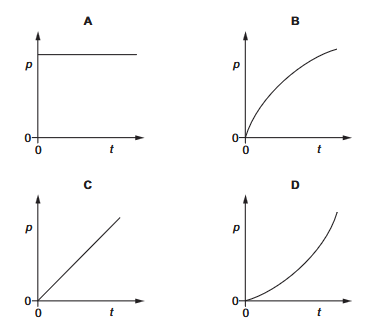
Which graph shows the variation of the momentum \(p\) of the object with time \(t\) until it hits the ground?
(B) B
(C) C
(D) D
▶️ Answer/Explanation
Correct Answer: \( \boxed{\mathrm{C}} \)
With negligible air resistance, the object has constant acceleration \(g\).
Since \(p=mv\) and \(v=gt\), the momentum is \(p=mgt\).
Therefore, momentum increases linearly with time, so the correct graph is (C).
Question 5
Topic: 3.2 Non-uniform motion
A projectile is fired at an angle of \(45^\circ\) upwards from horizontal ground. Air resistance is negligible.
Which row describes the horizontal motion and the vertical motion of the projectile after it is fired until immediately before it reaches the ground again?
| horizontal motion | vertical motion | |
|---|---|---|
| A | constant velocity | constant acceleration |
| B | constant velocity | varying acceleration |
| C | varying velocity | constant acceleration |
| D | varying velocity | varying acceleration |
▶️ Answer/Explanation
Correct Answer: \( \boxed{\mathrm{A}} \)
With negligible air resistance, there is no horizontal force, so the horizontal velocity remains constant.
The vertical motion is affected only by gravity, giving a constant downward acceleration of \(g\).
Therefore, the correct answer is (A).
Question 6
Topic: 2.1 Equations of motion
An aircraft on a runway accelerates uniformly from rest to its take-off speed of \(58\,\mathrm{m\,s^{-1}}\).
The acceleration of the aircraft is \(4.2\,\mathrm{m\,s^{-2}}\), and the aircraft uses \(74\%\) of the length of the runway to reach its take-off speed.
What is the length of the runway?
(B) \(540\,\mathrm{m}\)
(C) \(590\,\mathrm{m}\)
(D) \(800\,\mathrm{m}\)
▶️ Answer/Explanation
Correct Answer: \( \boxed{\mathrm{B}} \)
Using \(v^2=u^2+2as\),
\(s=\dfrac{58^2}{2\times4.2}\approx400\,\mathrm{m}\).
This is \(74\%\) of the runway length.
Runway length \(=\dfrac{400}{0.74}\approx540\,\mathrm{m}\).
Therefore, the correct answer is (B).
Question 7
Topic: 2.1 Equations of motion
How can the acceleration of an object be determined?
(B) from the area under a velocity–time graph
(C) from the gradient of a displacement–time graph
(D) from the gradient of a velocity–time graph
▶️ Answer/Explanation
Correct Answer: \( \boxed{\mathrm{D}} \)
The gradient of a velocity–time graph gives the acceleration of an object.
The area under a velocity–time graph gives displacement, while the gradient of a displacement–time graph gives velocity.
Therefore, the correct answer is (D).
Question 8
Topic: 4.3 Density and pressure
The acceleration of free fall on the Earth is different to the acceleration of free fall on the Moon.
How do the mass and weight of an object on the Earth compare to its mass and weight on the Moon?
| mass | weight | |
|---|---|---|
| A | different | different |
| B | different | same |
| C | same | different |
| D | same | same |
▶️ Answer/Explanation
Correct Answer: \( \boxed{\mathrm{C}} \)
Mass is the amount of matter in an object and remains unchanged regardless of location.
Weight is the gravitational force \(W=mg\), so it depends on the local gravitational field strength.
Therefore, the correct answer is (C).
Question 9
Topic: 4.3 Density and pressure
A sphere moves vertically downwards at terminal (constant) velocity in a liquid.
Which statement about the magnitude of the upthrust acting on the sphere is correct?
(B) It is equal to the weight of the sphere.
(C) It is proportional to the density of the sphere.
(D) It is proportional to the square of the radius of the sphere.
▶️ Answer/Explanation
Correct Answer: \( \boxed{\mathrm{A}} \)
Upthrust is given by \(U=\rho Vg\).
Hence, the upthrust is directly proportional to the acceleration due to gravity \(g\).
At terminal velocity, the weight equals the sum of the upthrust and the drag force, so the upthrust is not equal to the weight.
Therefore, the correct answer is (A).
Question 10
Topic: 3.3 Linear momentum and its conservation.png)
An object of mass \(2.0\,\mathrm{kg}\) is travelling at a speed of \(3.0\,\mathrm{m\,s^{-1}}\) on a horizontal frictionless surface. This object collides head-on with a stationary object of mass \(1.0\,\mathrm{kg}\). The two objects stick together on impact.
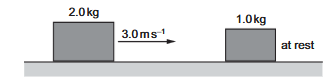
How much kinetic energy is lost on impact?
(B) \(2.0\,\mathrm{J}\)
(C) \(2.4\,\mathrm{J}\)
(D) \(3.0\,\mathrm{J}\)
▶️ Answer/Explanation
Correct Answer: \( \boxed{\mathrm{D}} \)
Initial kinetic energy \(=\dfrac{1}{2}(2.0)(3.0)^2=9.0\,\mathrm{J}\).
By conservation of momentum, the final speed is \(v=\dfrac{2.0\times3.0}{3.0}=2.0\,\mathrm{m\,s^{-1}}\).
Final kinetic energy \(=\dfrac{1}{2}(3.0)(2.0)^2=6.0\,\mathrm{J}\).
Kinetic energy lost \(=9.0-6.0=3.0\,\mathrm{J}\).
Therefore, the correct answer is (D).
Question 11
Topic: 3.3 Linear momentum and its conservation
A moving object \(X\) collides with a stationary object \(Y\).
The objects separate after the collision.
The collision is perfectly elastic and there are no external forces acting.
Which word equation is not correct?
(B) (relative speed of approach of \(X\) and \(Y\)) + (relative speed of separation of \(X\) and \(Y\)) \(=\) zero
(C) (total kinetic energy before collision) \(=\) (total kinetic energy after collision)
(D) (total momentum before collision) \(=\) (total momentum after collision)
▶️ Answer/Explanation
Correct Answer: \( \boxed{\mathrm{B}} \)
For a perfectly elastic collision, the relative speed of approach equals the relative speed of separation, not their sum being zero.
Newton’s third law, conservation of momentum and conservation of kinetic energy are all valid for this collision.
Therefore, the correct answer is (B).
Question 12
Topic: 4.3 Density and pressure.png)
The diagram shows a stationary sphere that is just fully submerged in a liquid. The radius of the sphere is \(r\) and the density of the liquid is \(\rho\). The acceleration due to free fall is \(g\).
The air exerts pressure \(P_A\) on the surface of the liquid.
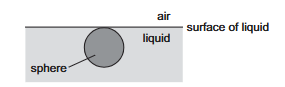
What is the pressure at the lowest point of the sphere?
(B) \(P_A-\dfrac{4}{3}\pi r^3\rho g\)
(C) \(P_A+2r\rho g\)
(D) \(2r\rho g-P_A\)
▶️ Answer/Explanation
Correct Answer: \( \boxed{\mathrm{C}} \)
Pressure in a liquid is given by \(P=P_A+\rho gh\).
Since the sphere is just fully submerged, its highest point is at the liquid surface, so the lowest point is at a depth of \(2r\).
Hence, \(P=P_A+\rho g(2r)=P_A+2r\rho g\).
Therefore, the correct answer is (C).
Question 13
Topic: 4.2 Equilibrium of forces.png)
A uniform rod is attached by a hinge at one end to a wall. The other end of the rod is supported by a wire so that the rod is horizontal and in equilibrium.
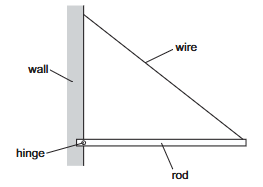
Which arrow shows the direction of the force on the rod from the hinge?
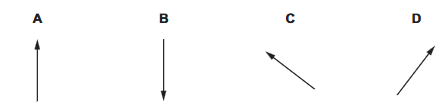
(B) B
(C) C
(D) D
▶️ Answer/Explanation
Correct Answer: \( \boxed{\mathrm{D}} \)
The wire exerts a force on the rod that has an upward and leftward component.
To maintain equilibrium, the hinge must provide a force with rightward and upward components.
Hence, the hinge force acts diagonally upwards to the right.
Therefore, the correct answer is (D).
Question 14
Topic: 4.1 Turning effects of forces
A couple is applied to a tap, as shown.
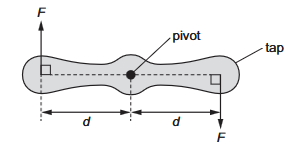
What is the torque of the couple?
(B) \(Fd\)
(C) \(2Fd\)
(D) \(4Fd\)
▶️ Answer/Explanation
Correct Answer: \( \boxed{\mathrm{C}} \)
The torque of a couple equals one of the forces multiplied by the perpendicular distance between their lines of action.
The two forces are separated by a distance \(d+d=2d\).
Hence, the torque is \(F(2d)=2Fd\).
Therefore, the correct answer is (C).
Question 15
Topic: 4.2 Equilibrium of forces.png)
A uniform beam rests on two supports, \(X\) and \(Y\), as shown.
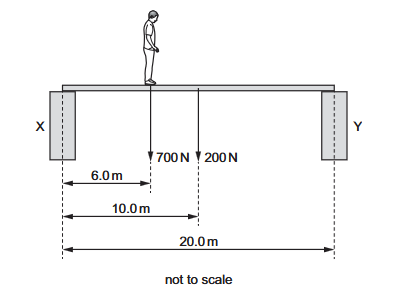
The beam has length \(20.0\,\mathrm{m}\) and weight \(200\,\mathrm{N}\).
A man of weight \(700\,\mathrm{N}\) stands on the beam at a distance of \(6.0\,\mathrm{m}\) from support \(X\).
The beam is in equilibrium.
What is the contact force of support \(X\) on the beam?
(B) \(450\,\mathrm{N}\)
(C) \(590\,\mathrm{N}\)
(D) \(900\,\mathrm{N}\)
▶️ Answer/Explanation
Correct Answer: \( \boxed{\mathrm{C}} \)
Let the reactions at supports \(X\) and \(Y\) be \(R_X\) and \(R_Y\).
Taking moments about \(X\):
\(R_Y(20)=700(6)+200(10)=6200\).
Hence, \(R_Y=310\,\mathrm{N}\).
Using vertical equilibrium,
\(R_X+310=700+200=900\).
Therefore, \(R_X=590\,\mathrm{N}\).
Question 16
Topic: 5.2 Gravitational potential energy and kinetic energy.png)
The diagram shows a block \(P\) of mass \(M\) connected by a string over a frictionless pulley to a block \(Q\) of mass \(m\).
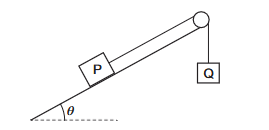
Block \(P\) moves up the slope with a constant velocity \(v\). The slope is at an angle \(\theta\) to the horizontal.
The acceleration due to free fall is \(g\).
The resistive forces on the blocks are negligible.
Which expressions give the energy transferred per unit time to block \(P\)?
1. \(Mgv\)
2. \(Mgv\sin\theta\)
3. \((M+m)gv\)
(B) 1 only
(C) 2 and 3
(D) 2 only
▶️ Answer/Explanation
Correct Answer: \( \boxed{\mathrm{A}} \)
The power delivered to block \(P\) by the tension is \(Tv\). Since the block moves with constant velocity, \(T=Mg\sin\theta\).
Hence, the rate of increase of gravitational potential energy of \(P\) is \(Mg(v\sin\theta)=Mgv\sin\theta\).
Also, the power supplied by the hanging block is \(mgv\), which equals the power transmitted through the string. Thus expressions 1 and 2 are valid in the context of energy transfer.
Therefore, the correct answer is (A).
Question 17
Topic: 5.1 Energy conservation
A toy car travels around a vertical loop track.
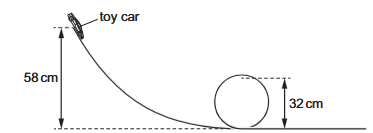
The toy car is released from rest at a height of \(58\,\mathrm{cm}\) above the bottom of the vertical loop.
The car is at a height of \(32\,\mathrm{cm}\) when it is at the top of the vertical loop.
Assume that there are no resistive forces acting on the car.
What is the speed of the car at the top of the vertical loop?
(B) \(2.3\,\mathrm{m\,s^{-1}}\)
(C) \(2.5\,\mathrm{m\,s^{-1}}\)
(D) \(3.4\,\mathrm{m\,s^{-1}}\)
▶️ Answer/Explanation
Correct Answer: \( \boxed{\mathrm{B}} \)
By conservation of mechanical energy,
\(mg(0.58)=mg(0.32)+\dfrac{1}{2}mv^2\).
Hence,
\(\dfrac{1}{2}v^2=g(0.26)\).
Using \(g=9.8\,\mathrm{m\,s^{-2}}\),
\(v=\sqrt{2(9.8)(0.26)}\approx2.3\,\mathrm{m\,s^{-1}}\).
Therefore, the correct answer is (B).
Question 18
Topic: 9.2 Potential difference and power
The total energy supplied to an electric motor is \(E\). Energy \(Q\) is wasted and the remaining energy does useful work.
What is the efficiency of the motor?
(B) \( \left(\dfrac{Q}{E}\right)-1 \)
(C) \( 1-\left(\dfrac{Q}{E}\right) \)
(D) \( \dfrac{1-Q}{E} \)
▶️ Answer/Explanation
Correct Answer: \( \boxed{\mathrm{C}} \)
Efficiency is the ratio of useful energy output to total energy input.
Useful energy \(=E-Q\).
Hence,
\( \eta=\dfrac{E-Q}{E}=1-\dfrac{Q}{E} \).
Therefore, the correct answer is (C).
Question 19
Topic: 5.2 Gravitational potential energy and kinetic energy
An object travels between two points. The change in gravitational potential energy \( \Delta E_p \) of the object is given by
\( \Delta E_p = mg\Delta h \)
where \(m\) is the mass of the object, \(\Delta h\) is its change in height and \(g\) is the acceleration due to free fall.
What is a necessary condition in order for the above equation to be valid?
(B) The object must be travelling in a uniform gravitational field.
(C) The object must be travelling only in a vertical direction.
(D) The resultant force on the object must be equal to its weight.
▶️ Answer/Explanation
Correct Answer: \( \boxed{\mathrm{B}} \)
The equation \( \Delta E_p=mg\Delta h \) assumes that the gravitational field strength \(g\) is constant.
This is true only in a uniform gravitational field.
Therefore, the correct answer is (B).
Question 20
Topic: 6.1 Stress and strain.png)
A cylindrical steel rod with negligible weight has a diameter of \(1.5\,\mathrm{cm}\) and a length of \(5.2\,\mathrm{cm}\).
The rod is firmly attached at the top end.
The rod is firmly attached to a machine at the other end that applies a constant force of \(363\,\mathrm{N}\) to the rod.
This causes the rod to extend to a length of \(7.4\,\mathrm{cm}\) and to have a minimum diameter of \(0.60\,\mathrm{cm}\) in the position shown.
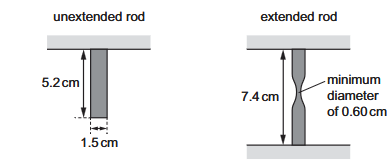
What is the maximum stress acting on the steel rod when the length is \(7.4\,\mathrm{cm}\)?
(B) \(3.2\times10^{5}\,\mathrm{Pa}\)
(C) \(5.7\times10^{5}\,\mathrm{Pa}\)
(D) \(1.3\times10^{7}\,\mathrm{Pa}\)
▶️ Answer/Explanation
Correct Answer: \( \boxed{\mathrm{D}} \)
Stress is given by
\( \sigma=\dfrac{F}{A} \).
The minimum cross-sectional area occurs where the diameter is \(0.60\,\mathrm{cm}=0.0060\,\mathrm{m}\).
\(A=\dfrac{\pi(0.0060)^2}{4}=2.83\times10^{-5}\,\mathrm{m^2}\).
Hence,
\( \sigma=\dfrac{363}{2.83\times10^{-5}}\approx1.28\times10^{7}\,\mathrm{Pa}\).
Therefore, the correct answer is (D).
Question 21
Topic: 6.2 Elastic and plastic behaviour.png)
The graph shows the variation in extension with force for a sample of rubber.
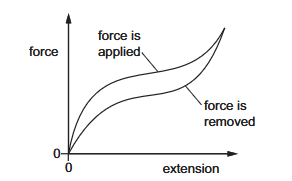
The top line shows the variation in extension as a force is applied.
The bottom line shows the variation in extension as the force is removed.
What is represented by the area between the two lines?
(B) the work done as the force is applied minus the work done as the force is removed
(C) the work done as the force is removed
(D) the work done as the force is removed plus the work done as the force is applied
▶️ Answer/Explanation
Correct Answer: \( \boxed{\mathrm{B}} \)
The area under a force-extension graph represents the work done.
The area between the loading and unloading curves is the difference between the work done during loading and the work recovered during unloading.
This is the energy dissipated as heat due to hysteresis.
Therefore, the correct answer is (B).
Question 22
Topic: 6.2 Elastic and plastic behaviour
Two identical springs have the same spring constant \(k\). The springs are connected in parallel. The length of the unstretched springs is \(x\).
A force \(F\) is applied to the spring combination. The length of the springs is now \(y\).
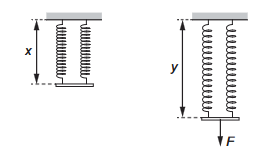
Both springs are deformed within their limits of proportionality.
Which expression gives the elastic potential energy stored in one of the springs?
(B) \( \dfrac{1}{2}F(y-x) \)
(C) \( \dfrac{1}{4}k(y-x)^2 \)
(D) \( k(y-x)^2 \)
▶️ Answer/Explanation
Correct Answer: \( \boxed{\mathrm{A}} \)
The extension of each spring is \(y-x\).
Since the springs are identical and connected in parallel, each carries a force of \(F/2\).
The elastic potential energy in one spring is
\(E=\dfrac{1}{2}\times\dfrac{F}{2}\times(y-x)=\dfrac{1}{4}F(y-x)\).
Therefore, the correct answer is (A).
Question 23
Topic: 6.1 Stress and strain
Which expression gives the formula for the spring constant?
(B) \(2Fx^2\)
(C) \( \dfrac{F}{x} \)
(D) \( \dfrac{F}{x^2} \)
▶️ Answer/Explanation
Correct Answer: \( \boxed{\mathrm{C}} \)
Hooke’s law states that \(F=kx\).
Rearranging gives
\(k=\dfrac{F}{x}\).
Therefore, the correct answer is (C).
Question 24
Topic: 7.1 Progressive waves.png)
A transverse progressive wave travels along a string.
The graph shows the variation with distance of the displacement of the string at time \(t=0\).
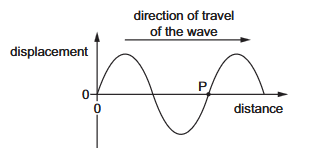
Which graph represents the variation with time of the velocity of point \(P\) on the string?
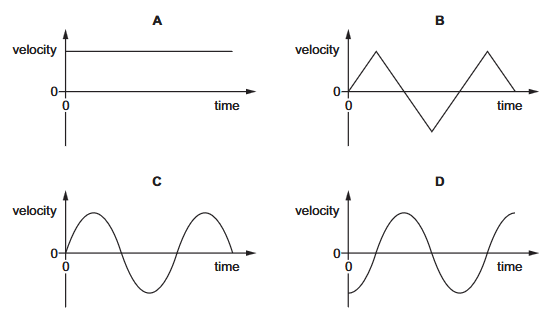
(B) B
(C) C
(D) D
▶️ Answer/Explanation
Correct Answer: \( \boxed{\mathrm{D}} \)
For a wave travelling to the right, the particle velocity is opposite in sign to the slope of the displacement-distance graph.
At point \(P\), the displacement is zero with a positive slope, so the particle initially has a negative velocity.
The particle velocity varies sinusoidally with time.
Therefore, the correct answer is (D).
Question 25
Topic: 7.4 Electromagnetic spectrum
Which statement about electromagnetic waves is correct?
(B) They can all travel at different speeds in free space.
(C) They cannot be polarised.
(D) They consist of vibrating atoms.
▶️ Answer/Explanation
Correct Answer: \( \boxed{\mathrm{A}} \)
A wavelength of \(5.0\times10^{-6}\,\mathrm{m}\) (\(5\,\mu\mathrm{m}\)) lies in the infrared region, which is invisible to the human eye.
All electromagnetic waves travel at the same speed in free space, they can be polarised, and they are oscillations of electric and magnetic fields rather than vibrating atoms.
Therefore, the correct answer is (A).
Question 26
Topic: 8.2 Diffraction
For a progressive transverse wave, what describes the term diffraction?
(B) the spreading of a wave as it passes through a gap or around an obstacle
(C) when oscillations of a wave are confined to one plane
(D) the resultant displacement of two waves is equal to the sum of the displacements of the individual waves when the waves meet
▶️ Answer/Explanation
Correct Answer: \( \boxed{\mathrm{B}} \)
Diffraction is the spreading of waves when they pass through a gap or around the edge of an obstacle.
The other options describe the Doppler effect, polarisation and the principle of superposition.
Therefore, the correct answer is (B).
Question 27
Topic: 7.3 Doppler effect for sound waves
An aircraft flies at a velocity \(v_s\) directly away from a stationary observer.
The aircraft emits a sound of constant frequency.
The speed of sound in air is \(v\).
The frequency of the sound heard by the observer on the ground is \(500\,\mathrm{Hz}\).
The speed of the aircraft is increased so that it flies away from the observer at a greater velocity.
The observer now hears a sound of frequency \(250\,\mathrm{Hz}\).
Which expression gives the new velocity of the aircraft?
(B) \(\dfrac{v+v_s}{2}\)
(C) \(2v_s+v\)
(D) \(2v_s-v\)
▶️ Answer/Explanation
Correct Answer: \( \boxed{\mathrm{C}} \)
For a source moving away, \(f’ = f\dfrac{v}{v+v_s}\).
Halving the observed frequency requires doubling the denominator:
\(v+v_{\text{new}}=2(v+v_s)\).
Hence, \(v_{\text{new}}=v+2v_s\).
Therefore, the correct answer is (C).
Question 28
Topic: 7.5 Polarisation
What may be observed with light waves but not with sound waves?
(B) interference
(C) polarisation
(D) reflection
▶️ Answer/Explanation
Correct Answer: \( \boxed{\mathrm{C}} \)
Only transverse waves can be polarised.
Light is a transverse electromagnetic wave, whereas sound in air is a longitudinal wave.
Therefore, the correct answer is (C).
Question 29
Topic: 8.1 Stationary waves
A wire is fixed at both ends and is vibrated by a source of frequency \(f\). A stationary wave is formed on the wire with a total of two antinodes.
The frequency of the source is increased to \(3f\) and a new stationary wave is formed.
What is the total number of antinodes on the new wave?
(B) 5
(C) 6
(D) 9
▶️ Answer/Explanation
Correct Answer: \( \boxed{\mathrm{C}} \)
The number of antinodes equals the harmonic number.
Two antinodes correspond to the second harmonic.
Tripling the frequency gives the sixth harmonic, which has six antinodes.
Therefore, the correct answer is (C).
Question 30
Topic: 8.4 The diffraction grating
A parallel beam of red light of wavelength \(700\,\mathrm{nm}\) is incident normally on a diffraction grating that has \(400\) lines per millimetre.
What is the total number of intensity maxima from the grating?
(B) 7
(C) 8
(D) 9
▶️ Answer/Explanation
Correct Answer: \( \boxed{\mathrm{B}} \)
The grating spacing is
\(d=\dfrac{1}{400\times10^3}=2.5\times10^{-6}\,\mathrm{m}\).
Using \(d\sin\theta=n\lambda\), the maximum order is
\(n_{\max}=\left\lfloor\dfrac{d}{\lambda}\right\rfloor=\left\lfloor\dfrac{2.5\times10^{-6}}{700\times10^{-9}}\right\rfloor=3\).
Total maxima \(=2n_{\max}+1=2(3)+1=7\).
Therefore, the correct answer is (B).
Question 31
Topic: 8.3 Interference
Two light sources are used to produce an interference pattern.
Interference fringes appear when the two sources emit waves that are coherent.
What is meant by coherent waves?
(B) The two waves are emitted with constant phase difference.
(C) The two waves are emitted with the same intensity.
(D) The two waves are emitted with zero phase difference.
▶️ Answer/Explanation
Correct Answer: \( \boxed{\mathrm{B}} \)
Coherent waves maintain a constant phase difference and have the same frequency.
A zero phase difference is not required; any constant phase difference will produce a stable interference pattern.
Therefore, the correct answer is (B).
Question 32
Topic: 9.3 Resistance and resistivity.png)
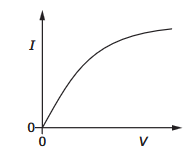
Which component has the \(I\)–\(V\) graph shown?
(B) metallic conductor at constant temperature
(C) resistor of fixed resistance
(D) semiconductor diode
▶️ Answer/Explanation
Correct Answer: \( \boxed{\mathrm{A}} \)
As the current increases, the filament becomes hotter, causing its resistance to increase.
The current therefore increases less rapidly with increasing voltage, giving a curve with a decreasing gradient.
Therefore, the correct answer is (A).
Question 33
Topic: 10.3 Potential dividers.png)
The diagram shows an electrical circuit containing a light-dependent resistor (LDR).
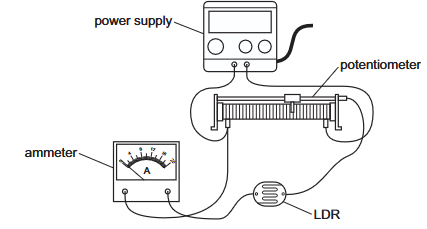
What is the circuit diagram for this circuit?
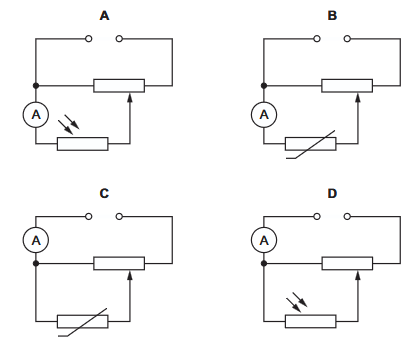
(B) B
(C) C
(D) D
▶️ Answer/Explanation
Correct Answer: \( \boxed{\mathrm{A}} \)
The circuit contains an LDR, a potentiometer used as a variable resistor, and an ammeter connected in series with the LDR.
Only circuit (A) correctly shows these components connected as in the photograph.
Therefore, the correct answer is (A).
Question 34
Topic: 9.2 Potential difference and power
A copper wire of length \(2\,\mathrm{m}\) has a circular cross-section. There is a constant current in the wire when it is connected to a mobile phone in order to charge the battery.
The wire has a fault. A \(1\,\mathrm{m}\) length of the wire has half the diameter of the other \(1\,\mathrm{m}\) length.
The power dissipated in the thicker length of wire is \(P\).
What is the power dissipated in the thinner length of wire?
(B) \( \dfrac{1}{2}P \)
(C) \(2P\)
(D) \(4P\)
▶️ Answer/Explanation
Correct Answer: \( \boxed{\mathrm{D}} \)
Since both sections carry the same current, \(P=I^2R\).
For wires of equal length and material, \(R\propto\dfrac{1}{A}\).
Halving the diameter reduces the cross-sectional area by a factor of \(4\), so the resistance becomes four times larger.
Hence, the thinner section dissipates four times the power of the thicker section.
Therefore, the correct answer is (D).
Question 35
Topic: 9.1 Electric current
A wire carries a current of \(5.6\,\mathrm{A}\).
What is the number of conduction electrons that pass a point on the wire in a time of \(20\,\mathrm{s}\)?
(B) \(2.2\times10^{19}\)
(C) \(3.5\times10^{19}\)
(D) \(7.0\times10^{20}\)
▶️ Answer/Explanation
Correct Answer: \( \boxed{\mathrm{D}} \)
The charge passing the point is
\(Q=It=5.6\times20=112\,\mathrm{C}\).
The number of electrons is
\(n=\dfrac{Q}{e}=\dfrac{112}{1.60\times10^{-19}}\approx7.0\times10^{20}\).
Therefore, the correct answer is (D).
Question 36
Topic: 10.1 Practical circuits.png)
Four resistors of resistance \(R\), \(2R\), \(3R\) and \(4R\) are connected to form a network.
A battery of negligible internal resistance and a voltmeter are connected to the resistor network as shown.
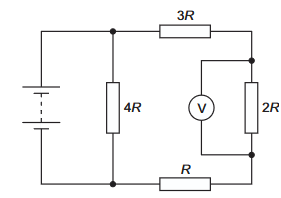
The voltmeter reading is \(2\,\mathrm{V}\).
What is the electromotive force (e.m.f.) of the battery?
(B) \(4\,\mathrm{V}\)
(C) \(6\,\mathrm{V}\)
(D) \(10\,\mathrm{V}\)
▶️ Answer/Explanation
Correct Answer: \( \boxed{\mathrm{C}} \)
The voltmeter measures the potential difference across the \(2R\) resistor.
Hence,
\(V_{2R}=I(2R)=2\,\mathrm{V}\)
\(\Rightarrow IR=1\,\mathrm{V}\)
Therefore, the potential differences across the other series resistors are
\(V_{3R}=I(3R)=3IR=3\,\mathrm{V}\)
\(V_{R}=I(R)=IR=1\,\mathrm{V}\)
The total potential difference across the series branch is
\(V_{\text{branch}}=V_{3R}+V_{2R}+V_R=3+2+1=6\,\mathrm{V}\)
Since this branch is connected directly across the battery,
\(E=V_{\text{branch}}=6\,\mathrm{V}\)
Therefore, the correct answer is (C).
Question 37
Topic: 10.1 Practical circuits.png)
The circuit diagram shows a battery with internal resistance \(r\), two resistors, a switch and a voltmeter. The switch is open.
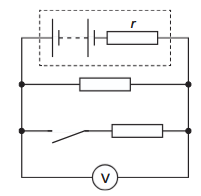
The switch is now closed.
What happens to the current in the battery, and what happens to the reading on the voltmeter, when the switch is closed?
| current in battery | reading on voltmeter | |
|---|---|---|
| A | increases | decreases |
| B | increases | remains the same |
| C | remains the same | decreases |
| D | remains the same | remains the same |
▶️ Answer/Explanation
Correct Answer: \( \boxed{\mathrm{A}} \)
Closing the switch places another resistor in parallel, reducing the external resistance.
The current supplied by the battery therefore increases.
The larger current produces a greater voltage drop across the internal resistance \(r\), so the terminal potential difference measured by the voltmeter decreases.
Therefore, the correct answer is (A).
Question 38
Topic: 11.2 Fundamental particles
What is the correct equation for \( \beta^{+} \) decay?
(B) neutron \( \rightarrow \) proton \(+\) electron \(+\) electron neutrino
(C) proton \( \rightarrow \) neutron \(+\) positron \(+\) electron antineutrino
(D) proton \( \rightarrow \) neutron \(+\) positron \(+\) electron neutrino
▶️ Answer/Explanation
Correct Answer: \( \boxed{\mathrm{D}} \)
In \( \beta^{+} \) decay, a proton changes into a neutron, emitting a positron and an electron neutrino.
The decay equation is
\(p \rightarrow n + e^{+} + \nu_e\).
Therefore, the correct answer is (D).
Question 39
Topic: 11.1 Atoms, nuclei and radiation
A nucleus of polonium, \(^{214}_{84}\mathrm{Po}\), decays by emitting an \(\alpha\)-particle to become a nucleus of lead.
The nucleus of lead is also unstable and decays by emitting a \( \beta^{-} \) particle to form a nucleus of bismuth which then decays by emitting a \( \beta^{-} \) particle to produce a nucleus \(X\).
What is the number of neutrons in nucleus \(X\)?
(B) 128
(C) 130
(D) 210
▶️ Answer/Explanation
Correct Answer: \( \boxed{\mathrm{A}} \)
After \(\alpha\)-decay:
\(^{214}_{84}\mathrm{Po}\rightarrow{}^{210}_{82}\mathrm{Pb}\).
Each \( \beta^{-} \) decay increases the atomic number by \(1\) while the mass number remains \(210\).
After two \( \beta^{-} \) decays, nucleus \(X\) is \(^{210}_{84}\mathrm{Po}\).
Number of neutrons \(=210-84=126\).
Therefore, the correct answer is (A).
Question 40
Topic: 11.2 Fundamental particles
Which combination of three quarks has no overall charge?
(B) up, charm, strange
(C) up, charm, top
(D) up, down, strange
▶️ Answer/Explanation
Correct Answer: \( \boxed{\mathrm{D}} \)
Up-type quarks (\(u\), \(c\), \(t\)) each have charge \(+\dfrac{2}{3}e\).
Down-type quarks (\(d\), \(s\), \(b\)) each have charge \(-\dfrac{1}{3}e\).
For option (D), the total charge is
\(+\dfrac{2}{3}e-\dfrac{1}{3}e-\dfrac{1}{3}e=0\).
Therefore, the correct answer is (D).