
Question 1
(a) Define acceleration. (1 mark)
_____________________
(b) A rocket is launched vertically from the surface of the Earth.
Fig. 1.1 shows the variation of the velocity of the rocket with time for the first 20 s after its launch.
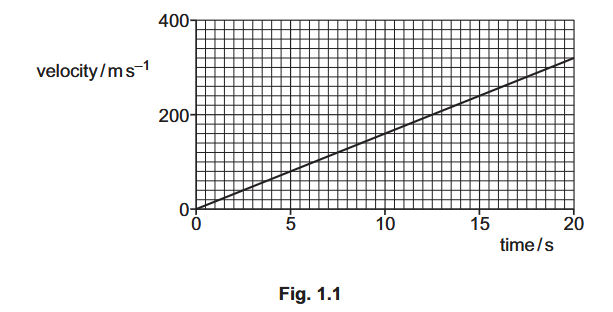
(i) Determine the acceleration of the rocket. (1 mark)
acceleration = ______________________________ \( \mathrm{m\,s^{-2}} \)
(ii) Show that the height of the rocket above the surface of the Earth at a time 20 s after launch is 3.2 km. (2 marks)
________________________________
(c) The mass of the rocket in (b) is \(2.9\times10^6\,\mathrm{kg}\). Assume that this mass remains constant.
For this rocket, from launch to its height at a time of 20 s after launch:
(i) calculate the gain in gravitational potential energy \( \Delta E_{\mathrm{P}} \). (2 marks)
\(\Delta E_{\mathrm{P}}=\) __________________________________________ \( \mathrm{J} \)
(ii) calculate the gain in kinetic energy \( \Delta E_{\mathrm{K}} \). (2 marks)
\(\Delta E_{\mathrm{K}}=\) __________________________________________ \( \mathrm{J} \)
(iii) determine the average power output of the rocket engines. Assume that resistive forces are negligible. (2 marks)
power = __________________________________________ \( \mathrm{W} \)
Syllabus Topic Codes (Cambridge International AS & A Level Physics 9702):
• 5.1: Energy conservation — part (c)(iii)
• 5.2: Gravitational potential energy and kinetic energy — parts (c)(i) and (c)(ii)
▶️ Answer/Explanation
(a) Definition of acceleration [1 mark]
Acceleration is the rate of change of velocity.
Answer: \( \boxed{\text{rate of change of velocity}} \)
(b)(i) Acceleration of the rocket [1 mark]
Acceleration is the gradient of the velocity-time graph:
\( \text{acceleration}=\frac{\Delta v}{\Delta t} \)
\( a=\frac{320}{20} \)
\( a=16\,\mathrm{m\,s^{-2}} \)
Answer: \( \boxed{16\,\mathrm{m\,s^{-2}}} \)
(b)(ii) Height of the rocket after 20 s [2 marks]
The height travelled is equal to the area under the velocity-time graph.
The graph forms a triangle, so
\( s=\frac{1}{2}\times\text{base}\times\text{height} \)
\( s=\frac{1}{2}\times20\times320 \)
\( s=3200\,\mathrm{m} \)
\( s=3.2\,\mathrm{km} \)
Answer: \( \boxed{3.2\,\mathrm{km}} \)
(c)(i) Gain in gravitational potential energy [2 marks]
The gain in gravitational potential energy is
\( \Delta E_{\mathrm{P}}=mg\Delta h \)
Using \(m=2.9\times10^6\,\mathrm{kg}\), \(g=9.81\,\mathrm{m\,s^{-2}}\) and \(\Delta h=3200\,\mathrm{m}\):
\( \Delta E_{\mathrm{P}} =(2.9\times10^6)(9.81)(3200) \)
\( \Delta E_{\mathrm{P}}=9.1\times10^{10}\,\mathrm{J} \)
Answer: \( \boxed{9.1\times10^{10}\,\mathrm{J}} \)
(c)(ii) Gain in kinetic energy [2 marks]
The rocket starts from rest, so its initial kinetic energy is zero. At 20 s, its speed is \(320\,\mathrm{m\,s^{-1}}\).
Therefore,
\( \Delta E_{\mathrm{K}}=\frac{1}{2}m\Delta(v^2) \)
\( \Delta E_{\mathrm{K}} =\frac{1}{2}(2.9\times10^6)(320)^2 \)
\( \Delta E_{\mathrm{K}}=1.5\times10^{11}\,\mathrm{J} \)
Answer: \( \boxed{1.5\times10^{11}\,\mathrm{J}} \)
(c)(iii) Average power output of the rocket engines [2 marks]
Since resistive forces are negligible, the work done by the rocket engines is equal to the total increase in mechanical energy.
\( W=\Delta E_{\mathrm{P}}+\Delta E_{\mathrm{K}} \)
\( W=9.1\times10^{10}+1.5\times10^{11} \)
\( W=2.41\times10^{11}\,\mathrm{J} \)
Average power is
\( P=\frac{W}{t} \)
\( P=\frac{2.41\times10^{11}}{20} \)
\( P=1.2\times10^{10}\,\mathrm{W} \)
Answer: \( \boxed{1.2\times10^{10}\,\mathrm{W}} \)
Question 2
(a) (i) Define pressure. (1 mark)
_____________________
(ii) Explain how hydrostatic pressure results in an upthrust force acting on a solid object immersed in a liquid. (2 marks)
_____________________
(b) A small steel ball of radius \(r\) and mass \(m\) falls vertically at terminal speed \(v\) through oil.
The viscous drag force \(D\) that acts on the ball is given by
\(D=6\pi\eta rv\)
where \(\eta\) is a property of the oil called its viscosity.
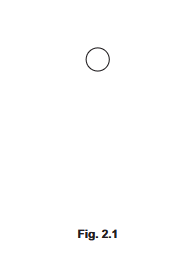
(i) On Fig. 2.1, draw labelled arrows from the ball to show the directions of the three forces that act on the ball as it falls. (3 marks)
(ii) Determine the SI base units of \(\eta\). (2 marks)
base units = ___________________
(c) The oil in (b) has a density of \(920\,\mathrm{kg\,m^{-3}}\) and a viscosity of \(4.7\) in SI units.
The steel ball has a mass of \(2.4\times10^{-3}\,\mathrm{kg}\) and a radius of \(4.2\times10^{-3}\,\mathrm{m}\).
(i) Show that the upthrust force acting on the ball is \(2.8\times10^{-3}\,\mathrm{N}\). (1 mark)
__________________________________
(ii) Determine the terminal speed of the ball. (3 marks)
\(v=\) __________________________________________ \( \mathrm{m\,s^{-1}} \)
Syllabus Topic Codes (Cambridge International AS & A Level Physics 9702):
• 3.2: Non-uniform motion — parts (b)(i) and (c)(ii)
• 4.3: Density and pressure — parts (a)(i), (a)(ii) and (c)(i)
▶️ Answer/Explanation
(a)(i) Definition of pressure [1 mark]
Pressure is the normal force per unit cross-sectional area.
\( p=\frac{F}{A} \)
Answer: \( \boxed{\text{normal force per unit cross-sectional area}} \)
(a)(ii) Hydrostatic pressure and upthrust [2 marks]
Hydrostatic pressure increases with depth. Therefore, there is a difference in pressure between the top and bottom of the immersed object.
The greater pressure at the bottom produces a greater upward force than the downward force produced by the pressure at the top. Hence, the resultant force is upwards and is called upthrust.
Answer: \( \boxed{\text{The pressure is greater at the bottom, producing a resultant upward force.}} \)
(b)(i) Forces acting on the falling ball [3 marks]
The three forces acting on the ball are:
• Weight acting vertically downwards.
• Upthrust acting vertically upwards.
• Viscous drag acting vertically upwards because the ball is moving downwards through the oil.
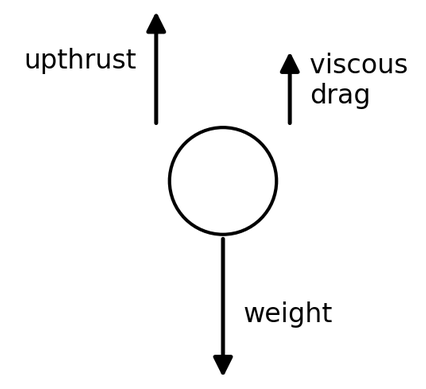
Answer: \( \boxed{\text{downward weight; upward upthrust; upward viscous drag}} \)
(b)(ii) SI base units of viscosity [2 marks]
From
\( D=6\pi\eta rv \)
The SI base units of force are
\( [D]=\mathrm{kg\,m\,s^{-2}} \)
Therefore,
\( [\eta]=\frac{\mathrm{kg\,m\,s^{-2}}}{\mathrm{m}\times\mathrm{m\,s^{-1}}} \)
\( [\eta]=\mathrm{kg\,m^{-1}\,s^{-1}} \)
Answer: \( \boxed{\mathrm{kg\,m^{-1}\,s^{-1}}} \)
(c)(i) Upthrust force [1 mark]
The upthrust is equal to the weight of oil displaced:
\( F_{\mathrm{up}}=\rho Vg \)
For a spherical ball,
\( V=\frac{4}{3}\pi r^3 \)
Hence,
\( F_{\mathrm{up}} =920\times\frac{4}{3}\pi(4.2\times10^{-3})^3\times9.81 \)
\( F_{\mathrm{up}}=2.8\times10^{-3}\,\mathrm{N} \)
Answer: \( \boxed{2.8\times10^{-3}\,\mathrm{N}} \)
(c)(ii) Terminal speed [3 marks]
At terminal speed, the resultant force is zero. Therefore, the weight is equal to the sum of the upthrust and viscous drag:
\( \text{weight}=\text{drag}+\text{upthrust} \)
The weight of the ball is
\( W=mg=(2.4\times10^{-3})(9.81) \)
Using \(D=6\pi\eta rv\):
\( (2.4\times10^{-3}\times9.81) =(2.8\times10^{-3})+ (6\pi\times4.7\times4.2\times10^{-3}\times v) \)
Solving for \(v\),
\( v=0.056\,\mathrm{m\,s^{-1}} \)
Answer: \( \boxed{0.056\,\mathrm{m\,s^{-1}}} \)
Question 3
A wire has length \(L\) and cross-sectional area \(A\). The wire is made from a metal that has Young modulus \(E\) and resistivity \(\rho\).
(a) Define the Young modulus of a material. (1 mark)
________________________________
(b) (i) State an expression, in terms of some or all of \(L\), \(A\), \(E\) and \(\rho\), for the resistance \(R_0\) of the wire. (1 mark)
\(R_0=\) __________________________
(ii) Show that the spring constant \(k_0\) of the wire is given by \(k_0=\dfrac{EA}{L}\). (2 marks)
___________________________________
(c) The wire is stretched, within the limit of proportionality, by a tensile force \(F\). Assume that any changes to the cross-sectional area of the wire are negligible.
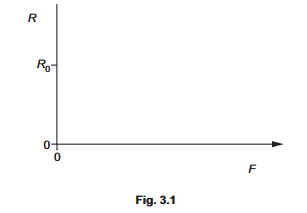
(i) On Fig. 3.1, sketch the variation with \(F\) of the resistance \(R\) of the wire. (1 mark)
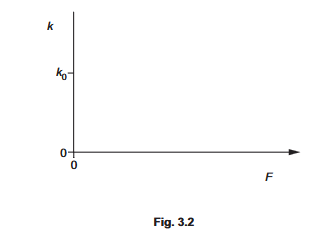
(ii) On Fig. 3.2, sketch the variation with \(F\) of the spring constant \(k\) of the wire. (1 mark)
(d) Copper has a resistivity of \(1.8\times10^{-8}\,\Omega\mathrm{m}\) and a Young modulus of \(1.3\times10^{11}\,\mathrm{Pa}\).
A copper wire of diameter \(1.6\,\mathrm{mm}\) has a resistance of \(0.034\,\Omega\).
(i) Show that the length of the wire is \(3.8\,\mathrm{m}\). (1 mark)
________________________________________________________________________________________________
(ii) Use the equation in (b)(ii) to determine the spring constant of the wire. (2 marks)
spring constant = __________________________________________ \( \mathrm{N\,m^{-1}} \)
Syllabus Topic Codes (Cambridge International AS & A Level Physics 9702):
• 6.2: Elastic and plastic behaviour — parts (b)(ii), (c)(i), (c)(ii) and (d)(ii)
• 9.3: Resistance and resistivity — parts (b)(i), (c)(i) and (d)(i)
▶️ Answer/Explanation
(a) Young modulus [1 mark]
Young modulus is the ratio of stress to strain, within the limit of proportionality.
\(\displaystyle E=\frac{\text{stress}}{\text{strain}}\)
Answer: \( \boxed{\text{ratio of stress to strain}} \)
(b)(i) Resistance of the wire [1 mark]
Using the resistance equation,
\(R=\dfrac{\rho L}{A}\)
Answer: \( \boxed{R_0=\dfrac{\rho L}{A}} \)
(b)(ii) Spring constant of the wire [2 marks]
The spring constant is
\(k=\dfrac{F}{x}\)
Young modulus is
\(E=\dfrac{FL}{Ax}\)
Since \(k=\dfrac{F}{x}\),
\(E=\dfrac{(F/x)L}{A}\)
\(E=\dfrac{kL}{A}\)
Therefore,
\(k_0=\dfrac{EA}{L}\)
Answer: \( \boxed{k_0=\dfrac{EA}{L}} \)
(c)(i) Variation of resistance with force [1 mark]
The resistance is \(R=\dfrac{\rho L}{A}\). The resistivity and cross-sectional area remain constant, while the length increases as the tensile force increases.
Therefore, \(R\) increases with \(F\). Since the wire remains within the limit of proportionality, the extension and hence the length increase linearly with force.
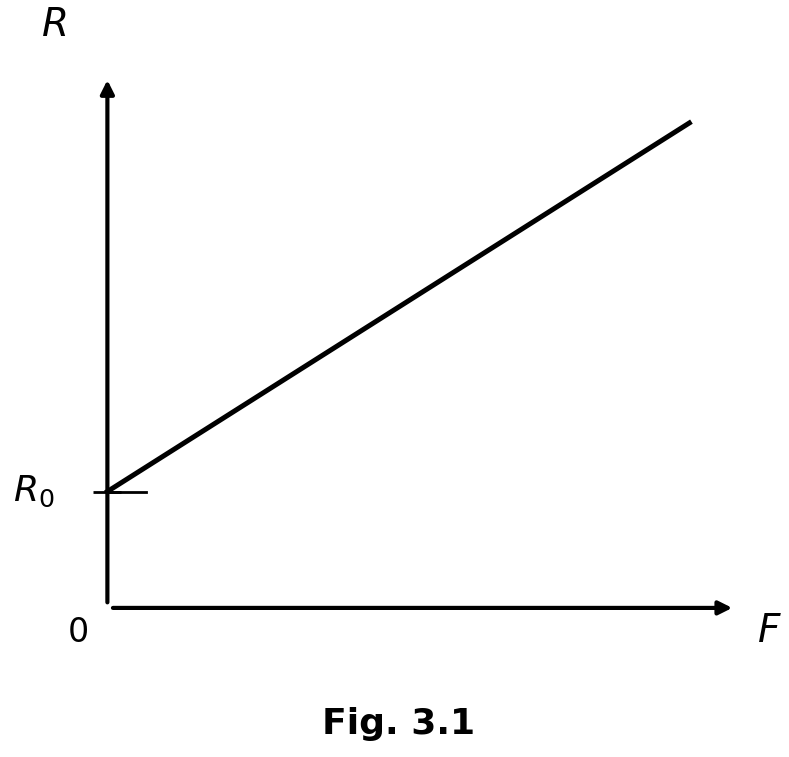
Required graph: a straight line with positive gradient starting at \( (0,R_0) \).
(c)(ii) Variation of spring constant with force [1 mark]
The spring constant is
\(k=\dfrac{EA}{L}\)
Within the limit of proportionality, the Young modulus \(E\) and cross-sectional area \(A\) remain constant. The increase in length is negligible for the required relationship, so the spring constant remains constant.

Required graph: a horizontal line starting at \( (0,k_0) \).
(d)(i) Length of the copper wire [1 mark]
The diameter is \(1.6\,\mathrm{mm}\), so the radius is
\(r=0.80\times10^{-3}\,\mathrm{m}\)
The cross-sectional area is
\(A=\pi r^2\)
Using \(R=\dfrac{\rho L}{A}\),
\(L=\dfrac{RA}{\rho}\)
\(L=\dfrac{0.034\times\pi(0.80\times10^{-3})^2}{1.8\times10^{-8}}\)
\(L=3.8\,\mathrm{m}\)
Answer: \( \boxed{3.8\,\mathrm{m}} \)
(d)(ii) Spring constant of the wire [2 marks]
Using the result from (b)(ii),
\(k=\dfrac{EA}{L}\)
\(k=\dfrac{1.3\times10^{11}\times\pi(0.80\times10^{-3})^2}{3.8}\)
\(k=6.9\times10^4\,\mathrm{N\,m^{-1}}\)
Answer: \( \boxed{6.9\times10^4\,\mathrm{N\,m^{-1}}} \)
Question 4
(a) State what is meant by diffraction of a wave. (2 marks)
________________________________
(b) A beam of vertically polarised light of wavelength \(540\,\mathrm{nm}\) is incident normally on a diffraction grating, as shown in Fig. 4.1.
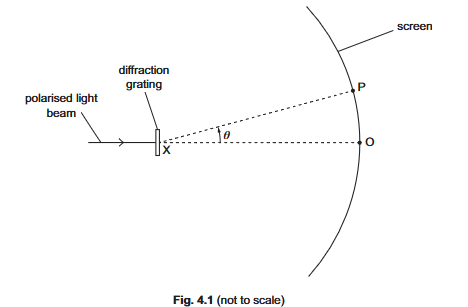
Fig. 4.1 shows the diffraction grating, screen, central bright fringe at point \(O\), and point \(P\) at a variable angle \(\theta\) to the line \(XO\).
The diffraction grating has line spacing of \(5.0\times10^{-6}\,\mathrm{m}\).
The light transmitted by the diffraction grating illuminates a circular screen. The diffraction grating is at the centre \(X\) of the circle.
The central bright fringe is formed at point \(O\) on the screen and has intensity \(I_0\).
\(P\) is a point on the screen where the line \(XP\) is at a variable angle \(\theta\) to the line \(XO\). The intensity of light on the screen at \(P\) varies with \(\theta\).
(i) Show that the angle \(\theta\) at which the first-order bright fringe is formed is \(6.2^\circ\). (2 marks)
________________________________
(ii) Determine the value of \(\theta\) at which the second-order bright fringe is formed. (1 mark)
\(\theta=\) __________________________ \(^{\circ}\)
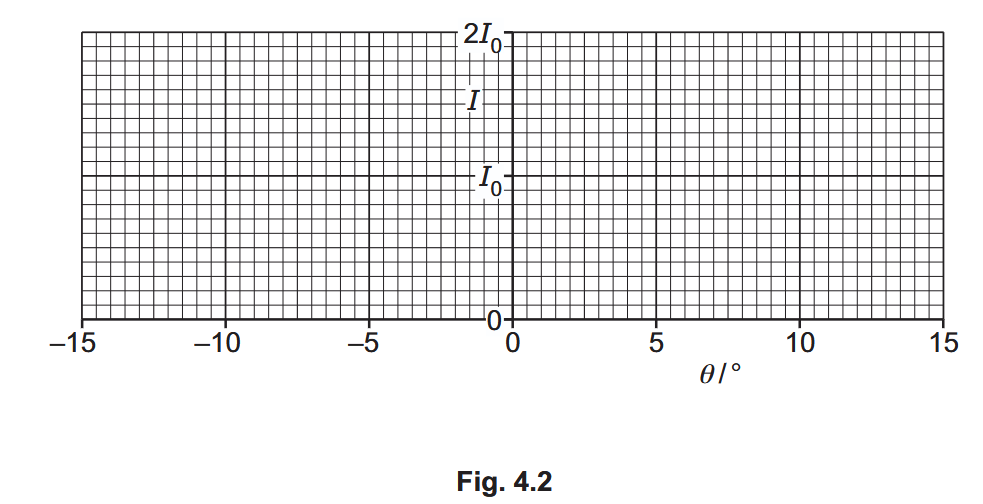
(iii) On Fig. 4.2, sketch the variation of the intensity \(I\) with \(\theta\) for values of \(\theta\) from \(-15^\circ\) to \(+15^\circ\). (3 marks)
(c) A polarising filter is placed in the path of the light beam that is incident on the diffraction grating in Fig. 4.1. The transmission axis of the filter is at \(45^\circ\) to the vertical.
Suggest how the variation of intensity with \(\theta\) for the light on the screen compares with the answer in (b)(iii). (2 marks)
________________________________
________________________________
Syllabus Topic Codes (Cambridge International AS & A Level Physics 9702):
• 8.4: The diffraction grating — parts (b)(i), (b)(ii) and (b)(iii)
• 7.5: Polarisation — part (c)
▶️ Answer/Explanation
(a) Diffraction [2 marks]
Diffraction is the spreading out of a wave as it passes through a gap or around an obstacle.
Answer: \( \boxed{\text{spreading out of a wave through a gap or around an obstacle}} \)
(b)(i) First-order bright fringe [2 marks]
For a diffraction grating, bright fringes occur when
\(n\lambda=d\sin\theta\)
For the first order, \(n=1\), so
\(\sin\theta=\dfrac{\lambda}{d}\)
\(\sin\theta=\dfrac{540\times10^{-9}}{5.0\times10^{-6}}\)
\(\theta=\sin^{-1}(0.108)\)
\(\theta=6.2^\circ\)
Answer: \( \boxed{6.2^\circ} \)
(b)(ii) Second-order bright fringe [1 mark]
For the second order, \(n=2\).
\(2\lambda=d\sin\theta\)
\(\sin\theta=\dfrac{2(540\times10^{-9})}{5.0\times10^{-6}}\)
\(\theta=\sin^{-1}(0.216)\)
\(\theta=12^\circ\)
Answer: \( \boxed{12^\circ} \)
(b)(iii) Intensity variation [3 marks]
The bright fringes occur symmetrically about \(\theta=0^\circ\).
The first-order maxima occur at \(\theta=\pm6.2^\circ\), approximately \(\pm6^\circ\), and the second-order maxima occur at \(\theta=\pm12^\circ\).
Therefore, the graph should show peaks at approximately \(\theta=0^\circ\), \(\pm6^\circ\) and \(\pm12^\circ\), with zero intensity between the maxima.
The central maximum has intensity \(I_0\), while the other maxima have intensities equal to or less than \(I_0\).
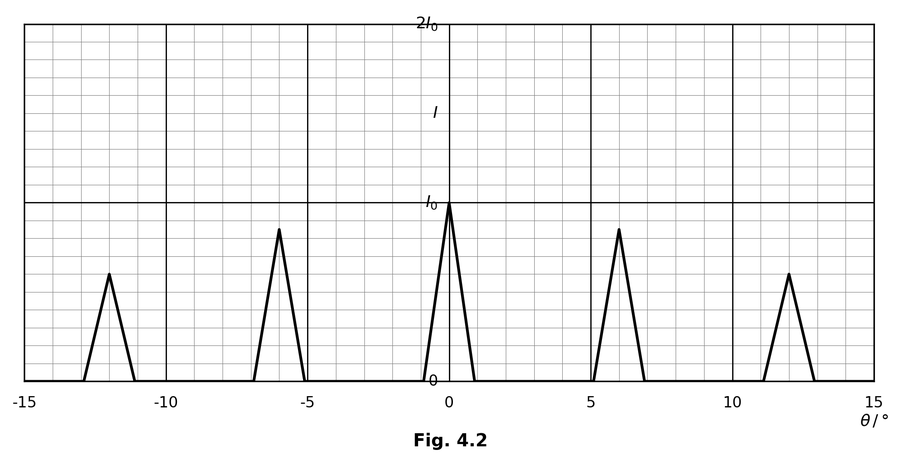
Answer: \( \boxed{\text{Maxima at }0^\circ,\ \pm6^\circ,\ \pm12^\circ\text{ with zero intensity between them}} \)
(c) Effect of the polarising filter [2 marks]
The positions of the diffraction maxima are determined by the diffraction-grating equation, so the maxima remain at the same angles as in (b)(iii).
The filter has its transmission axis at \(45^\circ\) to the original vertical polarisation. By Malus’ law, the transmitted intensity is
\(I=I_0\cos^2 45^\circ\)
\(I=\dfrac{I_0}{2}\)
Thus, the intensities of all the diffraction maxima are halved, while their angular positions remain unchanged.
Answer: \( \boxed{\text{The maxima occur at the same angles, but all intensities are halved.}} \)
Question 5
(a) State Kirchhoff’s first law. (1 mark)
________________________________
(b) Fig. 5.1 shows a circuit containing a thermistor T that has a negative temperature coefficient.
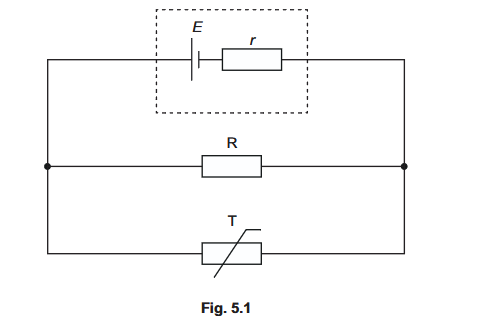
The thermistor has resistance \(R_0\) at a temperature of \(0^\circ\mathrm{C}\).
(i) On Fig. 5.2, sketch a possible variation of the resistance of the thermistor with temperature between \(0^\circ\mathrm{C}\) and \(100^\circ\mathrm{C}\). (2 marks)
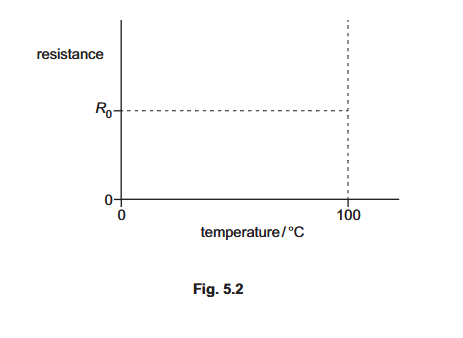
(ii) With reference to the current in the cell, explain why the current in resistor R decreases with increasing temperature of the thermistor. (3 marks)
________________________________
________________________________
________________________________
(c) The electromotive force (e.m.f.) \(E\) of the cell in Fig. 5.1 is \(1.50\,\mathrm{V}\). The internal resistance \(r\) of the cell is \(0.12\,\Omega\).
Resistor R has a resistance of \(6.00\,\Omega\).
At a particular temperature of the thermistor, the current in R is \(0.200\,\mathrm{A}\).
For this temperature of the thermistor, determine:
(i) the current in the cell. (2 marks)
current = __________________________________________ \( \mathrm{A} \)
(ii) the resistance of the thermistor. (2 marks)
resistance = __________________________________________ \( \Omega \)
Syllabus Topic Codes (Cambridge International AS & A Level Physics 9702):
• 9.2: Potential difference and power — part (c)(i)
• 9.3: Resistance and resistivity — parts (b)(i), (b)(ii) and (c)(ii)
• 10.1: Practical circuits — parts (b) and (c)
• 10.2: Kirchhoff’s laws — parts (a), (b)(ii) and (c)(i), (c)(ii)
▶️ Answer/Explanation
(a) Kirchhoff’s first law [1 mark]
The sum of the currents entering a junction is equal to the sum of the currents leaving the junction.
Equivalently, the algebraic sum of currents at a junction is zero.
Answer: \( \boxed{\text{sum of current(s) into a junction = sum of current(s) out of the junction}} \)
(b)(i) Variation of thermistor resistance with temperature [2 marks]
The thermistor has a negative temperature coefficient, so its resistance decreases as its temperature increases.
The graph should therefore be a line with a negative gradient, starting at \(R_0\) when the temperature is \(0^\circ\mathrm{C}\) and remaining above \(R=0\) between \(0^\circ\mathrm{C}\) and \(100^\circ\mathrm{C}\).
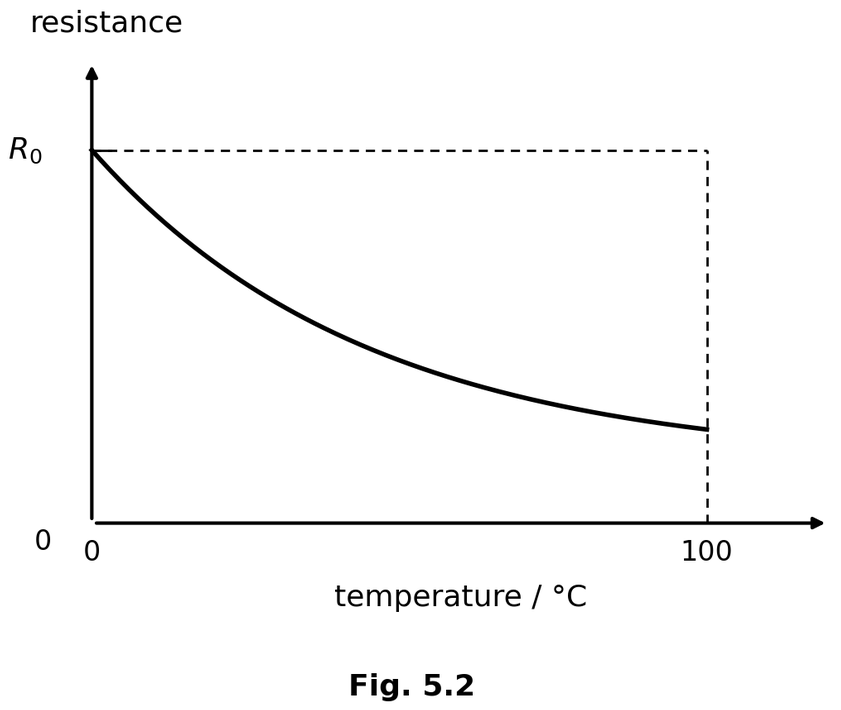
Answer: \( \boxed{\text{A decreasing resistance-temperature curve from }(0,R_0)} \)
(b)(ii) Current in resistor R [3 marks]
As the temperature increases, the resistance of thermistor T decreases.
Therefore, the total resistance of the external circuit decreases, so the current in the cell increases.
The increased cell current produces a greater potential difference across the internal resistance \(r\). Since the e.m.f. is constant, the terminal potential difference therefore decreases.
The resistance of resistor R is constant, so from \(I=\dfrac{V}{R}\), the decrease in terminal potential difference causes the current in R to decrease.
Answer: \( \boxed{\text{Current in R decreases because the terminal p.d. decreases.}} \)
(c)(i) Current in the cell [2 marks]
The potential difference across resistor R is
\(V_R=IR\)
\(V_R=0.200\times6.00\)
\(V_R=1.20\,\mathrm{V}\)
The potential difference across the internal resistance is therefore
\(V_r=E-V_R\)
\(V_r=1.50-1.20=0.30\,\mathrm{V}\)
Using \(V_r=Ir\),
\(I_{\mathrm{cell}}=\dfrac{0.30}{0.12}\)
\(I_{\mathrm{cell}}=2.5\,\mathrm{A}\)
Answer: \( \boxed{2.5\,\mathrm{A}} \)
(c)(ii) Resistance of the thermistor [2 marks]
Using Kirchhoff’s first law at the junction,
\(I_T=I_{\mathrm{cell}}-I_R\)
\(I_T=2.5-0.200\)
\(I_T=2.3\,\mathrm{A}\)
The thermistor and resistor R are connected in parallel, so the potential difference across the thermistor is \(1.20\,\mathrm{V}\).
Therefore,
\(R_T=\dfrac{V}{I_T}\)
\(R_T=\dfrac{6.00\times0.200}{2.3}\)
\(R_T=0.52\,\Omega\)
Answer: \( \boxed{0.52\,\Omega} \)
Question 6
The nuclide \(^{3}_{1}\mathrm{H}\) is an isotope of hydrogen that is called tritium.
(a) (i) Determine the numbers of protons, neutrons and electrons in a neutral atom of tritium. (2 marks)
number of protons = ______________________________
number of neutrons = ______________________________
number of electrons = ______________________________
(ii) Draw a labelled diagram to represent a simple model of the arrangement of the protons, neutrons and electrons in a tritium atom. (2 marks)
________________________________
(b) Tritium is radioactive and undergoes \(\beta^-\) decay to form an isotope of helium (He). Gamma radiation is not emitted during this decay.
(i) Complete the equation to represent the radioactive decay of tritium. (2 marks)
\(^{3}_{1}\mathrm{H}\rightarrow\) __________ \(\mathrm{He}+\) __________ \(\beta+{}^{0}_{0}\mathrm{X}\)
(ii) State the name of particle X. (1 mark)
________________________________
(c) Determine the quark composition of a tritium nucleus. (2 marks)
________________________________
________________________________
Syllabus Topic Codes (Cambridge International AS & A Level Physics 9702):
• 11.2: Fundamental particles — part (c)
▶️ Answer/Explanation
(a)(i) Numbers of protons, neutrons and electrons [2 marks]
For \(^{3}_{1}\mathrm{H}\), the atomic number is \(1\), so the number of protons is \(1\).
The number of neutrons is the nucleon number minus the proton number:
\(N=3-1=2\)
A neutral atom has equal numbers of protons and electrons, so the number of electrons is \(1\).
Answer:
\( \boxed{\text{protons}=1} \)
\( \boxed{\text{neutrons}=2} \)
\( \boxed{\text{electrons}=1} \)
(a)(ii) Simple model of the tritium atom [2 marks]
The nucleus must contain 1 proton and 2 neutrons, all labelled and forming the nucleus.
There must be 1 electron outside the nucleus, separated from the proton and neutrons.
Answer: \( \boxed{\text{nucleus: 1 proton + 2 neutrons; outside the nucleus: 1 electron}} \)
(b)(i) Radioactive decay equation [2 marks]
In \(\beta^-\) decay, the nucleon number remains unchanged while the proton number increases by \(1\).
Therefore, tritium becomes helium:
\(^{3}_{1}\mathrm{H}\rightarrow{}^{3}_{2}\mathrm{He}+{}^{0}_{-1}\beta+{}^{0}_{0}\mathrm{X}\)
The missing particle is the electron antineutrino.
Answer: \( \boxed{^{3}_{1}\mathrm{H}\rightarrow{}^{3}_{2}\mathrm{He}+{}^{0}_{-1}\beta+{}^{0}_{0}\mathrm{X}} \)
(b)(ii) Particle X [1 mark]
Particle X is an electron antineutrino.
Answer: \( \boxed{\text{electron antineutrino}} \)
(c) Quark composition of a tritium nucleus [2 marks]
A proton has quark composition
\(\text{proton}=\text{up up down}\)
A neutron has quark composition
\(\text{neutron}=\text{up down down}\)
A tritium nucleus contains \(1\) proton and \(2\) neutrons.
Therefore, the total quark composition is:
\(1\text{ proton}+2\text{ neutrons}\)
\(=(\text{up up down})+2(\text{up down down})\)
\(=4\text{ up},5\text{ down}\)
Answer: \( \boxed{4\text{ up quarks and }5\text{ down quarks}} \)