
Question 1
A child kicks a ball so that it leaves horizontal ground with a velocity of \(28\,\mathrm{m\,s^{-1}}\) at an angle of \(34^\circ\) to the horizontal, as shown in Fig. 1.1.
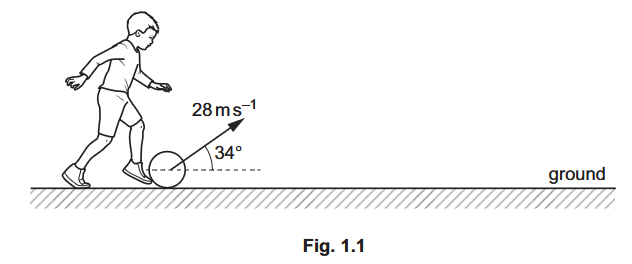
Air resistance is negligible. The ball leaves the ground at time \(t=0\).
(a) (i) Calculate the horizontal component \(v_{\mathrm{H}}\) and the vertical component \(v_{\mathrm{V}}\) of the velocity of the ball immediately after it has left the ground. (2 marks)
\(v_{\mathrm{H}}=\) __________________________ \(\mathrm{m\,s^{-1}}\)
\(v_{\mathrm{V}}=\) __________________________ \(\mathrm{m\,s^{-1}}\)
(ii) Show that the ball reaches its maximum height at \(t=1.6\,\mathrm{s}\). (1 mark)
____________________________________________
(iii) On Fig. 1.2, sketch the variation of \(v_{\mathrm{H}}\) with time \(t\) between \(t=0\) and \(t=3.2\,\mathrm{s}\). Label your line \(H\). (1 mark)
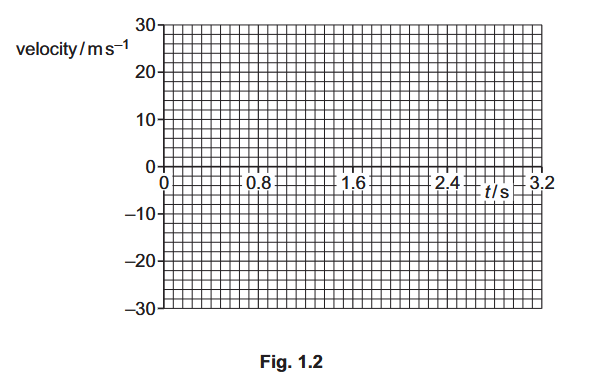
(iv) On Fig. 1.2, sketch the variation of \(v_{\mathrm{V}}\) with time \(t\) between \(t=0\) and \(t=3.2\,\mathrm{s}\). Assume that velocity in the upward direction is positive. Label your line \(V\). (3 marks)
(b) The total change in momentum of the ball between leaving the ground at \(t=0\) and landing on the ground at \(t=3.2\,\mathrm{s}\) is \(13\,\mathrm{kg\,m\,s^{-1}}\).
(i) Define momentum. (1 mark)
____________________________________________
(ii) Calculate the force that acts on the ball while it is in the air. (2 marks)
force = __________________________ \(\mathrm{N}\)
(iii) Determine the mass of the ball. (1 mark)
mass = __________________________ \(\mathrm{kg}\)
Syllabus Topic Codes (Cambridge International AS & A Level Physics 9702, 2025–2027):
• 3.1: Momentum and Newton’s laws of motion — parts (b)(i)–(iii)
▶️ Answer/Explanation
(a)(i) Velocity components [2 marks]
Resolve the initial velocity \(28\,\mathrm{m\,s^{-1}}\) into horizontal and vertical components.
Horizontal component:
\(v_{\mathrm{H}}=28\cos34^\circ\)
\(v_{\mathrm{H}}=23\,\mathrm{m\,s^{-1}}\)
Vertical component:
\(v_{\mathrm{V}}=28\sin34^\circ\)
\(v_{\mathrm{V}}=16\,\mathrm{m\,s^{-1}}\)
Answer: \( \boxed{v_{\mathrm{H}}=23\,\mathrm{m\,s^{-1}},\quad v_{\mathrm{V}}=16\,\mathrm{m\,s^{-1}}} \)
(a)(ii) Maximum height [1 mark]
At maximum height, the vertical velocity is zero.
Using \(v=u+at\):
\(0=16-9.81t\)
\(t=\dfrac{16}{9.81}=1.63\,\mathrm{s}\)
Therefore, \(t\approx1.6\,\mathrm{s}\).
Answer: \( \boxed{t=1.6\,\mathrm{s}} \)
(a)(iii) Horizontal velocity-time graph [1 mark]
There is no horizontal acceleration because air resistance is negligible. Therefore, the horizontal velocity remains constant.
The graph is a horizontal line at \(v_{\mathrm{H}}=23\,\mathrm{m\,s^{-1}}\) from \(t=0\) to \(t=3.2\,\mathrm{s}\), labelled \(H\).
(a)(iv) Vertical velocity-time graph [3 marks]
The vertical acceleration is constant and equal to \(-9.81\,\mathrm{m\,s^{-2}}\).
The ball starts with \(v_{\mathrm{V}}=+16\,\mathrm{m\,s^{-1}}\), reaches \(v_{\mathrm{V}}=0\) at \(t=1.6\,\mathrm{s}\), and has \(v_{\mathrm{V}}=-16\,\mathrm{m\,s^{-1}}\) at \(t=3.2\,\mathrm{s}\).
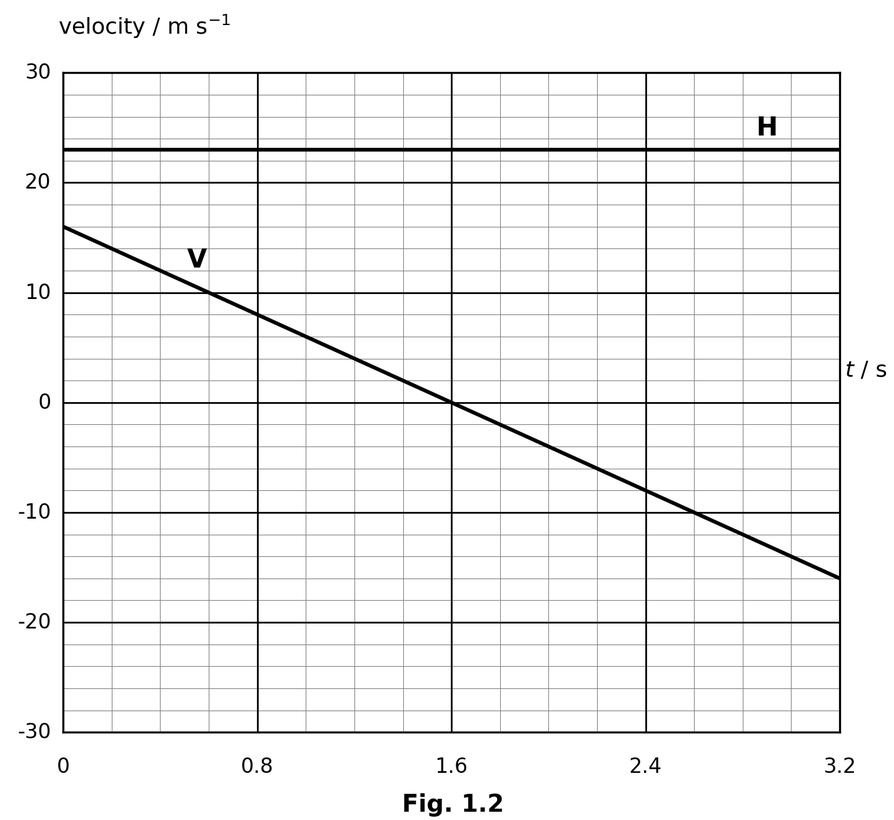
Therefore, the graph is a straight line from \((0,+16)\) through \((1.6,0)\) to \((3.2,-16)\), labelled \(V\).
(b)(i) Momentum [1 mark]
Momentum is defined as the product of mass and velocity.
\(p=mv\)
Answer: \( \boxed{\text{momentum}=\text{mass}\times\text{velocity}} \)
(b)(ii) Force on the ball [2 marks]
Force is the rate of change of momentum:
\(F=\dfrac{\Delta p}{\Delta t}\)
\(F=\dfrac{13}{3.2}\)
\(F=4.06\,\mathrm{N}\)
The change in momentum is downward, so the force is downward.
Answer: \( \boxed{4.1\,\mathrm{N}\text{ downward}} \)
(b)(iii) Mass of the ball [1 mark]
The vertical velocity changes from \(+16\,\mathrm{m\,s^{-1}}\) to \(-16\,\mathrm{m\,s^{-1}}\).
Therefore, the magnitude of the change in velocity is
\(\Delta v=16+16=32\,\mathrm{m\,s^{-1}}\)
Using \(\Delta p=m\Delta v\):
\(13=m(32)\)
\(m=\dfrac{13}{32}=0.406\,\mathrm{kg}\)
Answer: \( \boxed{0.41\,\mathrm{kg}} \)
Question 2
Fig. 2.1 shows a square metal sheet of non-uniform density, with a thin wooden rod fixed at the centre of one of the corners X of the sheet.
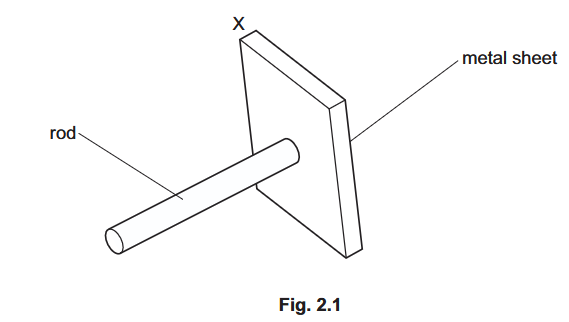
The rod has negligible mass. The mass of the metal sheet is \(2.8\,\mathrm{kg}\).
The rod is supported so that it is horizontal and the metal sheet is vertical.
(a) Define the torque of a couple. (2 marks)
________________________________
________________________________
(b) When the rod is supported in such a way that it can rotate freely within its support, the sheet hangs in equilibrium with point X vertically above the rod, as shown in Fig. 2.2.
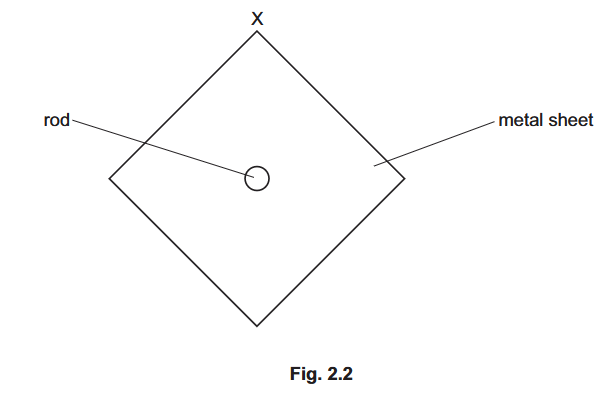
On Fig. 2.2, draw a line to indicate the range of possible positions for the centre of gravity of the metal sheet. (1 mark)
________________________________
(c) When a torque of \(3.3\,\mathrm{N\,m}\) is applied to the rod, the sheet is held in equilibrium with two of its edges horizontal, as in Fig. 2.3. Point X is at the top-left corner.
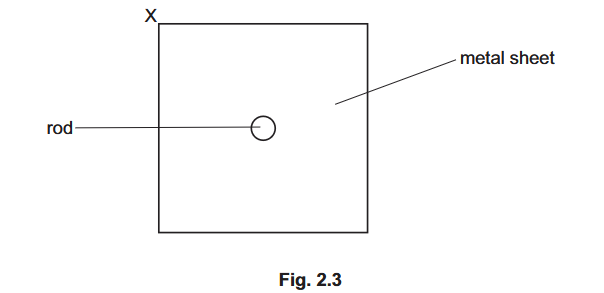
(i) Explain whether the torque applied to the rod to hold the sheet in equilibrium is clockwise or anticlockwise. (1 mark)
________________________________
(ii) Show that the centre of gravity of the sheet has a horizontal displacement of \(0.12\,\mathrm{m}\) from the rod. (1 mark)
________________________________
(d) The square metal sheet has an average density of \(3000\,\mathrm{kg\,m^{-3}}\) and a uniform thickness of \(4.0\,\mathrm{mm}\).
Show that the side length of the sheet is \(0.48\,\mathrm{m}\). (3 marks)
________________________________
________________________________
(e) Use the answer in (b) and the information in (c) and (d) to determine the position of the centre of gravity of the sheet. Indicate this position on Fig. 2.3 with a point labelled Y. (2 marks)
________________________________
________________________________
Syllabus Topic Codes (Cambridge International AS & A Level Physics 9702):
• 4.2: Equilibrium of forces — part (c)(ii)
• 4.3: Density and pressure — part (d)
▶️ Answer/Explanation
(a) Torque of a couple [2 marks]
The torque of a couple is the product of one of the forces and the perpendicular distance between the lines of action of the two forces.
\(\tau=Fd\)
Answer: \( \boxed{\text{torque of a couple}=\text{force}\times\text{perpendicular distance between the forces}} \)
(b) Possible positions of the centre of gravity [1 mark]
Since the sheet is hanging freely in equilibrium, its centre of gravity must lie vertically below the point of support.
The support is at the centre of the rod. Therefore, the possible centre of gravity lies on a straight vertical line drawn from the centre of the rod towards the bottom corner of the sheet.
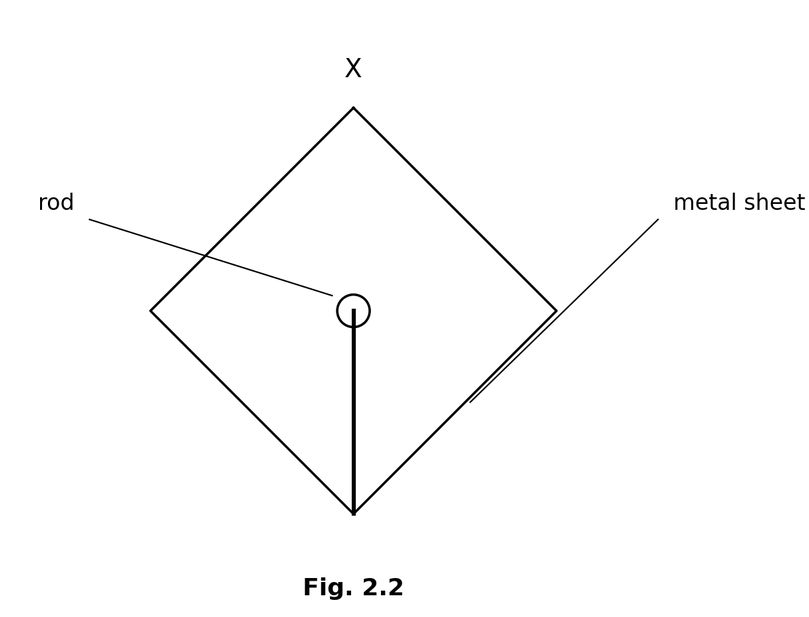
Answer: \( \boxed{\text{A straight vertical line from the centre of the rod to the bottom corner}} \)
(c)(i) Direction of applied torque [1 mark]
The centre of gravity is to the right of the rod.
The weight of the sheet therefore produces a clockwise moment about the rod.
To keep the sheet in equilibrium, the applied torque must act in the opposite direction.
Answer: \( \boxed{\text{anticlockwise}} \)
(c)(ii) Horizontal displacement of the centre of gravity [1 mark]
For rotational equilibrium, the clockwise moment due to the weight must equal the applied anticlockwise torque.
\(\tau=mgd\)
\(3.3=2.8\times9.81\times d\)
\(d=\dfrac{3.3}{2.8\times9.81}\)
\(d=0.12\,\mathrm{m}\)
Answer: \( \boxed{0.12\,\mathrm{m}} \)
(d) Side length of the sheet [3 marks]
Using the density equation,
\(\rho=\dfrac{m}{V}\)
The thickness is \(4.0\,\mathrm{mm}=4.0\times10^{-3}\,\mathrm{m}\).
If the side length is \(L\), the volume is
\(V=(4.0\times10^{-3})L^2\)
Therefore,
\(3000=\dfrac{2.8}{(4.0\times10^{-3})L^2}\)
\(L=\sqrt{\dfrac{2.8}{3000\times0.0040}}\)
\(L=0.48\,\mathrm{m}\)
Answer: \( \boxed{0.48\,\mathrm{m}} \)
(e) Position of the centre of gravity [2 marks]
From part (c)(ii), the centre of gravity is \(0.12\,\mathrm{m}\) horizontally to the right of the rod.
From part (b), the centre of gravity must also lie on the vertical line through the centre of the rod when the sheet is freely supported.
Using the side length \(0.48\,\mathrm{m}\), the required position is found by drawing a line at \(45^\circ\) to the horizontal from the bottom-right corner to the edge of the rod. The centre of gravity also lies on a vertical line halfway between the rod and the right-hand edge.
Answer: \( \boxed{\text{Y is at the intersection of these two lines.}} \)
Question 3
A bungee jumper of mass \(64\,\mathrm{kg}\) secures one end of an elastic rope to a bridge. The other end is attached to the jumper, who falls from the bridge and descends into the valley below, as shown in Fig. 3.1.
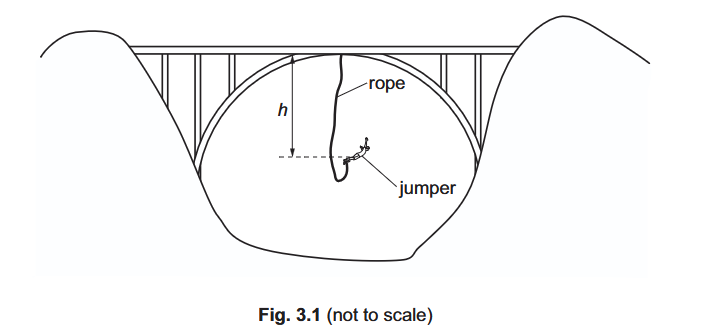
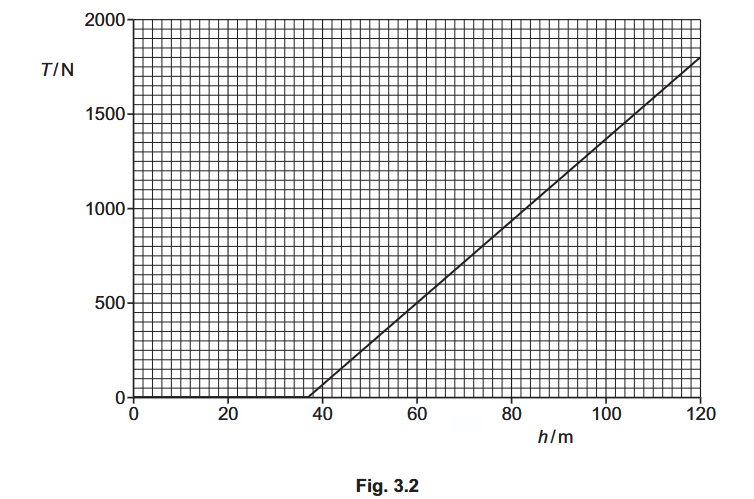
Fig. 3.2 shows the variation of the tension \(T\) in the rope with the vertical distance \(h\) of the jumper below the level of the bridge.
(a) The rope obeys Hooke’s law.
State Hooke’s law. (1 mark)
____________________________________________
(b) (i) Determine the unstretched length of the rope. (1 mark)
length = __________________________ \( \mathrm{m} \)
(ii) Determine the spring constant \(k\) of the rope. (2 marks)
\(k=\) __________________________ \( \mathrm{N\,m^{-1}} \)
(c) For the position of the bungee jumper at a distance of \(120\,\mathrm{m}\) below the bridge:
(i) Show that the loss of gravitational potential energy since leaving the bridge is \(75\,\mathrm{kJ}\). (2 marks)
____________________________________________
____________________________________________
(ii) Show that the elastic potential energy in the rope is \(75\,\mathrm{kJ}\). (2 marks)
____________________________________________
____________________________________________
(d) Explain what can be deduced from the information in (c) about the speed of the bungee jumper at a distance of \(120\,\mathrm{m}\) below the bridge. (2 marks)
____________________________________________
____________________________________________
Syllabus Topic Codes (Cambridge International AS & A Level Physics 9702):
• 5.1: Work, energy and power — parts (c)(i), (c)(ii) and (d)
▶️ Answer/Explanation
(a) Hooke’s law [1 mark]
Hooke’s law states that the force is proportional to the extension, provided the limit of proportionality is not exceeded.
Answer: \( \boxed{F\propto x} \)
(b)(i) Unstretched length [1 mark]
The rope begins to experience tension when the jumper has fallen to the unstretched length of the rope.
From Fig. 3.2, the tension becomes non-zero at approximately \(h=37\,\mathrm{m}\).
Answer: \( \boxed{37\,\mathrm{m}} \)
(b)(ii) Spring constant [2 marks]
Using Hooke’s law,
\(T=kx\)
At \(h=120\,\mathrm{m}\), the extension is
\(x=120-37=83\,\mathrm{m}\)
The tension is approximately \(1800\,\mathrm{N}\).
\(k=\dfrac{1800}{120-37}\)
\(k=21.7\,\mathrm{N\,m^{-1}}\)
Answer: \( \boxed{22\,\mathrm{N\,m^{-1}}} \)
(c)(i) Loss of gravitational potential energy [2 marks]
The loss of gravitational potential energy is
\(\Delta E_{\mathrm{P}}=mg\Delta h\)
\(\Delta E_{\mathrm{P}}=64\times9.81\times120\)
\(\Delta E_{\mathrm{P}}=75000\,\mathrm{J}\)
\(75000\,\mathrm{J}=75\,\mathrm{kJ}\)
Answer: \( \boxed{75\,\mathrm{kJ}} \)
(c)(ii) Elastic potential energy [2 marks]
The elastic potential energy stored in the rope is
\(E=\dfrac{1}{2}Fx\)
Using \(F=1800\,\mathrm{N}\) and \(x=120-37=83\,\mathrm{m}\),
\(E=\dfrac{1}{2}\times1800\times(120-37)\)
\(E=75000\,\mathrm{J}\)
\(E=75\,\mathrm{kJ}\)
Answer: \( \boxed{75\,\mathrm{kJ}} \)
(d) Speed of the bungee jumper [2 marks]
The loss of gravitational potential energy is \(75\,\mathrm{kJ}\), while the elastic potential energy stored in the rope is also \(75\,\mathrm{kJ}\).
Therefore, all of the gravitational potential energy lost has been converted into elastic potential energy.
There is no remaining energy available as kinetic energy, so the kinetic energy of the jumper is zero.
Answer: \( \boxed{\text{the speed of the jumper is zero}} \)
Question 4
(a) State the principle of superposition. (2 marks)
____________________________________________
____________________________________________
(b) An electromagnetic wave of wavelength \(0.026\,\mathrm{m}\) in free space is incident normally on an aluminium sheet, as shown in Fig. 4.1.
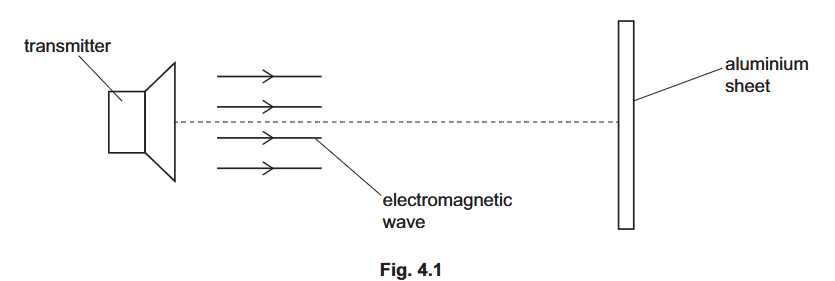
The wave reflects at the aluminium sheet and a stationary wave is formed in the region between the transmitter and the sheet.
(i) Explain how the stationary wave, including its nodes and antinodes, is formed. (3 marks)
____________________________________________
____________________________________________
____________________________________________
(ii) Calculate the frequency of the electromagnetic wave. (2 marks)
frequency = __________________________ \( \mathrm{Hz} \)
(iii) State the principal region of the electromagnetic spectrum to which the wave belongs. (1 mark)
____________________________________________
(iv) Determine the distance between a node and an adjacent antinode. (1 mark)
distance = __________________________ \( \mathrm{m} \)
Syllabus Topic Codes (Cambridge International AS & A Level Physics 9702):
• 8.2: Stationary waves — parts (b)(i) and (b)(iv)
• 7.4: Electromagnetic waves and the electromagnetic spectrum — parts (b)(ii) and (b)(iii)
▶️ Answer/Explanation
(a) Principle of superposition [2 marks]
When two or more waves meet, the resultant displacement is equal to the sum of the displacements of the individual waves.
Answer: \( \boxed{\text{resultant displacement = sum of the individual displacements}} \)
(b)(i) Formation of a stationary wave [3 marks]
The incident wave and the reflected wave travel in opposite directions and superpose.
At certain positions, the two waves interfere constructively, producing points of maximum amplitude called antinodes.
At other positions, the two waves interfere destructively, producing points of zero amplitude called nodes.
Answer: \( \boxed{\text{superposition of incident and reflected waves produces nodes and antinodes}} \)
(b)(ii) Frequency of the electromagnetic wave [2 marks]
For an electromagnetic wave in free space,
\(c=f\lambda\)
Therefore,
\(f=\dfrac{c}{\lambda}\)
\(f=\dfrac{3.00\times10^8}{0.026}\)
\(f=1.15\times10^{10}\,\mathrm{Hz}\)
Answer: \( \boxed{1.2\times10^{10}\,\mathrm{Hz}} \)
(b)(iii) Region of the electromagnetic spectrum [1 mark]
A wavelength of \(0.026\,\mathrm{m}\) corresponds to the microwave region of the electromagnetic spectrum.
Answer: \( \boxed{\text{microwave}} \)
(b)(iv) Distance between a node and adjacent antinode [1 mark]
In a stationary wave, the distance between an adjacent node and antinode is \(\dfrac{\lambda}{4}\).
\(\text{distance}=\dfrac{0.026}{4}\)
\(\text{distance}=6.5\times10^{-3}\,\mathrm{m}\)
Answer: \( \boxed{6.5\times10^{-3}\,\mathrm{m}} \)
Question 5
A student uses a circuit containing an ammeter, a voltmeter and a cell to take measurements to determine the resistance of a length of nichrome wire.
(a) (i) Define resistance. (1 mark)
____________________________________________
(ii) Draw a circuit diagram to show how the components should be connected. Use the symbol for a resistor to represent the nichrome wire. (2 marks)
____________________________________________
____________________________________________
(b) The student also measures the length and the diameter of the wire. Table 5.1 shows the measurements recorded for each quantity.
| quantity | measurement |
|---|---|
| length | \( (0.864 \pm 0.001)\,\mathrm{m} \) |
| diameter | \( (0.496 \pm 0.002)\,\mathrm{mm} \) |
| voltmeter reading | \( (1.38 \pm 0.02)\,\mathrm{V} \) |
| ammeter reading | \( (0.276 \pm 0.001)\,\mathrm{A} \) |
(i) Show that the resistance of the wire is \(5.00\,\Omega\). (1 mark)
____________________________________________
(ii) Calculate, to three significant figures, the resistivity \(\rho\) of the nichrome. (3 marks)
\(\rho=\) __________________________ \( \Omega\,\mathrm{m} \)
(iii) Calculate the percentage uncertainty in \(\rho\). (2 marks)
percentage uncertainty = __________________________ \( \% \)
(iv) Determine the absolute uncertainty in \(\rho\). (1 mark)
absolute uncertainty = __________________________ \( \Omega\,\mathrm{m} \)
Syllabus Topic Codes (Cambridge International AS & A Level Physics 9702):
• 10.1: Practical circuits — part (a)(ii)
• 1.3: Errors and uncertainties — parts (b)(ii), (b)(iii) and (b)(iv)
▶️ Answer/Explanation
(a)(i) Definition of resistance [1 mark]
Resistance is the potential difference per unit current.
\(R=\dfrac{V}{I}\)
Answer: \( \boxed{\text{potential difference per unit current}} \)
(a)(ii) Circuit diagram [2 marks]
The ammeter must be connected in series with the nichrome wire so that it measures the current through the wire.
The voltmeter must be connected in parallel across the nichrome wire so that it measures the potential difference across the wire.
The resistor symbol represents the nichrome wire, and the cell is connected in a complete circuit.
Required arrangement: cell, ammeter and resistor in series, with the voltmeter connected in parallel across the resistor.
(b)(i) Resistance of the wire [1 mark]
Using
\(R=\dfrac{V}{I}\)
\(R=\dfrac{1.38}{0.276}\)
\(R=5.00\,\Omega\)
Answer: \( \boxed{5.00\,\Omega} \)
(b)(ii) Resistivity of the nichrome [3 marks]
The resistivity is related to resistance by
\(R=\dfrac{\rho L}{A}\)
Therefore,
\(\rho=\dfrac{RA}{L}\)
The diameter is \(0.496\,\mathrm{mm}\), so the radius is
\(r=\dfrac{0.496\times10^{-3}}{2}=0.248\times10^{-3}\,\mathrm{m}\)
The cross-sectional area is
\(A=\pi r^2\)
Hence,
\(\rho=\dfrac{5.00\times\pi(0.248\times10^{-3})^2}{0.864}\)
\(\rho=1.12\times10^{-6}\,\Omega\,\mathrm{m}\)
Answer: \( \boxed{1.12\times10^{-6}\,\Omega\,\mathrm{m}} \)
(b)(iii) Percentage uncertainty in resistivity [2 marks]
Since
\(\rho=\dfrac{RA}{L}\)
and \(A=\pi d^2/4\), the percentage uncertainty in \(A\) is twice the percentage uncertainty in the diameter.
Therefore,
\(\text{percentage uncertainty}=\left[\dfrac{0.001}{0.864}+\dfrac{2(0.002)}{0.496}+\dfrac{0.02}{1.38}+\dfrac{0.001}{0.276}\right]\times100\)
\(\text{percentage uncertainty}=2.7\%\)
Answer: \( \boxed{2.7\%} \)
(b)(iv) Absolute uncertainty in resistivity [1 mark]
The absolute uncertainty is
\(\Delta\rho=1.12\times10^{-6}\times\dfrac{2.7}{100}\)
\(\Delta\rho=3.0\times10^{-8}\,\Omega\,\mathrm{m}\)
Answer: \( \boxed{3\times10^{-8}\,\Omega\,\mathrm{m}} \)
Question 6
Fig. 6.1 shows alpha particles W, X, Y and Z moving towards a gold nucleus that is in thin foil.
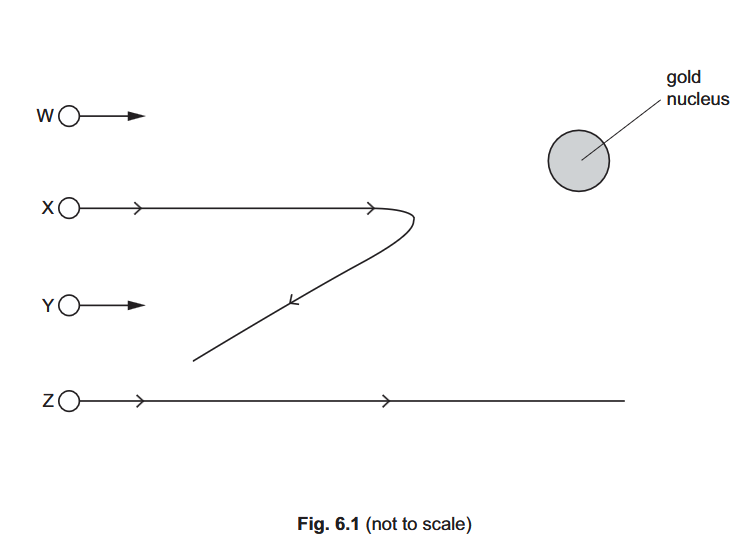
(a) (i) The paths of particles X and Z are shown.
Complete Fig. 6.1 to show two possible paths for particles W and Y. (3 marks)
____________________________________________
(ii) Describe what may be inferred about the structure of an atom from the path of particle X. (1 mark)
____________________________________________
(iii) When a beam containing many alpha particles is incident on thin gold foil, nearly all of the alpha particles follow paths that are similar to the path of particle Z.
Describe what may be inferred from this about the structure of an atom. (1 mark)
____________________________________________
(b) State the mass and the charge, in terms of the atomic mass unit \(u\) and the elementary charge \(e\), of an alpha particle. (2 marks)
mass = __________________________ \(u\)
charge = __________________________ \(e\)
(c) There are two types of hadron.
The hadrons that are in alpha particles are each composed of three quarks.
(i) State the name of this type of hadron. (1 mark)
____________________________________________
(ii) Show, by reference to their constituent quarks, that the hadrons in an alpha particle have charges of either zero or \(+1e\). (2 marks)
____________________________________________
____________________________________________
Syllabus Topic Codes (Cambridge International AS & A Level Physics 9702):
• 11.2: Fundamental particles — parts (c)(i) and (c)(ii)
▶️ Answer/Explanation
(a)(i) Paths of alpha particles W and Y [3 marks]
Alpha particles are positively charged, so they are repelled by the positively charged gold nucleus.
Particle W should therefore be deflected upwards. Its deflection is the mirror image of the path of X.
Particle Y passes further from the nucleus than X, so it experiences a smaller repulsive force and is deflected downwards by a smaller angle.
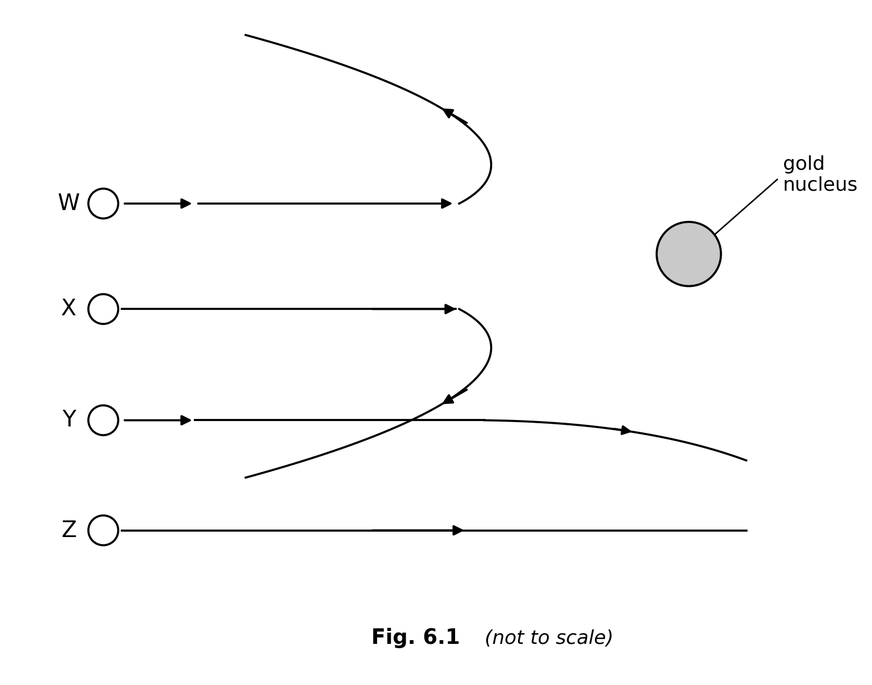
Answer: \( \boxed{\text{W deflects upwards; Y deflects downwards by less than X}} \)
(a)(ii) Structure of the atom from particle X [1 mark]
The large deflection of particle X shows that the atom contains a small, positively charged nucleus.
Answer: \( \boxed{\text{the nucleus is charged and contains most of the mass of the atom}} \)
(a)(iii) Structure of the atom from particle Z [1 mark]
Nearly all alpha particles pass through the foil with little or no deflection.
Therefore, the atom is mostly empty space, with the nucleus occupying a very small proportion of the atom.
Answer: \( \boxed{\text{the atom is mostly empty space}} \)
(b) Mass and charge of an alpha particle [2 marks]
An alpha particle is a helium nucleus containing two protons and two neutrons.
Its mass is approximately \(4u\).
Its charge is \(+2e\).
Answer:
\( \boxed{\text{mass}=4u} \)
\( \boxed{\text{charge}=+2e} \)
(c)(i) Type of hadron [1 mark]
A hadron composed of three quarks is called a baryon.
Answer: \( \boxed{\text{baryon}} \)
(c)(ii) Charges of the hadrons in an alpha particle [2 marks]
The charge of an up quark is \(+\dfrac{2}{3}e\), while the charge of a down quark is \(-\dfrac{1}{3}e\).
A proton has quark composition \(uud\), so its charge is
\(\left(2\times\dfrac{2}{3}e\right)-\left(\dfrac{1}{3}e\right)=+1e\)
A neutron has quark composition \(udd\), so its charge is
\(\left(\dfrac{2}{3}e\right)-\left(2\times\dfrac{1}{3}e\right)=0\)
An alpha particle contains two protons and two neutrons. Therefore, the hadrons in an alpha particle have charges of either \(+1e\) or \(0\).
Answer: \( \boxed{\text{proton}=+1e,\quad \text{neutron}=0} \)