Question 1
The Earth may be considered as a uniform sphere of radius \(6.37\times10^6\,\mathrm{m}\).
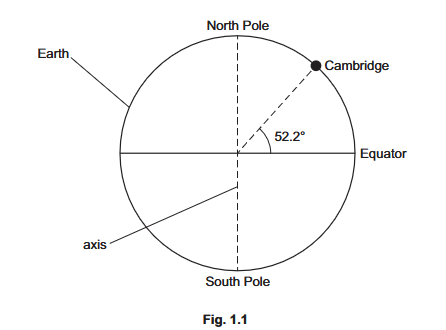
Cambridge is at a point on the Earth’s surface that has a latitude of \(52.2^\circ\) north of the Equator, as shown in Fig. 1.1.
As the Earth spins on its axis, Cambridge moves in a circle that is parallel to the Equator but with a smaller radius.
(a)
(i) Show that the radius of the circle around which Cambridge moves is \(3.90\times10^6\,\mathrm{m}\). [1]
________________________________________________________________________________________
(ii) Calculate the speed at which Cambridge moves around the circle. [3]
speed = ______________________________ \(\mathrm{m\,s^{-1}}\)
(b) A student of mass \(58.6\,\mathrm{kg}\) stands on horizontal ground in Cambridge.
(i) Determine the magnitude of the resultant force that acts to cause the circular motion of the student. [2]
resultant force = ______________________________ \(\mathrm{N}\)
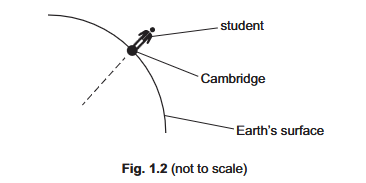
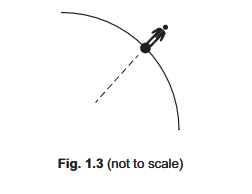
(ii) On Fig. 1.2, draw an arrow to show the direction of the resultant force that acts on the student. [1]

(iii) On Fig. 1.3, draw labelled arrows from the student to show the directions of the forces that act on the student to cause the resultant force in (b)(ii). [2]

Syllabus Topic Codes (Cambridge International AS & A Level Physics 9702):
12.1 Kinematics of uniform circular motion – motion of an object in a circle at constant speed, including angular speed and period.
12.2 Centripetal acceleration – centripetal acceleration and the resultant force required for circular motion.
▶️ Answer/Explanation
(a)(i) Radius of Cambridge’s circular path [1 mark]
The radius of the circle is the horizontal component of the Earth’s radius:
\(r=R\cos52.2^\circ\)
\(r=(6.37\times10^6)\cos52.2^\circ\)
\(r=3.90\times10^6\,\mathrm{m}\)
Answer: \(r=3.90\times10^6\,\mathrm{m}\)
(a)(ii) Speed of Cambridge [3 marks]
The Earth completes one rotation in \(24\,\mathrm{h}\), so the period is \(T=24\times60\times60\,\mathrm{s}\).
For uniform circular motion, \(v=\dfrac{2\pi r}{T}\).
Therefore, \(v=\dfrac{2\pi(3.90\times10^6)}{24\times60\times60}\)
\(v=280\,\mathrm{m\,s^{-1}}\)
Answer: \(v=280\,\mathrm{m\,s^{-1}}\)
(b)(i) Resultant force on the student [2 marks]
The student undergoes circular motion, so the resultant force is the centripetal force:
\(F=\dfrac{mv^2}{r}\)
\(F=\dfrac{(58.6)(280)^2}{3.90\times10^6}\)
\(F=1.2\,\mathrm{N}\)
Answer: \(F=1.2\,\mathrm{N}\)
(b)(ii) Direction of resultant force [1 mark]
The centripetal resultant force acts horizontally towards the centre of the circular path.
Answer: Arrow pointing horizontally to the left.
(b)(iii) Forces acting on the student [2 marks]
The student’s weight acts vertically downwards, along the dotted radial line towards the centre of the Earth.
The contact force from the ground acts upwards, perpendicular to the Earth’s surface. It is directed to the left of the normal shown in the diagram.
These two forces have a resultant directed horizontally towards the centre of the student’s circular path.
Answer: Draw a downward arrow labelled weight along the dotted radial line, and an upward contact-force arrow directed to the left of the normal and above the tangent to the Earth’s surface.
Question 2
(a) State Newton’s law of gravitation. [2]
________________________________________________________________________________________
________________________________________________________________________________________
(b) One of the basic assumptions of the kinetic theory of gases is that there are no forces exerted between the molecules of the gas except during collisions.
State two other basic assumptions of the kinetic theory of gases.
1. __________________________________________________________________________________
________________________________________________________________________________________
2. __________________________________________________________________________________
________________________________________________________________________________________
(c) Hydrogen gas consists of molecules that each have a mass of \(3.34\times10^{-27}\,\mathrm{kg}\). Hydrogen may be considered to be an ideal gas.
A spherical balloon contains \(0.0160\,\mathrm{mol}\) of hydrogen gas at a temperature of \(282\,\mathrm{K}\). At this temperature, the volume of gas in the balloon is \(1.87\times10^{-4}\,\mathrm{m^3}\).
(i) Determine the pressure of the gas. [2]
pressure = ______________________________ \(\mathrm{Pa}\)
(ii) Estimate the average separation of the hydrogen molecules in the gas. [2]
average separation = ______________________________ \(\mathrm{m}\)
(d)
(i) Use your answer in (c)(ii) to calculate the average gravitational force between adjacent molecules in hydrogen gas. [2]
average force = ______________________________ \(\mathrm{N}\)
(ii) By considering the weight of a molecule, suggest with a reason whether your answer in (d)(i) is consistent with the assumption of the kinetic theory of gases that there are no forces exerted between molecules. [1]
________________________________________________________________________________________
________________________________________________________________________________________
Syllabus Topic Codes (Cambridge International AS & A Level Physics 9702):
13.2 Gravitational force between point masses – Newton’s law of gravitation and gravitational force between masses.
15.2 Equation of state – ideal gas equation and molecular interpretation of temperature and pressure.
15.3 Kinetic theory of gases – kinetic theory assumptions
▶️ Answer/Explanation
(a) Newton’s law of gravitation [2 marks]
The gravitational force between two point masses is directly proportional to the product of their masses.
The force is inversely proportional to the square of their separation.
\(F=\dfrac{Gm_1m_2}{r^2}\)
Answer: \(F\propto\dfrac{m_1m_2}{r^2}\).
(b) Assumptions of the kinetic theory of gases [2 marks]
Any two of the following:
1. The molecules are in continuous random motion.
2. The molecules have negligible volume compared with the volume of the gas.
3. Collisions involving molecules are perfectly elastic.
4. Collisions between molecules are instantaneous.
(c)(i) Pressure of the gas [2 marks]
Using the ideal gas equation, \(pV=nRT\).
Therefore, \(p=\dfrac{nRT}{V}\).
\(p=\dfrac{(0.0160)(8.31)(282)}{1.87\times10^{-4}}\)
\(p=2.01\times10^5\,\mathrm{Pa}\)
Answer: \(p=2.01\times10^5\,\mathrm{Pa}\)
(c)(ii) Average separation of the molecules [2 marks]
First determine the number of molecules:
\(N=nN_{\mathrm A}\)
\(N=(0.0160)(6.02\times10^{23})\)
\(N=9.63\times10^{21}\)
If each molecule occupies an average volume \(s^3\), then \(s^3=\dfrac{V}{N}\).
\(s=\sqrt[3]{\dfrac{1.87\times10^{-4}}{0.0160(6.02\times10^{23})}}\)
\(s=2.7\times10^{-9}\,\mathrm{m}\)
Answer: \(s=2.7\times10^{-9}\,\mathrm{m}\)
(d)(i) Average gravitational force [2 marks]
Using Newton’s law of gravitation, \(F=\dfrac{Gm^2}{r^2}\).
Here, \(m=3.34\times10^{-27}\,\mathrm{kg}\) and \(r=2.7\times10^{-9}\,\mathrm{m}\).
\(F=\dfrac{(6.67\times10^{-11})(3.34\times10^{-27})^2}{(2.7\times10^{-9})^2}\)
\(F=1.0\times10^{-46}\,\mathrm{N}\)
Answer: \(F=1.0\times10^{-46}\,\mathrm{N}\)
(d)(ii) Comparison with the weight of a molecule [1 mark]
The weight of one molecule is approximately \(W=mg\approx10^{-26}\,\mathrm{N}\).
The gravitational force between adjacent molecules is only about \(10^{-46}\,\mathrm{N}\), which is enormously smaller than the weight.
Answer: The gravitational force between molecules is negligible, so the result is consistent with the kinetic theory assumption that intermolecular forces can be ignored except during collisions.
Question 3
(a) State what is meant by two objects being in thermal equilibrium. [2]
________________________________________________________________________________________
________________________________________________________________________________________
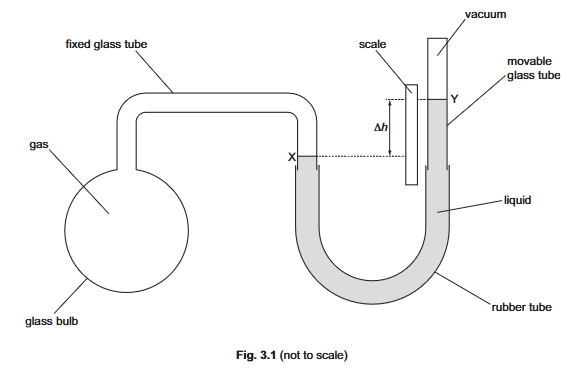
(b) Fig. 3.1 shows a type of thermometer called a constant volume gas thermometer.

The thermometer is used to determine the thermodynamic temperature \(T\) of the gas in the glass bulb.
The glass bulb is immersed in the environment for which the temperature is to be measured. The height of the movable glass tube is adjusted so that the level of the liquid on the left-hand side is the same as the level \(X\) marked on the fixed glass tube. The reference line \(Y\) is marked on the side of the movable glass tube. The level of the liquid at \(Y\) is higher than at \(X\) as a result of the pressure of the gas in the glass bulb.
The difference in height \(\Delta h\) between the liquid levels at \(X\) and \(Y\) is measured using the scale. The thermodynamic temperature \(T\) of the gas is directly proportional to the pressure of the gas. This pressure is proportional to \(\Delta h\).
(i) The value of \(\Delta h\) can be used to calculate the pressure of the gas. In order to do this, the gravitational field strength is used, along with a property of the liquid. State the property of the liquid that is used to calculate the pressure. [1]
________________________________________________________________________________________
(ii) Before the measurement of \(\Delta h\) can be made, the glass bulb needs to reach thermal equilibrium with the environment for which the temperature is to be measured.
State two disadvantages of using a constant volume gas thermometer to measure temperature. [2]
1. __________________________________________________________________________________
________________________________________________________________________________________
2. __________________________________________________________________________________
________________________________________________________________________________________
(iii) Suggest one situation in which a constant volume gas thermometer would be an appropriate type of thermometer to choose for measuring temperature. [1]
________________________________________________________________________________________
(iv) Level \(X\) aligns with \(2.31\,\mathrm{cm}\) on the scale. At \(0^\circ\mathrm{C}\), level \(Y\) aligns with \(8.69\,\mathrm{cm}\).
At temperature \(\theta\), level \(Y\) aligns with \(7.83\,\mathrm{cm}\) on the scale.
Determine a value for \(\theta\) in \(^{\circ}\mathrm{C}\). [3]
\(\theta=\) ______________________________ \(^{\circ}\mathrm{C}\)
Syllabus Topic Codes (Cambridge International AS & A Level Physics 9702):
14.1 Thermal equilibrium – thermal equilibrium
14.2 Temperature scales – thermodynamic temperature and temperature measurement using a constant-volume gas thermometer.
▶️ Answer/Explanation
(a) Thermal equilibrium [2 marks]
Two objects are in thermal equilibrium when they are at the same temperature.
There is no net transfer of thermal energy between them.
(b)(i) Property of the liquid [1 mark]
The property used is the density of the liquid.
The pressure difference is related to the height difference by \(\Delta p=\rho g\Delta h\).
(b)(ii) Disadvantages of a constant volume gas thermometer [2 marks]
Any two valid disadvantages:
1. It has a large response time because the gas must reach thermal equilibrium with the environment, so it cannot measure rapidly changing temperatures.
2. A significant transfer of thermal energy may be required to reach thermal equilibrium, which can change the temperature of the environment being measured and makes it unsuitable for very small objects.
Another valid disadvantage is that the apparatus is bulky and difficult to set up or take readings from.
(b)(iii) Appropriate situation [1 mark]
It would be appropriate for measuring the temperature of a substance with a large mass or a temperature that remains constant over time.
It may also be used to calibrate other thermometers in a laboratory.
(b)(iv) Determination of \(\theta\) [3 marks]
The level of \(X\) remains fixed at \(2.31\,\mathrm{cm}\), so the height difference is \(\Delta h=Y-X\).
At \(0^\circ\mathrm{C}\):
\(\Delta h_0=8.69-2.31=6.38\,\mathrm{cm}\)
At temperature \(\theta\):
\(\Delta h_\theta=7.83-2.31=5.52\,\mathrm{cm}\)
Since the gas is at constant volume, its thermodynamic temperature is proportional to its pressure, and the pressure is proportional to \(\Delta h\):
\(\dfrac{T_\theta}{273}=\dfrac{5.52}{6.38}\)
\(T_\theta=273\left(\dfrac{5.52}{6.38}\right)\)
\(T_\theta\approx236\,\mathrm{K}\)
Therefore, \(\theta=T_\theta-273\)
\(\theta\approx-36.8^\circ\mathrm{C}\)
Answer: \(\boxed{\theta\approx-37^\circ\mathrm{C}}\)
Question 4
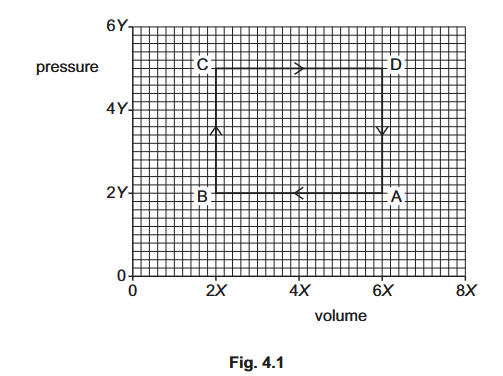
A cylinder contains a fixed mass of an ideal gas at pressure \(2Y\) and volume \(6X\).
The gas undergoes a sequence of changes from its initial state A, through states B, C and D, then finally back to its initial state A, as shown in Fig. 4.1.

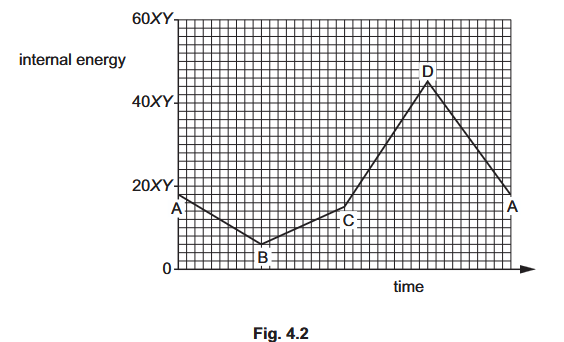
Fig. 4.2 shows the variation with time of the internal energy of the gas.

(a) State the first law of thermodynamics. [2]
________________________________________________________________________________________
________________________________________________________________________________________
(b)
(i) Use Fig. 4.1 and Fig. 4.2 to determine the general expression for the internal energy \(U\) of the gas when it has pressure \(p\) and volume \(V\). [1]
\(U=\) ______________________________
(ii) An ideal gas at thermodynamic temperature \(T\) contains \(N\) molecules.
Use your answer in (b)(i) and the equation of state for an ideal gas to deduce an expression for \(U\) in terms of \(N\) and \(T\). Identify any other symbols you use. [2]
\(U=\) ______________________________
(c) Determine expressions, in terms of \(X\) and \(Y\), for the work \(W\) done on the gas during:
(i) change AB [1]
\(W=\) ______________________________
(ii) change CD. [1]
\(W=\) ______________________________
(d) Use your answers in (c) and the first law of thermodynamics to determine an expression, in terms of \(X\) and \(Y\), for the net thermal energy \(Q\) supplied to the gas during one full cycle ABCDA. Explain your reasoning. [3]
\(Q=\) ______________________________
Syllabus Topic Codes (Cambridge International AS & A Level Physics 9702):
16.2 The first law of thermodynamics – first law of thermodynamics, internal energy, work done and thermal energy transfer.
▶️ Answer/Explanation
(a) First law of thermodynamics [2 marks]
The change in internal energy of a system is equal to the work done on the system plus the thermal energy transferred to the system by heating.
\(\Delta U=W+Q\)
Here, \(W\) is the work done on the system and \(Q\) is the thermal energy supplied to the system.
(b)(i) General expression for internal energy [1 mark]
From Fig. 4.1 and Fig. 4.2, the internal energy is proportional to the product of pressure and volume:
\(U=\dfrac{3}{2}pV\)
Answer: \(U=\dfrac{3}{2}pV\)
(b)(ii) Internal energy in terms of \(N\) and \(T\) [2 marks]
For an ideal gas, \(pV=NkT\), where \(k\) is the Boltzmann constant.
Substituting into \(U=\dfrac{3}{2}pV\):
\(U=\dfrac{3}{2}NkT\)
Answer: \(U=\dfrac{3}{2}NkT\), where \(k\) is the Boltzmann constant.
(c)(i) Work done during AB [1 mark]
During AB, the pressure is constant at \(2Y\), while the volume decreases from \(6X\) to \(2X\).
The work done on the gas is positive because the gas is compressed:
\(W=(2Y)(6X-2X)=8XY\)
Answer: \(W=+8XY\)
(c)(ii) Work done during CD [1 mark]
During CD, the pressure is constant at \(5Y\), while the volume increases from \(2X\) to \(6X\).
\(W=-(5Y)(6X-2X)=-20XY\)
Answer: \(W=-20XY\)
(d) Net thermal energy supplied during one cycle [3 marks]
During the vertical stages BC and DA, the volume is constant, so no work is done:
\(W_{\mathrm{BC}}=W_{\mathrm{DA}}=0\)
Over one complete cycle, the gas returns to its initial state, so its change in internal energy is zero:
\(\Delta U=0\)
From the first law, \(\Delta U=W+Q\).
Therefore, for the complete cycle, \(Q=-W\).
The net work done on the gas is \(W=8XY-20XY=-12XY\).
Hence, \(Q=-(-12XY)=12XY\).
Answer: \(Q=+12XY\)
Question 5
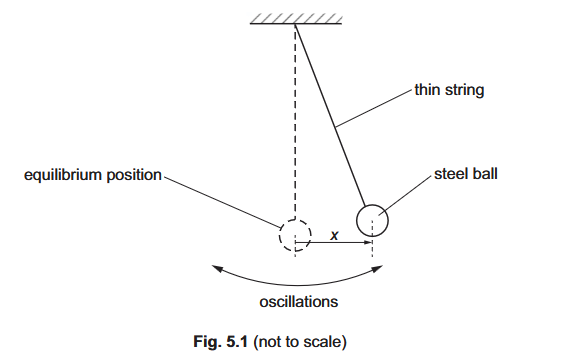
A steel ball on the end of a thin string oscillates with small oscillations, as shown in Fig. 5.1.
The displacement of the centre of the ball from its equilibrium position is \(x\).
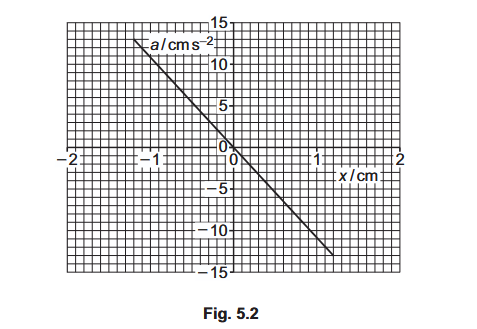
(a) Fig. 5.2 shows the variation with \(x\) of the acceleration \(a\) of the ball.

(i) Explain how Fig. 5.2 shows that the oscillations of the ball are simple harmonic. [2]
________________________________________________________________________________________
________________________________________________________________________________________
(ii) Determine the period \(T\) of the oscillations. [3]
\(T=\) ______________________________ \(\mathrm{s}\)
(b) At time \(t=0\), when the displacement of the ball has its maximum value, the ball is immersed in a trough containing thick oil so that the ball is just below the surface of the oil. This results in the subsequent motion of the ball being heavily damped.
(i) State what is meant by damping. [2]
________________________________________________________________________________________
________________________________________________________________________________________
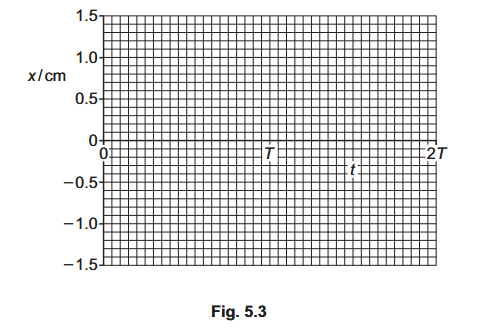
(ii) On Fig. 5.3, sketch a possible variation of the displacement \(x\) of the ball with \(t\) between \(t=0\) and \(t=2T\). [3]

Syllabus Topic Codes (Cambridge International AS & A Level Physics 9702):
17.1 Simple harmonic oscillations
17.3 Damped and forced oscillations, resonance
▶️ Answer/Explanation
(a)(i) Simple harmonic motion [2 marks]
The graph is a straight line through the origin, showing that the acceleration is proportional to the displacement:
\(a\propto x\)
The negative gradient shows that the acceleration is always in the opposite direction to the displacement.
Therefore, \(a\propto -x\), which is the condition for simple harmonic motion.
(a)(ii) Period of oscillations [3 marks]
For simple harmonic motion, \(a_0=\omega^2x_0\).
From the graph, \(x_0=1.2\,\mathrm{cm}\) and \(a_0=13\,\mathrm{cm\,s^{-2}}\).
Hence, \(\omega=\sqrt{\dfrac{a_0}{x_0}}\).
Also, \(\omega=\dfrac{2\pi}{T}\).
Therefore, \(T=2\pi\sqrt{\dfrac{x_0}{a_0}}\).
\(T=2\pi\sqrt{\dfrac{1.2}{13}}\)
\(T=1.9\,\mathrm{s}\)
Answer: \(T=1.9\,\mathrm{s}\)
(b)(i) Damping [2 marks]
Damping is the loss of energy from an oscillating system.
The energy is lost due to resistive force(s).
(b)(ii) Displacement-time graph for heavily damped motion [3 marks]
At \(t=0\), the displacement has its maximum value, so the graph starts at a non-zero positive displacement of approximately \(+1.2\,\mathrm{cm}\).
The oscillations are heavily damped, so the magnitude of the displacement decreases continuously with time.
A suitable sketch remains on one side of the \(t\)-axis, with both the magnitude of \(x\) and the magnitude of the gradient continuously decreasing.
Answer: A decaying curve starting from \(x\approx1.2\,\mathrm{cm}\) at \(t=0\), remaining above the \(t\)-axis and approaching \(x=0\) by \(t=2T\).
Question 6
(a) Define electric field at a point. [1]
________________________________________________________________________________________
(b) An isolated conducting sphere in a vacuum has a capacitance of \(69\,\mathrm{pF}\). The charge on the sphere is \(+83\,\mathrm{pC}\).
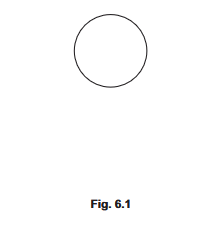
(i) On Fig. 6.1, draw field lines to represent the electric field outside the sphere due to the charge on the sphere. [2]

(ii) Calculate the electric potential at the surface of the sphere. [2]
electric potential = ______________________________ \(\mathrm{V}\)
(iii) Determine the radius of the sphere. [2]
radius = ______________________________ \(\mathrm{m}\)
(iv) Calculate the electric field strength \(E\) at the surface of the sphere. Give a unit with your answer. [2]
\(E=\) ______________________________ unit ______________________________
(c) The sphere in (b) is discharged by connecting it to earth (0V) through a resistor of resistance \(120\,\mathrm{M\Omega}\).
Calculate the time taken for the charge to fall to \(26\,\mathrm{pC}\). [2]
time = ______________________________ \(\mathrm{s}\)
Syllabus Topic Codes (Cambridge International AS & A Level Physics 9702):
18.1 Electric fields and field lines
18.4 Electric field of a point charge
18.5 Electric potential
19.3 Discharging a capacitor
▶️ Answer/Explanation
(a) Electric field [1 mark]
Electric field at a point is the force per unit positive charge placed at that point.
\(E=\dfrac{F}{Q}\)
(b)(i) Electric field lines [2 marks]
The sphere has a positive charge, so the electric field lines are radial and directed away from the sphere.
Answer: Draw radial field lines perpendicular to the surface, with arrows pointing away from the positively charged sphere.
(b)(ii) Electric potential at the surface [2 marks]
The capacitance is related to charge and potential by \(C=\dfrac{Q}{V}\).
Therefore, \(V=\dfrac{Q}{C}\).
\(V=\dfrac{83}{69}\)
\(V=1.2\,\mathrm{V}\)
Answer: \(V=+1.2\,\mathrm{V}\)
(b)(iii) Radius of the sphere [2 marks]
For an isolated conducting sphere, \(V=\dfrac{Q}{4\pi\varepsilon_0r}\).
Rearranging, \(r=\dfrac{Q}{4\pi\varepsilon_0V}\).
\(r=\dfrac{83\times10^{-12}}{4\pi(8.85\times10^{-12})(1.2)}\)
\(r=0.62\,\mathrm{m}\)
Answer: \(r=0.62\,\mathrm{m}\)
(b)(iv) Electric field strength at the surface [2 marks]
For a point charge, \(E=\dfrac{Q}{4\pi\varepsilon_0r^2}\).
\(E=\dfrac{83\times10^{-12}}{4\pi(8.85\times10^{-12})(0.62)^2}\)
\(E=1.9\,\mathrm{N\,C^{-1}}\)
Answer: \(E=1.9\,\mathrm{N\,C^{-1}}\)
(c) Discharge of the sphere [2 marks]
The charge on a discharging capacitor follows \(Q=Q_0e^{-t/RC}\).
Here, \(Q_0=83\,\mathrm{pC}\), \(Q=26\,\mathrm{pC}\), \(R=120\times10^6\,\Omega\), and \(C=69\times10^{-12}\,\mathrm{F}\).
\(26=83\exp\left[-\dfrac{t}{(120\times10^6)(69\times10^{-12})}\right]\)
\(t=9.6\times10^{-3}\,\mathrm{s}\)
Answer: \(t=9.6\times10^{-3}\,\mathrm{s}\)
Question 7
An alternating voltage \(V\) varies with time \(t\) according to
\(V=18\cos40\pi t\)
where \(V\) is in V and \(t\) is in s.
(a) For the alternating voltage:
(i) show that the period is \(0.050\,\mathrm{s}\). [1]
________________________________________________________________________________________
(ii) determine the root-mean-square (r.m.s.) voltage. [1]
r.m.s. voltage = ______________________________ \(\mathrm{V}\)
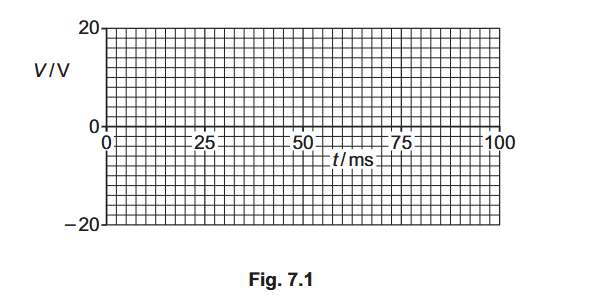
(b) On Fig. 7.1, sketch the variation of \(V\) with \(t\) for values of \(t\) from \(t=0\) to \(t=100\,\mathrm{ms}\).

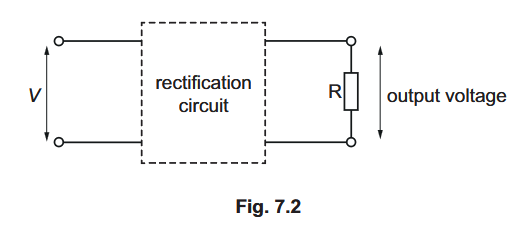
(c) The alternating voltage is rectified to produce an output voltage across a load resistor \(R\), as shown in Fig. 7.2.

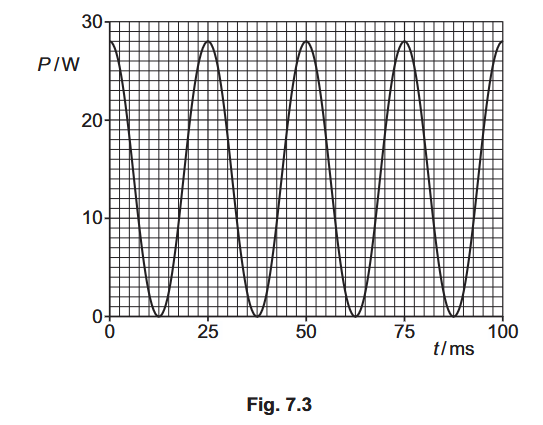
Fig. 7.3 shows the variation with \(t\) of the power \(P\) in the load resistor.

State three conclusions that can be drawn from Fig. 7.3. The conclusions may be qualitative or quantitative. Use the space for any working.
1 ________________________________________________________________________________________
2 ________________________________________________________________________________________
3 ________________________________________________________________________________________
Syllabus Topic Codes (Cambridge International AS & A Level Physics 9702):
21.2 Rectification and smoothing
▶️ Answer/Explanation
(a)(i) Period of the alternating voltage [1 mark]
Comparing \(V=18\cos40\pi t\) with \(V=V_0\cos\omega t\):
\(\omega=40\pi\,\mathrm{rad\,s^{-1}}\)
Using \(\omega=\dfrac{2\pi}{T}\):
\(T=\dfrac{2\pi}{40\pi}\)
\(T=0.050\,\mathrm{s}\)
Answer: \(T=0.050\,\mathrm{s}\)
(a)(ii) r.m.s. voltage [1 mark]
For a sinusoidal alternating voltage, \(V_{\mathrm{r.m.s.}}=\dfrac{V_0}{\sqrt{2}}\).
\(V_{\mathrm{r.m.s.}}=\dfrac{18}{\sqrt{2}}\)
\(V_{\mathrm{r.m.s.}}\approx13\,\mathrm{V}\)
Answer: \(13\,\mathrm{V}\)
(b) Sketch of alternating voltage [3 marks]
The graph is a sinusoidal curve with period \(50\,\mathrm{ms}\).
At \(t=0\), \(V\) has its maximum value of \(+18\,\mathrm{V}\). The voltage reaches \(-18\,\mathrm{V}\) at \(t=25\,\mathrm{ms}\), returns to \(+18\,\mathrm{V}\) at \(t=50\,\mathrm{ms}\), and repeats this pattern.
The sketch therefore shows two complete sinusoidal cycles between \(0\) and \(100\,\mathrm{ms}\), with maximum and minimum voltages of \(\pm18\,\mathrm{V}\).
(c) Conclusions from Fig. 7.3 [3 marks]
Any three valid conclusions:
• The rectification is full-wave.
• The mean power is approximately \(14\,\mathrm{W}\).
• The resistance of the load resistor is approximately \(12\,\Omega\).
• The peak current in \(R\) is approximately \(1.6\,\mathrm{A}\), or the r.m.s. current is approximately \(1.1\,\mathrm{A}\).
• The period of the output voltage or power is \(25\,\mathrm{ms}\).
Therefore, the frequency of the output voltage or power is \(40\,\mathrm{Hz}\), or its angular frequency is approximately \(250\,\mathrm{rad\,s^{-1}}\).
Question 8
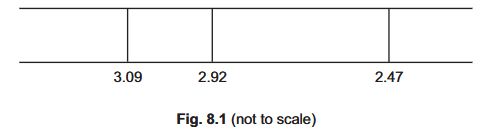
Fig. 8.1 shows the three lowest-frequency lines in the part of the emission spectrum for hydrogen that relates to electron transitions to the ground state (level \(n=1\)).

The numbers represent the frequencies, in \(10^{15}\,\mathrm{Hz}\), associated with the spectral lines.
(a) Use the photon model of electromagnetic radiation to explain how the existence of spectral lines in the emission spectrum provides evidence for discrete electron energy levels in the hydrogen atom. [3]
_________________________________________
(b) The energy of the ground state (level \(n=1\)) in a hydrogen atom is \(-13.6\,\mathrm{eV}\).
(i) Calculate the energy, in J, of the ground state. [1]
energy = ______________________________ \(\mathrm{J}\)
(ii) Show that the energy difference between levels \(n=1\) and \(n=2\) is \(10.2\,\mathrm{eV}\). [2]
_____________________________
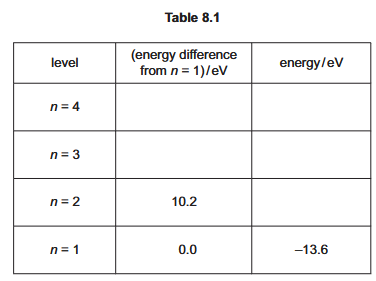
(iii) Complete Table 8.1 to show the energy differences from the ground state, and the energies of the levels up to \(n=4\), in the hydrogen atom. Use the space for any working.

Syllabus Topic Code (Cambridge International AS & A Level Physics 9702):
22.4 Energy levels in atoms and line spectra
▶️ Answer/Explanation
(a) Photon model and discrete energy levels [3 marks]
When an electron moves between two energy levels, it emits a single photon.
The energy of the photon is equal to the difference between the two electron energy levels: \(\Delta E=hf\).
Since the spectrum contains only discrete frequencies, the possible differences between electron energies must also be discrete. Therefore, the electron energy levels are discrete.
(b)(i) Energy of the ground state [1 mark]
\(E=-(13.6)(1.60\times10^{-19})\)
\(E=-2.18\times10^{-18}\,\mathrm{J}\)
Answer: \(-2.18\times10^{-18}\,\mathrm{J}\)
(b)(ii) Energy difference between \(n=1\) and \(n=2\) [2 marks]
The lowest-frequency spectral line shown is \(2.47\times10^{15}\,\mathrm{Hz}\), corresponding to the transition between \(n=2\) and \(n=1\).
Using \(\Delta E=hf\):
\(\Delta E=(6.63\times10^{-34})(2.47\times10^{15})\)
Converting to eV: \[ \Delta E=\dfrac{(6.63\times10^{-34})(2.47\times10^{15})}{1.60\times10^{-19}} \]
\(\Delta E=10.2\,\mathrm{eV}\)
Answer: \(\Delta E=10.2\,\mathrm{eV}\)
(b)(iii) Hydrogen energy levels [4 marks]
For \(n=2\), the energy difference from the ground state is \(10.2\,\mathrm{eV}\), so
\(E_2=-13.6+10.2=-3.4\,\mathrm{eV}\)
The spectral line at \(2.92\times10^{15}\,\mathrm{Hz}\) corresponds to the transition from \(n=3\) to \(n=1\):
\(\Delta E=\dfrac{(6.63\times10^{-34})(2.92\times10^{15})}{1.60\times10^{-19}}\)
\(\Delta E=12.1\,\mathrm{eV}\)
Therefore, \(E_3=-13.6+12.1=-1.5\,\mathrm{eV}\).
The spectral line at \(3.09\times10^{15}\,\mathrm{Hz}\) corresponds to the transition from \(n=4\) to \(n=1\):
\(\Delta E=\dfrac{(6.63\times10^{-34})(3.09\times10^{15})}{1.60\times10^{-19}}\)
\(\Delta E=12.8\,\mathrm{eV}\)
Therefore, \(E_4=-13.6+12.8=-0.8\,\mathrm{eV}\).
Completed values:
| Level | Energy difference from \(n=1\) / eV | Energy / eV |
|---|---|---|
| \(n=4\) | \(12.8\) | \(-0.8\) |
| \(n=3\) | \(12.1\) | \(-1.5\) |
| \(n=2\) | \(10.2\) | \(-3.4\) |
| \(n=1\) | \(0.0\) | \(-13.6\) |
Question 9
(a) State what is meant by the mass defect of a nucleus. [2]
________________________________________________________________________________________
________________________________________________________________________________________
(b) The nuclear fusion reaction for the formation of helium-4 from deuterium is represented by
\(^{2}_{1}\mathrm{H}+^{2}_{1}\mathrm{H}\rightarrow{}^{4}_{2}\mathrm{He}\)
Table 9.1 shows the masses of the nuclides involved in this reaction.
| nuclide | nuclide mass / \(\mathrm{u}\) |
|---|---|
| \(^{2}_{1}\mathrm{H}\) | \(2.013553\) |
| \(^{4}_{2}\mathrm{He}\) | \(4.001505\) |
Calculate the energy released in the formation of \(1.00\,\mathrm{mol}\) of helium-4. [4]
energy = ______________________________ \(\mathrm{J}\)
(c) The star Sirius has a radius of \(1.19\times10^{9}\,\mathrm{m}\) and loses mass due to nuclear fusion at a rate of \(1.09\times10^{11}\,\mathrm{kg\,s^{-1}}\). Assume that the power of the radiation emitted by the star is equal to the power released by this process.
(i) Determine a value for the luminosity of Sirius. Give a unit with your answer. [2]
luminosity = ______________________________ unit ______________________________
(ii) Use your answer in (c)(i) to determine the surface temperature of Sirius. [2]
surface temperature = ______________________________ \(\mathrm{K}\)
(d) Explain how cosmologists use standard candles to estimate the distance of a galaxy from the Earth. [3]
_____________________________________
Syllabus Topic Codes (Cambridge International AS & A Level Physics 9702):
23.1 Mass defect and nuclear binding energy
25.1 Standard candles
25.2 Stellar radii
▶️ Answer/Explanation
(a) Mass defect [2 marks]
Mass defect is the difference between the mass of a nucleus and the total mass of its constituent nucleons when the nucleons are separated to infinity.
(b) Energy released in nuclear fusion [4 marks]
The mass defect for the formation of one helium-4 nucleus is
\(\Delta m=(2\times2.013553)-4.001505\)
\(\Delta m=0.025601\,\mathrm{u}\)
Using \(E=c^2\Delta m\):
\(E=0.025601\times1.66\times10^{-27}\times(3.00\times10^8)^2\)
\(E=3.82\times10^{-12}\,\mathrm{J}\)
One mole contains \(6.02\times10^{23}\) nuclei, so
\(E=(3.82\times10^{-12})(6.02\times10^{23})\)
\(E=2.30\times10^{12}\,\mathrm{J}\)
Answer: \(2.30\times10^{12}\,\mathrm{J}\)
(c)(i) Luminosity of Sirius [2 marks]
The energy released per kilogram of mass converted is \(c^2\). Therefore, the power released is
\(L=\dot{m}c^2\)
\(L=(1.09\times10^{11})(3.00\times10^8)^2\)
\(L=9.81\times10^{27}\,\mathrm{W}\)
Answer: \(L=9.81\times10^{27}\,\mathrm{W}\)
(c)(ii) Surface temperature of Sirius [2 marks]
Using the Stefan-Boltzmann law, \(L=4\pi\sigma r^2T^4\).
\(9.81\times10^{27}=4\pi(5.67\times10^{-8})(1.19\times10^9)^2T^4\)
Rearranging, \(T=\left[\dfrac{9.81\times10^{27}}{4\pi(5.67\times10^{-8})(1.19\times10^9)^2}\right]^{1/4}\)
\(T=9930\,\mathrm{K}\)
Answer: \(T=9930\,\mathrm{K}\)
(d) Standard candles [3 marks]
Standard candles are objects whose luminosity is known.
The radiant flux intensity from the object is measured on Earth.
The distance can then be calculated using the inverse-square relationship:
\(F=\dfrac{L}{4\pi d^2}\)
Hence, \(d=\sqrt{\dfrac{L}{4\pi F}}\).
Question 10
(a) State what is meant by contrast in an X-ray image. [1]
________________________________________________________________________________________
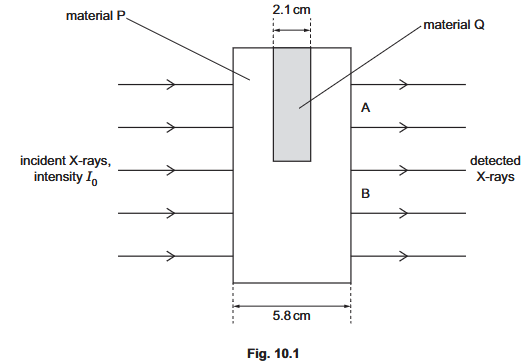
(b) X-rays of intensity \(I_0\) are incident normally on a structure, as shown in Fig. 10.1.

Material P has a linear attenuation coefficient of \(0.35\,\mathrm{cm^{-1}}\). The X-rays emerging from the structure in region A have an intensity of \(0.053I_0\).
(i) Show that the intensity of the X-rays emerging in region B is \(0.13I_0\). [1]
intensity = ______________________________ \(I_0\)
(ii) Determine the linear attenuation coefficient \(\mu\) of material Q. [3]
\(\mu=\) ______________________________ \(\mathrm{cm^{-1}}\)
(iii) Use the information in (b)(i) to suggest why the X-rays emerging from the structure form an image that has poor contrast. [1]
________________________________________________________________________________________
(c) Explain how X-rays are used in computed tomography (CT) scanning to produce a three-dimensional image of an internal structure. [3]
________________________________________________________________________________________
________________________________________________________________________________________
________________________________________________________________________________________
________________________________________________________________________________________
Syllabus Topic Codes (Cambridge International AS & A Level Physics 9702):
24.2 Production and use of X-rays – X-ray attenuation, contrast and the use of X-rays in medical imaging including CT scanning.
▶️ Answer/Explanation
(a) Contrast [1 mark]
Contrast is the difference in degrees of blackening between different parts of an X-ray image.
(b)(i) Intensity in region B [1 mark]
The X-rays in region B pass through \(5.8\,\mathrm{cm}\) of material P.
Using the attenuation equation \(I=I_0\exp(-\mu x)\):
\(I=I_0\exp[-(0.35)(5.8)]\)
\(I=0.13I_0\)
Answer: \(I=0.13I_0\)
(b)(ii) Linear attenuation coefficient of Q [3 marks]
The thickness of material P in region A is
\(5.8-2.1=3.7\,\mathrm{cm}\)
Therefore,
\(0.053I_0=I_0\exp[-(0.35\times3.7+2.1\mu)]\)
Dividing by \(I_0\):
\(0.053=\exp[-(0.35\times3.7+2.1\mu)]\)
Solving for \(\mu\):
\(\mu\approx0.78\,\mathrm{cm^{-1}}\)
Answer: \(\mu=0.78\,\mathrm{cm^{-1}}\)
(b)(iii) Contrast [1 mark]
The detected intensities are only different by a factor of \(\dfrac{0.13}{0.053}\approx2.5\), so there is only a small difference in blackening and hence poor contrast.
(c) CT scanning [3 marks]
The structure is scanned in thin sections.
Many X-ray scans of each section are taken from different angles.
The scanning is repeated for all sections and the data are processed and combined to form a three-dimensional image.