Home / 9702_w25_qp_43

Question 1

(a) In terms of velocity and acceleration, describe uniform circular motion of an object. [2]

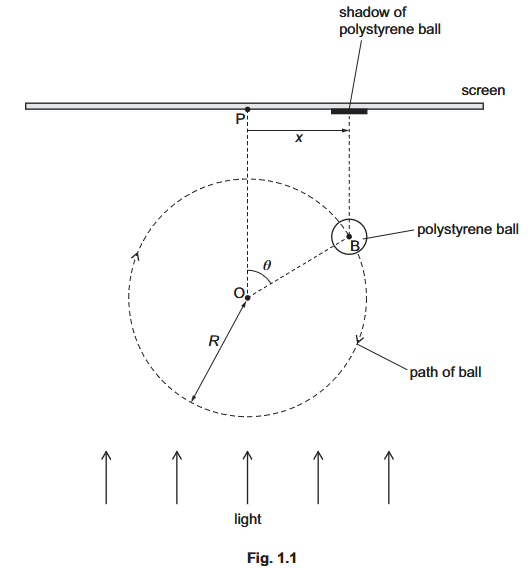
(b) Fig. 1.1 shows the view from above of a polystyrene ball undergoing horizontal circular motion of radius \(R\).

The ball is illuminated by parallel light so that a shadow of the ball forms on a screen placed on the opposite side of the ball from the light source.

The line joining points O and P is perpendicular to the screen.

The angular speed of the circular motion is \(\omega\).

(i) State an expression, in terms of \(R\) and \(\omega\), for the speed of the ball. [1]

\(v=\) ______________________________

(ii) Determine an expression, in terms of \(v\) and \(\omega\), for the centripetal acceleration of the ball. [2]

centripetal acceleration = ______________________________

(c) The ball in (b) is in the position shown in Fig. 1.1, such that line OB is at an angle \(\theta\) to the line OP.

(i) Determine an expression, in terms of \(R\) and \(\theta\), for the displacement \(x\) of the shadow from P. [1]

\(x=\) ______________________________

(ii) The value of \(\theta\) is zero at time \(t=0\). State an expression for \(\theta\) in terms of \(\omega\) and \(t\). [1]

\(\theta=\) ______________________________

(iii) Use your answers in (c)(i) and (c)(ii) to show that \(x\) is given by \(x=R\sin\omega t\). [1]

(iv) Explain, with reference to the equation in (c)(iii), why the motion of the shadow on the screen may be modelled as simple harmonic. [1]

(d) The circular motion of the ball in Fig. 1.1 has a diameter of \(0.46\,\mathrm{m}\) and an angular speed of \(1.9\,\mathrm{rad\,s^{-1}}\).

For the simple harmonic motion of the shadow of the ball in Fig. 1.1, calculate:

(i) the amplitude

amplitude = ______________________________ \(\mathrm{m}\)

(ii) the period

period = ______________________________ \(\mathrm{s}\)

(iii) the maximum acceleration

maximum acceleration = ______________________________ \(\mathrm{m\,s^{-2}}\)

(e) On Fig. 1.1, draw and label with the letter A, the position of the shadow on the screen when the shadow has its maximum positive acceleration. [1]

Syllabus Topic Codes (Cambridge International AS & A Level Physics 9702):

12.1 Kinematics of uniform circular motion – uniform circular motion, angular speed, tangential speed and centripetal acceleration.

12.2 Centripetal acceleration – centripetal acceleration in circular motion.

17.1 Simple harmonic oscillations – modelling the projection of uniform circular motion as simple harmonic motion.

17.2 Energy in simple harmonic motion – properties of simple harmonic motion including amplitude and period.

▶️ Answer/Explanation
Solution

(a) Uniform circular motion [2 marks]

The velocity and acceleration both have constant magnitude.

The velocity is always perpendicular to the acceleration.

(b)(i) Speed of the ball [1 mark]

The relationship between tangential speed and angular speed is \(v=R\omega\).

Answer: \(v=R\omega\)

(b)(ii) Centripetal acceleration [2 marks]

For circular motion, \(a=\dfrac{v^2}{R}\).

Since \(v=R\omega\), \(a=\dfrac{(R\omega)^2}{R}=R\omega^2\).

Therefore, \(a=v\omega\).

Answer: \(a=v\omega\)

(c)(i) Displacement of the shadow [1 mark]

From the geometry of Fig. 1.1, \(\sin\theta=\dfrac{x}{R}\).

Hence, \(x=R\sin\theta\).

Answer: \(x=R\sin\theta\)

(c)(ii) Angular displacement [1 mark]

Angular displacement is related to angular speed by \(\theta=\omega t\), since \(\theta=0\) at \(t=0\).

Answer: \(\theta=\omega t\)

(c)(iii) Equation for the shadow [1 mark]

From (c)(i), \(x=R\sin\theta\).

Substituting \(\theta=\omega t\): \(x=R\sin(\omega t)\).

Answer: \(x=R\sin\omega t\)

(c)(iv) Simple harmonic motion [1 mark]

The equation has the form \(x=x_0\sin\omega t\), which is the standard form for simple harmonic motion.

Answer: The motion may therefore be modelled as simple harmonic motion.

(d)(i) Amplitude [1 mark]

The amplitude of the shadow is equal to the radius of the circular motion.

\(R=\dfrac{0.46}{2}=0.23\,\mathrm{m}\)

Answer: amplitude \(=0.23\,\mathrm{m}\)

(d)(ii) Period [2 marks]

Angular speed is related to period by \(\omega=\dfrac{2\pi}{T}\).

Therefore, \(T=\dfrac{2\pi}{\omega}\).

\(T=\dfrac{2\pi}{1.9}\)

\(T\approx3.3\,\mathrm{s}\)

Answer: period \(=3.3\,\mathrm{s}\)

(d)(iii) Maximum acceleration [2 marks]

For simple harmonic motion, the magnitude of acceleration is \(a=\omega^2x\).

Maximum acceleration occurs when \(x=x_0\), where \(x_0\) is the amplitude.

\(a_{\max}=\omega^2x_0\)

\(a_{\max}=(1.9)^2(0.23)\)

\(a_{\max}\approx0.83\,\mathrm{m\,s^{-2}}\)

Answer: maximum acceleration \(=0.83\,\mathrm{m\,s^{-2}}\)

(e) Position of maximum positive acceleration [1 mark]

For simple harmonic motion, acceleration is directed towards the equilibrium position.

Maximum positive acceleration therefore occurs when the shadow has maximum negative displacement, corresponding to the upper-left position of the circular path as shown in the mark scheme.
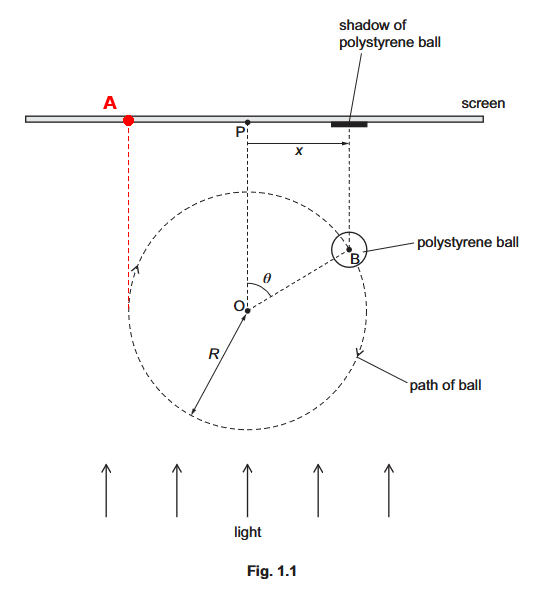
Answer: Label A at the shadow position on the screen above the left-hand edge of the circular path.
Question 2

(a) State two ways in which the first law of thermodynamics describes that the internal energy of a system may be changed. [2]

1. _________________________

2. _________________________

(b)

(i) Use the first law of thermodynamics to explain why a bicycle pump gets hot when it is used to pump up a tyre quickly. [3]

_________________________

(ii) With reference to molecular energies, explain why the temperature of water remains at \(100^\circ\mathrm{C}\) when it vaporises in a kettle, even though it is being heated. [3]

_________________________

Syllabus Topic Codes (Cambridge International AS & A Level Physics 9702):

16.2 The first law of thermodynamics – internal energy changes due to thermal energy transfer and work done.

16.1 Internal energy – internal energy in terms of the molecular kinetic and potential energies.

▶️ Answer/Explanation
Solution

(a) 

The internal energy of a system may be changed by thermal energy being transferred to or from the system.

It may also be changed by work being done on or by the system.

Answer: thermal energy supplied to or removed from the system; work done on or by the system.

(b)(i) 

When the pump is used quickly, there is little time for thermal energy to be transferred to or from the gas.

Work is done on the gas as it is compressed, decreasing its volume.

Therefore, the internal energy of the gas increases, so its temperature increases and the pump becomes hot.

Answer: The rapid compression gives little time for thermal energy transfer. Work is done on the gas, increasing its internal energy and hence its temperature.

(b)(ii) 

During vaporisation, the separation between the water molecules increases.

The energy supplied is therefore used to increase the potential energy of the molecules.

The kinetic energy of the molecules remains unchanged, so the temperature remains at \(100^\circ\mathrm{C}\).

Answer: The supplied energy increases molecular separation and hence molecular potential energy, while the average kinetic energy remains unchanged. Therefore, the temperature remains constant.

Question 3

(a) Define gravitational field at a point. [1]


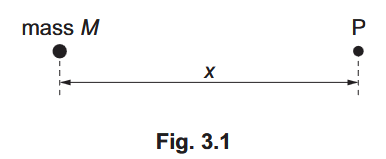
(b) Fig. 3.1 shows an isolated point mass of mass \(M\).

Point P is at distance \(x\) from the point mass.

(i) By considering the force exerted by the point mass on a test mass of mass \(m\) placed at P, derive an equation for the gravitational field strength \(g\) at P, in terms of \(M\) and \(x\). Identify any other symbols you use. [2]

(ii) On Fig. 3.1, draw an arrow to indicate the direction of the gravitational field at P. [1]

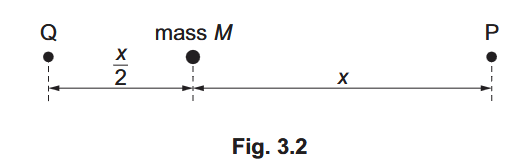
(iii) Point Q is at a distance \(\dfrac{x}{2}\) from the point mass, on the opposite side of the mass from P, as shown in Fig. 3.2.

Compare the gravitational field at Q with that at P. [2]

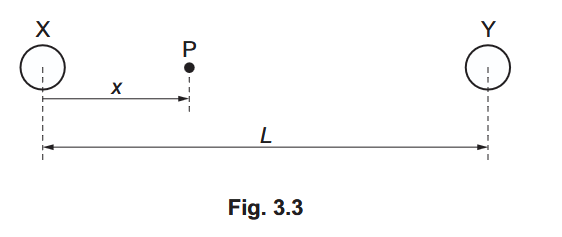
(c) Two identical isolated uniform spheres X and Y each have radius \(R\). The centres of the spheres are separated by distance \(L\), as shown in Fig. 3.3.

Point P lies on the line joining the centres of X and Y, and is at a variable displacement \(x\) from the centre of sphere X.

The gravitational field strength at the surface of each sphere is \(g_0\).

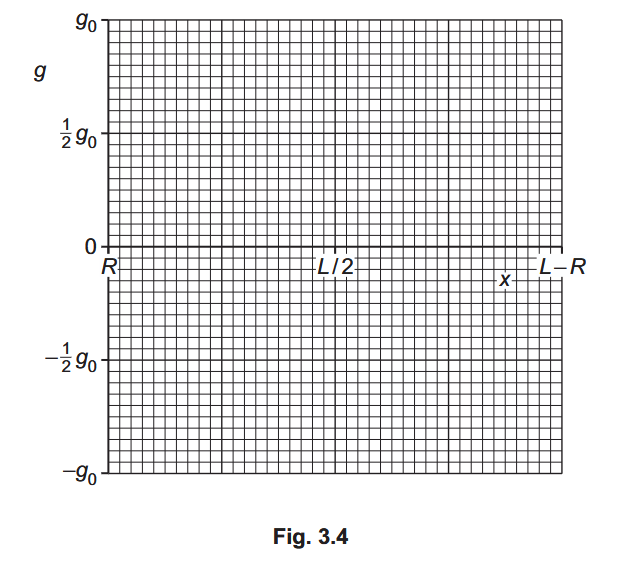
On Fig. 3.4, sketch the variation with \(x\) of the gravitational field \(g\) at point P between \(x=R\) and \(x=L-R\). [3]

Syllabus Topic Codes (Cambridge International AS & A Level Physics 9702):

13.1 Gravitational field – gravitational field strength and its definition as force per unit mass.

13.2 Gravitational force between point masses – gravitational force between masses using Newton’s law of gravitation.

13.3 Gravitational field of a point mass – gravitational field strength due to an isolated point mass and variation of field strength with distance.

▶️ Answer/Explanation
Solution

(a) Gravitational field at a point [1 mark]

Gravitational field strength at a point is the force per unit mass acting on a small test mass placed at that point.

Answer: Gravitational field strength is force per unit mass.

(b)(i) Gravitational field strength at P [2 marks]

From Newton’s law of gravitation, the force between the point mass \(M\) and the test mass \(m\) is \(F=\dfrac{GMm}{x^2}\).

Gravitational field strength is force per unit mass: \(g=\dfrac{F}{m}\).

Therefore, \(g=\dfrac{GMm}{x^2m}\).

Hence, \(g=\dfrac{GM}{x^2}\), where \(G\) is the gravitational constant.

Answer: \(g=\dfrac{GM}{x^2}\), where \(G\) is the gravitational constant.

(b)(ii) Direction of gravitational field [1 mark]

A gravitational field is directed towards the mass producing the field.

Answer: The arrow at P points directly towards the point mass \(M\).

(b)(iii) Comparison of fields at Q and P [2 marks]

The magnitude of gravitational field strength due to a point mass is \(g=\dfrac{GM}{r^2}\).

At P, the distance is \(x\), so \(g_P=\dfrac{GM}{x^2}\).

At Q, the distance is \(\dfrac{x}{2}\), so \(g_Q=\dfrac{GM}{(x/2)^2}=\dfrac{4GM}{x^2}=4g_P\).

The fields at Q and P are in opposite directions because Q and P are on opposite sides of the mass.

Answer: The gravitational field strength at Q is four times that at P, and the two fields are in opposite directions.

(c) Variation of gravitational field strength [3 marks]

At \(x=R\), point P is at the surface of sphere X. The field due to X is directed towards X, so \(g=-g_0\).

At \(x=L-R\), point P is at the surface of sphere Y. The field due to Y is directed towards Y, so \(g=+g_0\).

At the midpoint \(x=\dfrac{L}{2}\), the gravitational fields due to the identical spheres are equal in magnitude and opposite in direction.

Therefore, \(g=0\) at \(x=\dfrac{L}{2}\).

The curve becomes progressively shallower from \(x=R\) to \(x=\dfrac{L}{2}\), then becomes progressively steeper from \(x=\dfrac{L}{2}\) to \(x=L-R\).
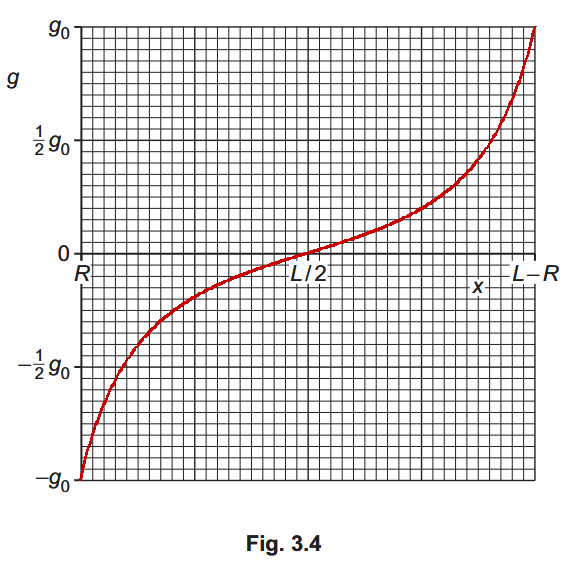
Answer: The graph starts at \((R,-g_0)\), passes through \(\left(\dfrac{L}{2},0\right)\), and ends at \((L-R,+g_0)\), with the curve becoming shallower towards the midpoint and steeper after the midpoint.

Question 4

(a) State the value of absolute zero on:

(i) the Celsius temperature scale

temperature = ______________________________ \(^\circ\mathrm{C}\) [1]

(ii) the thermodynamic temperature scale. Give a unit with your answer.

temperature = ______________________________ unit __________ [1]

(b) A sample contains a fixed amount of gas. The gas has pressure \(p\), volume \(V\) and thermodynamic temperature \(T\).

Fig. 4.1 shows the variation of \(pV\) with \(kT\) for the sample, where \(k\) is the Boltzmann constant.

Question 4 graph

(i) State what is indicated about the nature of the gas from the variation shown in Fig. 4.1. [1]

________________________________________________________________________________________

(ii) Determine the number \(N\) of molecules of the gas in the sample. [2]

\(N=\) ______________________________

(iii) Use your answer in (b)(ii) to determine the amount \(n\) of gas in the sample.

\(n=\) ______________________________ \(\mathrm{mol}\) [1]

(c) The root-mean-square (r.m.s.) speed of the molecules of the gas is \(1900\,\mathrm{m\,s^{-1}}\) when \(pV\) is equal to \(270\,\mathrm{J}\).

Determine the mass, in \(\mathrm{u}\), of one molecule of the gas, where \(\mathrm{u}\) is the unified atomic mass unit.

mass = ______________________________ \(\mathrm{u}\) [4]

Syllabus Topic Codes (Cambridge International AS & A Level Physics 9702):

14.2 Temperature scales – Celsius and thermodynamic temperature scales and absolute zero.

15.1 The mole – amount of substance and the relationship between number of molecules and amount of gas.

15.2 Equation of state – the equation \(pV=NkT\) for an ideal gas.

15.3 Kinetic theory of gases – molecular kinetic energy and r.m.s. speed.

▶️ Answer/Explanation
Solution

(a)(i) Absolute zero on the Celsius scale [1 mark]

Absolute zero corresponds to \(0\,\mathrm{K}\), which is approximately \(-273.15^\circ\mathrm{C}\).

Answer: \(-273.15^\circ\mathrm{C}\)

(a)(ii) Absolute zero on the thermodynamic scale [1 mark]

On the thermodynamic temperature scale, absolute zero is defined as \(0\,\mathrm{K}\).

Answer: \(0\,\mathrm{K}\)

(b)(i) Nature of the gas [1 mark]

The graph shows a straight-line relationship between \(pV\) and \(kT\) passing through the origin.

This indicates that the gas behaves as an ideal gas.

Answer: The gas is ideal.

(b)(ii) Number of molecules [2 marks]

For an ideal gas, \(pV=NkT\).

From the graph, when \(kT=8.0\times10^{-21}\,\mathrm{J}\), \(pV=270\,\mathrm{J}\).

Therefore, \(N=\dfrac{pV}{kT}\).

\(N=\dfrac{270}{8.0\times10^{-21}}\)

\(N=3.4\times10^{22}\)

Answer: \(N=3.4\times10^{22}\) molecules

(b)(iii) Amount of gas [1 mark]

The number of molecules is related to the amount of gas by \(N=nN_{\mathrm A}\).

Hence, \(n=\dfrac{N}{N_{\mathrm A}}\).

\(n=\dfrac{3.4\times10^{22}}{6.02\times10^{23}}\)

\(n=0.056\,\mathrm{mol}\)

Answer: \(n=0.056\,\mathrm{mol}\)

(c) Mass of one molecule [4 marks]

From kinetic theory, \(pV=\dfrac{2}{3}N\left(\dfrac{1}{2}mv_{\mathrm{rms}}^2\right)\).

Therefore, \(\dfrac{1}{2}mv_{\mathrm{rms}}^2=\dfrac{3}{2}kT\).

Since \(pV=NkT\), \(\dfrac{1}{2}mv_{\mathrm{rms}}^2=\dfrac{3pV}{2N}\).

Using \(pV=270\,\mathrm{J}\), \(N=3.4\times10^{22}\) and \(v_{\mathrm{rms}}=1900\,\mathrm{m\,s^{-1}}\):

\(\dfrac{1}{2}m(1900)^2=\dfrac{3}{2}\left(\dfrac{270}{3.4\times10^{22}}\right)\)

This gives \(m\approx6.65\times10^{-27}\,\mathrm{kg}\).

Using \(1\,\mathrm{u}=1.66\times10^{-27}\,\mathrm{kg}\):

\(m=\dfrac{6.65\times10^{-27}}{1.66\times10^{-27}}\)

\(m=4.0\,\mathrm{u}\)

Answer: \(m=4.0\,\mathrm{u}\)

Question 5

(a) Define electric potential at a point. [2]

___________________________

(b) A hydrogen atom may be considered to consist of a proton and an electron separated by a distance of \(120\,\mathrm{pm}\), as shown in Fig. 5.1.

Fig. 5.1 hydrogen atom diagram

The two particles may be considered as point charges.

Point P lies on the line joining the electron and the proton and is at a variable distance \(x\) from the proton.

(i) Show that the electric potential \(V\) at point P when \(x=10\,\mathrm{pm}\) is equal to \(130\,\mathrm{V}\). [2]

______________________________

(ii) Calculate, to two significant figures, \(V\) when \(x=30\,\mathrm{pm}\). [2]

\(V=\) ______________________________ \(\mathrm{V}\)

(iii) On Fig. 5.1, draw a cross (×) at one position, other than infinity, where the electric potential is zero. [1]

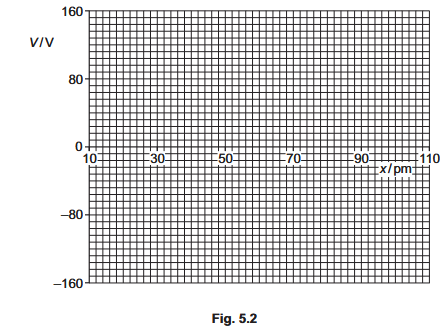
(iv) On Fig. 5.2, sketch the variation of \(V\) with \(x\) between \(x=10\,\mathrm{pm}\) and \(x=110\,\mathrm{pm}\). [3]

Syllabus Topic Codes (Cambridge International AS & A Level Physics 9702):

18.5 Electric potential – electric potential due to point charges and the superposition of electric potentials.

18.4 Electric field of a point charge – electric fields and potentials produced by isolated point charges.

▶️ Answer/Explanation
Solution

(a) Electric potential at a point [2 marks]

Electric potential is the work done per unit positive charge.

It is the work done in moving a positive test charge from infinity to the point.

Answer: Work done per unit charge in moving a positive charge from infinity to the point.

(b)(i) Show that \(V=130\,\mathrm{V}\) [2 marks]

The electric potential due to a point charge is \(V=\dfrac{Q}{4\pi\varepsilon_0r}\).

Potential due to the proton:

\(V_{\mathrm p}=\dfrac{1.60\times10^{-19}}{4\pi(8.85\times10^{-12})(10\times10^{-12})}\)

Potential due to the electron:

\(V_{\mathrm e}=\dfrac{-1.60\times10^{-19}}{4\pi(8.85\times10^{-12})(110\times10^{-12})}\)

Total potential:

\(V=\dfrac{1.60\times10^{-19}}{4\pi(8.85\times10^{-12})}\left(\dfrac{1}{10\times10^{-12}}-\dfrac{1}{110\times10^{-12}}\right)\)

\(V=130\,\mathrm{V}\)

Answer: \(130\,\mathrm{V}\)

(b)(ii) Potential when \(x=30\,\mathrm{pm}\) [2 marks]

Distance from proton \(=30\,\mathrm{pm}\).

Distance from electron \(=120-30=90\,\mathrm{pm}\).

\(V=\dfrac{1.60\times10^{-19}}{4\pi(8.85\times10^{-12})}\left(\dfrac{1}{30\times10^{-12}}-\dfrac{1}{90\times10^{-12}}\right)\)

\(V=32\,\mathrm{V}\)

Answer: \(V=+32\,\mathrm{V}\)

(b)(iii) Position where electric potential is zero [1 mark]

The electric potential is zero at the point midway between the proton and the electron because the positive and negative potentials are equal in magnitude.

Answer: Draw the cross at the midpoint, \(x=60\,\mathrm{pm}\).

(b)(iv) Sketch of variation of \(V\) with \(x\) [3 marks]

The graph begins at \((10,+130)\) and ends at \((110,-130)\).

It becomes progressively shallower until \(x=60\,\mathrm{pm}\), where it crosses the axis at \(V=0\).

After \(x=60\,\mathrm{pm}\), the curve becomes progressively steeper and passes through approximately \((30,+32)\) and \((90,-32)\).
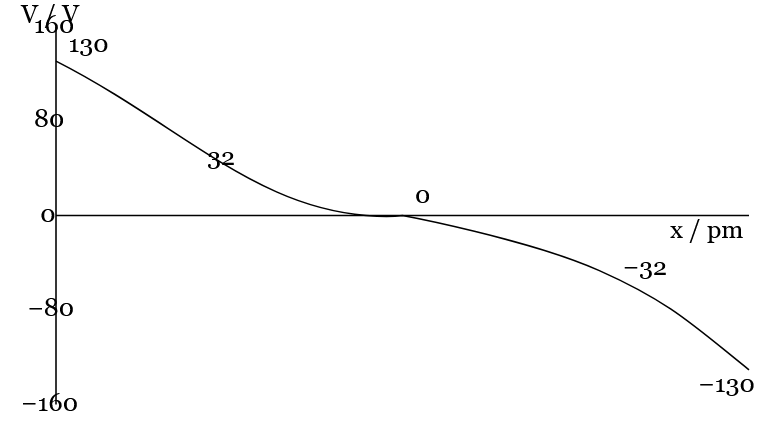
 

Answer: Smooth decreasing curve through \((10,+130)\), \((30,+32)\), \((60,0)\), \((90,-32)\) and \((110,-130)\), becoming shallower before \(60\,\mathrm{pm}\) and steeper afterwards.
Question 6

(a) Two parallel plate capacitors \(C_1\) and \(C_2\) are connected to a supply that has a potential difference (p.d.) \(V_{\mathrm S}\). The capacitors may be connected in series or in parallel.

The supply provides charge \(Q_{\mathrm S}\) and the plates of the two capacitors acquire charges \(Q_1\) and \(Q_2\) respectively. The p.d.s across the plates of the capacitors are \(V_1\) and \(V_2\) respectively.

Complete Table 6.1 to indicate how \(Q_{\mathrm S}\), \(Q_1\) and \(Q_2\) relate to each other, and how \(V_{\mathrm S}\), \(V_1\) and \(V_2\) relate to each other, for series and parallel connections of the capacitors to the supply. [4]

 relationship between chargesrelationship between p.d.s
series____________________________________________________________
parallel____________________________________________________________

(b) An isolated capacitor of capacitance \(470\,\mu\mathrm{F}\) stores \(19\,\mathrm{mJ}\) of energy.

(i) Calculate the p.d. across the capacitor. [2]

p.d. = ______________________________ \(\mathrm{V}\)

(ii) Calculate the charge on the capacitor. [2]

charge = ______________________________ \(\mathrm{C}\)

(iii) The capacitor is now connected in parallel with a capacitor of capacitance \(180\,\mu\mathrm{F}\) that is initially uncharged.

Determine the total energy, in \(\mathrm{mJ}\), now stored in the two capacitors. [3]

energy = ______________________________ \(\mathrm{mJ}\)

Syllabus Topic Codes (Cambridge International AS & A Level Physics 9702):

19.1 Capacitors and capacitance – capacitance, charge and p.d. relationships for capacitors in series and parallel.

19.2 Energy stored in a capacitor – energy stored in a charged capacitor using \(E=\dfrac{1}{2}CV^2\) and \(E=\dfrac{Q^2}{2C}\).

▶️ Answer/Explanation
Solution

(a) Series and parallel capacitors [4 marks]

 relationship between chargesrelationship between p.d.s
series\(Q_{\mathrm S}=Q_1=Q_2\)\(V_{\mathrm S}=V_1+V_2\)
parallel\(Q_{\mathrm S}=Q_1+Q_2\)\(V_{\mathrm S}=V_1=V_2\)

(b)(i) P.d. across the capacitor [2 marks]

The energy stored in a capacitor is \(E=\dfrac{1}{2}CV^2\).

Rearranging: \(V=\sqrt{\dfrac{2E}{C}}\).

\(E=19\times10^{-3}\,\mathrm{J}\) and \(C=470\times10^{-6}\,\mathrm{F}\).

\(V=\sqrt{\dfrac{2(19\times10^{-3})}{470\times10^{-6}}}\)

\(V=9.0\,\mathrm{V}\)

Answer: \(V=9.0\,\mathrm{V}\)

(b)(ii) Charge on the capacitor [2 marks]

Using \(Q=CV\):

\(Q=(470\times10^{-6})(9.0)\)

\(Q=4.23\times10^{-3}\,\mathrm{C}\)

Answer: \(Q=4.2\times10^{-3}\,\mathrm{C}\)

(b)(iii) Total energy after connection in parallel [3 marks]

The second capacitor is initially uncharged, so when the two capacitors are connected in parallel, the total charge is conserved.

The total capacitance is \(C_{\mathrm{total}}=470+180=650\,\mu\mathrm{F}\).

The common final p.d. is \(V_{\mathrm f}=\dfrac{Q_{\mathrm{total}}}{C_{\mathrm{total}}}\).

\(V_{\mathrm f}=\dfrac{4.23\times10^{-3}}{650\times10^{-6}}\)

\(V_{\mathrm f}\approx6.51\,\mathrm{V}\)

The total stored energy is \(E=\dfrac{Q^2}{2C}\).

\(E=\dfrac{(4.23\times10^{-3})^2}{2(650\times10^{-6})}\)

\(E\approx0.014\,\mathrm{J}\)

\(E=14\,\mathrm{mJ}\)

Answer: \(14\,\mathrm{mJ}\)

Question 7

(a) State Faraday’s law of electromagnetic induction. [2]

________________________________________________________________________________________

________________________________________________________________________________________

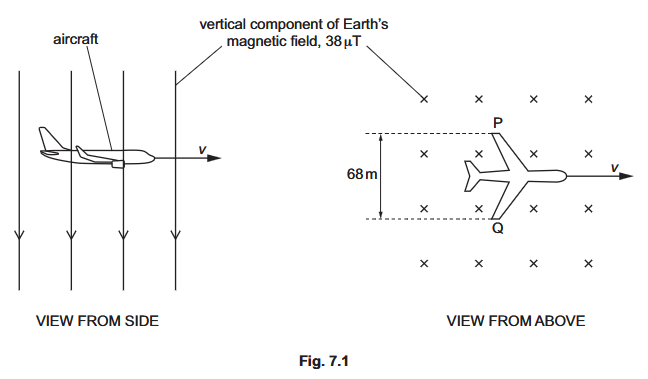
(b) An aircraft is flying horizontally at constant speed \(v\) through the Earth’s magnetic field, as shown in Fig. 7.1.

At the location of the aircraft, the vertical component of the Earth’s magnetic field is \(38\,\mu\mathrm{T}\) towards the ground.

The distance between the wingtips P and Q is \(68\,\mathrm{m}\).

As the aircraft moves through the magnetic field, an electromotive force (e.m.f.) of \(0.54\,\mathrm{V}\) is induced between the wingtips P and Q.

(i) Calculate the magnetic flux cut by the wings of the aircraft in a time of \(15\,\mathrm{s}\). Give a unit with your answer. [2]

magnetic flux = ______________________________ unit __________

(ii) Determine the area of flux cut by the wings in a time of \(15\,\mathrm{s}\). [2]

area = ______________________________ \(\mathrm{m^2}\)

(iii) Use your answer in (b)(ii) to determine the speed of the aircraft. [2]

\(v=\) ______________________________ \(\mathrm{m\,s^{-1}}\)

(iv) Use Lenz’s law of electromagnetic induction to explain which of the wingtips P and Q is at the higher induced potential. [3]

________________________________________________________________________________________

________________________________________________________________________________________

________________________________________________________________________________________

Syllabus Topic Codes (Cambridge International AS & A Level Physics 9702):

20.5 Electromagnetic induction – Faraday’s law and Lenz’s law of electromagnetic induction.

20.1 Concept of a magnetic field – magnetic field and magnetic flux through an area.

▶️ Answer/Explanation
Solution

(a) Faraday’s law [2 marks]

Faraday’s law states that the induced e.m.f. is directly proportional to the rate of change of magnetic flux linkage.

For a single conductor or single-turn loop, \(\mathcal{E}=\dfrac{\Delta\Phi}{\Delta t}\).

Answer: The induced e.m.f. is directly proportional to the rate of change of magnetic flux linkage.

(b)(i) Magnetic flux cut by the wings [2 marks]

From Faraday’s law, \(\mathcal{E}=\dfrac{\Delta\Phi}{\Delta t}\).

Therefore, \(\Delta\Phi=\mathcal{E}\Delta t\).

\(\Delta\Phi=0.54\times15\)

\(\Delta\Phi=8.1\,\mathrm{Wb}\)

Answer: magnetic flux \(=8.1\,\mathrm{Wb}\)

(b)(ii) Area of flux cut [2 marks]

Magnetic flux is given by \(\Phi=BA\), since the magnetic field is perpendicular to the area swept out by the wings.

Hence, \(A=\dfrac{\Phi}{B}\).

\(B=38\times10^{-6}\,\mathrm{T}\).

\(A=\dfrac{8.1}{38\times10^{-6}}\)

\(A=2.1\times10^5\,\mathrm{m^2}\)

Answer: \(A=2.1\times10^5\,\mathrm{m^2}\)

(b)(iii) Speed of the aircraft [2 marks]

The area swept out by the wings is \(A=vtw\), where \(w=68\,\mathrm{m}\) is the distance between the wingtips.

Therefore, \(v=\dfrac{A}{tw}\).

\(v=\dfrac{2.1\times10^5}{15\times68}\)

\(v=210\,\mathrm{m\,s^{-1}}\)

Answer: \(v=210\,\mathrm{m\,s^{-1}}\)

(b)(iv) Lenz’s law and higher potential [3 marks]

The aircraft moves through a magnetic field directed downwards. The induced current must produce a magnetic effect that opposes the change causing the induction.

Using Fleming’s left-hand rule, the force on a conventional current in the wings must act backwards, opposing the forward motion of the aircraft.

For the force to act backwards, the conventional current in the wings is from Q to P.

Inside an e.m.f. source, conventional current flows from the negative terminal towards the positive terminal. Therefore, P is at the higher potential.

Answer: P is at the higher potential because the induced current is from Q to P, making P the positive terminal of the induced e.m.f.
Question 8

(a) State what is meant by a photon. [2]

________________________________________________________________________________________

________________________________________________________________________________________

(b) A stationary nucleus of uranium-238 \(\left(^{238}_{92}\mathrm{U}\right)\) undergoes alpha decay to produce a nucleus of thorium-234 \(\left(^{234}_{90}\mathrm{Th}\right)\). The kinetic energy of the emitted alpha particle is \(4.200\,\mathrm{MeV}\). A gamma-ray photon is also emitted during the decay.

Assume that the rebound kinetic energy of the thorium nucleus is negligible.

Table 8.1 shows the masses of the nuclides involved in the decay reaction. The mass of the uranium-238 nuclide is missing.

nuclidenuclide mass / \(\mathrm{u}\)
\(^{4}_{2}\alpha\)\(4.000407\)
\(^{234}_{90}\mathrm{Th}\)\(233.915174\)
\(^{238}_{92}\mathrm{U}\)________________

The total energy released in the decay of the nucleus of uranium-238 is \(4.274\,\mathrm{MeV}\).

(i) Calculate the mass, in \(\mathrm{u}\), of the uranium-238 nuclide. Give your answer to five decimal places. [3]

mass = ______________________________ \(\mathrm{u}\)

(ii) Determine a value for the wavelength of the gamma radiation emitted during the decay of the uranium-238 nucleus. [3]

wavelength = ______________________________ \(\mathrm{m}\)

(iii) In practice, the rebound kinetic energy of the thorium nucleus is not negligible.

Explain, without further calculation, how your answer in (b)(ii) compares with the true wavelength of gamma radiation emitted during the decay of the uranium-238 nucleus. [1]

________________________________________________________________________________________

(c) Gamma radiation emitted during the decay of a sample of uranium-238 has a single wavelength.

Nuclei of cobalt-60 \(\left(^{60}_{27}\mathrm{Co}\right)\) decay by beta emission, and also emit gamma radiation in the process.

Suggest why there is not a single wavelength for the gamma radiation emitted during the decay of a sample of cobalt-60. [2]

________________________________________________________________________________________

________________________________________________________________________________________

Syllabus Topic Codes (Cambridge International AS & A Level Physics 9702):

23.1 Mass defect and nuclear binding energy – mass-energy equivalence and energy released in nuclear decay.

23.2 Radioactive decay – alpha and beta radioactive decay and associated gamma radiation.

22.1 Energy and momentum of a photon – photon energy and the relationship \(E=\dfrac{hc}{\lambda}\).

▶️ Answer/Explanation
Solution

(a) Photon [2 marks]

A photon is a packet, or quantum, of energy of electromagnetic radiation.

Answer: A photon is a quantum of energy of electromagnetic radiation.

(b)(i) Mass of uranium-238 [3 marks]

The total energy released is related to the mass defect by \(E=\Delta mc^2\).

Hence, \(\Delta m=\dfrac{E}{c^2}\).

Convert \(4.274\,\mathrm{MeV}\) into joules: \(E=4.274\times10^6\times1.60\times10^{-19}\,\mathrm{J}\).

Therefore, \[ \Delta m =\dfrac{4.274\times10^6\times1.60\times10^{-19}} {(3.00\times10^8)^2} \]

\(\Delta m=0.00458\,\mathrm{u}\).

The uranium mass is the sum of the thorium mass, alpha-particle mass and mass defect:

\(m_{\mathrm U}=233.915174+4.000407+0.00458\)

\(m_{\mathrm U}=237.92016\,\mathrm{u}\)

Answer: \(237.92016\,\mathrm{u}\)

(b)(ii) Wavelength of gamma radiation [3 marks]

The total energy released is \(4.274\,\mathrm{MeV}\), while the alpha particle has kinetic energy \(4.200\,\mathrm{MeV}\).

With the rebound kinetic energy of the thorium nucleus assumed negligible, the remaining energy is carried by the gamma photon:

\(E_\gamma=(4.274-4.200)\,\mathrm{MeV}\)

\(E_\gamma=0.074\,\mathrm{MeV}=0.074\times1.60\times10^{-13}\,\mathrm{J}\)

For a photon, \(E=\dfrac{hc}{\lambda}\).

Hence, \(\lambda=\dfrac{hc}{E}\).

\(\lambda=\dfrac{(6.63\times10^{-34})(3.00\times10^8)} {(0.074)(1.60\times10^{-13})}\)

\(\lambda=1.7\times10^{-11}\,\mathrm{m}\)

Answer: \(\lambda=1.7\times10^{-11}\,\mathrm{m}\)

(b)(iii) Effect of thorium recoil [1 mark]

If the thorium nucleus has non-negligible recoil kinetic energy, the gamma photon has less energy than assumed in (b)(ii).

Since \(E=\dfrac{hc}{\lambda}\), a smaller photon energy corresponds to a larger wavelength.

Answer: The true wavelength is larger than the value calculated in (b)(ii).

(c) Gamma radiation from cobalt-60 [2 marks]

Neutrinos are emitted during beta decay.

The particles emitted during beta decay can carry varying amounts of energy. Therefore, the energy available for the gamma photon can also vary between decays.

Answer: The beta decay involves emission of a neutrino, and the emitted particles can carry varying amounts of energy. Consequently, the energy of the gamma photon can vary between decays, giving more than one wavelength.

Question 9

(a) State Wien’s displacement law. [2]

________________________________________________________________________________________

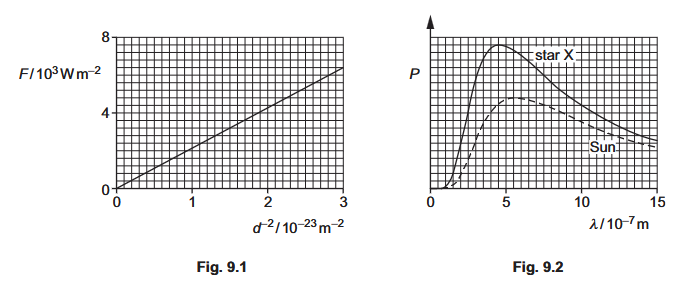
(b) Fig. 9.1 shows the variation with \(d^2\) of the radiant flux intensity \(F\) observed from a star X, where \(d\) is the distance of the observer from the star. Fig. 9.2 shows the variation with wavelength \(\lambda\) of the rates of emission \(P\) of radiation by star X and the Sun.

The surface temperature of the Sun is \(5770\,\mathrm{K}\).

State three conclusions about star X that can be drawn from this data. The conclusions may be qualitative or quantitative. Use the space for any working.

1. __________________________________________________________________________________

________________________________________________________________________________________

2. __________________________________________________________________________________

________________________________________________________________________________________

3. __________________________________________________________________________________

________________________________________________________________________________________

(c) Star X is in a galaxy that is moving away from the Earth.

Suggest, with a reason, how the line for star X in Fig. 9.2 would appear differently if it had been obtained from data measured from the Earth. [2]

________________________________________________________________________________________

________________________________________________________________________________________

Syllabus Topic Codes (Cambridge International AS & A Level Physics 9702):

25.2 Stellar radii – determining properties of stars from their radiation and luminosity.

25.3 Hubble’s law and the Big Bang theory – redshift of radiation from a galaxy moving away from the Earth.

▶️ Answer/Explanation
Solution

(a) Wien’s displacement law [2 marks]

Wien’s displacement law states that the temperature of a hot object is inversely proportional to the wavelength at which its emission rate is a maximum.

The relationship is \(\lambda_{\max}T=b\), where \(b\) is Wien’s displacement constant.

Answer: \(\lambda_{\max}T=\mathrm{constant}\)

(b) Conclusions about star X [3 marks]

1. Surface temperature: The peak wavelength for star X is shorter than that of the Sun. Since temperature is inversely proportional to peak wavelength, star X has a higher surface temperature than the Sun.

From the graph, the peak wavelength for star X is approximately \(4.1\times10^{-7}\,\mathrm{m}\). Therefore, \(T_{\mathrm X}\approx7000\,\mathrm{K}\).

2. Luminosity: The radiant flux intensity follows an inverse-square relationship with distance, so the graph can be used to determine the luminosity of star X.

The luminosity of star X is approximately \(2.7\times10^{27}\,\mathrm{W}\), which is greater than that of the Sun.

3. Radius: Using the luminosity and surface temperature, the radius of star X is approximately \(1.3\times10^9\,\mathrm{m}\).

Answer: Any three valid conclusions, such as \(T_{\mathrm X}\approx7000\,\mathrm{K}\), star X has a higher luminosity than the Sun, \(L_{\mathrm X}\approx2.7\times10^{27}\,\mathrm{W}\), or \(R_{\mathrm X}\approx1.3\times10^9\,\mathrm{m}\).

(c) Effect of the galaxy’s motion [2 marks]

Since the galaxy containing star X is moving away from the Earth, the radiation observed from Earth is redshifted.

Therefore, the whole emission curve would be shifted towards longer wavelengths. In particular, the wavelength of maximum emission would be greater in the observed data.

Answer: The line would be shifted towards longer wavelengths because the light from star X is redshifted as the galaxy moves away from the Earth.

Question 10

(a) Define specific acoustic impedance. [2]

_______________________________

(b) Explain how ultrasound waves are detected by a piezoelectric crystal. [2]

_______________________________

(c) Table 10.1 shows the specific acoustic impedance \(Z\) for body tissue, water and steel.

material\(Z/\mathrm{kg\,m^{-2}\,s^{-1}}\)
body tissue\(1.38\times10^6\)
water\(1.48\times10^6\)
steel\(4.04\times10^7\)

(i) Calculate the intensity reflection coefficient for ultrasound incident on a water-steel boundary. [2]

intensity reflection coefficient = ______________________________

(ii) Explain, without calculation, what is likely to happen when ultrasound is incident on a body tissue-water boundary. [2]

_________________________

Syllabus Topic Codes (Cambridge International AS & A Level Physics 9702):

24.1 Production and use of ultrasound – acoustic impedance, reflection of ultrasound at boundaries, and piezoelectric crystals.

▶️ Answer/Explanation
Solution

(a) Specific acoustic impedance [2 marks]

Specific acoustic impedance is the product of the density of a medium and the speed of sound in the medium.

\(Z=\rho c\)

where \(\rho\) is the density of the medium and \(c\) is the speed of sound in the medium.

(b) Detection of ultrasound by a piezoelectric crystal [2 marks]

The ultrasound waves cause the piezoelectric crystal to vibrate.

The vibrations of the crystal produce an induced e.m.f. across the crystal, which can be detected as an electrical signal.

(c)(i) Intensity reflection coefficient [2 marks]

The intensity reflection coefficient at a boundary is

\(R=\left(\dfrac{Z_2-Z_1}{Z_2+Z_1}\right)^2\)

For water, \(Z_1=1.48\times10^6\,\mathrm{kg\,m^{-2}\,s^{-1}}\), and for steel, \(Z_2=4.04\times10^7\,\mathrm{kg\,m^{-2}\,s^{-1}}\).

\(R=\left(\dfrac{40.4-1.48}{40.4+1.48}\right)^2\)

\(R=0.86\)

Answer: \(R=0.86\)

(c)(ii) Body tissue-water boundary [2 marks]

The specific acoustic impedance values of body tissue and water are very similar: \(1.38\times10^6\) and \(1.48\times10^6\,\mathrm{kg\,m^{-2}\,s^{-1}}\), respectively.

Therefore, there is very little reflection at the boundary and almost all of the ultrasound will be transmitted.

Answer: Almost all the ultrasound is transmitted and very little is reflected because the acoustic impedances are very similar.

Scroll to Top