Question 1
(a) State Newton’s law of gravitation. [2]
________________________________________________________________________________________
________________________________________________________________________________________
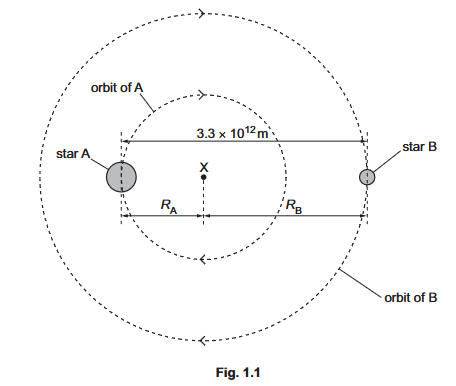
(b) A binary star consists of star A, of mass \(4.0\times10^{30}\,\mathrm{kg}\), and star B, of mass \(2.0\times10^{30}\,\mathrm{kg}\), separated by a distance of \(3.3\times10^{12}\,\mathrm{m}\). The stars are both in circular orbits around their common centre of gravity X, as shown in Fig. 1.1.

The radius \(R_B\) of the orbit of star B is double the radius \(R_A\) of the orbit of star A.
(i) Use Newton’s law of gravitation to calculate the magnitude of the gravitational force exerted by each star on the other. [2]
force = ______________________________ \(\mathrm{N}\)
(ii) Calculate the centripetal acceleration of star A. [1]
acceleration = ______________________________ \(\mathrm{m\,s^{-2}}\)
(iii) Use your answer in (b)(ii) to determine the period of the orbit of star A. [3]
period = ______________________________ \(\mathrm{s}\)
(iv) By placing a tick (\(\checkmark\)) in each row, complete Table 1.1 to show how the quantities indicated for star B compare with the same quantities for star A.
| B less than A | B equal to A | B greater than A | |
|---|---|---|---|
| centripetal acceleration | |||
| linear speed | |||
| period |
Syllabus Topic Codes (Cambridge International AS & A Level Physics 9702):
13.2 Gravitational force between point masses
12.1 Kinematics of uniform circular motion
▶️ Answer/Explanation
(a) Newton’s law of gravitation [2 marks]
The gravitational force between two point masses is directly proportional to the product of their masses.
The force is inversely proportional to the square of their separation.
\(F=\dfrac{Gm_1m_2}{r^2}\)
(b)(i) Gravitational force [2 marks]
Using \(F=\dfrac{Gm_Am_B}{r^2}\):
\(F=\dfrac{(6.67\times10^{-11})(4.0\times10^{30})(2.0\times10^{30})}{(3.3\times10^{12})^2}\)
\(F=4.9\times10^{25}\,\mathrm{N}\)
Answer: \(F=4.9\times10^{25}\,\mathrm{N}\)
(b)(ii) Centripetal acceleration of star A [1 mark]
The gravitational force provides the centripetal force:
\(a=\dfrac{F}{m_A}\)
\(a=\dfrac{4.9\times10^{25}}{4.0\times10^{30}}\)
\(a=1.2\times10^{-5}\,\mathrm{m\,s^{-2}}\)
Answer: \(a=1.2\times10^{-5}\,\mathrm{m\,s^{-2}}\)
(b)(iii) Period of star A [3 marks]
For uniform circular motion, \(a=r\omega^2\) and \(\omega=\dfrac{2\pi}{T}\).
Since \(R_B=2R_A\) and \(R_A+R_B=3.3\times10^{12}\,\mathrm{m}\):
\(R_A=\dfrac{3.3\times10^{12}}{3}=1.1\times10^{12}\,\mathrm{m}\)
Therefore, \(a=R_A\left(\dfrac{2\pi}{T}\right)^2\).
Rearranging: \(T=2\pi\sqrt{\dfrac{R_A}{a}}\)
\(T=2\pi\sqrt{\dfrac{1.1\times10^{12}}{1.2\times10^{-5}}}\)
\(T=1.9\times10^9\,\mathrm{s}\)
Answer: \(T=1.9\times10^9\,\mathrm{s}\)
(b)(iv) Comparison of quantities [3 marks]
| B less than A | B equal to A | B greater than A | |
|---|---|---|---|
| centripetal acceleration | ✓ | ||
| linear speed | ✓ | ||
| period | ✓ |
Both stars orbit their common centre of gravity with the same angular speed, so their periods are equal. Since star B has the larger orbital radius, its linear speed and centripetal acceleration are greater.
Question 2
(a) The equation of state for an ideal gas may be expressed as
\(pV=NkT\).
(i) State the meaning of each of the symbols in this equation. [3]
\(p\): __________________________________________________________________________________
\(V\): __________________________________________________________________________________
\(N\): __________________________________________________________________________________
\(k\): __________________________________________________________________________________
\(T\): __________________________________________________________________________________
(ii) Using the equation of state, derive an expression for the average translational kinetic energy \(E_k\) of a particle in the gas in terms of some or all of \(N\), \(k\) and \(T\). [2]
\(E_k=\) ________________________________________________________________________________
(b) A molecule of hydrogen gas consists of two hydrogen atoms, each of nucleon number 1. A molecule of oxygen gas consists of two oxygen atoms, each of nucleon number 16.
Assume that hydrogen and oxygen both behave as ideal gases.
A sample of hydrogen gas is at the same temperature as a sample of oxygen gas.
For the two samples, determine the ratio
\(\dfrac{\text{root-mean-square (r.m.s.) speed of hydrogen molecules}} {\text{root-mean-square (r.m.s.) speed of oxygen molecules}}\).
ratio = ______________________________
Syllabus Topic Codes (Cambridge International AS & A Level Physics 9702):
15.1 Equation of state – equation of state for an ideal gas.
15.2 Kinetic theory of gases – molecular motion, kinetic energy and r.m.s. speed.
▶️ Answer/Explanation
(a)(i) Meaning of symbols [3 marks]
\(p\) = pressure of the gas.
\(V\) = volume of the gas.
\(N\) = number of molecules in the gas.
\(k\) = Boltzmann constant.
\(T\) = thermodynamic temperature of the gas.
(a)(ii) Average translational kinetic energy [2 marks]
From kinetic theory, \(pV=\dfrac{1}{3}Nm\langle c^2\rangle\).
From the equation of state, \(pV=NkT\).
Therefore, \(NkT=\dfrac{1}{3}Nm\langle c^2\rangle\).
Hence, \[ \dfrac{1}{2}m\langle c^2\rangle=\dfrac{3}{2}kT \]
Answer: \(E_k=\dfrac{3}{2}kT\)
(b) Ratio of r.m.s. speeds [2 marks]
At the same temperature, the average translational kinetic energy of a molecule is the same for both gases:
\(\dfrac{1}{2}m_{\mathrm{H}}\langle c_{\mathrm{H}}^2\rangle = \dfrac{1}{2}m_{\mathrm{O}}\langle c_{\mathrm{O}}^2\rangle\)
Therefore, \(\dfrac{c_{\mathrm{H}}}{c_{\mathrm{O}}} = \sqrt{\dfrac{m_{\mathrm{O}}}{m_{\mathrm{H}}}}\).
A hydrogen molecule has nucleon number \(2\), while an oxygen molecule has nucleon number \(32\).
\[ \dfrac{c_{\mathrm{H}}}{c_{\mathrm{O}}} = \sqrt{\dfrac{32}{2}} = \sqrt{16} = 4.0 \]
Answer: ratio \(=4.0\)
Question 3
(a) With reference to molecular kinetic energy and molecular potential energy, explain what is meant by the internal energy of an ideal gas. [2]
________________________________________________________________________________________
________________________________________________________________________________________
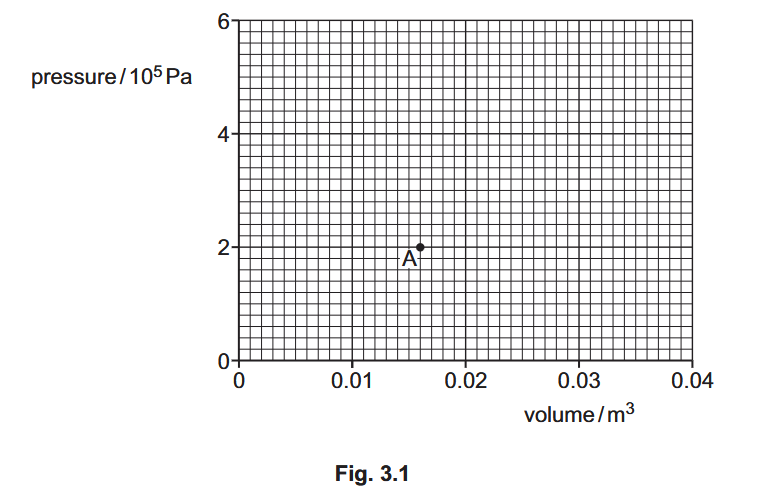
(b) A sample of an ideal gas is initially in state A, at a pressure of \(2.0\times10^5\,\mathrm{Pa}\) and with a volume of \(0.016\,\mathrm{m^3}\), as shown in Fig. 3.1.

In state A, the temperature of the gas is \(400\,\mathrm{K}\).
The gas undergoes two successive changes X and Y.
In change X, it is heated at constant volume to a pressure of \(4.0\times10^5\,\mathrm{Pa}\). At the end of change X, the gas is in state B.
In change Y, it is then allowed to expand at constant temperature back to its original pressure. At the end of change Y, the gas is in state C.
(i) Determine the internal energy of the gas in state A. [2]
internal energy = ______________________________ \(\mathrm{J}\)
(ii) Determine the temperature of the gas in state B. [1]
temperature = ______________________________ \(\mathrm{K}\)
(iii) Determine the volume of the gas in state C. [1]
volume = ______________________________ \(\mathrm{m^3}\)
(iv) On Fig. 3.1, draw two lines, one to represent change X and one to represent change Y. Label your lines X and Y respectively. [3]
Syllabus Topic Codes (Cambridge International AS & A Level Physics 9702):
16.1 Internal energy – internal energy of an ideal gas and molecular kinetic energy.
15.2 Equation of state – equation of state for an ideal gas and relationships between pressure, volume and thermodynamic temperature.
▶️ Answer/Explanation
(a) Internal energy [2 marks]
The internal energy of an ideal gas is the total kinetic energy associated with the random motion of its molecules.
The molecular potential energy is taken to be zero because there are no intermolecular forces in an ideal gas.
(b)(i) Internal energy of the gas in state A [2 marks]
For an ideal gas, \(pV=NkT\) and \(U=\dfrac{3}{2}NkT\).
Therefore, \(U=\dfrac{3}{2}pV\).
\(U=\dfrac{3}{2}\times2.0\times10^5\times0.016\)
\(U=4800\,\mathrm{J}\)
Answer: \(U=4.8\times10^3\,\mathrm{J}\)
(b)(ii) Temperature in state B [1 mark]
At constant volume, \(p\propto T\).
\(\dfrac{p_A}{T_A}=\dfrac{p_B}{T_B}\)
\(T_B=400\times\dfrac{4.0\times10^5}{2.0\times10^5}\)
\(T_B=800\,\mathrm{K}\)
Answer: \(T_B=800\,\mathrm{K}\)
(b)(iii) Volume in state C [1 mark]
Change Y occurs at constant temperature, so \(pV\) is constant.
\(p_BV_B=p_CV_C\)
\((4.0\times10^5)(0.016)=(2.0\times10^5)V_C\)
\(V_C=0.032\,\mathrm{m^3}\)
Answer: \(V_C=0.032\,\mathrm{m^3}\)
(b)(iv) Pressure-volume graph [3 marks]
Change X is heating at constant volume, so it is represented by a straight vertical line from A at \((0.016,2.0)\) to B at \((0.016,4.0)\).
Change Y is an isothermal expansion, so \(pV=\text{constant}\). The graph is a curve with continuously decreasing negative gradient from B to C.
The curve ends at C at \((0.032,2.0)\).
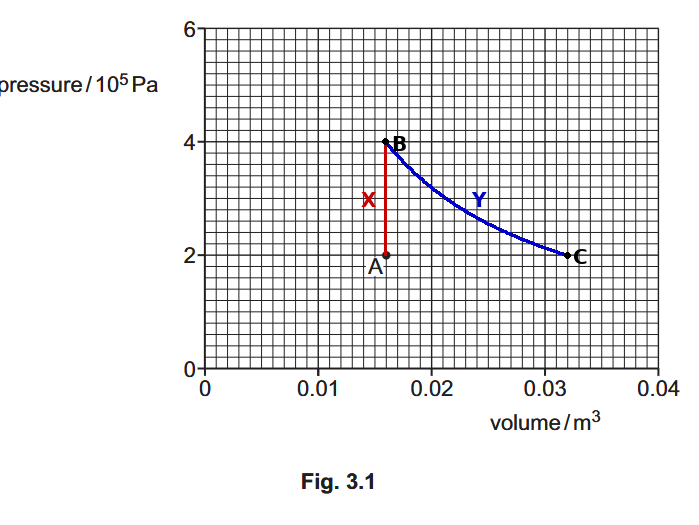
Answer: vertical line \(X\) from A to B, followed by an isothermal curve \(Y\) from B to C.
Question 4
(a) State what is meant by the frequency of the oscillations of an oscillating object. [1]
________________________________________________________________________________________
(b) An object is oscillating.
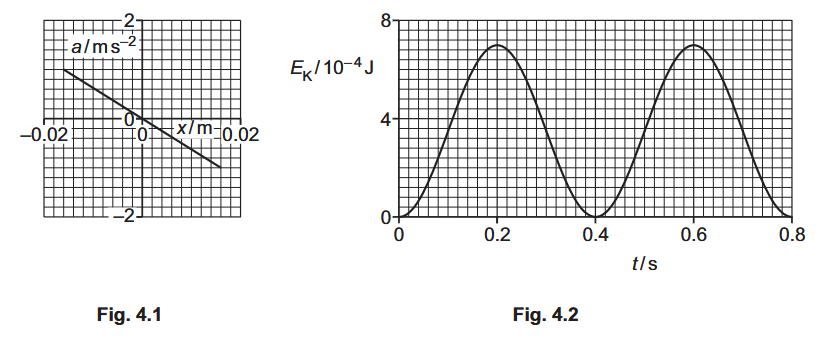
Fig. 4.1 shows the variation of the acceleration \(a\) of the object with its displacement \(x\) from the equilibrium position.
Fig. 4.2 shows the variation of the kinetic energy \(E_k\) of the object with time \(t\).

(i) Explain how Fig. 4.2 shows that the period of the oscillations is \(0.80\,\mathrm{s}\). [1]
________________________________________________________________________________________
(ii) Calculate the angular frequency \(\omega\) of the oscillations. [2]
\(\omega=\) ______________________________ \(\mathrm{rad\,s^{-1}}\)
(iii) Apart from the period, frequency and angular frequency of the oscillations, determine three other conclusions about the object and its oscillations that may be drawn from Fig. 4.1 and Fig. 4.2. The conclusions may be qualitative or quantitative. Use the space below for any working. [3]
1. ______________________
2. ______________________
3. ______________________
(iv) Describe the interchange between kinetic energy and potential energy during the oscillations. Numerical values are not required. [3]
___________________
Syllabus Topic Codes (Cambridge International AS & A Level Physics 9702):
17.1 Simple harmonic oscillations – simple harmonic motion and the relationship between acceleration and displacement.
17.2 Energy in simple harmonic motion – energy changes, amplitude and period in simple harmonic motion.
▶️ Answer/Explanation
(a) Frequency [1 mark]
Frequency is the number of complete oscillations per unit time.
\(f=\dfrac{1}{T}\)
(b)(i) Period from Fig. 4.2 [1 mark]
The kinetic energy reaches a maximum twice during each complete oscillation. From the graph, successive maxima occur at \(t=0.20\,\mathrm{s}\) and \(t=0.60\,\mathrm{s}\).
Therefore, \(T=0.60-0.20=0.40\,\mathrm{s}\) between successive kinetic-energy maxima, giving an oscillation period of \(2\times0.40=0.80\,\mathrm{s}\).
(b)(ii) Angular frequency [2 marks]
Using \(\omega=\dfrac{2\pi}{T}\):
\(\omega=\dfrac{2\pi}{0.80}\)
\(\omega=7.85\,\mathrm{rad\,s^{-1}}\)
Answer: \(\omega=7.9\,\mathrm{rad\,s^{-1}}\)
(b)(iii) Conclusions from the graphs [3 marks]
Any three points:
• The oscillations are simple harmonic.
• The amplitude is \(0.016\,\mathrm{m}\).
• The maximum speed is approximately \(0.13\,\mathrm{m\,s^{-1}}\).
• The total energy of the oscillations is approximately \(7.0\times10^{-4}\,\mathrm{J}\).
• The mass of the object is approximately \(0.087\,\mathrm{kg}\).
• The maximum momentum is approximately \(0.011\,\mathrm{kg\,m\,s^{-1}}\) or \(0.011\,\mathrm{N\,s}\).
(b)(iv) Interchange between kinetic and potential energy [3 marks]
As the object moves from an extreme position towards the equilibrium position, potential energy decreases and is converted into kinetic energy.
At the equilibrium position, the kinetic energy is maximum and the potential energy is minimum.
As the object moves from the equilibrium position towards an extreme position, kinetic energy is converted back into potential energy. At the extreme position, kinetic energy is zero and potential energy is maximum.
The total energy remains constant for an undamped oscillation.
Question 5
(a) Explain why the electric potential near an isolated proton is positive. [3]
____________________________
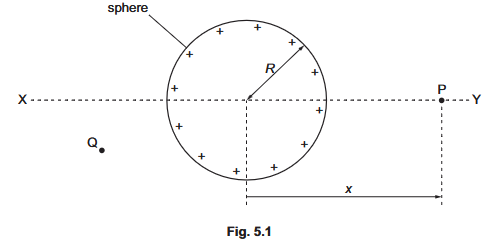
(b) An isolated metal sphere is positively charged and has radius \(R\), as shown in Fig. 5.1.

Line XY passes through the centre of the sphere. Point P lies on line XY at a variable distance \(x\) from the centre of the sphere.
Point Q is at a fixed position that is not on line XY.
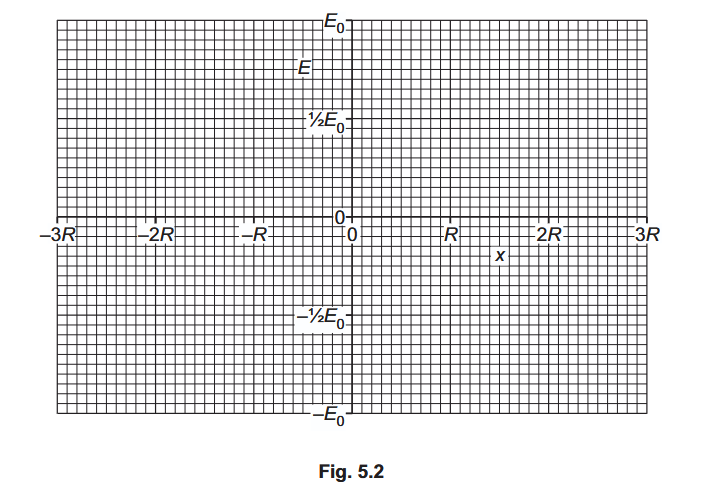
The electric field strength at the surface of the sphere is \(E_0\).
(i) On Fig. 5.1, draw an arrow at point Q to show the direction of the electric field at that point. [1]
(ii) On Fig. 5.2, sketch the variation of the electric field \(E\) at point P with \(x\) for values of \(x\) between \(x=-3R\) and \(x=3R\). Do not include the region inside the sphere between \(x=-R\) and \(x=R\). [3]

(c) The proton and the electron in a hydrogen atom are separated by a distance of \(5.3\times10^{-11}\,\mathrm{m}\).
Calculate the electric potential energy of the proton and the electron. [2]
electric potential energy = ______________________________ \(\mathrm{J}\)
Syllabus Topic Codes (Cambridge International AS & A Level Physics 9702):
18.5 Electric potential – electric potential, electric potential energy and electric field strength around charged objects.
▶️ Answer/Explanation
(a) Electric potential near an isolated proton [3 marks]
Electric potential is defined to be zero at infinity.
A proton has a positive charge, so it repels another positive test charge.
Work must be done to move a positive test charge towards the proton, so the electric potential is positive.
(b)(i) Direction of electric field at Q [1 mark]
Since the sphere is positively charged, the electric field is directed radially away from the centre of the sphere.
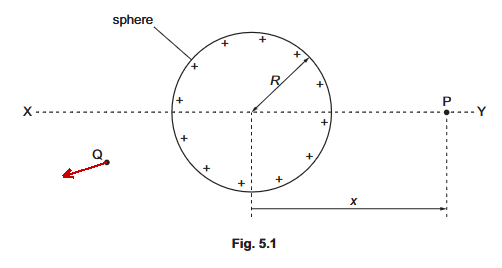
Therefore, the arrow at Q should point away from the centre of the sphere, in a WSW direction.
(b)(ii) Variation of electric field with \(x\) [3 marks]
Outside the charged sphere, the electric field follows \(E=\dfrac{1}{4\pi\varepsilon_0}\dfrac{Q}{r^2}\).
At \(x=R\), \(E=E_0\), and at \(x=2R\), \(E=\dfrac{1}{4}E_0\).
For \(x>R\), the field is positive and decreases in magnitude as \(x\) increases. For \(x<-R\), the field is negative and its magnitude decreases as \(x\) becomes more negative.
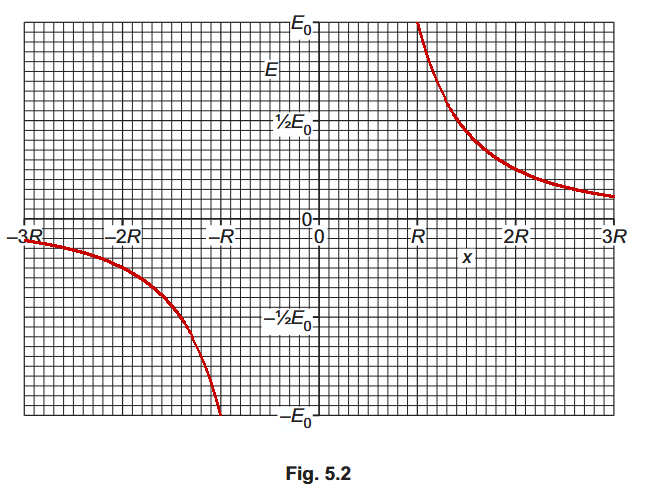
The sketch should therefore pass through \((R,E_0)\), \((2R,\dfrac{1}{4}E_0)\), \((-R,-E_0)\) and \((-2R,-\dfrac{1}{4}E_0)\), with the curves becoming shallower further from the sphere.
(c) Electric potential energy [2 marks]
For two point charges, \(E_{\mathrm{p}}=\dfrac{1}{4\pi\varepsilon_0}\dfrac{q_1q_2}{r}\).
For a proton and an electron, \(q_1q_2\) is negative:
\(E_{\mathrm{p}}=-\dfrac{(1.60\times10^{-19})^2}{4\pi(8.85\times10^{-12})(5.3\times10^{-11})}\)
\(E_{\mathrm{p}}=-4.3\times10^{-18}\,\mathrm{J}\)
Answer: \(E_{\mathrm{p}}=-4.3\times10^{-18}\,\mathrm{J}\)
Question 6
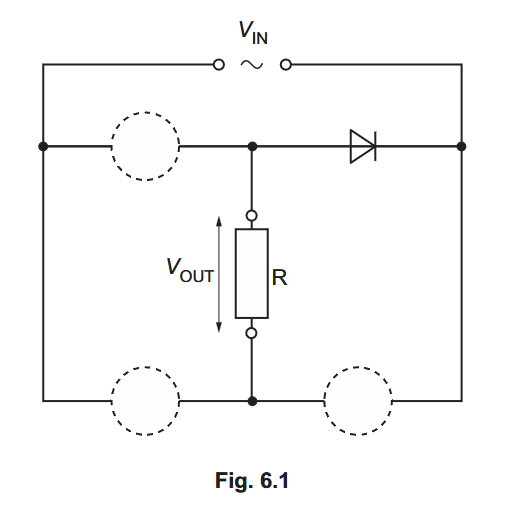
(a) Fig. 6.1 shows part of a bridge rectifier circuit that can be used for rectification of an alternating input voltage \(V_{\mathrm{IN}}\).

The circuit contains four diodes, one of which is shown. The rectified output voltage \(V_{\mathrm{OUT}}\) is applied across load resistor \(R\).
(i) State what is meant by rectification. [1]
(ii) State the name of the type of rectification produced by a bridge rectifier circuit. [1]
(iii) Complete the circuit in Fig. 6.1 by drawing the three missing diodes inside the dashed circles. [2]
(b) The input voltage varies with time \(t\) according to the equation
\(V_{\mathrm{IN}}=34\sin18t\)
where \(V_{\mathrm{IN}}\) is in V and \(t\) is in s.
(i) Show that the period of the input voltage is \(0.35\,\mathrm{s}\). [2]
(ii) Calculate the root-mean-square (r.m.s.) input voltage. [1]
r.m.s. voltage = ______________________________ \(\mathrm{V}\)
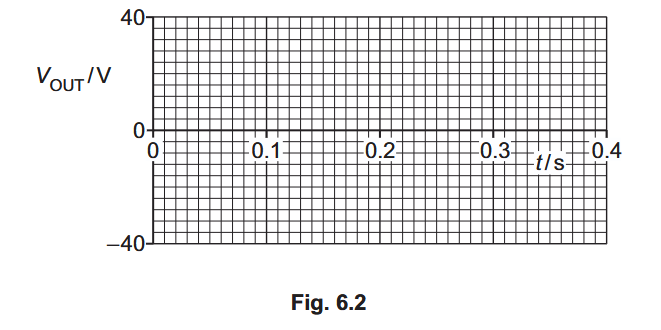
(iii) On Fig. 6.2, sketch the variation of \(V_{\mathrm{OUT}}\) with \(t\) from \(t=0\) to \(t=0.35\,\mathrm{s}\). [3]

(c) Resistor \(R\) has a resistance of \(56\,\mathrm{k\Omega}\). A capacitor of capacitance \(12\,\mu\mathrm{F}\) is connected into the circuit of Fig. 6.1 in order to smooth the output voltage.
(i) On Fig. 6.1, draw the capacitor correctly connected into the circuit. [1]
(ii) Calculate the time constant of the smoothing circuit. [2]
time constant = ______________________________ \(\mathrm{s}\)
(iii) During each discharge cycle, the time for which the capacitor is discharging is \(0.14\,\mathrm{s}\).
Determine the minimum value of the smoothed output voltage. [2]
minimum voltage = ______________________________ \(\mathrm{V}\)
Syllabus Topic Codes (Cambridge International AS & A Level Physics 9702):
21.2 Rectification and smoothing – rectification of alternating currents and smoothing using capacitors.
▶️ Answer/Explanation
(a)(i) Rectification [1 mark]
Rectification is the conversion of a.c. to d.c.
(a)(ii) Type of rectification [1 mark]
The bridge rectifier produces full-wave rectification.
(a)(iii) Completing the bridge rectifier [2 marks]
The three missing diodes must be connected with the correct diode symbols and orientations.
The lower-left diode points towards the right, while the upper-left and lower-right diodes both point towards the left.
(b)(i) Period of the input voltage [2 marks]
Comparing \(V_{\mathrm{IN}}=34\sin18t\) with \(V=V_0\sin\omega t\):
\(\omega=18\,\mathrm{rad\,s^{-1}}\)
Using \(\omega=\dfrac{2\pi}{T}\):
\(T=\dfrac{2\pi}{18}\)
\(T=0.35\,\mathrm{s}\)
Answer: \(T=0.35\,\mathrm{s}\)
(b)(ii) r.m.s. input voltage [1 mark]
For a sinusoidal alternating voltage:
\(V_{\mathrm{r.m.s.}}=\dfrac{V_0}{\sqrt{2}}\)
\(V_{\mathrm{r.m.s.}}=\dfrac{34}{\sqrt{2}}\)
\(V_{\mathrm{r.m.s.}}=24\,\mathrm{V}\)
Answer: \(V_{\mathrm{r.m.s.}}=24\,\mathrm{V}\)
(b)(iii) Rectified output waveform [3 marks]
Full-wave rectification makes both halves of the input sinusoidal waveform appear on the same side of the time axis.
The waveform has a peak value of \(34\,\mathrm{V}\), a minimum value of \(0\,\mathrm{V}\), and two identical positive humps during one input period.
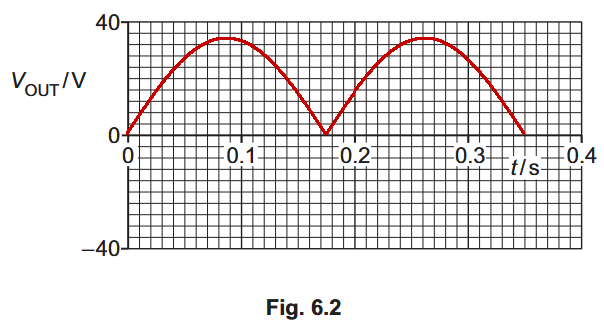
Therefore, \(V_{\mathrm{OUT}}=0\) at \(t=0\), \(t=0.175\,\mathrm{s}\) and \(t=0.350\,\mathrm{s}\), with non-zero \(V_{\mathrm{OUT}}\) between these points.
(c)(i) Capacitor connection [1 mark]
The capacitor is connected in parallel with resistor \(R\), across the output terminals.
(c)(ii) Time constant [2 marks]
The time constant is
\(\tau=RC\)
\(\tau=(56\times10^3)(12\times10^{-6})\)
\(\tau=0.67\,\mathrm{s}\)
Answer: \(\tau=0.67\,\mathrm{s}\)
(c)(iii) Minimum smoothed output voltage [2 marks]
During discharge, the capacitor voltage follows \(V=V_0\exp\left(-\dfrac{t}{\tau}\right)\).
Here, \(V_0=34\,\mathrm{V}\), \(t=0.14\,\mathrm{s}\), and \(\tau=0.67\,\mathrm{s}\).
\(V_{\min}=34\exp\left(-\dfrac{0.14}{0.67}\right)\)
\(V_{\min}=28\,\mathrm{V}\)
Answer: \(V_{\min}=28\,\mathrm{V}\)
Question 7
(a) State Lenz’s law of electromagnetic induction. [2]
________________________________
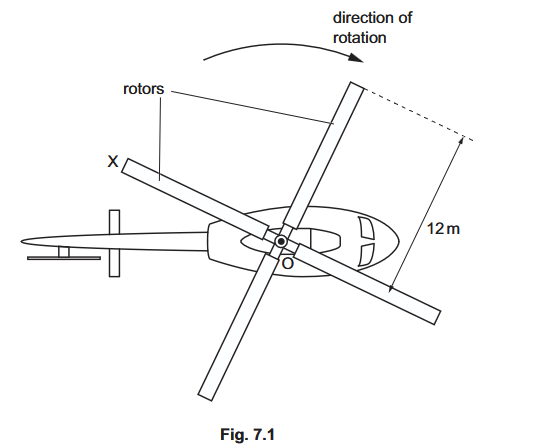
(b) A helicopter hovering in stationary equilibrium has four rotors, each of length \(12\,\mathrm{m}\), as shown in the view from above in Fig. 7.1.

The vertical component of the Earth’s magnetic field at the helicopter is downwards with a flux density of \(0.047\,\mathrm{mT}\).
The rotors each rotate in a horizontal plane in the direction shown with a frequency of \(85\,\mathrm{Hz}\).
(i) Calculate the magnetic flux \(\Phi\) cut by rotor OX during one complete rotation. Give a unit with your answer. [3]
\(\Phi=\) ______________________________ unit __________________
(ii) Determine the magnitude of the electromotive force (e.m.f.) induced across the length of rotor OX. [2]
e.m.f. = ______________________________ \(\mathrm{V}\)
(iii) Use Lenz’s law to explain whether end O or end X of the rotor is at the higher potential. [2]
________________________________________________________________________________________
________________________________________________________________________________________
Syllabus Topic Code (Cambridge International AS & A Level Physics 9702):
20.5 Electromagnetic induction – magnetic flux, magnetic flux linkage, Faraday’s law and Lenz’s law of electromagnetic induction.
▶️ Answer/Explanation
(a) Lenz’s law [2 marks]
The direction of the induced e.m.f. is such that it produces effects that oppose the change that caused it.
(b)(i) Magnetic flux cut by rotor OX [3 marks]
The area swept out by rotor OX during one complete rotation is the area of a circle of radius \(12\,\mathrm{m}\):
\(A=\pi r^2\)
The magnetic flux is \(\Phi=BA\).
\(B=0.047\,\mathrm{mT}=0.047\times10^{-3}\,\mathrm{T}\)
\(\Phi=(0.047\times10^{-3})\times\pi\times12^2\)
\(\Phi=0.021\,\mathrm{Wb}\)
Answer: \(\Phi=0.021\,\mathrm{Wb}\)
(b)(ii) Induced e.m.f. [2 marks]
The magnitude of the induced e.m.f. is the magnetic flux cut per unit time:
\(\mathrm{e.m.f.}=\dfrac{\text{flux cut}}{\text{time}}\)
The frequency is \(85\,\mathrm{Hz}\), so the time for one complete rotation is \(T=\dfrac{1}{85}\,\mathrm{s}\).
\(\mathrm{e.m.f.}=\dfrac{0.021}{1/85}\)
\(\mathrm{e.m.f.}=1.8\,\mathrm{V}\)
Answer: \(\mathrm{e.m.f.}=1.8\,\mathrm{V}\)
(b)(iii) Higher potential end [2 marks]
The induced current must produce an anticlockwise moment to oppose the rotation, according to Lenz’s law.
Using Fleming’s left-hand rule, the induced current is from O to X.
Conventional current inside an e.m.f. source flows from the lower potential to the higher potential.
Therefore, X is at the higher potential.
Question 8
Oxygen-15 \(\left(^{15}_{8}\mathrm{O}\right)\) is radioactive and has a half-life of \(2.04\,\mathrm{minutes}\).
The decay of oxygen-15 produces positrons. For this reason, oxygen-15 is sometimes used as a tracer in positron emission tomography (PET scanning).
(a) State what is meant by a tracer. [2]
_________________________
(b) The equation for the decay of oxygen-15 is
\(^{15}_{8}\mathrm{O}\rightarrow{}^{P}_{Q}X+{}^{R}_{S}\mathrm{p}^{+}+Z\)
where X is the nucleus formed during the decay and Z is another particle.
(i) State the values of the integers \(P\), \(Q\), \(R\) and \(S\). [2]
\(P=\) ______________________________ \(R=\) ______________________________
\(Q=\) ______________________________ \(S=\) ______________________________
(ii) State the name of particle Z. [1]
____________________
(c)
(i) Define the activity of a sample. [1]
________________________
(ii) Calculate the decay constant of oxygen-15. Give a unit with your answer. [2]
decay constant = ______________________________ unit __________________
(iii) Determine the rate at which positrons are produced in a sample of oxygen-15 that has a mass of \(2.85\times10^{-6}\,\mathrm{kg}\). [4]
rate = ______________________________ \(\mathrm{s^{-1}}\)
(d) The particles that are emitted from the body and detected outside it during PET scanning are not positrons but another type of particle.
(i) State the name of the particles that are detected. [1]
________________________________________________________________________________________
(ii) Explain how these particles are formed inside the body. [2]
_______________________________________
Syllabus Topic Codes (Cambridge International AS & A Level Physics 9702):
23.2 Radioactive decay
24.3 PET scanning
▶️ Answer/Explanation
(a) Tracer [2 marks]
A tracer is a radioactive substance introduced into the body.
The substance is absorbed by the tissues being studied.
(b)(i) Values of \(P\), \(Q\), \(R\) and \(S\) [2 marks]
In positron emission, the mass number is unchanged and the proton number decreases by one.
Therefore, \(P=15\), \(Q=7\), \(R=0\) and \(S=+1\).
Answer: \(P=15,\ Q=7,\ R=0,\ S=+1\)
(b)(ii) Particle Z [1 mark]
Particle Z is an electron neutrino.
(c)(i) Activity [1 mark]
Activity is the number of nuclear disintegrations per unit time.
(c)(ii) Decay constant [2 marks]
Using \(\lambda=\dfrac{\ln 2}{T_{\frac12}}\):
\(T_{\frac12}=2.04\times60=122.4\,\mathrm{s}\)
\(\lambda=\dfrac{\ln 2}{2.04\times60}\)
\(\lambda=5.66\times10^{-3}\,\mathrm{s^{-1}}\)
Answer: \(\lambda=5.66\times10^{-3}\,\mathrm{s^{-1}}\)
(c)(iii) Rate of positron production [4 marks]
The mass of one oxygen-15 nucleus is approximately \(15\times1.66\times10^{-27}\,\mathrm{kg}\).
Number of nuclei:
\(N=\dfrac{2.85\times10^{-6}}{15\times1.66\times10^{-27}}\)
Activity is given by \(A=\lambda N\).
\(A=(5.66\times10^{-3})\dfrac{2.85\times10^{-6}}{15\times1.66\times10^{-27}}\)
\(A=6.48\times10^{17}\,\mathrm{s^{-1}}\)
Answer: \(6.48\times10^{17}\,\mathrm{s^{-1}}\)
(d)(i) Detected particles [1 mark]
The detected particles are gamma photons.
(d)(ii) Formation of the detected particles [2 marks]
The positron collides with an electron inside the body.
The positron and electron annihilate, resulting in their masses being converted into photon energy.
Question 9
(a) State what is meant by the photoelectric effect. [2]
_____________________________________
(b) The photoelectric effect is investigated using two clean metal plates. One plate is made from metal X and the other is made from metal Y.
Metal X has work function energy \(\phi\). Metal Y has work function energy \(2\phi\).
Metal X has threshold frequency \(F\).
State expressions, in terms of either or both of \(\phi\) and \(F\), for
(i) the threshold frequency of metal Y. [1]
threshold frequency = ______________________________
(ii) the Planck constant. [1]
Planck constant = ______________________________
(c) The maximum kinetic energy \(E_{\mathrm{K}}\) of photoelectrons is determined for each of the plates in (b) for different frequencies \(f\) of incident radiation.
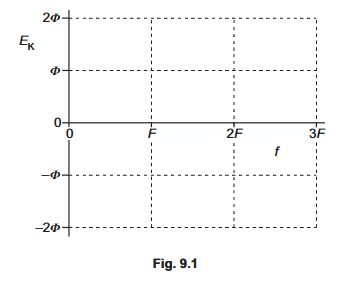
On Fig. 9.1, sketch the variation of \(E_{\mathrm{K}}\) with \(f\) for each plate. Label your lines X and Y to identify which line relates to which plate. [4]

Syllabus Topic Code (Cambridge International AS & A Level Physics 9702):
22.1-22.2 Quantum physics – photoelectric effect, photon energy and work function.
▶️ Answer/Explanation
(a) Photoelectric effect [2 marks]
The photoelectric effect is the emission of electrons from a metal surface when electromagnetic radiation is incident on the surface.
(b)(i) Threshold frequency of metal Y [1 mark]
For a metal, the work function is related to threshold frequency by \(\phi=hf_0\).
Metal X has \(\phi=hF\).
Metal Y has work function \(2\phi\), so its threshold frequency is
\(f_{\mathrm{0,Y}}=\dfrac{2\phi}{h}=2F\)
Answer: \(2F\)
(b)(ii) Planck constant [1 mark]
For metal X, \(\phi=hF\).
Therefore, \(h=\dfrac{\phi}{F}\).
Answer: \(h=\dfrac{\phi}{F}\)
(c) Graph of maximum kinetic energy against frequency [4 marks]
The photoelectric equation is \(E_{\mathrm{K,max}}=hf-\phi\).
Therefore, both graphs are straight lines with the same positive gradient \(h\).
For metal X, the threshold frequency is \(F\), so the X line crosses the \(f\)-axis at \((F,0)\).
Its extrapolation to \(f=0\) gives \(E_{\mathrm{K}}=-\phi\).
For metal Y, the work function is \(2\phi\), so its threshold frequency is \(2F\). Therefore, the Y line crosses the \(f\)-axis at \((2F,0)\).
Its extrapolation to \(f=0\) gives \(E_{\mathrm{K}}=-2\phi\).
Both lines have equal gradients because the gradient is \(h\).
The lines should therefore be two diagonal straight lines of equal positive gradient, with X passing through \((F,0)\) and Y passing through \((2F,0)\).
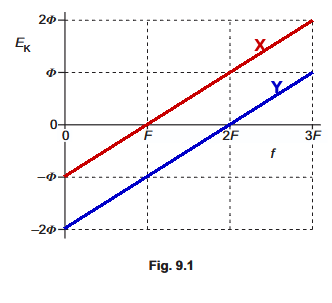
The X line extrapolates back to \((0,-\phi)\), while the Y line extrapolates back to \((0,-2\phi)\).
Question 10
(a) State what is meant by redshift. [2]
_________________________
(b) Explain how observations of redshift lead to the idea that the universe is expanding. [2]
____________________________________________________________
(c) Explain how Hubble’s law leads to the Big Bang theory of the origin of the universe. [3]
____________________________________________________________
Syllabus Topic Code (Cambridge International AS & A Level Physics 9702):
25.3 Hubble’s law and the Big Bang theory – redshift, expansion of the Universe, Hubble’s law and the Big Bang theory.
▶️ Answer/Explanation
(a) Redshift [2 marks]
Redshift occurs when the recession of a galaxy from the observer causes its emitted light to have an increased observed wavelength.
Equivalently, the observed frequency decreases.
(b) Redshift and expansion of the Universe [2 marks]
Distant galaxies show redshift, indicating that the galaxies are moving away from us.
Since galaxies are moving apart, this provides evidence that the Universe is expanding.
(c) Hubble’s law and the Big Bang theory [3 marks]
Hubble’s law states that the speed of recession of a galaxy is proportional to its distance from us: \(v=H_0d\).
Therefore, more distant galaxies are receding faster.
Looking at more distant galaxies means observing further back in time. A long time ago, the galaxies and matter in the Universe must have been much closer together.
This leads to the idea that the Universe began in a very small, dense state and has been expanding, which forms the basis of the Big Bang theory.