Home / 9709_m21_qp_12-ashok-done

9709_m21_qp_12-ashok-done

Question

a) Find the first three terms in the expansion, in ascending powers of x, of (1+x)5.
b) Find the first terms in the expansion, in ascending powers of x, (1-2x)6.
c) Hence find the coefficient of x2 in the expansion of (1+x)5(1-2x)6.

Answer/Explanation

Ans:
a) 1-5x+10x2
b) 1-12x+60x2
c) (1+5x+10x2)(1-12x+60x2) leading to 60-60+10
     10

Question

By using a suitable substitute, solve the equation
\((2x-3)^2-\frac{4}{(2x-3)^2}-3=0\)

Answer/Explanation

Ans:
u = 2x – 3 leading to u4 – 3u2 – 4 [=0]

(u2 – 4)(u2 + 1) [=0]

2x – 3 = [±]2

\(x=\frac{1}{2}, \frac{5}{2}\) only

Question

Solve the equation \(\frac{tan\Theta + 2sin\Theta }{tan\Theta – 2sin\Theta}=3for 0^o<\Theta <180^o\).

Answer/Explanation

Ans:

tan Θ+2sinΘ=3tanΘ-6sinΘ leading to 2tanΘ – 8sinΘ [=Θ]

\(cosΘ =\frac{1}{4}\)

\(Θ=75.5^o\) only

Question

A line has equation y = 3x + k and a curve has equation y = x2 + kx + 6, where k is a constant.
Find the set of values of k for which the line and curve have two distinct points of intersection.

Answer/Explanation

Ans:

\(x^2+kx+6=3x+k\) leading to \(x^2+x(k-3)+(6-k)[=0]\)

\((k-3)^2-4(6-k)[>0]\)

\((k^2-2k-15[>0]\)

k<-3, k>5

Question

In the diagram, the graph of y = f(x) is shown with solid lines. The graph shown with broken lines is a transformation of y = f(x).

(a) Describe fully the two single transformations of y = f(x) that have been combined to give the resulting transformation.

(b) State in terms of y, f and x, the equation of the graph shown with broken lines.

Answer/Explanation

Ans:

a)(Stretch)(factor 3 in y direction or parallel to the y-axis)

(Translation)\(\binom{4}{0}\)
b) [y=]3f(x-4)

Question

A curve is such that \(\frac{dy}{dx}=\frac{6}{3x-2}^3\) and A (1, -3) lies on the curve. A point is moving along the curve and at A the y – coordinate of the point is increasing at 3 units per second.

(a) Find the rate of increase at A of the x-coordinate of the point.
(b) Find the equation of the curve.

Answer/Explanation

Ans:

(a) At \(x=1,\frac{dy}{dx}=6\)
\(\frac{dx}{dt}=(\frac{dx}{dy}\times \frac{dy}{dt})=\frac{1}{6}\times 3=\frac{1}{2}\)
(b) \([y=](\frac{6(3x-2)^{-2}}{-2})+(3)[+c]\)
-3=-1+c
\(y=-(3x-2)^{-2}-2\)

Question

Functions f and g are defined as follows:
f:x  →x2 + 2x + 3 for x ≤ -1,
g:x →2x + 1 for x ≥ -1.

(a) Express f(x) in the form (x+a)2 + b and state the range of f.

(b) Find the expression for f-1(x).
(c) Solve the equation gf(x)=13

Answer/Explanation

Ans:

(a) \([f(x)=](x+1)^2+2\)
Range [of f is (y)] ≥ 2
(b) \(y=(x+1)^2+2\) leading to \(x=[±]=-\sqrt{y-2}-1\)
\(f^{-1}=-\sqrt{x-2}-1\)
(c) \(2(x^2+2x+3)+1=13\)
\(2x^2+4x-6[=0]\) leading to (2)(x-1)(x+3)[=0]
x=-3 only

Question

The points A(7, 1), B(7, 9) and C(1, 9) are on the circumference of a circle.
(a) Find an equation of the circle.
(b) Find an equation for the tangent to the circle at B.

Answer/Explanation

Ans:

(a) Centre of circle is (4,5)
\(r^2=(7-4)^2+(1-5)^2\)
r = 5
Equation is \((x-4)^2+(y-5)^2=25\)
(b) Gradient of radius \(=\frac{9-5}{7-4}=\frac{4}{3}\)
Equation of tangent is \(y-9=-\frac{3}{4}(x-7)\)

Question

The first term of a progression is \(cos\theta\), where \(0<\theta<\frac{1}{2}\pi\).
(a) For the case where the progression is geometric, the sum to infinity is \(\frac{1}{cos\theta}\).
(i) Show that the second term is \(cos\theta sin^2 \theta\).
(ii) Find the sum of the first 12 terms when \(\theta=\frac{1}{3}\pi\), giving your answer correct to 4 significant figures.
(b) For the case where the progression is arithmetic, the first two terms are again \(cos \theta \) and \(cos \theta sin^2 \theta\) respectively.
Find the 85th term when \(\theta =\frac{1}{3}\pi\).

Answer/Explanation

Ans:

(a) (i) \(\frac{cos \theta}{1-r}=\frac{1}{cos \theta}\)
\(1-r=cos^2 \theta\) leading to \(r=1-cos^2 \theta\)
\(r=sin^2 \theta\) leading to 2nd term \(=cos \theta sin^2 \theta\)
(a)(ii) \(S_{12}=\frac{cos(\frac{\pi}{3})[1-(sin^2(\frac{\pi}{3}))^{12}]}{1-sin^2(\frac{\pi}{3})}\)=\(0.5[1-(0.75)^{12}]}{1-0.75}\)
1.937
(b) \([d=]cos\theta sin^2 \theta – cos \theta\)
\(-\frac{1}{8}\)
[85th term=] \(\frac{1}{2} + 84 \times – \frac{1}{8}\)
-10

Question


The diagram shows a sector ABC which is part of a circle of radius a. The points D and E lie on AB and AC respectively and are such that AD = AE = ka, where k<1. The line DE divides the sector into two regions which are equal in area.
(a) For the case where angle \(BAC=\frac{1}{6}\pi\) radians, find k correct to 4 significant figures.
(b) For the general case in which angle \(BAC=\theta\) radians, where \(0<\theta<\frac{1}{2}\pi\), it is given that \(\frac{\theta}{sin\theta}>1\).
Find the set of possible values of k.

Answer/Explanation

Ans:

(a) \(ΔADE=\frac{1}{2}(ka)^2 sin\frac{\pi}{6}\)
\(\frac{1}{4}k^2a^2\)
Sector \(ABC=\frac{1}{2}a^2\frac{\pi}{6}\)
\(2\times \frac{1}{4}k^2a^2=\frac{1}{2}a^2\frac{\pi}{6}\)
\(k=(\sqrt{\frac{\pi}{6}})=0.7236\)
(b) \(2\times\frac{1}{2}sin \theta = \frac{1}{2} a^2 \theta\)
\(k^2=\frac{\theta}{2sin\theta}\)
\(k^2>\frac{1}{2}\) leading to \(\frac{1}{\sqrt{2}}<k<1\)

Question
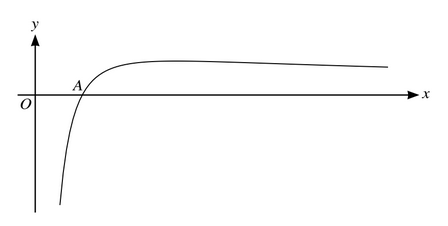

The diagram shows the curve with equation \(y=9(x^{-\frac{1}{2}}-4x^{-\frac{3}{2}})\). The curve crosses the x-axis at the point A.
(a) Find the x-coordinate of A.
(b) Find the equation of the tangent to the curve at A.
(c) Find the x-coordinate of the maximum point of the curve.
(d) Find the area of the region bounded by the curve, the x-axis and the line x=9.

Answer/Explanation

Ans:

(a) \(9(x^{-\frac{1}{2}}-4x^{-\frac{3}{2}})=0\) leading to \(9x^{-\frac{3}{2}(x-4)=0\)
x=4 only

(b) \(\frac{dy}{dx}=9(-\frac{1}{2}x^{-\frac{3}{2}}+6x^{-\frac{5}{2}})\)
At x = 4 gradient \(=9(-\frac{1}{16}+\frac{6}{32})=\frac{9}{8}\)
Equation is \(y=\frac{9}{8}(x-4)\)

(c) \(9x^{-\frac{5}{2}}(-\frac{1}{2}x+6)=0\)
x=12

(d) \(\int 9(x^{-\frac{1}{2}}-4x^{-\frac{3}{2}})dx=9(\frac{x^{\frac{1}{2}}}{\frac{1}{2}}-\frac{4x^{-\frac{1}{2}}}{-\frac{1}{2}})\)
\(9[(6+\frac{8}{3})-(4+4)]\)
6

Scroll to Top