1. [Maximum mark: 4]
The graph of \( y = f(x) \) is transformed to the graph of \( y = 3 – f(x) \). Describe fully, in the correct order, the two transformations that have been combined.
▶️Answer/Explanation
Answer:
{Reflection in the x-axis} or {Stretch of scale factor -1 parallel to the y-axis}, followed by {Translation} \( \begin{pmatrix} 0 \\ 3 \end{pmatrix} \) (3 units in the positive y-direction).
Note: If the order is reversed, a maximum of 3 out of 4 marks is awarded.
2. [Maximum mark: 5]
(a) Find the first three terms, in ascending powers of \( x \), in the expansion of \( (1 + ax)^6 \).
(b) Given that the coefficient of \( x^2 \) in the expansion of \( (1 – 3x)(1 + ax)^6 \) is \(-3\), find the possible values of the constant \( a \).
▶️Answer/Explanation
(a) \( 1 + 6ax + 15a^2x^2 \)
(b)
The coefficient of \( x^2 \) is \( 15a^2 – 18a \). Setting this equal to \(-3\):
\( 15a^2 – 18a = -3 \)
\( 15a^2 – 18a + 3 = 0 \)
\( 5a^2 – 6a + 1 = 0 \)
Solving the quadratic equation:
\( a = 1 \) or \( a = \frac{1}{5} \).
3. [Maximum mark: 5]
(a) Express \( 5y^2 – 30y + 50 \) in the form \( 5(y + a)^2 + b \), where \( a \) and \( b \) are constants.
(b) The function \( f \) is defined by \( f(x) = x^5 – 10x^3 + 50x \) for \( x \in \mathbb{R} \). Determine whether \( f \) is an increasing function, a decreasing function, or neither.
▶️Answer/Explanation
(a) \( 5(y – 3)^2 + 5 \) (where \( a = -3 \) and \( b = 5 \)).
(b)
Find the derivative: \( f'(x) = 5x^4 – 30x^2 + 50 \).
Rewrite \( f'(x) \) as \( 5(x^2 – 3)^2 + 5 \). Since \( f'(x) > 0 \) for all \( x \), \( f \) is an increasing function.
4. [Maximum mark: 5]
The first term of an arithmetic progression is 84 and the common difference is \(-3\).
(a) Find the smallest value of \( n \) for which the \( n \)th term is negative.
(b) It is given that the sum of the first \( 2k \) terms of this progression is equal to the sum of the first \( k \) terms. Find the value of \( k \).
▶️Answer/Explanation
(a)
The \( n \)th term is given by \( 84 – 3(n – 1) \). Setting this less than 0:
\( 84 – 3(n – 1) < 0 \)
\( 84 – 3n + 3 < 0 \)
\( 87 < 3n \)
\( n > 29 \). Thus, the smallest \( n \) is 30.
(b)
Sum of the first \( 2k \) terms: \( \frac{2k}{2} [2 \times 84 + (2k – 1)(-3)] \).
Sum of the first \( k \) terms: \( \frac{k}{2} [2 \times 84 + (k – 1)(-3)] \).
Setting them equal and solving:
\( k = 19 \).
5. [Maximum mark: 7]
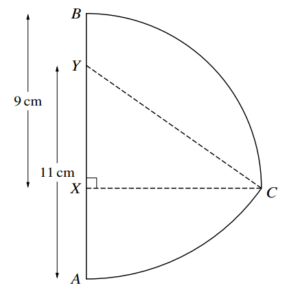
In the diagram, \( X \) and \( Y \) are points on the line \( AB \) such that \( BX = 9 \) cm and \( AY = 11 \) cm. Arc \( BC \) is part of a circle with center \( X \) and radius 9 cm, where \( CX \) is perpendicular to \( AB \). Arc \( AC \) is part of a circle with center \( Y \) and radius 11 cm.
(a) Show that angle \( XYC = 0.9582 \) radians, correct to 4 significant figures.
(b) Find the perimeter of \( ABC \).
▶️Answer/Explanation
(a)
Angle \( XYC = \sin^{-1}\left(\frac{9}{11}\right) = 0.9582 \) radians.
(b)
Calculate \( XY = \sqrt{11^2 – 9^2} = \sqrt{40} \).
\( AB = 9 + 11 – XY = 20 – \sqrt{40} \).
Arc \( AC = 11 \times 0.9582 \).
Arc \( BC = 9 \times \frac{\pi}{2} \).
Perimeter of \( ABC = AB + Arc AC + Arc BC \approx 38.4 \) cm.
6. [Maximum mark: 8]
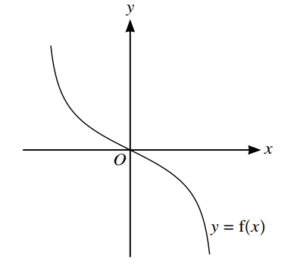
The diagram shows the graph of \( y = f(x) \).
(a) On this diagram, sketch the graph of \( y = f^{-1}(x) \).
(b) It is now given that \( f(x) = -\frac{x}{\sqrt{4 – x^2}} \) where \( -2 < x < 2 \). Find an expression for \( f^{-1}(x) \).
(c) The function \( g \) is defined by \( g(x) = 2x \) for \( -a < x < a \), where \( a \) is a constant. State the maximum possible value of \( a \) for which \( fg \) can be formed.
(d) Assuming that \( fg \) can be formed, find and simplify an expression for \( fg(x) \).
▶️Answer/Explanation

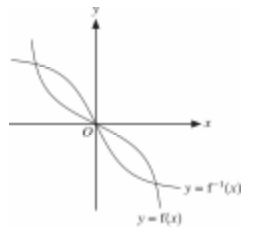
(a) The graph of \( y = f^{-1}(x) \) is the reflection of \( y = f(x) \) in the line \( y = x \).
(b)
Let \( y = -\frac{x}{\sqrt{4 – x^2}} \). Swap \( x \) and \( y \) and solve for \( y \):
\( x = -\frac{y}{\sqrt{4 – y^2}} \)
\( x^2 = \frac{y^2}{4 – y^2} \)
\( 4x^2 – x^2 y^2 = y^2 \)
\( y^2 = \frac{4x^2}{1 + x^2}} \)
\( f^{-1}(x) = -\frac{2x}{\sqrt{1 + x^2}} \).
(c) The maximum value of \( a \) is 1.
(d) \( fg(x) = f(2x) = -\frac{2x}{\sqrt{4 – (2x)^2}} = -\frac{x}{\sqrt{1 – x^2}} \).
7. [Maximum mark: 8]
(a) Show that the equation \( \frac{\tan x + \cos x}{\tan x – \cos x} = k \), where \( k \) is a constant, can be expressed as \( (k + 1)\sin^2 x + (k – 1)\sin x – (k + 1) = 0 \).
(b) Hence solve the equation \( \frac{\tan x + \cos x}{\tan x – \cos x} = 4 \) for \( 0^\circ \leq x \leq 360^\circ \).
▶️Answer/Explanation
(a)
Multiply both sides by \( \tan x – \cos x \):
\( \tan x + \cos x = k(\tan x – \cos x) \).
Substitute \( \tan x = \frac{\sin x}{\cos x} \):
\( \frac{\sin x}{\cos x} + \cos x = k\left(\frac{\sin x}{\cos x} – \cos x\right) \).
Multiply through by \( \cos x \):
\( \sin x + \cos^2 x = k(\sin x – \cos^2 x) \).
Substitute \( \cos^2 x = 1 – \sin^2 x \):
\( (k + 1)\sin^2 x + (k – 1)\sin x – (k + 1) = 0 \).
(b)
Substitute \( k = 4 \):
\( 5\sin^2 x + 3\sin x – 5 = 0 \).
Solve using the quadratic formula:
\( \sin x = \frac{-3 \pm \sqrt{9 + 100}}{10} \).
Valid solutions: \( x = 48.1^\circ, 131.9^\circ \).
8. [Maximum mark: 10]

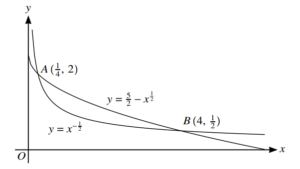
The diagram shows the curves with equations \( y = x^{-\frac{1}{2}} \) and \( y = \frac{5}{2} – x^{\frac{1}{2}} \). The curves intersect at the points \( A\left(\frac{1}{4}, 2\right) \) and \( B\left(4, \frac{1}{2}\right) \).
(a) Find the area of the region between the two curves.
(b) The normal to the curve \( y = x^{-\frac{1}{2}} \) at the point \( (1, 1) \) intersects the \( y \)-axis at the point \( (0, p) \). Find the value of \( p \).
▶️Answer/Explanation
(a)
The area is given by:
\( \int_{\frac{1}{4}}^{4} \left( \frac{5}{2} – x^{\frac{1}{2}} – x^{-\frac{1}{2}} \right) dx \).
Integrate term by term:
\( \left[ \frac{5}{2}x – \frac{2}{3}x^{\frac{3}{2}} – 2x^{\frac{1}{2}} \right]_{\frac{1}{4}}^{4} \).
Evaluate at the limits:
Area \( = \frac{9}{8} \) or 1.125.
(b)
The derivative of \( y = x^{-\frac{1}{2}} \) is \( \frac{dy}{dx} = -\frac{1}{2}x^{-\frac{3}{2}} \).
At \( x = 1 \), the gradient is \( -\frac{1}{2} \).
The normal gradient is \( 2 \).
Equation of the normal: \( y – 1 = 2(x – 1) \).
At \( x = 0 \), \( y = -1 \). Thus, \( p = -1 \).
9. [Maximum mark: 12]
The line \( y = 2x + 5 \) intersects the circle with equation \( x^2 + y^2 = 20 \) at \( A \) and \( B \).
(a) Find the coordinates of \( A \) and \( B \) in surd form and hence find the exact length of the chord \( AB \).
(b) A straight line through the point \( (10, 0) \) with gradient \( m \) is a tangent to the circle. Find the two possible values of \( m \).
▶️Answer/Explanation
(a)
Substitute \( y = 2x + 5 \) into the circle equation:
\( x^2 + (2x + 5)^2 = 20 \).
Expand and simplify: \( 5x^2 + 20x + 5 = 0 \).
Solve for \( x \): \( x = -2 \pm \sqrt{3} \).
Coordinates: \( A(-2 + \sqrt{3}, 1 + 2\sqrt{3}) \), \( B(-2 – \sqrt{3}, 1 – 2\sqrt{3}) \).
Length of \( AB \): \( \sqrt{60} \).
(b)
The equation of the tangent: \( y = m(x – 10) \).
Substitute into the circle equation:
\( x^2 + m^2(x – 10)^2 = 20 \).
The condition for tangency is \( b^2 – 4ac = 0 \).
Solve for \( m \): \( m = \pm \frac{1}{2} \).
10. [Maximum mark: 11]
A curve has equation \( y = f(x) \) and it is given that \( f'(x) = \left(\frac{1}{2}x + k\right)^{-2} – (1 + k)^{-2} \), where \( k \) is a constant. The curve has a minimum point at \( x = 2 \).
(a) Find \( f”(x) \) in terms of \( k \) and \( x \), and hence find the set of possible values of \( k \).
(b) It is now given that \( k = -3 \) and the minimum point is at \( \left(2, 3\frac{1}{2}\right) \). Find \( f(x) \).
(c) Find the coordinates of the other stationary point and determine its nature.
▶️Answer/Explanation
(a)
Differentiate \( f'(x) \): \( f”(x) = -2\left(\frac{1}{2}x + k\right)^{-3} \times \frac{1}{2} \).
At \( x = 2 \), \( f”(2) > 0 \): \( -(1 + k)^{-3} > 0 \).
Thus, \( k < -1 \).
(b)
Integrate \( f'(x) \): \( f(x) = -2\left(\frac{1}{2}x – 3\right)^{-1} – \frac{x}{4} + c \).
Substitute \( (2, 3.5) \) to find \( c = 3 \).
Thus, \( f(x) = \frac{-2}{\frac{1}{2}x – 3} – \frac{x}{4} + 3 \).
(c)
Set \( f'(x) = 0 \): \( \left(\frac{1}{2}x – 3\right)^{-2} – 4 = 0 \).
Solve for \( x \): \( x = 10 \).
Substitute into \( f(x) \): \( y = -\frac{1}{2} \).
The other stationary point is \( (10, -\frac{1}{2}) \), and it is a maximum.