Home / 9709_w21_qp_32

1. [Maximum mark: 4]

Find the value of \( x \) for which \( 3(2^{1-x}) = 7^x \). Give your answer in the form \( \frac{\ln a}{\ln b} \), where \( a \) and \( b \) are integers.

▶️Answer/Explanation

Solution:
Take the natural logarithm of both sides:
\( \ln(3 \cdot 2^{1-x}) = \ln(7^x) \)
Simplify using logarithm properties:
\( \ln 3 + (1-x)\ln 2 = x \ln 7 \)
Rearrange to solve for \( x \):
\( \ln 3 + \ln 2 – x \ln 2 = x \ln 7 \)
\( \ln 6 = x (\ln 7 + \ln 2) \)
\( x = \frac{\ln 6}{\ln 14} \)
Final answer: \( \boxed{\dfrac{\ln 6}{\ln 14}} \)

2. [Maximum mark: 4]

Solve the inequality \( |3x – a| > 2|x + 2a| \), where \( a \) is a positive constant.

▶️Answer/Explanation

Solution:
Square both sides to eliminate absolute values:
\( (3x – a)^2 > 4(x + 2a)^2 \)
Expand and simplify:
\( 9x^2 – 6ax + a^2 > 4x^2 + 16ax + 16a^2 \)
\( 5x^2 – 22ax – 15a^2 > 0 \)
Solve the quadratic inequality:
Critical points: \( x = 5a \) and \( x = -\frac{3}{5}a \)
Test intervals to find solution:
\( \boxed{x < -\frac{3}{5}a \text{ or } x > 5a} \)

3. [Maximum mark: 6]

(a) Given the complex numbers \( u = a + ib \) and \( w = c + id \), where \( a, b, c \) and \( d \) are real, prove that \( (u + w)^* = u^* + w^* \).

(b) Solve the equation \( (z + 2 + i)^* + (2 + i)z = 0 \), giving your answer in the form \( x + iy \) where \( x \) and \( y \) are real.

▶️Answer/Explanation

(a) Solution:
Let \( u + w = (a + c) + i(b + d) \)
Conjugate: \( (u + w)^* = (a + c) – i(b + d) \)
Now \( u^* + w^* = (a – ib) + (c – id) = (a + c) – i(b + d) \)
Thus \( (u + w)^* = u^* + w^* \).

(b) Solution:
Let \( z = x + iy \):
\( (x + 2 + i(y + 1))^* + (2 + i)(x + iy) = 0 \)
Simplify:
\( (x + 2) – i(y + 1) + 2x + 2iy + ix – y = 0 \)
Equate real and imaginary parts:
Real: \( 3x – y + 2 = 0 \)
Imaginary: \( x + y – 1 = 0 \)
Solve system: \( x = -\frac{1}{4} \), \( y = \frac{5}{4} \)
Final answer: \( \boxed{-\frac{1}{4} + \frac{5}{4}i} \)

4. [Maximum mark: 5]

Express \( \frac{4x^{2}-13x+13}{(2x-1)(x-3)} \) in partial fractions.

▶️Answer/Explanation

Solution:
Assume form: \( A + \frac{B}{2x-1} + \frac{C}{x-3} \)
Multiply through by denominator:
\( 4x^2 – 13x + 13 = A(2x-1)(x-3) + B(x-3) + C(2x-1) \)
Substitute \( x = \frac{1}{2} \): \( B = -3 \)
Substitute \( x = 3 \): \( C = 2 \)
Compare \( x^2 \) coefficients: \( A = 2 \)
Final answer: \( \boxed{2 – \frac{3}{2x-1} + \frac{2}{x-3}} \)

5. [Maximum mark: 7]

(a) On a sketch of an Argand diagram, shade the region whose points represent complex numbers \( z \) satisfying the inequalities \( |z – 3 – 2i| \leq 1 \) and \( \text{Im } z \geq 2 \).

(b) Find the greatest value of \( \arg z \) for points in the shaded region, giving your answer in degrees.

▶️Answer/Explanation

(a) Solution:
– Circle centered at \( (3,2) \) with radius 1
– Horizontal line \( y = 2 \)
– Shade intersection of circle and area above line
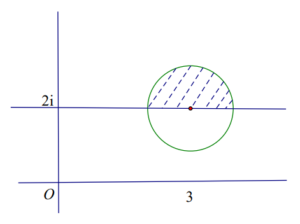
(b) Solution:
The point with greatest argument is tangent to circle from origin.
Find angle using trigonometry:
Base angle: \( \tan^{-1}(\frac{2}{3}) \approx 33.69^\circ \)
Additional angle: \( \sin^{-1}(\frac{1}{\sqrt{13}}) \approx 16.10^\circ \)
Final answer: \( \boxed{49.8^\circ} \)

6. [Maximum mark: 6]

(a) Using the expansions of \( \sin(3x + 2x) \) and \( \sin(3x – 2x) \), show that \( \frac{1}{2}(\sin 5x + sin x) \equiv \sin 3x \cos 2x \).

(b) Hence show that \( \int_{0}^{\frac{1}{4}\pi} \sin 3x \cos 2x \, dx = \frac{1}{5}(3 – \sqrt{2}) \).

▶️Answer/Explanation

(a) Solution:
Using angle addition formulas:
\( \sin(5x) = \sin 3x \cos 2x + \cos 3x \sin 2x \)
\( \sin x = \sin 3x \cos 2x – \cos 3x \sin 2x \)
Add them: \( \sin 5x + \sin x = 2 \sin 3x \cos 2x \)
Thus \( \frac{1}{2}(\sin 5x + \sin x) = \sin 3x \cos 2x \)

(b) Solution:
Using part (a):
\( \int \sin 3x \cos 2x \, dx = \frac{1}{2} \int (\sin 5x + \sin x) \, dx \)
\( = -\frac{1}{10} \cos 5x – \frac{1}{2} \cos x \)
Evaluate from 0 to \( \pi/4 \):
\( = -\frac{1}{10} \cos(\frac{5\pi}{4}) – \frac{1}{2} \cos(\frac{\pi}{4}) – (-\frac{1}{10} – \frac{1}{2}) \)
Simplify using exact values:
\( = \frac{1}{5}(3 – \sqrt{2}) \)

7. [Maximum mark: 7]

The variables \( x \) and \( y \) satisfy the differential equation \( e^{2x} \frac{dy}{dx} = 4xy^2 \), and it is given that \( y = 1 \) when \( x = 0 \). Solve the differential equation, obtaining an expression for \( y \) in terms of \( x \).

▶️Answer/Explanation

Solution:
Separate variables:
\( \frac{1}{y^2} dy = 4x e^{-2x} dx \)
Integrate both sides:
Left: \( -\frac{1}{y} \)
Right (using integration by parts):
\( \int 4x e^{-2x} dx = -2x e^{-2x} – e^{-2x} + C \)
Combine and use initial condition \( y(0) = 1 \):
\( -\frac{1}{y} = -2x e^{-2x} – e^{-2x} + 1 \)
Solve for \( y \):
Final answer: \( \boxed{y = \frac{e^{2x}}{2x + 1}} \)

8. [Maximum mark: 7]

(a) By first expanding \( (\cos^2 \theta + \sin^2 \theta)^2 \), show that \( \cos^4 \theta + \sin^4 \theta \equiv 1 – \frac{1}{2} \sin^2 2\theta \).

(b) Hence solve the equation \( \cos^4 \theta + \sin^4 \theta = \frac{5}{9} \), for \( 0^\circ < \theta < 180^\circ \).

▶️Answer/Explanation

(a) Solution:
Expand \( (\cos^2 \theta + \sin^2 \theta)^2 = \cos^4 \theta + 2\cos^2 \theta \sin^2 \theta + \sin^4 \theta \)
But \( \cos^2 \theta + \sin^2 \theta = 1 \), so:
\( \cos^4 \theta + \sin^4 \theta = 1 – 2\cos^2 \theta \sin^2 \theta \)
Using \( \sin 2\theta = 2\sin \theta \cos \theta \):
\( = 1 – \frac{1}{2} \sin^2 2\theta \)

(b) Solution:
From part (a): \( 1 – \frac{1}{2} \sin^2 2\theta = \frac{5}{9} \)
Solve: \( \sin^2 2\theta = \frac{8}{9} \)
\( \sin 2\theta = \pm \frac{2\sqrt{2}}{3} \)
Find all solutions in \( 0^\circ < \theta < 180^\circ \):
\( \theta \approx 35.3^\circ, 144.7^\circ, 54.7^\circ, 125.3^\circ \)
Final answers: \( \boxed{35.3^\circ}, \boxed{54.7^\circ}, \boxed{125.3^\circ}, \boxed{144.7^\circ} \)

9. [Maximum mark: 8]

The equation of a curve is \( ye^{2x} – y^2e^x = 2 \).

(a) Show that \( \frac{dy}{dx} = \frac{2ye^x – y^2}{2y – e^x} \).

(b) Find the exact coordinates of the point on the curve where the tangent is parallel to the y-axis.

▶️Answer/Explanation

(a) Solution:
Differentiate implicitly:
\( e^{2x} \frac{dy}{dx} + 2y e^{2x} – (2y e^x \frac{dy}{dx} + y^2 e^x) = 0 \)
Collect \( \frac{dy}{dx} \) terms:
\( (e^{2x} – 2y e^x) \frac{dy}{dx} = y^2 e^x – 2y e^{2x} \)
Factor and simplify:
\( \frac{dy}{dx} = \frac{2y e^x – y^2}{2y – e^x} \)

(b) Solution:
Tangent parallel to y-axis when denominator is zero:
\( 2y – e^x = 0 \) ⇒ \( e^x = 2y \)
Substitute into original equation:
\( y(2y)^2 – y^2(2y) = 2 \) ⇒ \( 4y^3 – 2y^3 = 2 \)
\( y^3 = 1 \) ⇒ \( y = 1 \)
Then \( e^x = 2 \) ⇒ \( x = \ln 2 \)
Final answer: \( \boxed{(\ln 2, 1)} \)

10. [Maximum mark: 10]

With respect to the origin O, the position vectors of the points A and B are given by \( \overrightarrow{OA} = \begin{pmatrix} 1 \\ 2 \\ -1 \end{pmatrix} \) and \( \overrightarrow{OB} = \begin{pmatrix} 0 \\ 3 \\ 1 \end{pmatrix} \).

(a) Find a vector equation for the line l through A and B.

(b) The point C lies on l and is such that \( \overrightarrow{AC} = 3 \overrightarrow{AB} \). Find the position vector of C. 

(c) Find the possible position vectors of the point P on l such that \( OP = \sqrt{14} \).

▶️Answer/Explanation

(a) Solution:
Direction vector \( \overrightarrow{AB} = \begin{pmatrix} -1 \\ 1 \\ 2 \end{pmatrix} \)
Vector equation: \( \mathbf{r} = \begin{pmatrix} 1 \\ 2 \\ -1 \end{pmatrix} + \lambda \begin{pmatrix} -1 \\ 1 \\ 2 \end{pmatrix} \)

(b) Solution:
Since \( \overrightarrow{AC} = 3 \overrightarrow{AB} \), parameter \( \lambda = 3 \):
\( \mathbf{r}_C = \begin{pmatrix} 1 \\ 2 \\ -1 \end{pmatrix} + 3 \begin{pmatrix} -1 \\ 1 \\ 2 \end{pmatrix} = \begin{pmatrix} -2 \\ 5 \\ 5 \end{pmatrix} \)

(c) Solution:
General point on line: \( \begin{pmatrix} 1 – \lambda \\ 2 + \lambda \\ -1 + 2\lambda \end{pmatrix} \)
Set \( OP = \sqrt{14} \):
\( (1 – \lambda)^2 + (2 + \lambda)^2 + (-1 + 2\lambda)^2 = 14 \)
Simplify: \( 6\lambda^2 – 2\lambda – 8 = 0 \) ⇒ \( 3\lambda^2 – \lambda – 4 = 0 \)
Solutions: \( \lambda = -1 \) and \( \lambda = \frac{4}{3} \)
Corresponding position vectors:
\( \boxed{\begin{pmatrix} 2 \\ 1 \\ -3 \end{pmatrix}} \) and \( \boxed{\begin{pmatrix} -\frac{1}{3} \\ \frac{10}{3} \\ \frac{5}{3} \end{pmatrix}} \)

11. [Maximum mark: 11]

The equation of a curve is \( y = \sqrt{\tan x} \), for \( 0 \leq x < \frac{1}{2}\pi \).

(a) Express \( \frac{dy}{dx} \) in terms of \( \tan x \), and verify that \( \frac{dy}{dx} = 1 \) when \( x = \frac{1}{4}\pi \).

The value of $\frac{dy}{dx}$ is also 1 at another point on the curve where $x = a$, as shown in the diagram.
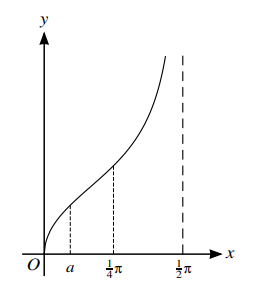
(b) Show that \( t^3 + t^2 + 3t – 1 = 0 \), where \( t = \tan a \).

(c) Use the iterative formula \( a_{n+1} = \tan^{-1} \left( \frac{1}{3}(1 – \tan^2 a_n – \tan^3 a_n) \right) \) to determine \( a \) correct to 2 decimal places, giving the result of each iteration to 4 decimal places.

▶️Answer/Explanation

(a) Solution:
Using chain rule: \( \frac{dy}{dx} = \frac{\sec^2 x}{2\sqrt{\tan x}} \)
Express in terms of \( \tan x \): \( \frac{1 + \tan^2 x}{2\sqrt{\tan x}} \)
At \( x = \pi/4 \): \( \frac{1 + 1}{2 \times 1} = 1 \)

(b) Solution:
Set \( \frac{dy}{dx} = 1 \): \( 1 + t^2 = 2\sqrt{t} \)
Square both sides: \( (1 + t^2)^2 = 4t \)
Expand: \( t^4 + 2t^2 + 1 = 4t \)
Divide by \( t – 1 \) (since \( t = 1 \) is root from part (a)):
\( t^3 + t^2 + 3t – 1 = 0 \)

(c) Solution:
Iterative process:
Start with \( a_0 = 0.3 \):
\( a_1 = \tan^{-1}\left(\frac{1}{3}(1 – 0.09 – 0.027)\right) \approx 0.2854 \)
\( a_2 \approx 0.2894 \), \( a_3 \approx 0.2883 \), …
Converges to \( \boxed{0.29} \) (2 d.p.)

Scroll to Top