1. [Maximum mark: 5]
Each of the 180 students at a college plays exactly one of the piano, the guitar and the drums. The numbers of male and female students who play the piano, the guitar and the drums are given in the following table.
| Piano | Guitar | Drums | |
|---|---|---|---|
| Male | 25 | 44 | 11 |
| Female | 42 | 38 | 20 |
A student at the college is chosen at random.
(a) Find the probability that the student plays the guitar.
(b) Find the probability that the student is male given that the student plays the drums.
(c) Determine whether the events ‘the student plays the guitar’ and ‘the student is female’ are independent, justifying your answer.
▶️Answer/Explanation
(a) \( \frac{82}{180} = \frac{41}{90} \) or 0.456 (3 sf).
(b) \( P(\text{Male} \mid \text{Drums}) = \frac{11}{31} \) or 0.355 (3 sf).
(c) \( P(\text{Female}) = \frac{100}{180} = \frac{5}{9} \), \( P(\text{Guitar}) = \frac{82}{180} = \frac{41}{90} \).
\( P(\text{Female} \cap \text{Guitar}) = \frac{38}{180} = \frac{19}{90} \).
Since \( \frac{5}{9} \times \frac{41}{90} \neq \frac{19}{90} \), the events are not independent.
2. [Maximum mark: 5]
A group of 6 people is to be chosen from 4 men and 11 women.
(a) In how many different ways can a group of 6 be chosen if it must contain exactly 1 man?
(b) In how many different ways can a group of 6 be chosen if Jane and Kate (two of the 11 women) cannot both be in the group?
▶️Answer/Explanation
(a) \( \binom{4}{1} \times \binom{11}{5} = 1848 \).
(b) Total ways without restriction: \( \binom{15}{6} = 5005 \).
Subtract cases where both Jane and Kate are selected: \( \binom{13}{4} = 715 \).
Final answer: \( 5005 – 715 = 4290 \).
3. [Maximum mark: 7]
A bag contains 5 yellow and 4 green marbles. Three marbles are selected at random from the bag, without replacement.
(a) Show that the probability that exactly one of the marbles is yellow is \( \frac{5}{14} \).
(b) Draw up the probability distribution table for \( X \), the number of yellow marbles selected.
(c) Find \( E(X) \).
▶️Answer/Explanation
(a) \( P(\text{1 yellow}) = \frac{\binom{5}{1} \times \binom{4}{2}}{\binom{9}{3}} = \frac{30}{84} = \frac{5}{14} \).
(b) Probability distribution table:
\( X = 0 \): \( \frac{4}{84} = \frac{1}{21} \);
\( X = 1 \): \( \frac{30}{84} = \frac{5}{14} \);
\( X = 2 \): \( \frac{40}{84} = \frac{10}{21} \);
\( X = 3 \): \( \frac{10}{84} = \frac{5}{42} \).
(c) \( E(X) = \frac{5}{3} \) or 1.67 (3 sf).
4. [Maximum mark: 6]
(a) In how many different ways can the 9 letters of the word TELESCOPE be arranged?
(b) In how many different ways can the 9 letters of the word TELESCOPE be arranged so that there are exactly two letters between the T and the C?
▶️Answer/Explanation
(a) \( \frac{9!}{3!} = 60480 \) (since there are 3 identical E’s).
(b) Treat T and C as a single unit with two letters in between (e.g., T _ _ C). There are 6 possible positions for this unit in the 9-letter arrangement. The remaining 5 letters can be arranged in \( \frac{5!}{3!} \) ways (dividing by 3! for the identical E’s). Multiply by 2 for the order (T _ _ C or C _ _ T). Total: \( 6 \times \frac{5!}{3!} \times 2 = 120 \times 2 = 240 \).
5. [Maximum mark: 7]
In a certain region, the probability that any given day in October is wet is 0.16, independently of other days.
(a) Find the probability that, in a 10-day period in October, fewer than 3 days will be wet.
(b) Find the probability that the first wet day in October is 8 October.
(c) For 4 randomly chosen years, find the probability that in exactly 1 of these years the first wet day in October is 8 October.
▶️Answer/Explanation
(a) \( P(\text{fewer than 3 wet days}) = P(0) + P(1) + P(2) \).
Using binomial formula: \( \binom{10}{0}(0.16)^0(0.84)^{10} + \binom{10}{1}(0.16)^1(0.84)^9 + \binom{10}{2}(0.16)^2(0.84)^8 \).
Result: 0.794 (3 sf).
(b) \( P(\text{first wet on 8 Oct}) = (0.84)^7 \times 0.16 = 0.0472 \) (3 sf).
(c) Binomial probability: \( \binom{4}{1} \times (0.0472)^1 \times (0.9528)^3 = 0.163 \) (3 sf).
6. [Maximum mark: 10]
The times taken, in minutes, to complete a particular task by employees at a large company are normally distributed with mean 32.2 and standard deviation 9.6.
(a) Find the probability that a randomly chosen employee takes more than 28.6 minutes to complete the task.
(b) 20% of employees take longer than \( t \) minutes to complete the task. Find the value of \( t \).
(c) Find the probability that the time taken to complete the task by a randomly chosen employee differs from the mean by less than 15.0 minutes.
▶️Answer/Explanation
(a) Standardize: \( Z = \frac{28.6 – 32.2}{9.6} = -0.375 \).
\( P(X > 28.6) = P(Z > -0.375) = 0.646 \) (3 sf).
(b) For 20% in the upper tail, \( z = 0.842 \).
Solve \( \frac{t – 32.2}{9.6} = 0.842 \): \( t = 40.3 \) (3 sf).
(c) \( P(32.2 – 15.0 < X < 32.2 + 15.0) = P(-1.5625 < Z < 1.5625) \).
Using symmetry: \( 2 \times \Phi(1.5625) – 1 = 0.882 \) (3 sf).
7. [Maximum mark: 10]
The distances, \( x \) meters, travelled to school by 140 children were recorded. The results are summarised in the cumulative frequency table below.
| Distance, \( x \) (m) | \( x \leq 200 \) | \( x \leq 300 \) | \( x \leq 500 \) | \( x \leq 900 \) | \( x \leq 1200 \) | \( x \leq 1600 \) |
|---|---|---|---|---|---|---|
| Cumulative frequency | 16 | 46 | 88 | 122 | 134 | 140 |
(a) On the grid, draw a cumulative frequency graph to represent these results.

(b) Use your graph to estimate the interquartile range of the distances.
(c) Calculate estimates of the mean and standard deviation of the distances.
▶️Answer/Explanation
(a) Plot points at (200, 16), (300, 46), (500, 88), (900, 122), (1200, 134), (1600, 140) and join with a smooth curve.
(b) Lower quartile (Q1) ≈ 260 m, Upper quartile (Q3) ≈ 700 m. IQR = 440 m.
(c) Mean: \( \frac{\sum (midpoint \times frequency)}{140} = 505 \) m.
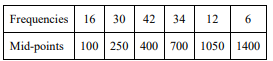
Standard deviation: \( \sqrt{\frac{\sum (midpoint^2 \times frequency)}{140} – \text{mean}^2} = 324 \) m (3 sf).
