Home / 9709_w21_qp_53

1. [Maximum mark: 2]

The 26 members of the local sports club include Mr and Mrs Khan and their son Abad. The club is holding a party to celebrate Abad’s birthday, but there is only room for 20 people to attend. In how many ways can the 20 people be chosen from the 26 members of the club, given that Mr and Mrs Khan and Abad must be included?

▶️Answer/Explanation

Since Mr and Mrs Khan and Abad must be included, we first select these 3 members. The remaining 17 members are chosen from the remaining 23 members of the club. The number of ways to do this is given by the combination formula \(^{23}C_{17}\).

Calculation:
\(^{23}C_{17} = 100947\)

2. [Maximum mark: 6]

Lakeview and Riverside are two schools. The pupils at both schools took part in a competition to see how far they could throw a ball. The distances thrown, to the nearest metre, by 11 pupils from each school are shown in the following table.

Lakeview1014192226272830323341
Riverside2336211837251820243025

(a) Draw a back-to-back stem-and-leaf diagram to represent this information, with Lakeview on the left-hand side.

(b) Find the interquartile range of the distances thrown by the 11 pupils at Lakeview school.

▶️Answer/Explanation

(a) The back-to-back stem-and-leaf diagram should have Lakeview on the left and Riverside on the right, with a common stem. The leaves should be ordered from the stem outward for both schools. A key must be provided to indicate the units.

(b) For Lakeview:
– Lower quartile (LQ) = 19
– Upper quartile (UQ) = 32
– Interquartile range (IQR) = UQ – LQ = 32 – 19 = 13

3. [Maximum mark: 6]

The times taken, in minutes, by 360 employees at a large company to travel from home to work are summarised in the following table.

Time, \( t \) minutes\( 0 \leq t < 5 \)\( 5 \leq t < 10 \)\( 10 \leq t < 20 \)\( 20 \leq t < 30 \)\( 30 \leq t < 50 \)
Frequency231021357624

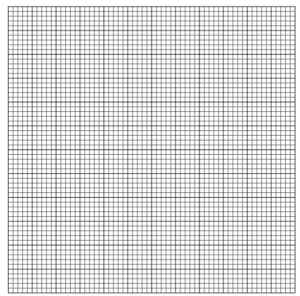
(a) Draw a histogram to represent this information.
(b) Calculate an estimate of the mean time taken by an employee to travel to work.

▶️Answer/Explanation

(a) The histogram should have time intervals on the x-axis and frequency density (frequency divided by class width) on the y-axis. The bars should be drawn with no gaps between them, and the heights should correspond to the frequency densities.

(b) The mean time is estimated using the midpoint of each interval multiplied by the frequency, summed, and then divided by the total number of employees.
Calculation:
\[ \text{Mean} = \frac{(2.5 \times 23) + (7.5 \times 102) + (15 \times 135) + (25 \times 76) + (40 \times 24)}{360} = 15.9 \text{ minutes} \]

4. [Maximum mark: 8]

Raj wants to improve his fitness, so every day he goes for a run. The times, in minutes, of his runs have a normal distribution with mean 41.2 and standard deviation 3.6.

(a) Find the probability that on a randomly chosen day Raj runs for more than 43.2 minutes.

(b) Find an estimate for the number of days in a year (365 days) on which Raj runs for less than 43.2 minutes.

(c) On 95% of days, Raj runs for more than \( t \) minutes. Find the value of \( t \).

▶️Answer/Explanation

(a) Standardize the value 43.2 using the formula \( z = \frac{43.2 – 41.2}{3.6} \approx 0.5556 \). The probability \( P(Z > 0.5556) = 1 – \Phi(0.5556) \approx 0.289 \).

(b) The probability of running less than 43.2 minutes is \( 1 – 0.289 = 0.711 \). The estimated number of days is \( 0.711 \times 365 \approx 260 \) days.

(c) For the 5th percentile, the critical \( z \)-value is approximately -1.645. Solving \( t = 41.2 – 1.645 \times 3.6 \) gives \( t \approx 35.3 \) minutes.

5. [Maximum mark: 8]

A security code consists of 2 letters followed by a 4-digit number. The letters are chosen from \{A, B, C, D, E\} and the digits are chosen from \{1, 2, 3, 4, 5, 6, 7\}. No letter or digit may appear more than once. An example of a code is BE3216.

(a) How many different codes can be formed?

(b) Find the number of different codes that include the letter A or the digit 5 or both.

(c) Find the probability that the code is DE followed by a number between 4500 and 5000.

▶️Answer/Explanation

(a) The number of ways to choose 2 distinct letters from 5 is \( ^5P_2 = 20 \). The number of ways to choose 4 distinct digits from 7 is \( ^7P_4 = 840 \). Total codes: \( 20 \times 840 = 16,800 \).

(b) Using complementary counting: Total codes minus codes with neither A nor 5. Total codes = 16,800. Codes without A: \( ^4P_2 \times ^7P_4 = 12 \times 840 = 10,080 \). Codes without 5: \( ^5P_2 \times ^6P_4 = 20 \times 360 = 7,200 \). Codes without A or 5: \( ^4P_2 \times ^6P_4 = 12 \times 360 = 4,320 \). Using inclusion-exclusion: \( 10,080 + 7,200 – 4,320 = 12,960 \). Alternatively, subtract directly: \( 16,800 – 4,320 = 12,480 \).

(c) The letters DE are fixed (1 way). The number must be between 4500 and 5000, so the first digit is 4, the second is 5, 6, or 7, and the remaining digits are chosen from the remaining 5 digits. Number of valid numbers: \( 3 \times ^5P_2 = 3 \times 20 = 60 \). Probability: \( \frac{60}{16,800} = \frac{1}{280} \).

6. [Maximum mark: 10]

In a game, Jim throws three darts at a board. This is called a ‘turn’. The centre of the board is called the bull’s-eye. The random variable \( X \) is the number of darts in a turn that hit the bull’s-eye. The probability distribution of \( X \) is given in the following table.

\( x \)0123
\( P(X = x) \)0.6\( p \)\( q \)0.05

It is given that \( E(X) = 0.55 \).

(a) Find the values of \( p \) and \( q \).

(b) Find Var(\( X \)).

(c) Find the probability that \( X = 1 \) in at least 3 of 12 randomly chosen turns. 

(d) Find the probability that Jim first succeeds in hitting the bull’s-eye with all three darts on his 9th turn.

▶️Answer/Explanation

(a) The sum of probabilities must be 1: \( 0.6 + p + q + 0.05 = 1 \), so \( p + q = 0.35 \). The expected value is given by \( E(X) = 0 \times 0.6 + 1 \times p + 2 \times q + 3 \times 0.05 = 0.55 \), so \( p + 2q = 0.4 \). Solving these equations gives \( p = 0.3 \) and \( q = 0.05 \).

(b) Variance is calculated as \( E(X^2) – [E(X)]^2 \). \( E(X^2) = 0^2 \times 0.6 + 1^2 \times 0.3 + 2^2 \times 0.05 + 3^2 \times 0.05 = 0.3 + 0.2 + 0.45 = 0.95 \). Variance: \( 0.95 – 0.55^2 = 0.6475 \).

(c) The probability of \( X = 1 \) in a single turn is 0.3. The probability of this happening in at least 3 of 12 turns is calculated using the binomial formula: \( 1 – P(0, 1, 2) \). \( P(0) = 0.7^{12} \), \( P(1) = 12 \times 0.3 \times 0.7^{11} \), \( P(2) = 66 \times 0.3^2 \times 0.7^{10} \). Summing these and subtracting from 1 gives approximately 0.747.

(d) The probability of first succeeding on the 9th turn is \( (0.95)^8 \times 0.05 \approx 0.0332 \).

7. [Maximum mark: 10]

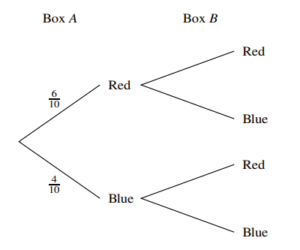
Box A contains 6 red balls and 4 blue balls. Box B contains \( x \) red balls and 9 blue balls. A ball is chosen at random from box A and placed in box B. A ball is then chosen at random from box B.

(a) Complete the tree diagram below, giving the remaining four probabilities in terms of \( x \).
(b) Show that the probability that both balls chosen are blue is \( \frac{4}{x+10} \).

(c) It is given that the probability that both balls chosen are blue is \( \frac{1}{6} \). Find the probability, correct to 3 significant figures, that the ball chosen from box A is red given that the ball chosen from box B is red.

▶️Answer/Explanation

(a) The tree diagram should include:
– From Box A: Red (\( \frac{6}{10} \)) and Blue (\( \frac{4}{10} \)).
– If Red is chosen from Box A, Box B has \( x + 1 \) red and 9 blue balls. Probabilities: \( \frac{x + 1}{x + 10} \) (Red) and \( \frac{9}{x + 10} \) (Blue).
– If Blue is chosen from Box A, Box B has \( x \) red and 10 blue balls. Probabilities: \( \frac{x}{x + 10} \) (Red) and \( \frac{10}{x + 10} \) (Blue).

(b) The probability both balls are blue is \( \frac{4}{10} \times \frac{10}{x + 10} = \frac{4}{x + 10} \).

(c) Given \( \frac{4}{x + 10} = \frac{1}{6} \), solving gives \( x = 14 \). The probability that the ball from Box A is red given that the ball from Box B is red is calculated using Bayes’ theorem:
\[ P(\text{Red from A} \mid \text{Red from B}) = \frac{\frac{6}{10} \times \frac{15}{24}}{\frac{6}{10} \times \frac{15}{24} + \frac{4}{10} \times \frac{14}{24}} = \frac{45}{73} \approx 0.616 \]

Scroll to Top