
Preparation of Alcohols
Alcohols can be prepared by a variety of reactions at AS / A level. It is essential to recall the reagents and conditions for each method.
(a) Electrophilic Addition of Steam to an Alkene
Alkenes react with steam to form alcohols by electrophilic addition.

Reagents and conditions: \( \mathrm{H_2O(g)} \), phosphoric acid catalyst, high temperature and pressure.
General equation:
\( \mathrm{CH_2=CH_2 + H_2O \rightarrow CH_3CH_2OH} \)
(b) Oxidation of Alkenes with Potassium Manganate(VII)
Alkenes react with cold, dilute, acidified potassium manganate(VII) to form diols.

Reagents and conditions: cold, dilute, acidified \( \mathrm{KMnO_4} \).
General equation (ethene):
\( \mathrm{CH_2=CH_2 \rightarrow HOCH_2CH_2OH} \)
(c) Substitution of a Halogenoalkane
Halogenoalkanes react with aqueous hydroxide ions in a nucleophilic substitution reaction to form alcohols.
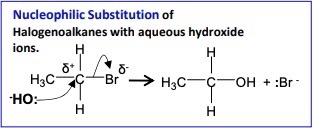
Reagents and conditions: \( \mathrm{NaOH(aq)} \), heat under reflux.
General equation:
\( \mathrm{R{-}X + OH^- \rightarrow R{-}OH + X^-} \)
(d) Reduction of Aldehydes and Ketones
Aldehydes and ketones can be reduced to alcohols using sodium borohydride or lithium aluminium hydride.
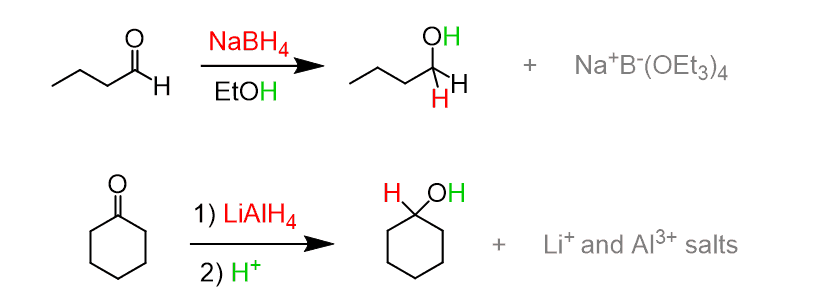
Reagents and conditions: \( \mathrm{NaBH_4} \) or \( \mathrm{LiAlH_4} \).
General equations:
\( \mathrm{RCHO \rightarrow RCH_2OH} \)
\( \mathrm{RCOR’ \rightarrow RCHOHR’} \)
(e) Reduction of Carboxylic Acids
Carboxylic acids can be reduced to primary alcohols using lithium aluminium hydride.

Reagents and conditions: \( \mathrm{LiAlH_4} \) in dry ether.
General equation:
\( \mathrm{RCOOH \rightarrow RCH_2OH} \)
(f) Hydrolysis of Esters
Esters can be hydrolysed to form alcohols using dilute acid or dilute alkali and heat.

Reagents and conditions: dilute acid or dilute alkali, heat under reflux.
General equation:
\( \mathrm{RCOOR’ \rightarrow R’OH} \)
Example
State the reagents and conditions required to prepare ethanol from bromoethane.
▶️ Answer / Explanation
Bromoethane is heated under reflux with aqueous sodium hydroxide.
A nucleophilic substitution reaction forms ethanol.
Example
Devise a two-step synthesis to prepare propan-1-ol from propene.
▶️ Answer / Explanation
Step 1: React propene with cold, dilute, acidified potassium manganate(VII) to form a diol.
Step 2: Reduce an appropriate intermediate or carry out controlled reactions to obtain propan-1-ol.
All reagents and conditions are from the syllabus.
Reactions of Alcohols
Alcohols undergo a range of important reactions at AS / A level. These include combustion, substitution, oxidation, dehydration, and esterification.

(a) Combustion
Alcohols burn in oxygen in an exothermic reaction to form carbon dioxide and water.
General equation:
\( \mathrm{C_2H_5OH + 3O_2 \rightarrow 2CO_2 + 3H_2O} \)
(b) Substitution to Form Halogenoalkanes
Alcohols undergo substitution reactions in which the –OH group is replaced by a halogen atom.
Methods include:
- Reaction with hydrogen halides, \( \mathrm{HX(g)} \)
- Reaction with potassium halide and concentrated acid
- Reaction with phosphorus chlorides
- Reaction with thionyl chloride
General equation:
\( \mathrm{ROH + HX \rightarrow RX + H_2O} \)
Examples:
\( \mathrm{ROH + PCl_5 \rightarrow RCl + POCl_3 + HCl} \)
\( \mathrm{ROH + SOCl_2 \rightarrow RCl + SO_2 + HCl} \)
(c) Reaction with Sodium
Alcohols react with sodium metal to form a sodium alkoxide and hydrogen gas.
General equation:
\( \mathrm{2ROH + 2Na \rightarrow 2RONa + H_2} \)
(d) Oxidation of Alcohols
(i) Oxidation to Carbonyl Compounds
Primary and secondary alcohols can be oxidised using acidified potassium dichromate(VI) or acidified potassium manganate(VII).
Conditions: heat with distillation.
Primary alcohol:
\( \mathrm{RCH_2OH \rightarrow RCHO} \)
Secondary alcohol:
\( \mathrm{R_2CHOH \rightarrow R_2CO} \)
(ii) Oxidation to Carboxylic Acids
Primary alcohols can be further oxidised to carboxylic acids.
Conditions: heat under reflux.
\( \mathrm{RCH_2OH \rightarrow RCOOH} \)
Secondary alcohols give ketones only. Tertiary alcohols cannot be oxidised.
(e) Dehydration to Form an Alkene
Alcohols can be dehydrated to form alkenes by eliminating water.
Conditions: heated \( \mathrm{Al_2O_3} \) catalyst or concentrated acid.
General equation:
\( \mathrm{CH_3CH_2OH \rightarrow CH_2=CH_2 + H_2O} \)
(f) Esterification
Alcohols react with carboxylic acids to form esters and water.
Conditions: concentrated sulfuric acid catalyst, heat under reflux.
Example (ethanol):
\( \mathrm{CH_3CH_2OH + CH_3COOH \rightleftharpoons CH_3COOCH_2CH_3 + H_2O} \)
Example
Describe how ethanol reacts with sodium metal.
▶️ Answer / Explanation
Ethanol reacts with sodium to form sodium ethoxide.
Hydrogen gas is released.
The reaction shows the weakly acidic nature of ethanol.
Example
Explain how the oxidation of propan-1-ol can be controlled to form either an aldehyde or a carboxylic acid.
▶️ Answer / Explanation
Distillation removes the aldehyde as it forms, preventing further oxidation.
Reflux allows continued oxidation to the carboxylic acid.
Control of conditions determines the final product.
Classification and Identification of Alcohols
Alcohols can be classified as primary, secondary or tertiary depending on the number of carbon atoms attached to the carbon bearing the –OH group.
(a) Classification of Alcohols

Primary alcohols have the –OH group attached to a carbon bonded to one other carbon atom.
General structure:
\( \mathrm{RCH_2OH} \)
Example: ethanol, \( \mathrm{CH_3CH_2OH} \)
Secondary alcohols have the –OH group attached to a carbon bonded to two other carbon atoms.
General structure:
\( \mathrm{R_2CHOH} \)
Example: propan-2-ol, \( \mathrm{CH_3CHOHCH_3} \)
Tertiary alcohols have the –OH group attached to a carbon bonded to three other carbon atoms.
General structure:
\( \mathrm{R_3COH} \)
Example: 2-methylpropan-2-ol
In molecules containing more than one –OH group, each –OH group is classified separately.
Example: propane-1,2-diol contains
- one primary alcohol group
- one secondary alcohol group
(b) Distinguishing Reactions: Oxidation
Alcohols can be distinguished using mild oxidation with acidified potassium dichromate(VI).
Reagent: acidified \( \mathrm{K_2Cr_2O_7} \)
Observation: colour change from orange to green if oxidation occurs.
Results of the Test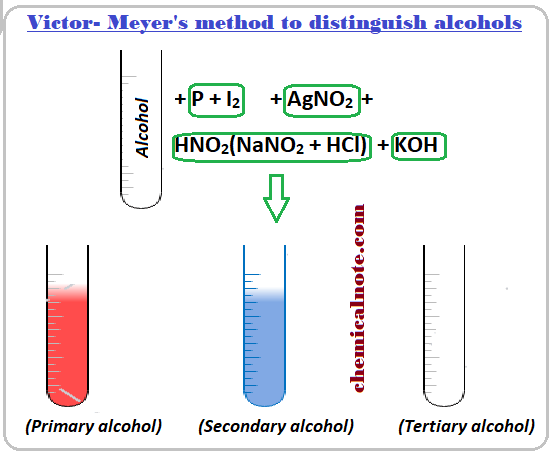
- Primary alcohol → oxidised (orange → green)
- Secondary alcohol → oxidised (orange → green)
- Tertiary alcohol → no reaction (no colour change)
Primary alcohol oxidation:
\( \mathrm{RCH_2OH \rightarrow RCHO \rightarrow RCOOH} \)
Secondary alcohol oxidation:
\( \mathrm{R_2CHOH \rightarrow R_2CO} \)
Tertiary alcohols are not oxidised under these conditions.
Example
A colour change from orange to green is observed when an alcohol is warmed with acidified potassium dichromate(VI). What types of alcohol could be present?
▶️ Answer / Explanation
The colour change indicates oxidation.
Primary and secondary alcohols are oxidised.
The alcohol cannot be tertiary.
Example
A diol reacts with acidified potassium dichromate(VI) showing an orange to green colour change. Explain what this indicates about the –OH groups present.
▶️ Answer / Explanation
The colour change shows that at least one –OH group is oxidised.
Therefore at least one of the alcohol groups is primary or secondary.
A tertiary alcohol group would not give this colour change.
Test for the CH3CH(OH)– Group: Iodoform Reaction
Alcohols containing the CH3CH(OH)– group can be identified using the iodoform test. This is a characteristic reaction of certain secondary alcohols.

Reagent
The reagent used is alkaline iodine, \( \mathrm{I_2(aq)} \) with sodium hydroxide.
Observation
A yellow precipitate of tri-iodomethane, \( \mathrm{CHI_3} \), is formed.
Meaning of a Positive Test
A positive iodoform test for an alcohol indicates the presence of a CH3CH(OH)– group, with the general structure \( \mathrm{CH_3CH(OH){-}R} \).
During the reaction, the alcohol is oxidised to a carbonyl compound, which then undergoes the iodoform reaction.
Reaction
The reaction produces tri-iodomethane and a carboxylate ion, \( \mathrm{RCO_2^-} \).
General equation:
\( \mathrm{CH_3CH(OH){-}R + 3I_2 + 4OH^- \rightarrow CHI_3 + RCO_2^- + 3I^- + 3H_2O} \)
Only alcohols containing the CH3CH(OH)– group give this reaction. Other primary and tertiary alcohols give no yellow precipitate.
Examples That Give a Positive Test
- Ethanol, \( \mathrm{CH_3CH_2OH} \)
- Propan-2-ol, \( \mathrm{CH_3CH(OH)CH_3} \)
Example
An alcohol gives a yellow precipitate when warmed with alkaline iodine. What structural feature must be present?
▶️ Answer / Explanation
The yellow precipitate is tri-iodomethane.
This indicates a positive iodoform test.
The alcohol must contain a CH3CH(OH)– group.
Example
An organic compound gives a positive 2,4-DNPH test only after oxidation and also produces a yellow precipitate with alkaline iodine. Deduce the nature of the alcohol present.
▶️ Answer / Explanation
The positive iodoform test indicates the presence of a CH3CH(OH)– group.
The need for oxidation before the 2,4-DNPH test shows the compound is an alcohol.
The alcohol must therefore be a secondary alcohol containing a CH3CH(OH)– group.