
Entropy
Entropy, \( \mathrm{S} \), is a measure of the degree of disorder in a system.
Definition of Entropy, \( \mathrm{S} \)
Entropy is defined as the number of possible arrangements of the particles and their energy in a given system.

A system with more possible arrangements has a higher entropy.
Entropy increases when:
- A solid changes to a liquid or gas
- A liquid changes to a gas
- The number of particles increases
- A gas expands or is formed from solids or liquids
Example
Explain why a gas has a higher entropy than a solid.
▶️ Answer / Explanation
Particles in a gas are free to move randomly.
They have many more possible arrangements of position and energy.
A solid has particles fixed in a regular lattice with fewer arrangements.
Example
Using the definition of entropy, explain why entropy increases when ammonium chloride sublimes.
▶️ Answer / Explanation
During sublimation, solid ammonium chloride forms gaseous particles.
The gaseous particles have greater freedom of movement.
There are many more possible arrangements of particles and energy.
This leads to an increase in entropy.
Predicting the Sign of Entropy Changes
The sign of an entropy change, \( \mathrm{\Delta S} \), can be predicted by considering changes in the number of possible arrangements of particles and their energy.
(a) Entropy Change During a Change of State
Entropy increases when matter changes from a more ordered state to a less ordered state.

- Melting (solid → liquid): \( \mathrm{\Delta S > 0} \)
- Boiling (liquid → gas): \( \mathrm{\Delta S > 0} \)
- Dissolving: usually \( \mathrm{\Delta S > 0} \)
In these processes, particles become more free to move and have more possible arrangements.
The reverse processes lead to a decrease in entropy:
- Freezing (liquid → solid): \( \mathrm{\Delta S < 0} \)
- Condensation (gas → liquid): \( \mathrm{\Delta S < 0} \)
- Crystallisation from solution: \( \mathrm{\Delta S < 0} \)
(b) Entropy Change During a Temperature Change
An increase in temperature leads to an increase in entropy.

Particles have a wider range of possible energy values at higher temperatures, so there are more possible arrangements of energy.
A decrease in temperature results in a decrease in entropy.
(c) Entropy Change in Reactions Involving Gases
Entropy change depends strongly on the number of gaseous molecules.
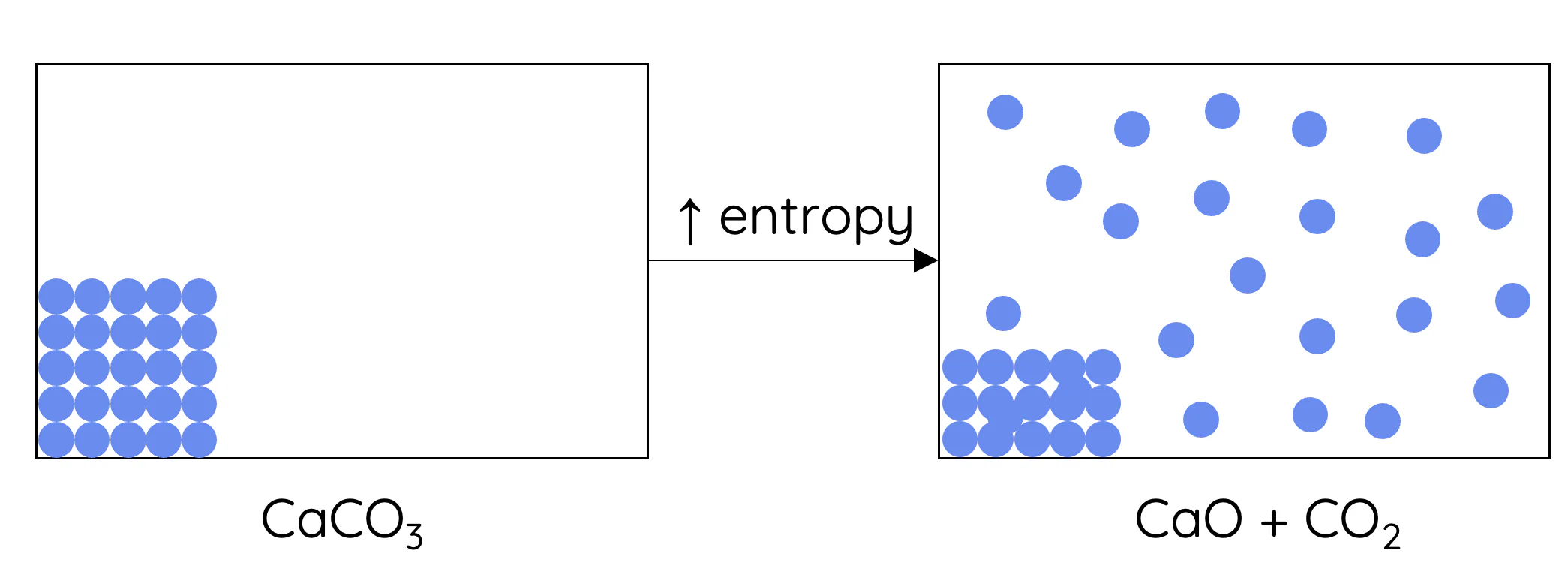
- If the number of gaseous molecules increases, \( \mathrm{\Delta S > 0} \)
- If the number of gaseous molecules decreases, \( \mathrm{\Delta S < 0} \)
- If there is no change, \( \mathrm{\Delta S} \) is likely to be small
More gas particles means more freedom of movement and more possible arrangements.
Example
Predict the sign of the entropy change when liquid ethanol boils.
▶️ Answer / Explanation
The entropy change is positive.
Ethanol changes from a liquid to a gas.
Gas particles have more freedom of movement and more possible arrangements.
Example
Predict and explain the sign of the entropy change for the reaction:
\( \mathrm{N_2(g) + 3H_2(g) \rightarrow 2NH_3(g)} \)
▶️ Answer / Explanation
The entropy change is negative.
The number of gaseous molecules decreases from four to two.
This reduces the number of possible arrangements of particles and energy.