
Conjugate Acids and Conjugate Bases
Brønsted–Lowry acid–base reactions involve the transfer of protons. The terms conjugate acid and conjugate base are used to describe species related by the loss or gain of a proton.
Definitions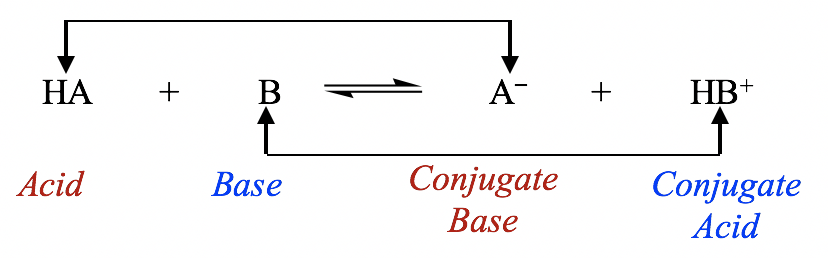
A conjugate acid is the species formed when a base gains a proton.
A conjugate base is the species formed when an acid loses a proton.
An acid–base pair that differs by one proton is called a conjugate acid–base pair.
General Representation
For an acid:
\( \mathrm{HA \rightleftharpoons H^+ + A^-} \)
• \( \mathrm{HA} \) is the acid • \( \mathrm{A^-} \) is its conjugate base
For a base:
\( \mathrm{B + H^+ \rightleftharpoons BH^+} \)
• \( \mathrm{B} \) is the base • \( \mathrm{BH^+} \) is its conjugate acid
Example
Identify the conjugate acid–base pairs in the reaction:
\( \mathrm{NH_3(aq) + H_2O(l) \rightleftharpoons NH_4^+(aq) + OH^-(aq)} \)
▶️ Answer / Explanation
\( \mathrm{NH_3} \) is a base and gains a proton to form \( \mathrm{NH_4^+} \).
\( \mathrm{NH_4^+} \) is the conjugate acid of ammonia.
\( \mathrm{H_2O} \) is an acid and loses a proton to form \( \mathrm{OH^-} \).
\( \mathrm{OH^-} \) is the conjugate base of water.
Example
For the reaction:
\( \mathrm{HSO_4^-(aq) + H_2O(l) \rightleftharpoons SO_4^{2-}(aq) + H_3O^+(aq)} \)
Identify the acid, base, conjugate acid and conjugate base.
▶️ Answer / Explanation
\( \mathrm{HSO_4^-} \) donates a proton and acts as the acid.
\( \mathrm{SO_4^{2-}} \) is its conjugate base.
\( \mathrm{H_2O} \) accepts a proton and acts as the base.
\( \mathrm{H_3O^+} \) is the conjugate acid of water.
Conjugate Acid–Base Pairs
In Brønsted–Lowry acid–base chemistry, acids and bases are related to each other by the transfer of a proton. These related species are described as conjugate acid–base pairs.
Definition
A conjugate acid–base pair consists of two species that differ by one proton (H⁺).
• The acid loses a proton to form its conjugate base
• The base gains a proton to form its conjugate acid
General Representation
For an acid:
\( \mathrm{HA \rightleftharpoons H^+ + A^-} \)
\( \mathrm{HA} \) and \( \mathrm{A^-} \) form a conjugate acid–base pair.
For a base:
\( \mathrm{B + H^+ \rightleftharpoons BH^+} \)
\( \mathrm{B} \) and \( \mathrm{BH^+} \) form a conjugate acid–base pair.
Identifying Conjugate Acid–Base Pairs in Reactions
- Find the species that loses a proton (the acid)
- Find the species that gains a proton (the base)
- Match each species with the form that differs by one H⁺
Example
Identify the conjugate acid–base pairs in the reaction:
\( \mathrm{HCl(aq) + H_2O(l) \rightarrow Cl^-(aq) + H_3O^+(aq)} \)
▶️ Answer / Explanation
\( \mathrm{HCl} \) donates a proton and acts as the acid.
\( \mathrm{Cl^-} \) is the conjugate base of \( \mathrm{HCl} \).
\( \mathrm{H_2O} \) accepts a proton and acts as the base.
\( \mathrm{H_3O^+} \) is the conjugate acid of \( \mathrm{H_2O} \).
Conjugate pairs: \( \mathrm{HCl/Cl^-} \) and \( \mathrm{H_2O/H_3O^+} \).
Example
Identify all conjugate acid–base pairs in the reaction:
\( \mathrm{NH_4^+(aq) + OH^-(aq) \rightleftharpoons NH_3(aq) + H_2O(l)} \)
▶️ Answer / Explanation
\( \mathrm{NH_4^+} \) donates a proton and is the acid.
\( \mathrm{NH_3} \) is its conjugate base.
\( \mathrm{OH^-} \) accepts a proton and is the base.
\( \mathrm{H_2O} \) is the conjugate acid of \( \mathrm{OH^-} \).
Conjugate pairs: \( \mathrm{NH_4^+/NH_3} \) and \( \mathrm{OH^-/H_2O} \).
pH and Acid–Base Equilibrium Constants
The strength of acids and the acidity of solutions are described quantitatively using pH, acid dissociation constants, and the ionic product of water.
(a) pH

pH is defined mathematically as:
\( \mathrm{pH = -\log[H^+]} \)
where \( \mathrm{[H^+]} \) is the hydrogen ion concentration in \( \mathrm{mol\,dm^{-3}} \).
This equation can be rearranged to calculate hydrogen ion concentration:
\( \mathrm{[H^+] = 10^{-pH}} \)
(b) Acid Dissociation Constant, \( \mathrm{K_a} \)
For a weak acid:
\( \mathrm{HA(aq) + H_2O(l) \rightleftharpoons H_3O^+(aq) + A^-(aq)} \)
The acid dissociation constant is defined as:
\( \mathrm{K_a = \dfrac{[H^+][A^-]}{[HA]}} \)
A larger value of \( \mathrm{K_a} \) indicates a stronger acid.
(c) \( \mathrm{pK_a} \)
The term \( \mathrm{pK_a} \) is defined mathematically as:
\( \mathrm{pK_a = -\log K_a} \)
A smaller value of \( \mathrm{pK_a} \) corresponds to a stronger acid.
(d) Ionic Product of Water, \( \mathrm{K_w} \)
The ionic product of water is defined as:
\( \mathrm{K_w = [H^+][OH^-]} \)
At \( \mathrm{298\ K} \):
\( \mathrm{K_w = 1.0 \times 10^{-14}} \)
Example
Calculate the pH of a solution with \( \mathrm{[H^+] = 2.5 \times 10^{-3}\ mol\,dm^{-3}} \).
▶️ Answer / Explanation
Use the definition of pH:
\( \mathrm{pH = -\log(2.5 \times 10^{-3})} \)
\( \mathrm{pH = 2.60} \)
Example
A weak acid has a \( \mathrm{K_a} \) value of \( \mathrm{1.8 \times 10^{-5}} \). Calculate its \( \mathrm{pK_a} \).
▶️ Answer / Explanation
Use the definition of \( \mathrm{pK_a} \):
\( \mathrm{pK_a = -\log(1.8 \times 10^{-5})} \)
\( \mathrm{pK_a = 4.74} \)
This value indicates a weak acid.
Buffer Solutions
Buffer solutions are essential in chemistry and biology because they resist changes in pH when small amounts of acid or alkali are added.
(a) Definition of a Buffer Solution
A buffer solution is a solution that resists changes in pH when small amounts of acid or alkali are added.
(b) Preparation of a Buffer Solution
A buffer solution is made by mixing:
- a weak acid and its conjugate base (usually as a salt)
- or a weak base and its conjugate acid
Examples:
- Ethanoic acid and sodium ethanoate
- Ammonia solution and ammonium chloride
(c) How Buffer Solutions Control pH
Buffer action depends on the presence of large concentrations of a weak acid and its conjugate base.
Consider an acidic buffer made from ethanoic acid and ethanoate ions:
\( \mathrm{CH_3COOH(aq) \rightleftharpoons H^+(aq) + CH_3COO^-(aq)} \)
Response to added acid
Added hydrogen ions are removed by reaction with the conjugate base:
\( \mathrm{H^+(aq) + CH_3COO^-(aq) \rightarrow CH_3COOH(aq)} \)
Response to added alkali
Added hydroxide ions react with the weak acid:
\( \mathrm{OH^-(aq) + CH_3COOH(aq) \rightarrow CH_3COO^-(aq) + H_2O(l)} \)
In both cases, the pH changes only slightly.
(d) Uses of Buffer Solutions
Buffer solutions are used:

- to maintain constant pH in biological systems
- in enzymatic reactions, where pH affects enzyme activity
- in industrial processes and laboratory solutions
The bicarbonate buffer system in blood
Blood pH is maintained at about 7.4 by the hydrogencarbonate (bicarbonate) buffer system.
\( \mathrm{CO_2(aq) + H_2O(l) \rightleftharpoons H_2CO_3(aq)} \)
\( \mathrm{H_2CO_3(aq) \rightleftharpoons H^+(aq) + HCO_3^-(aq)} \)
• Added \( \mathrm{H^+} \) is removed by \( \mathrm{HCO_3^-} \)
• Added \( \mathrm{OH^-} \) reacts with \( \mathrm{H_2CO_3} \)
This system prevents dangerous changes in blood pH.
Example
Explain how a buffer made from ethanoic acid and sodium ethanoate resists an increase in pH when sodium hydroxide is added.
▶️ Answer / Explanation
The hydroxide ions react with ethanoic acid.
\( \mathrm{OH^- + CH_3COOH \rightarrow CH_3COO^- + H_2O} \)
The added OH⁻ is removed, so the pH increases only slightly.
Example
Explain how the hydrogencarbonate buffer system controls the pH of blood when excess hydrogen ions are produced during exercise.
▶️ Answer / Explanation
Hydrogen ions combine with hydrogencarbonate ions.
\( \mathrm{H^+ + HCO_3^- \rightarrow H_2CO_3} \)
Carbonic acid can then decompose to carbon dioxide and water.
This prevents a large decrease in blood pH.
Solubility Product, \( \mathrm{K_{sp}} \)
The solubility product, \( \mathrm{K_{sp}} \), is used to describe the extent to which a sparingly soluble ionic compound dissolves in water.
Definition of the Solubility Product
The solubility product, \( \mathrm{K_{sp}} \), is the equilibrium constant for the dissolution of a sparingly soluble salt, expressed in terms of the concentrations of the ions in solution.
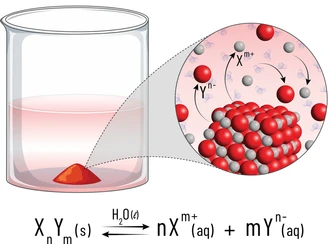
Only aqueous ions appear in the expression. Solid substances are omitted.
General Expression
For a salt \( \mathrm{A_{x}B_{y}(s)} \):
\( \mathrm{A_{x}B_{y}(s) \rightleftharpoons xA^{y+}(aq) + yB^{x-}(aq)} \)
The solubility product is:
\( \mathrm{K_{sp} = [A^{y+}]^x [B^{x-}]^y} \)
A smaller value of \( \mathrm{K_{sp}} \) indicates a less soluble salt.
Important Exam Rules
- \( \mathrm{K_{sp}} \) applies only to saturated solutions
- Units are not normally required
- \( \mathrm{K_{sp}} \) is constant at a given temperature
Example
Write the \( \mathrm{K_{sp}} \) expression for silver chloride.
\( \mathrm{AgCl(s) \rightleftharpoons Ag^+(aq) + Cl^-(aq)} \)
▶️ Answer / Explanation
\( \mathrm{K_{sp} = [Ag^+][Cl^-]} \)
Example
The solubility product of calcium fluoride is \( \mathrm{K_{sp} = 3.9 \times 10^{-11}} \). Write an expression for \( \mathrm{K_{sp}} \) and explain why calcium fluoride is only sparingly soluble.
\( \mathrm{CaF_2(s) \rightleftharpoons Ca^{2+}(aq) + 2F^-(aq)} \)
▶️ Answer / Explanation
The solubility product expression is:
\( \mathrm{K_{sp} = [Ca^{2+}][F^-]^2} \)
The very small value of \( \mathrm{K_{sp}} \) shows that only a small concentration of ions is present at equilibrium.
This indicates that calcium fluoride is sparingly soluble.
Writing an Expression for the Solubility Product, \( \mathrm{K_{sp}} \)

The solubility product expression shows the relationship between the concentrations of ions in a saturated solution of a sparingly soluble salt.
General Rules
- Write the equilibrium equation for dissolution
- Include only aqueous ions in the expression
- Exclude solids completely
- Raise each concentration to the power of its stoichiometric coefficient
General Form
For a salt \( \mathrm{A_{x}B_{y}(s)} \):
\( \mathrm{A_{x}B_{y}(s) \rightleftharpoons xA^{y+}(aq) + yB^{x-}(aq)} \)
The solubility product expression is:
\( \mathrm{K_{sp} = [A^{y+}]^x [B^{x-}]^y} \)
The value of \( \mathrm{K_{sp}} \) applies only to a saturated solution at a fixed temperature.
Example
Write the solubility product expression for lead(II) chloride.
\( \mathrm{PbCl_2(s) \rightleftharpoons Pb^{2+}(aq) + 2Cl^-(aq)} \)
▶️ Answer / Explanation
\( \mathrm{K_{sp} = [Pb^{2+}][Cl^-]^2} \)
Example
Write the solubility product expression for aluminium hydroxide.
\( \mathrm{Al(OH)_3(s) \rightleftharpoons Al^{3+}(aq) + 3OH^-(aq)} \)
▶️ Answer / Explanation
\( \mathrm{K_{sp} = [Al^{3+}][OH^-]^3} \)
The solid aluminium hydroxide does not appear in the expression.
The Common Ion Effect
The common ion effect explains how the solubility of a sparingly soluble salt changes when one of its ions is already present in solution. This effect is interpreted using Le Chatelier’s principle and the solubility product, \( \mathrm{K_{sp}} \).
(a) Explaining the Common Ion Effect
The common ion effect is the reduction in solubility of an ionic compound when a solution already contains one of the ions produced on dissolution.

For a salt \( \mathrm{MX(s)} \):
\( \mathrm{MX(s) \rightleftharpoons M^+(aq) + X^-(aq)} \)
If extra \( \mathrm{X^-} \) ions are added from another source (e.g. a soluble salt), the equilibrium shifts to the left to oppose the increase in ion concentration.
As a result, less solid dissolves and the solubility decreases.
(b) Using \( \mathrm{K_{sp}} \) with a Common Ion
The value of \( \mathrm{K_{sp}} \) remains constant at a fixed temperature. When a common ion is present, the concentration of the other ion must decrease to maintain the same \( \mathrm{K_{sp}} \) value.
This allows calculation of solubility in the presence of a common ion.
Example
Silver chloride is less soluble in sodium chloride solution than in pure water. Explain this observation.
▶️ Answer / Explanation
Silver chloride dissociates as:
\( \mathrm{AgCl(s) \rightleftharpoons Ag^+(aq) + Cl^-(aq)} \)
Sodium chloride provides extra \( \mathrm{Cl^-} \) ions.
The equilibrium shifts to the left to oppose the increase in chloride ions.
This reduces the solubility of silver chloride.
Example
The solubility product of silver chloride is \( \mathrm{K_{sp} = 1.8 \times 10^{-10}} \).
Calculate the concentration of \( \mathrm{Ag^+} \) ions in a solution that contains \( \mathrm{0.100\ mol\,dm^{-3}} \) chloride ions.
\( \mathrm{AgCl(s) \rightleftharpoons Ag^+(aq) + Cl^-(aq)} \)
▶️ Answer / Explanation
Write the solubility product expression:
\( \mathrm{K_{sp} = [Ag^+][Cl^-]} \)
Substitute known values:
\( \mathrm{1.8 \times 10^{-10} = [Ag^+] \times 0.100} \)
Solve for \( \mathrm{[Ag^+]} \):
\( \mathrm{[Ag^+] = 1.8 \times 10^{-9}\ mol\,dm^{-3}} \)
The presence of the common chloride ion greatly reduces the solubility.