
Stereoisomerism in Transition Metal Complexes
Stereoisomerism occurs when compounds have the same structural formula but differ in the three-dimensional arrangement of atoms in space. Transition metal complexes commonly show stereoisomerism due to their fixed geometries and the presence of different ligands.
Types of Stereoisomerism in Complexes
- Geometrical (cis/trans) isomerism
- Optical isomerism
(a) Geometrical (cis/trans) Isomerism
Geometrical isomerism occurs when ligands occupy different positions relative to each other around the central metal ion.
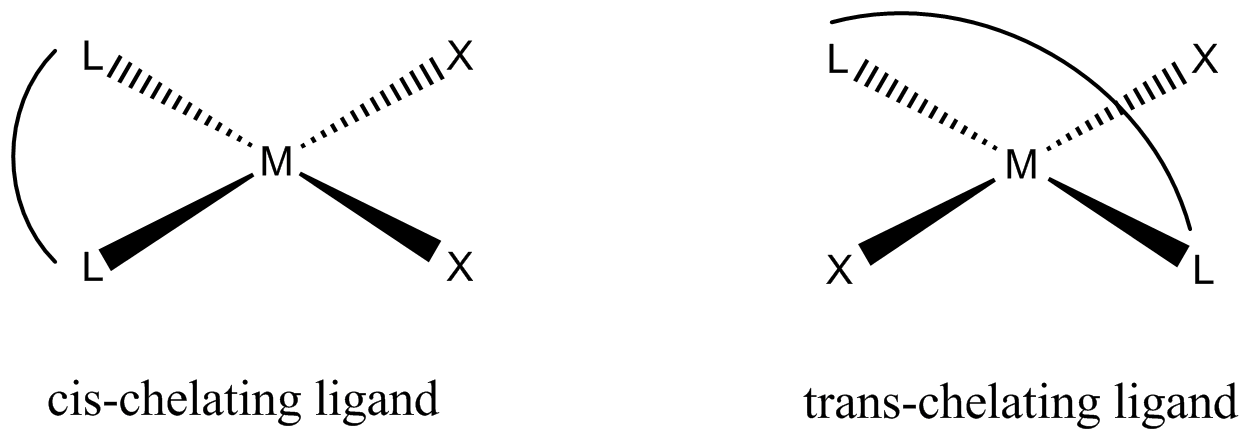
- cis → similar ligands adjacent (90° apart)
- trans → similar ligands opposite (180° apart)
Square Planar Complexes
Square planar complexes with the formula \( \mathrm{MA_2B_2} \) show cis/trans isomerism.
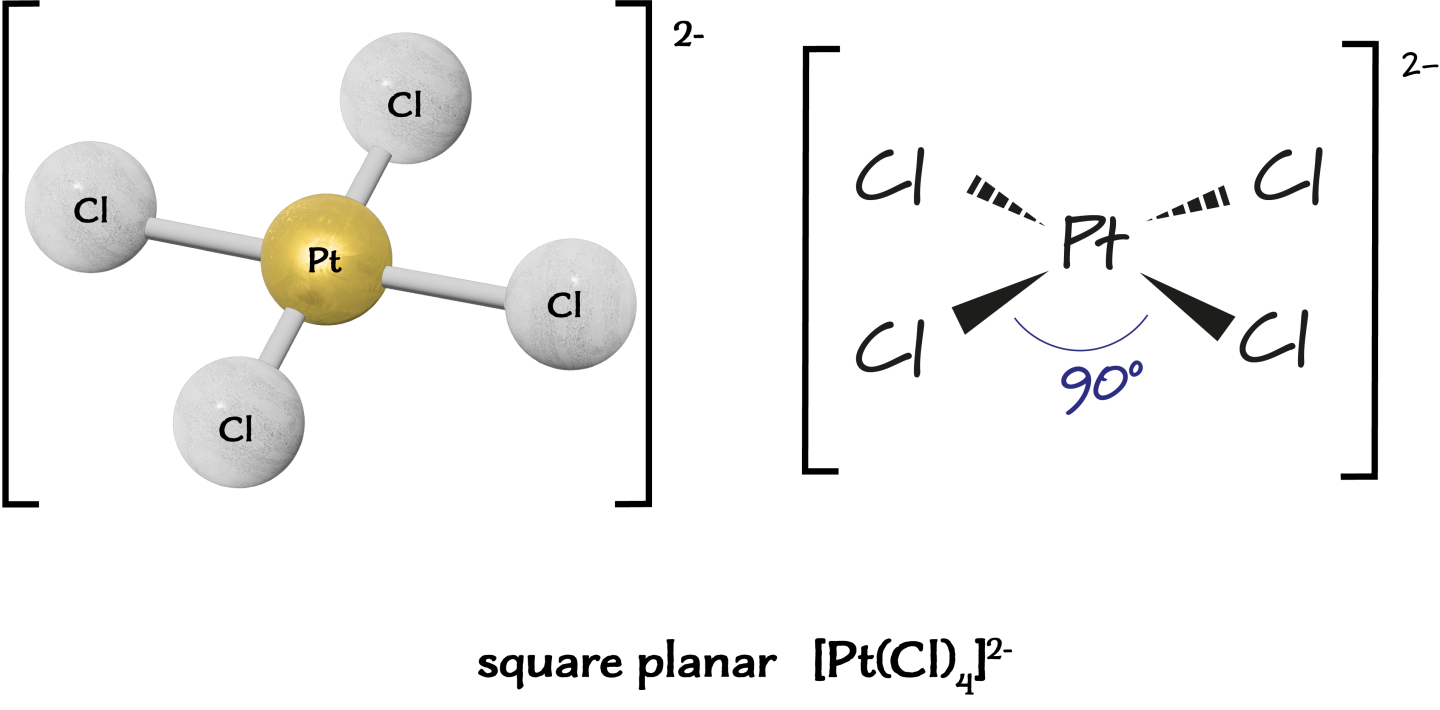
Example:
\( \mathrm{[Pt(NH_3)_2Cl_2]} \)
- cis-[Pt(NH₃)₂Cl₂] → two \( \mathrm{Cl^-} \) ligands adjacent
- trans-[Pt(NH₃)₂Cl₂] → two \( \mathrm{Cl^-} \) ligands opposite
Octahedral Complexes
Octahedral complexes can also show geometrical isomerism.

Example:
\( \mathrm{[Co(NH_3)_4(H_2O)_2]^{2+}} \)
- cis → two \( \mathrm{H_2O} \) ligands adjacent
- trans → two \( \mathrm{H_2O} \) ligands opposite
Geometrical Isomerism with Bidentate Ligands
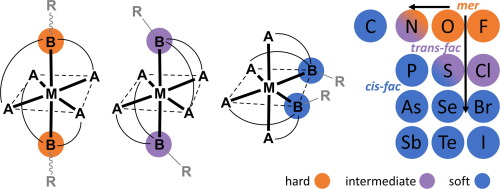
Bidentate ligands occupy two coordination sites and restrict ligand positions.
Example:
\( \mathrm{[Ni(en)_2(H_2O)_2]^{2+}} \)
- cis form exists
- trans form exists
Here, the two water ligands can be adjacent or opposite.
(b) Optical Isomerism
Optical isomerism occurs when a complex:
- Has no plane of symmetry
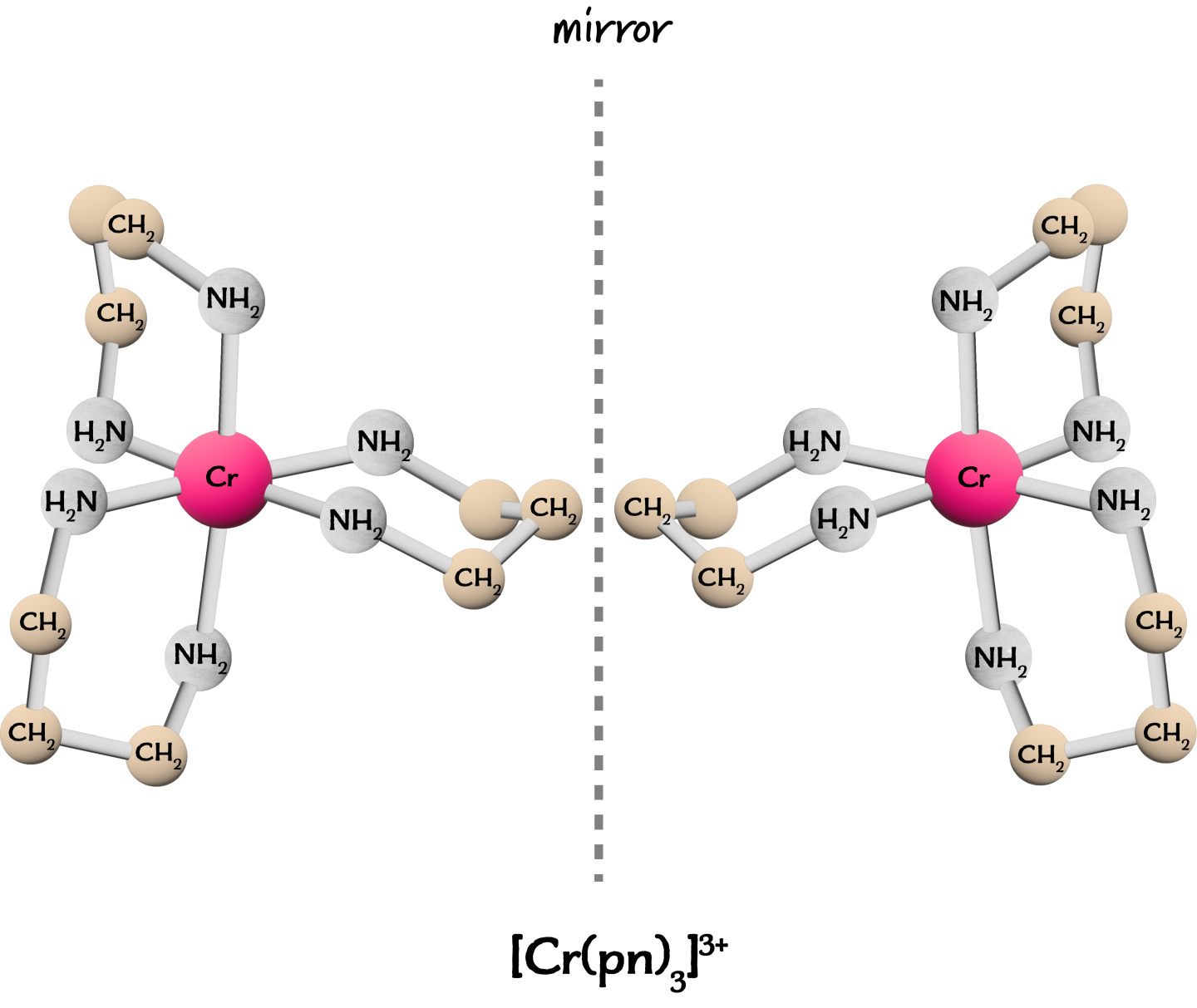
- Exists as non-superimposable mirror images (enantiomers)
Each optical isomer rotates plane-polarised light in opposite directions.
Optical Isomerism with Bidentate Ligands
Octahedral complexes containing only bidentate ligands often show optical isomerism.
Example:
\( \mathrm{[Ni(en)_3]^{2+}} \)
This complex exists as two optical isomers that are mirror images and cannot be superimposed.
Optical Isomerism with Mixed Ligands
Example:
\( \mathrm{[Ni(en)_2(H_2O)_2]^{2+}} \)
The cis form is optically active because it lacks a plane of symmetry. The trans form is not optically active.
Example
State the type of stereoisomerism shown by \( \mathrm{[Pt(NH_3)_2Cl_2]} \).
▶️ Answer / Explanation
It shows geometrical (cis/trans) isomerism.
Example
Explain why \( \mathrm{[Ni(en)_3]^{2+}} \) shows optical isomerism.
▶️ Answer / Explanation
The complex contains three bidentate ligands arranged octahedrally.
This arrangement has no plane of symmetry and exists as two non-superimposable mirror images.
Therefore, it shows optical isomerism.
Overall Polarity of Transition Metal Complexes
- The overall polarity of a transition metal complex depends on its three-dimensional shape and the arrangement of ligands around the central metal ion.
- Polarity is determined by whether the individual bond dipoles cancel out or reinforce each other.
Key Principle
- A complex is non-polar if it has a symmetrical arrangement of ligands so that bond dipoles cancel.
- A complex is polar if it has an unsymmetrical arrangement of ligands so that bond dipoles do not cancel.
(a) Complexes Showing Geometrical (cis/trans) Isomerism
Square Planar: \( \mathrm{[Pt(NH_3)_2Cl_2]} \)
- trans-[Pt(NH₃)₂Cl₂] is non-polar
- The two \( \mathrm{Cl^-} \) ligands are opposite each other
- Bond dipoles cancel due to symmetry
- cis-[Pt(NH₃)₂Cl₂] is polar
- The \( \mathrm{Cl^-} \) ligands are adjacent
- Dipoles do not cancel
Octahedral: \( \mathrm{[Co(NH_3)_4(H_2O)_2]^{2+}} \)
- trans isomer is non-polar
- Identical ligands are opposite each other, giving symmetry
- cis isomer is polar
- Unequal ligand arrangement leads to incomplete dipole cancellation
Octahedral with Bidentate Ligands: \( \mathrm{[Ni(en)_2(H_2O)_2]^{2+}} \)
- trans isomer is generally non-polar due to symmetry
- cis isomer is polar because ligand positions are unsymmetrical
(b) Complexes Showing Optical Isomerism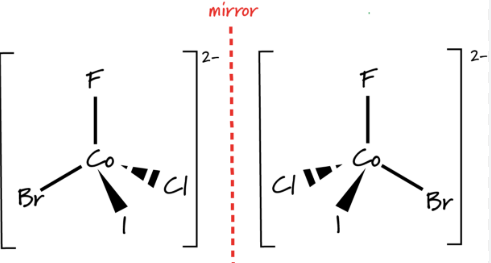
\( \mathrm{[Ni(en)_3]^{2+}} \)
- Contains three bidentate ligands arranged octahedrally
- Has no plane of symmetry
- Forms two optical isomers (enantiomers)
- Each optical isomer is polar
\( \mathrm{[Ni(en)_2(H_2O)_2]^{2+}} \)
- cis form is polar and optically active
- trans form is non-polar and optically inactive
Example
Deduce whether cis- or trans-\( \mathrm{[Pt(NH_3)_2Cl_2]} \) is polar.
▶️ Answer / Explanation
The cis isomer is polar because the ligand arrangement is unsymmetrical.
The trans isomer is non-polar because bond dipoles cancel.
Example
Explain why \( \mathrm{[Ni(en)_3]^{2+}} \) is polar.
▶️ Answer / Explanation
The complex has no plane of symmetry and exists as non-superimposable mirror images.
As a result, bond dipoles do not cancel and each optical isomer is polar.