
Dot-and-Cross Diagrams for Ionic, Covalent and Coordinate Bonding
Dot-and-cross diagrams show electrons involved in bonding. Electrons from one atom are drawn as dots, and electrons from the other atom are drawn as crosses. They are used to illustrate:
- Ionic bonding (transfer of electrons)
- Covalent bonding (sharing of electrons)
- Coordinate (dative) bonding (shared pair donated by one atom)
1. Dot-and-Cross Diagrams for Ionic Bonding
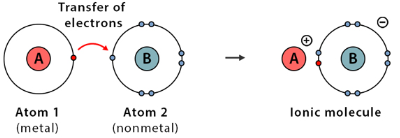
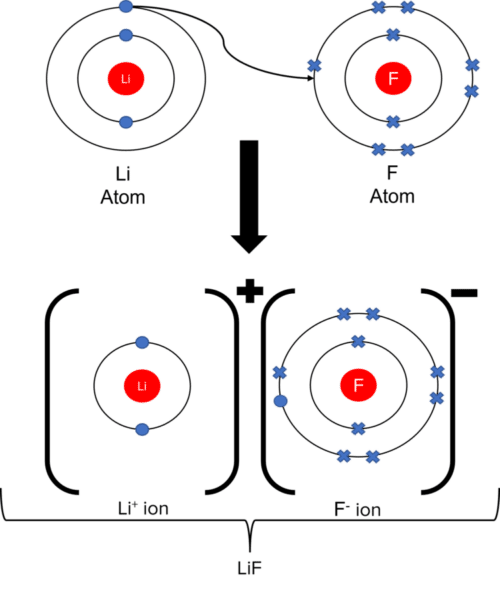
Ionic bonding occurs when electrons are transferred from a metal atom to a non-metal atom, forming oppositely charged ions.
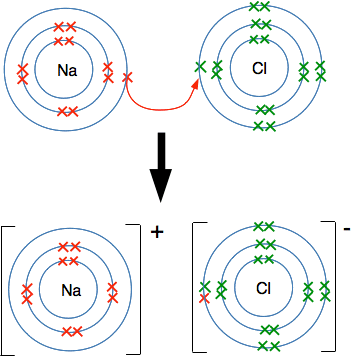
Example: Sodium Chloride, \( \mathrm{NaCl} \)
- Na loses 1 electron → \( \mathrm{Na^+} \)
- Cl gains 1 electron → \( \mathrm{Cl^-} \)
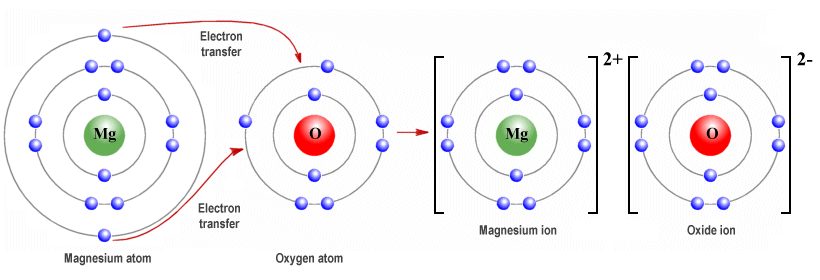
Example: Magnesium Oxide, \( \mathrm{MgO} \)
- Mg loses 2 electrons → \( \mathrm{Mg^{2+}} \)
- O gains 2 electrons → \( \mathrm{O^{2-}} \)
2. Dot-and-Cross Diagrams for Covalent Bonding
Covalent bonds form when atoms share pairs of electrons.

Example: Water, \( \mathrm{H_2O} \)
- Each H shares 1 electron with O.
- O has 2 lone pairs.

Example: Carbon Dioxide, \( \mathrm{CO_2} \) (double covalent bonds)

Example: Nitrogen, \( \mathrm{N_2} \) (triple covalent bond)

3. Dot-and-Cross Diagrams for Coordinate (Dative) Bonding

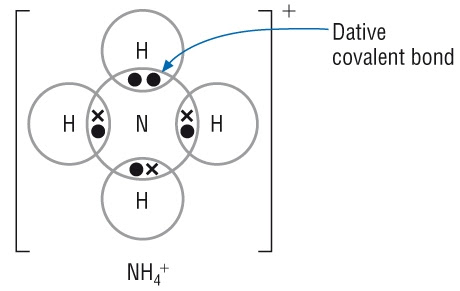
A coordinate bond is a covalent bond in which both electrons in the shared pair come from the same atom.
Example: Ammonium ion, \( \mathrm{NH_4^+} \)
Example: Hydronium ion, \( \mathrm{H_3O^+} \)

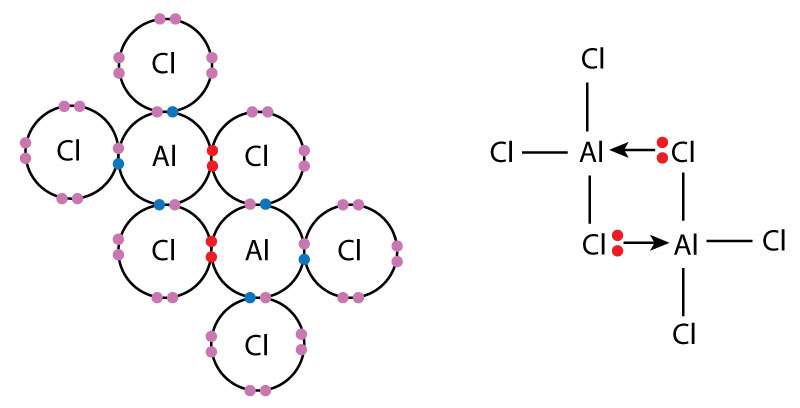
Example: Aluminium Chloride Dimer (\( \mathrm{Al_2Cl_6} \)) — expanded octet
Example
Draw a dot-and-cross diagram for \( \mathrm{LiF} \).
▶️ Answer / Explanation
Example
Draw a dot-and-cross diagram for methane, \( \mathrm{CH_4} \).
▶️ Answer / Explanation

Example
Draw a dot-and-cross diagram for the formation of \( \mathrm{NH_4^+} \).