
Predicting Properties of Elements Using Chemical Periodicity
Elements in the same group of the Periodic Table have similar chemical and physical properties. This is because they have the same number of electrons in their outer shell. As you go down a group, predictable trends occur due to increasing atomic radius and shielding.
Same group → same outer electron configuration → similar properties
Key Periodic Trends Down a Group
When predicting the properties of an element in a given group, consider the following trends:

- Atomic radius increases.
- First ionisation energy decreases.
- Electronegativity decreases.
- Metallic character increases (for groups containing metals).
- Reactivity may increase or decrease, depending on the group.
Using Group Trends to Predict Properties
1. Group 1 (Alkali Metals)

- Have one electron in the outer shell.
- Form \( \mathrm{M^+} \) ions.
- Reactivity increases down the group.
- Melting points decrease down the group.
- Soft metals and good electrical conductors.
2. Group 7 (Halogens)
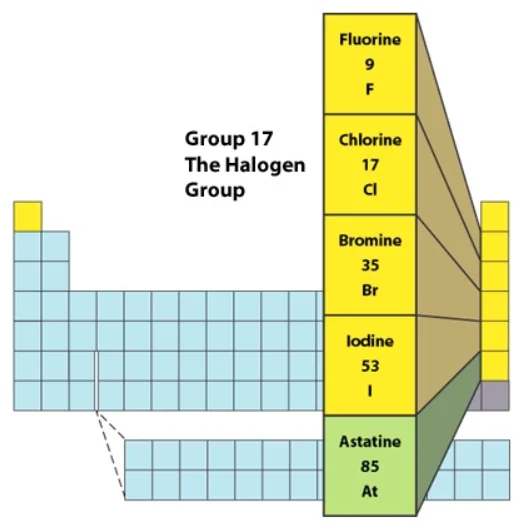
- Have seven electrons in the outer shell.
- Form \( \mathrm{X^-} \) ions.
- Reactivity decreases down the group.
- Melting and boiling points increase down the group.
- Poor electrical conductivity.
3. Group 0 (Noble Gases)

- Full outer electron shells.
- Very low reactivity.
- Exist as monatomic gases.
- Very low melting and boiling points.
General Prediction Strategy
To predict the properties of an unknown element in a group:
- Identify the group → find number of outer electrons.
- Use trends down the group (radius, ionisation energy, electronegativity).
- Compare with known elements above or below it.
Example
An element is in Group 1. Predict the charge of the ion it forms.
▶️ Answer / Explanation
Group 1 elements lose one outer electron and form \( \mathrm{M^+} \) ions with a +1 charge.
Example
Element X is below chlorine in Group 7. Predict how its reactivity compares with chlorine.
▶️ Answer / Explanation
Reactivity of Group 7 elements decreases down the group. Therefore, element X will be less reactive than chlorine.
Example
An unknown element Y is in Group 1 below potassium. Predict and explain its melting point, reactivity and ion formation.
▶️ Answer / Explanation
Down Group 1, atomic radius increases and ionisation energy decreases.
Element Y will:
- Have a lower melting point than potassium.
- Be more reactive than potassium.
- Form \( \mathrm{Y^+} \) ions by losing one outer electron.
These predictions follow from periodic trends in Group 1.
Deducing the Nature and Identity of Unknown Elements
The nature, position and possible identity of an unknown element can be deduced by analysing its physical and chemical properties. These properties reflect the element’s position in the Periodic Table and follow predictable periodic trends.
Observed properties → periodic trends → group → period → identity

1. Deducing the Nature of an Element
The first step is to decide whether the element is a metal, non-metal or noble gas.
- Metal: conducts electricity, shiny, forms positive ions.
- Non-metal: poor conductor, low melting point (except giant covalent), forms negative ions or covalent bonds.
- Noble gas: very low reactivity, monatomic gas, very low boiling point.
2. Deducing the Group
The group can often be deduced from chemical behaviour.
- Forms \( \mathrm{M^+} \) ions → likely Group 1.
- Forms \( \mathrm{X^-} \) ions → likely Group 7.
- Very unreactive → likely Group 0.
- Variable oxidation states, coloured compounds → transition metal.
3. Deducing the Period
The period can be inferred from atomic size, melting point and reactivity.
- Higher period → larger atomic radius.
- Lower ionisation energy → element is further down a group.
- Comparing reactivity with known elements gives relative position.
4. Deducing the Identity
Once the group and period are identified, the element can be matched with a specific element in the Periodic Table.
Group + Period → unique element
Summary Table: Key Clues
| Observed property | Deduction |
|---|---|
| Good electrical conductivity | Metal |
| Forms \( \mathrm{+1} \) ions | Group 1 |
| Forms \( \mathrm{-1} \) ions | Group 7 |
| Low reactivity, monatomic gas | Group 0 |
| Coloured compounds | Transition metal |
Example
An element is a poor conductor of electricity and forms \( \mathrm{Cl^-} \)-like ions. Deduce its group.
▶️ Answer / Explanation
The element forms negative ions and behaves like chlorine. It is therefore in Group 7.
Example
An element X conducts electricity, forms a \( \mathrm{X^+} \) ion and is more reactive than sodium. Deduce its group and relative position.
▶️ Answer / Explanation
Formation of \( \mathrm{X^+} \) indicates Group 1.
Being more reactive than sodium means it is below sodium in the group.
Therefore, X is a Group 1 element in a lower period than sodium.
Example
An element Y has a high melting point, forms coloured compounds, and exhibits variable oxidation states. Deduce the nature, position and a possible identity of Y.
▶️ Answer / Explanation
High melting point and good conductivity indicate a metal.
Coloured compounds and variable oxidation states are characteristic of transition metals.
Therefore, Y is a transition metal in the central block of the Periodic Table.
A possible identity could be \( \mathrm{Fe} \), \( \mathrm{Cu} \) or \( \mathrm{Ni} \), depending on the exact oxidation states and colours observed.