Question 1
▶️ Answer/Explanation
The phrase “input values of \(p\) increase without bound” corresponds to the limit as \(x \to \infty\).
The phrase “output values of \(p\) decrease without bound” corresponds to the limit equaling \(-\infty\).
Therefore, the condition is defined as \(\lim_{x \to \infty} p(x) = -\infty\).
Considering the leading term, \(\lim_{x \to \infty} (ax^n + b) = \lim_{x \to \infty} ax^n\).
Since \(n\) is a positive integer, \(x^n \to \infty\) as \(x\) increases.
For the product \(ax^n\) to approach \(-\infty\), the coefficient \(a\) must be negative.
Thus, the correct statement is that \(a\) is negative because \(\lim_{x \to \infty} p(x) = -\infty\).
Question 2
▶️ Answer/Explanation
Question 3

▶️ Answer/Explanation
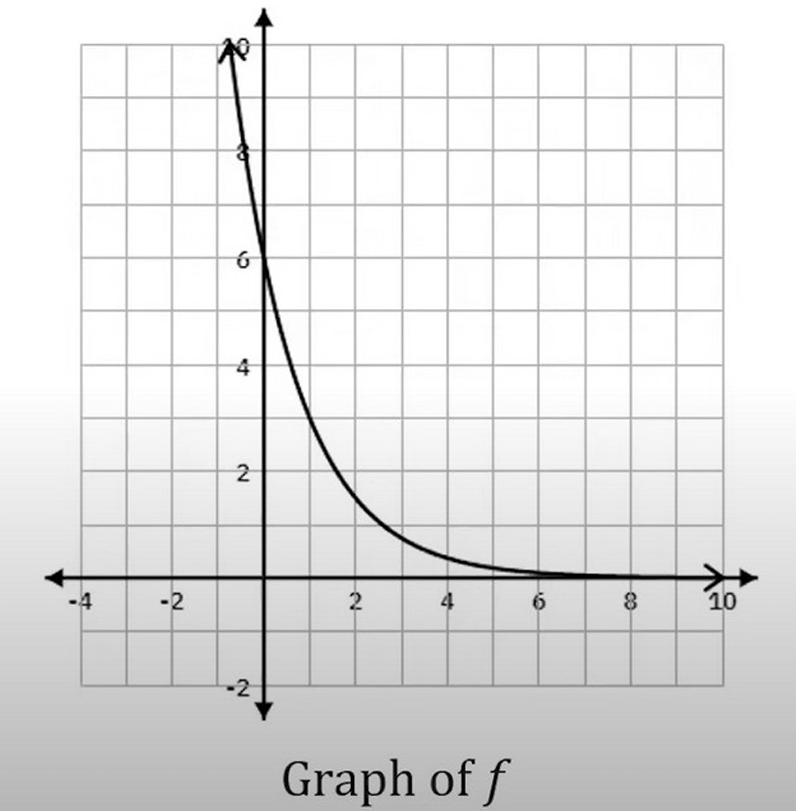
The function \(f\) is described as an exponential decay function with the \(x\)-axis as a horizontal asymptote.
Looking at the graph, as \(x\) moves to the right (\(x \to \infty\)), the curve approaches the x-axis, implying \(\lim_{x \to \infty} f(x) = 0\).
Looking at the left side of the graph, as \(x\) moves to the left (\(x \to -\infty\)), the curve goes up steeply.
This upward trend indicates that the function values increase without bound as \(x\) decreases.
Mathematically, this behavior is written as \(\lim_{x \to -\infty} f(x) = \infty\).
Comparing this result with the given choices, option (D) is the correct description.
Question 4

▶️ Answer/Explanation
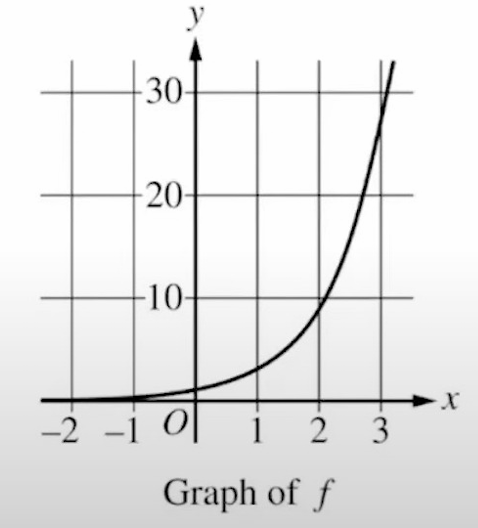
The correct option is (D).
Step 1: Analyze the given points on the graph to identify the function \(f(x)\). The points are \((1, 3)\), \((2, 9)\), and \((3, 27)\).
Step 2: Observe the exponential pattern: \(3^1 = 3\), \(3^2 = 9\), and \(3^3 = 27\). This indicates that the function is \(f(x) = 3^x\). This function has the \(x\)-axis as a horizontal asymptote.
Step 3: To find the inverse function, let \(y = f(x)\), so we have \(y = 3^x\).
Step 4: Interchange the variables \(x\) and \(y\) to solve for the inverse: \(x = 3^y\).
Step 5: Convert the exponential equation into logarithmic form. By definition, \(x = 3^y\) is equivalent to \(y = \log_3 x\).
Step 6: Therefore, the inverse function is \(f^{-1}(x) = \log_3 x\).

Question 5
▶️ Answer/Explanation
The correct option is (C).
First, apply the product property of logarithms: \( \log_b(mn) = \log_b m + \log_b n \).
Using this property on \( g(x) \), we get: \( g(x) = \log_2(8x) = \log_2 8 + \log_2 x \).
Next, evaluate the constant term: since \( 2^3 = 8 \), it follows that \( \log_2 8 = 3 \).
Substituting this value back into the equation gives: \( g(x) = 3 + \log_2 x \), or \( g(x) = 3 + f(x) \).
In function transformations, adding a constant \( k \) (where \( f(x) + k \)) results in a vertical translation.
Therefore, the graph of \( g \) is a vertical translation of the graph of \( f \) shifted up by 3 units.
Question 6

(B) 1
(C) 6
(D) 9
▶️ Answer/Explanation
The constant \( b \) determines the frequency and is related to the period \( P \) by the formula \( b = \frac{2\pi}{P} \).
To find the period, we identify the distance between two consecutive peaks (maximum values) in the data.
The first peak occurs at \( x = 4.5 \) with \( y = 7.02 \), and the next peak is at \( x = 13.5 \) with \( y = 7.04 \).
Calculating the difference gives the period: \( P = 13.5 – 4.5 = 9 \).
Now, we substitute \( P = 9 \) into the formula for \( b \): \( b = \frac{2\pi}{9} \).
Approximating \( \pi \approx 3.14 \), we get \( b \approx \frac{6.28}{9} \approx 0.698 \).
Rounding to the nearest option, the value is approximately \( 0.7 \).
Question 7
| \(t\) hours | \(0\) | \(3\) | \(6\) | \(9\) | \(12\) |
|---|---|---|---|---|---|
| \(y(t)\) inches | \(78\) | \(70\) | \(62\) | \(70\) | \(78\) |
▶️ Answer/Explanation
The maximum height is \(78\) and the minimum is \(62\), so the vertical shift (midline) is \(\frac{78 + 62}{2} = 70\) and amplitude is \(78 – 70 = 8\).
The function repeats its values from \(t=0\) to \(t=12\), so the period is \(12\).
The coefficient \(B\) is calculated as \(\frac{2\pi}{\text{Period}} = \frac{2\pi}{12} = \frac{\pi}{6}\). This eliminates options (A) and (C).
We test the point \(t=0\) (where \(y=78\)) on the remaining options to find the correct expression.
For option (D): \(8 \cos\left(\frac{\pi}{6}(0-3)\right) + 70 = 8 \cos\left(-\frac{\pi}{2}\right) + 70 = 0 + 70 = 70\) (Incorrect).
For option (B): \(-8 \sin\left(\frac{\pi}{6}(0-3)\right) + 70 = -8 \sin\left(-\frac{\pi}{2}\right) + 70 = -8(-1) + 70 = 78\) (Correct).
Therefore, the correct expression is (B).
Question 8
▶️ Answer/Explanation
The standard tangent function, \( y = \tan(x) \), has vertical asymptotes where the function is undefined, which is at \( x = \frac{\pi}{2} + \pi k \) for any integer \( k \).
For the function \( h(\theta) = \tan(3\theta) + 1 \), the argument is \( 3\theta \).
We set the argument equal to the asymptotic condition: \( 3\theta = \frac{\pi}{2} + \pi k \).
Solving for \( \theta \), we divide the entire equation by 3: \( \theta = \frac{1}{3}(\frac{\pi}{2} + \pi k) \).
This simplifies to \( \theta = \frac{\pi}{6} + \frac{\pi}{3}k \).
Comparing this result with the given options, it corresponds to statement (B).
