
Question
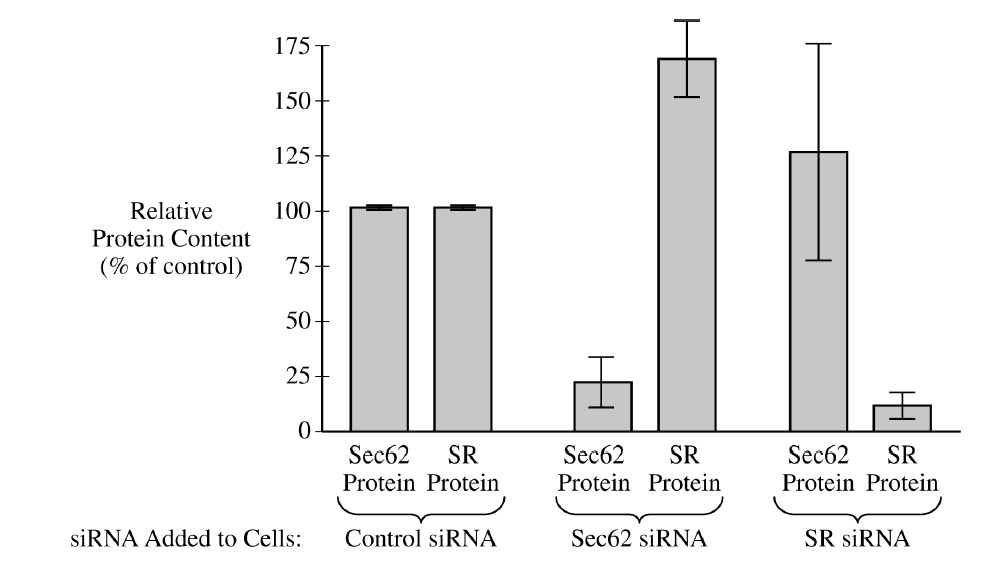
(i) Identify the dependent variable in the experiments shown in Figure \(1\).
(ii) Justify why the researchers included the control of measuring the relative amounts of both \( Sec62 \) and \( SR \) proteins in cells that were treated with \( Sec62 \) siRNA only.
(iii) Based on Figure \(1\), describe the effect on the production of \( SR \) protein when cells are treated with \( Sec62 \) siRNA.
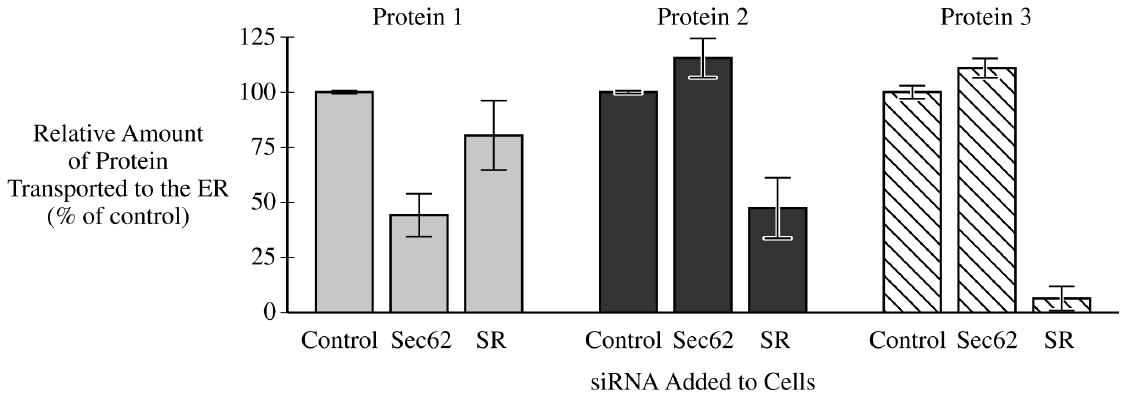
(i) Identify the independent variable in the researchers’ second experiment shown in Figure \(2\).
(ii) Based on Figure \(2\), identify the protein(s) that when treated with \( Sec62 \) siRNA showed an increase in percent transport to the \( ER \) compared with the control.
(iii) Protein \(1\) is encoded by \(234\) nucleotides, while protein \(2\) is encoded by \(495\) nucleotides. Assuming all nucleotides encode amino acids, calculate the difference in the number of amino acids between the two proteins.
(i) Researchers claim that protein \(1\) is the only tested protein that is transported to the \( ER \) following its complete translation in the cytosol. Using data from Figure \(2\), support the researchers’ claim.
(ii) For any protein that enters the \( ER \), researchers claim that amino acids close to the protein’s amino terminus determine how likely the protein is to pass through the protein channel within the ER membrane. Justify this claim.
Most-appropriate topic codes (AP Biology 2025):
• Topic 2.1 — Cell Structure and Function: Role of ribosomes, rough \( ER \), and protein transport pathways — context and parts (A), (D)(i)
• Topic 2.4 — Membrane Permeability: Passage of proteins through channels in the ER membrane — part (D)(ii)
• Topic 2.6 — Facilitated Diffusion / Transport Proteins: Movement of molecules or proteins through membrane transport channels — part (D)(ii)
• Topic 1.7 — Structure and Function of Proteins: Effect of amino-acid polarity and charge on interactions with protein channels — part (D)(ii)
• Science Practice 3 — Experimental Variables: Identification of independent and dependent variables and experimental controls — parts (B)(i), (B)(ii), (C)(i)
• Science Practice 4 — Data Analysis: Interpretation of experimental graphs and comparison of treatments — parts (B)(iii), (C)(ii), (D)(i)
• Science Practice 5 — Mathematical Reasoning: Calculation of amino-acid numbers from nucleotide sequence data — part (C)(iii)
▶️ Answer/Explanation
(A)
Ribosomes synthesize polypeptides or proteins.
Ribosomes perform translation by reading mRNA sequences.
They are the cellular structures where amino acids are assembled into a polypeptide chain.
Summary: Ribosomes convert genetic information in mRNA into a protein.
(B)
(i) The dependent variable is the relative amount of protein or protein content measured in the cells.
(ii) The control allowed researchers to determine whether the \( Sec62 \) siRNA reduced or affected the amount of both proteins compared with the control treatment.
It also allowed them to determine whether the \( Sec62 \) siRNA specifically reduced the amount of \( Sec62 \) protein only.
Using a control ensures that changes in protein levels are caused by the siRNA treatment rather than other experimental variables.
(iii) The production of \( SR \) protein increased when cells were treated with \( Sec62 \) siRNA.
From the graph, the increase is approximately \(65\%\) compared with the control (acceptable range \(50\%\)–\(80\%\)).
(C)
(i) The independent variable is the type of siRNA added to the cells.
Another acceptable answer is the type of protein whose ER transport was measured.
(ii) Proteins \(2\) and \(3\) showed an increase in percent transport to the \( ER \) when treated with \( Sec62 \) siRNA compared with the control.
(iii) Each amino acid is encoded by \(3\) nucleotides.
Protein \(1\): \( \frac{234}{3}=78 \) amino acids.
Protein \(2\): \( \frac{495}{3}=165 \) amino acids.
Difference \( =165-78=87 \) amino acids.
\[ \boxed{87\ \text{amino acids}} \]
(D)
(i) Only protein \(1\) showed a reduced percentage of transport to the \( ER \) when cells were treated with \( Sec62 \) siRNA.
Proteins \(2\) and \(3\) did not decrease under this treatment.
Therefore the data support that protein \(1\) is transported to the ER after translation in the cytosol.
(ii) Amino acids near the amino terminus influence whether a protein can pass through the protein channel in the ER membrane.
Amino acids with similar polarity or opposite charge to the \(R\)-groups lining the channel interact more favorably and are more likely to pass through the channel.
Amino acids with similar charge or dissimilar polarity interact less favorably and therefore are less likely to pass through the channel.