Home / AP Biology 5.1 Meiosis- Exam Style questions – FRQs

AP Biology 5.1 Meiosis- Exam Style questions - FRQs- New Syllabus

Question

The ald gene of fruit flies encodes the ALD protein, which is associated with both the centromeres of chromosomes and protein filaments produced during meiosis. In the absence of functional ALD proteins, gamete-producing cells enter anaphase \( I \) before homologous chromosomes are correctly aligned. As a result, the gametes produced do not contain the correct numbers of chromosomes.
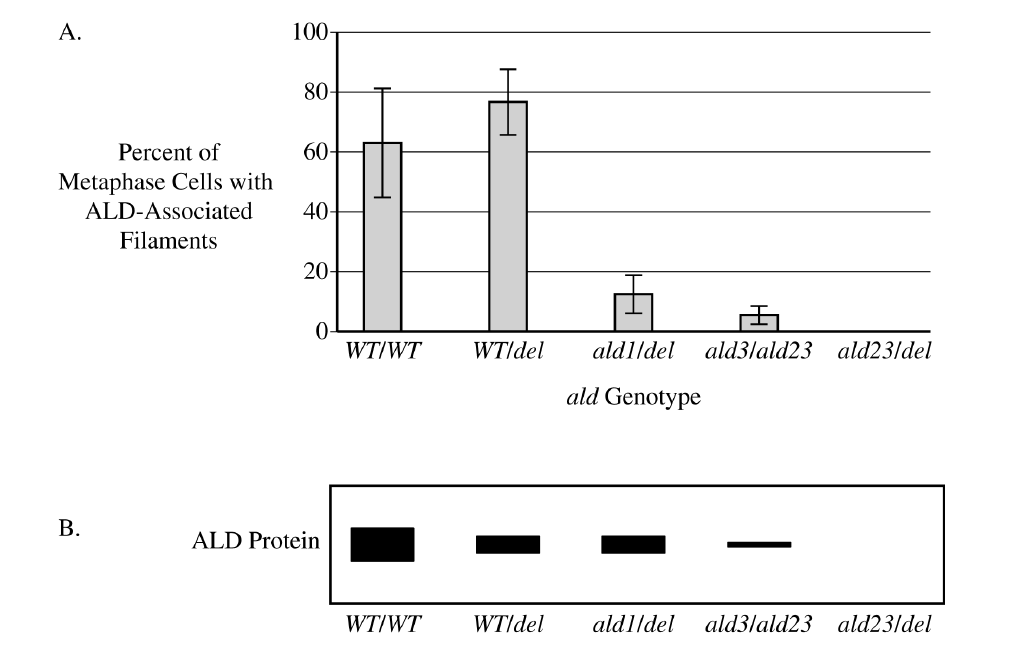
Scientists generated four mutations in the ald gene: ald1, ald3, ald23, and del, where del was a deletion of the gene. To study the role of the ALD protein in meiosis, scientists used gamete-forming metaphase cells from groups of flies with different ald genotypes. Some of the flies were homozygous for the wild-type allele of ald: \( WT/WT \). Other flies were heterozygous for different ald alleles: \( WT/del \), \( ald1/del \), \( ald3/ald23 \), and \( ald23/del \). The scientists measured the percent of metaphase cells that contained ALD-associated filaments \( (\text{Figure }1A) \) and the amount of ALD protein produced by each cell type \( (\text{Figure }1B) \).

Figure \(1\). (A) The average percent of gamete-forming metaphase cells that contained filaments associated with ALD and (B) the amount of ALD protein produced by each cell type. A thicker band indicates a greater amount of ALD protein.
(A) Based on Figure \(1A\), identify the fly genotype in which the average percent of metaphase cells with ALD-associated filaments is close to \(12\%\).
(B) Based on Figure \(1B\), describe the difference in ALD protein production between gamete-forming metaphase cells of flies with the genotype \( ald3/ald23 \) and flies with the genotype \( ald23/del \).
(C) Scientists hypothesize that gamete-forming metaphase cells can produce a normal amount of ALD-associated filaments even when they produce about half as much ALD protein as the wild-type cells produce. Use the data in Figures \(1A\) and \(1B\) to support the scientists’ hypothesis.
(D) For gamete-forming metaphase cells of the \( WT/del \) and \( ald1/del \) flies, explain why the phenotypes observed in Figure \(1A\) differ even though the amount of ALD protein produced \( (\text{Figure }1B) \) does not.

Most-appropriate topic codes (AP Biology 2025):

Topic 5.1 — Meiosis: Chromosome alignment and centromere-associated proteins are important for correct chromosome separation — context and part (D)
Topic 5.3 — Mendelian Genetics: Different genotypes can produce different phenotypes depending on allele function — parts (A), (B), (D)
Topic 6.5 — Regulation of Gene Expression: Phenotype depends on the amount and functionality of the gene product — parts (B), (C), (D)
Science Practice 4 — Representing and Describing Data: Interpreting graphs and band intensity to identify genotype differences — parts (A), (B)
Science Practice 6 — Argumentation: Using evidence from figures to support a hypothesis and explain phenotypic differences — parts (C), (D)
▶️ Answer/Explanation

(A)
The genotype is \( ald1/del \).
From Figure \(1A\), this genotype shows a value close to \(12\%\) of metaphase cells with ALD-associated filaments.

(B)
More ALD protein is produced by \( ald3/ald23 \) cells than by \( ald23/del \) cells.
Less ALD protein is produced by \( ald23/del \) cells than by \( ald3/ald23 \) cells.
No ALD protein is produced by \( ald23/del \) cells, whereas ALD protein is produced by \( ald3/ald23 \) cells.
Summary: Figure \(1B\) shows a visible band for \( ald3/ald23 \) but no band for \( ald23/del \).

(C)
With about half as much protein, the \( WT/del \) cells show no difference in the percent of gamete-forming metaphase cells with ALD-associated filaments compared with the \( WT/WT \) cells.
The data for \( WT/del \), relative to or in comparison with the \( WT/WT \) cells, support the scientists’ hypothesis.
This suggests that half the normal amount of functional ALD protein can still produce a normal filament phenotype.

(D)
The phenotypes differ because only the \( WT/del \) flies produce enough functional ALD protein to generate a wild-type phenotype.
When one allele encodes functional ALD protein \( (\text{in } WT/del \text{ flies}) \), the flies can generate a wild-type phenotype and produce ALD-associated filaments similar to \( WT/WT \) flies.
Both genotypes produce ALD protein, but the ald1 mutation produces a protein with reduced function compared with the wild-type protein.
Summary: the amount of protein is similar, but the functionality of the protein differs.

Scroll to Top