
8.3.A – Population Ecology
📌 What is Population Ecology?
- Population ecology studies how and why populations change in size and structure over time.
- A population = a group of individuals of the same species living in the same area.
📈 Key Factors That Influence Population Growth:
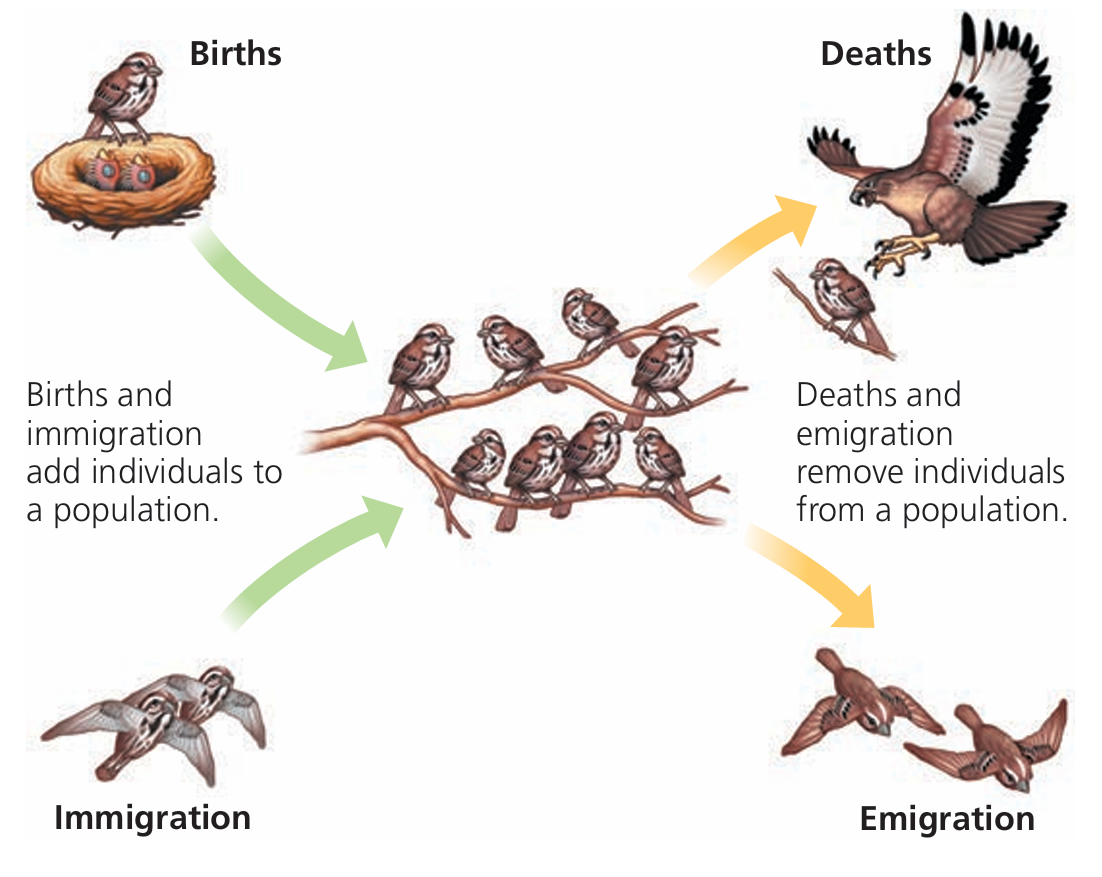 1. Birth Rate (Natality)
- Higher birth rates = faster population growth
- More individuals being born = increase in size
2. Death Rate (Mortality)
- Higher death rates = slower growth or decline
- Caused by disease, predators, old age, etc.
3. Immigration
- Organisms entering a population = growth
- Adds new individuals
4. Emigration
- Organisms leaving a population = decline
- Reduces population size
🌱 Other Influencing Factors:
Resource Availability:
- More food, water, space = more growth
- Limited resources = slowed or stopped growth
Environmental Pressures:
- Natural disasters, droughts, diseases can reduce size
- Predators or human interference also affect dynamics
Competition:
- Intra- or interspecific competition for food, mates, territory
Climate & Weather:
- Seasonal changes and climate shifts impact survival & reproduction
🧠 Key Concept – Carrying Capacity (K):
- The maximum number of individuals an environment can support without degrading resources.
- Populations may fluctuate around this point.
- When population > K, resources run out, leading to decline.
🧪 Summary Table:
| Factor | Increases Pop Size | Decreases Pop Size |
|---|---|---|
| Birth rate | Correct | Incorrect |
| Death rate | Incorrect | Correct |
| Immigration | Correct | Incorrect |
| Emigration | Incorrect | Correct |
| Resources | Correct (when abundant) | Correct (when scarce) |
8.3.A.2 – Population Growth & Energy Use in Organisms
🧠 Key Idea:
Adaptations help organisms obtain and use energy efficiently in their environment. These adaptations impact how fast populations grow or decline.
🔋 Energy, Matter & Adaptations:
- Every organism needs energy and nutrients to grow, reproduce, and survive.
- Natural selection favors traits that help organisms use energy better (e.g., efficient metabolism, better hunting skills, storing fat, etc.).
- These adaptations influence whether a population thrives or declines.
📊 i. Population Growth Depends On: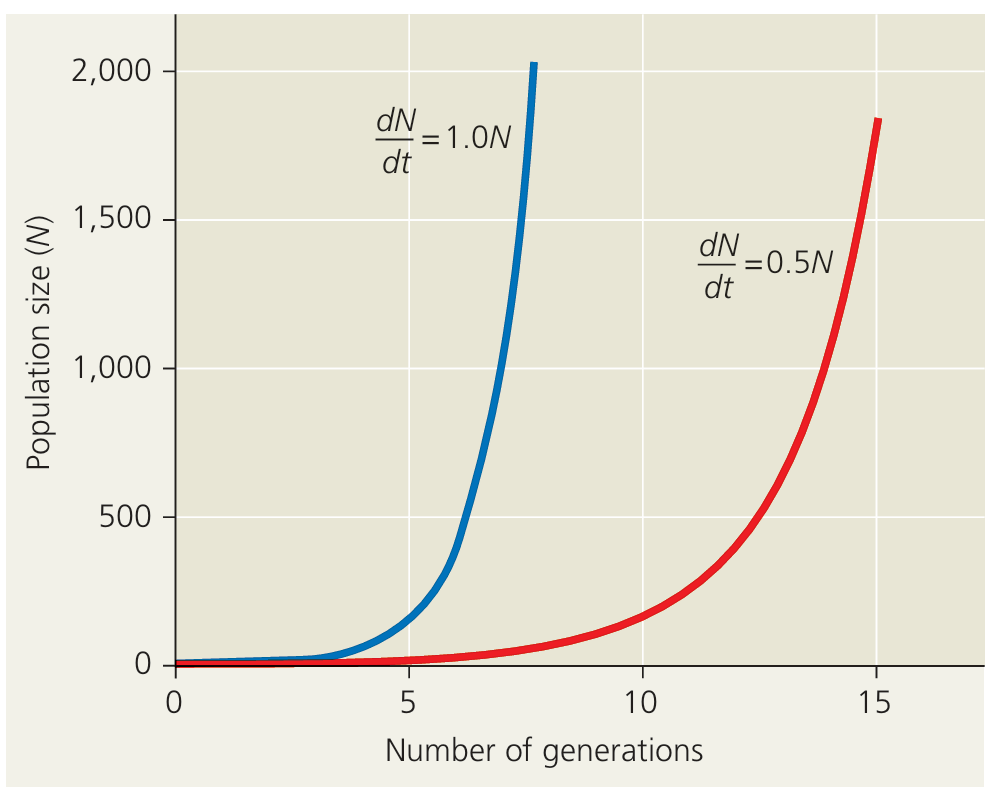
- Birth rate (B) – How many individuals are born
- Death rate (D) – How many die
- Population size (N) – How many are already in the population
🔢 Population Growth Formula:
\( \frac{dN}{dt} = B – D \)
Where:
\( \frac{dN}{dt} \) = change in population size over time
\( B \) = birth rate
\( D \) = death rate
💡 If births > deaths → population grows
💡 If deaths > births → population shrinks
📈 ii. Exponential Growth (Uncontrolled):
If resources are unlimited and there are no constraints, population can grow very rapidly.
🔢 Exponential Growth Equation: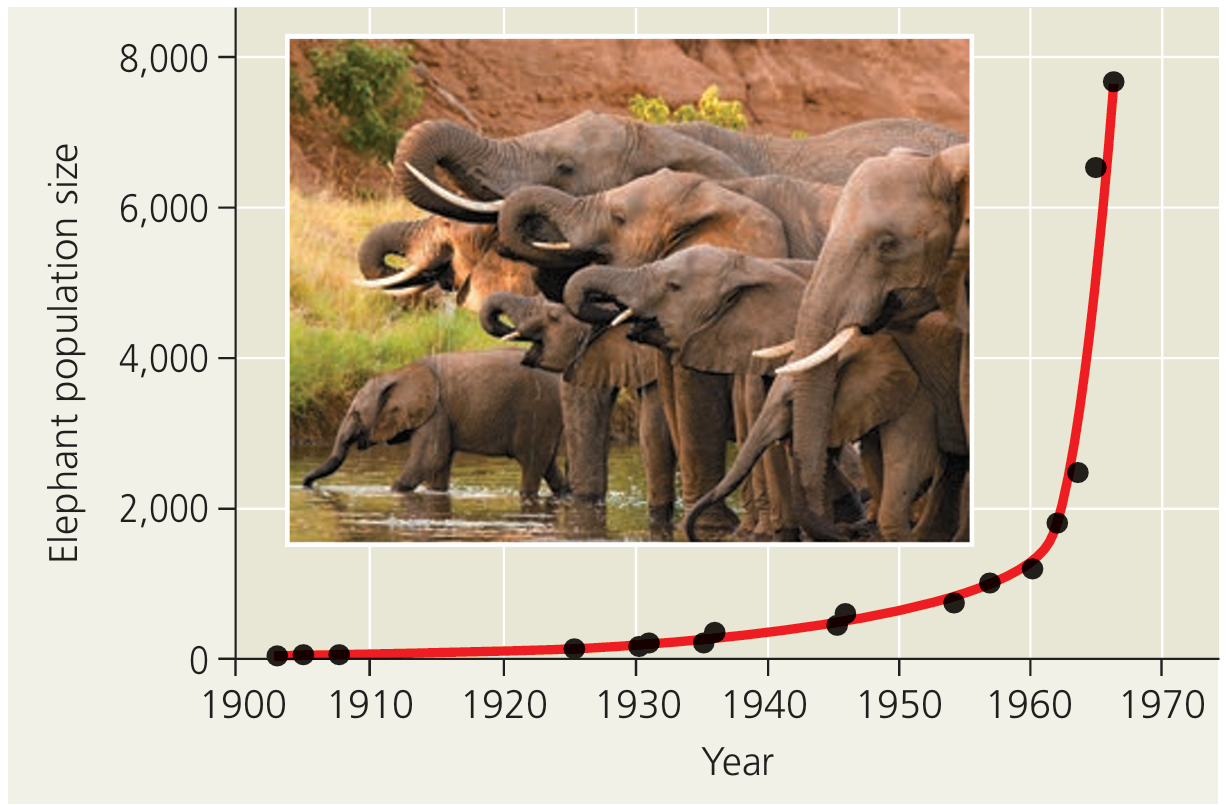
\( \frac{dN}{dt} = r_{max} \cdot N \)
Where:
\( \frac{dN}{dt} \) = change in population size
\( r_{max} \) = maximum per capita growth rate
\( N \) = population size
🧨 This results in a J-shaped curve — fast growth at first, then explodes.
🔍 Example:
Bacteria doubling every hour in ideal conditions → exponential growth.
But in real life, resources run out or space becomes limited — so growth slows.
🧬 Summary:
Populations grow based on births, deaths, and adaptations related to energy use. When nothing limits growth, exponential increase happens — but nature always introduces constraints.