Home / AP Biology Free-Response Questions and answer-2025

Question 1

Most proteins that are secreted from a cell must be transported to the endoplasmic reticulum (ER) either during translation or after translation.
A. Describe the function of ribosomes.
For proteins transported during translation, this process begins in the cytosol and pauses when a specific sequence of amino acids is translated. The translation complex is then transported to the surface of the ER where translation continues. Proteins that are transported after translation are translated entirely in the cytosol and then transported to the ER. In both instances, the translated proteins enter the ER through a protein channel in the membrane of the ER.
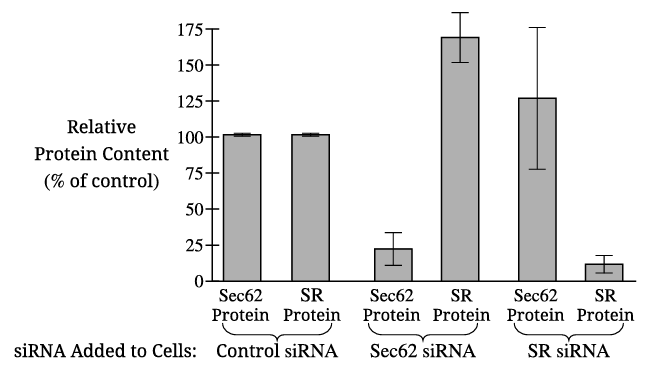
Researchers studying the two types of protein transport identified that the ER membrane protein SR is necessary for transport during translation, while the ER membrane protein Sec62 is necessary for transport after translation. To investigate which transport mechanism is used for different proteins, researchers first created small interfering RNAs (siRNAs) that reduce expression of either SR or Sec62. They then treated groups of cells with either the SR siRNA or the Sec62 siRNA and determined the relative amount of SR and Sec62 protein in each group of cells compared with cells treated with a control siRNA (Figure 1).
Figure 1. Average relative amounts of Sec62 and SR proteins in cells treated with control siRNA, Sec62 siRNA, or SR siRNA. Error bars represent \( \pm SE_{\bar{x}} \).


B. i. Identify the dependent variable in the experiments shown in Figure 1. ii. Justify why the researchers included the control of measuring the relative amounts of both Sec62 and SR proteins in cells that were treated with Sec62 siRNA only (data shown in Figure 1). iii. Based on Figure 1, describe the effect on the production of SR protein when cells are treated with Sec62 siRNA.
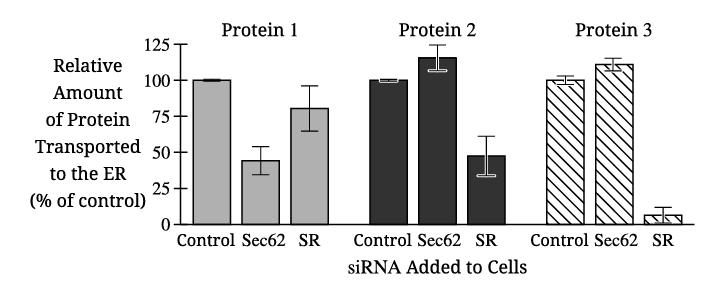
The researchers then measured the amount of each of three different proteins that was transported to the ER in cells treated with Sec62 siRNA or SR siRNA. The researchers calculated the percent transported relative to the cells treated with control siRNA (Figure 2).
Figure 2. Average relative amounts of three proteins that were transported to the ER when treated with control siRNA, Sec62 siRNA, or SR siRNA. Error bars represent \( \pm SE_{\bar{x}} \).


C. i. Identify the independent variable in the researchers’ second experiment (data shown in Figure 2). ii. Based on Figure 2, identify the protein(s) that when treated with Sec62 siRNA showed an increase in percent transport to the ER compared with the control. iii. Protein 1 is encoded by 234 nucleotides, while protein 2 is encoded by 495 nucleotides. Assuming all nucleotides for both proteins encode amino acids, calculate the difference in the number of amino acids between the two proteins.
D. i. Researchers claim that protein 1 is the only tested protein that is transported to the ER following its complete translation in the cytosol. Using data from Figure 2, support the researchers’ claim. ii. For any protein that enters the ER, researchers claim that amino acids close to the protein’s amino terminus determine how likely the protein is to pass through the protein channel within the ER membrane. Justify the researchers’ claim based on your understanding of factors that affect the transport of proteins across membranes.

Most-appropriate topic codes (AP Biology 2025 Course Framework):

Topic 2.1.A.1: Ribosome structure and function — part A
Science Practice 3: Questions and Methods (identifying variables/controls) — parts B.i, B.ii, C.i
Science Practice 5: Statistical Tests and Data Analysis (graph interpretation/calculations) — parts B.iii, C.ii, C.iii
Science Practice 6: Argumentation (supporting claims with evidence) — part D.i
Topic 2.1.A.3 & 2.9.B.1: Endoplasmic reticulum and compartmentalization — part D.ii
▶️ Answer/Explanation

(A)
Ribosomes are the cellular structures where protein synthesis (translation) occurs. They facilitate the assembly of amino acids into polypeptide chains by reading mRNA sequences and catalyzing the formation of peptide bonds.
Answer: \( \boxed{\text{Ribosomes synthesize proteins via translation.}} \)

B(i)
The dependent variable in Figure 1 is the relative protein content (percentage of control) of Sec62 and SR proteins.
Answer: \( \boxed{\text{Relative protein content (of Sec62 and SR)}} \)

B(ii)
The control with Sec62 siRNA alone allows researchers to determine whether this siRNA specifically reduces Sec62 expression without affecting SR expression, confirming the siRNA’s specificity and validating the experimental design.
Answer: \( \boxed{\text{To confirm that Sec62 siRNA specifically targets only Sec62 and does not affect SR protein levels.}} \)

B(iii)
When cells are treated with Sec62 siRNA, the production of SR protein increases significantly (approximately 65% above the control level).
Answer: \( \boxed{\text{SR protein production increases by about 65%.}} \)

C(i)
The independent variable in Figure 2 is the type of siRNA added to the cells (control, Sec62 siRNA, or SR siRNA).
Answer: \( \boxed{\text{Type of siRNA treatment}} \)

C(ii)
Proteins 2 and 3 both show an increase in percent transport to the ER when treated with Sec62 siRNA compared to the control.
Answer: \( \boxed{\text{Proteins 2 and 3}} \)

C(iii)
Each amino acid is encoded by 3 nucleotides.
Protein 1 amino acids: \( \frac{234}{3} = 78 \)
Protein 2 amino acids: \( \frac{495}{3} = 165 \)
Difference: \( 165 – 78 = 87 \) amino acids.
Answer: \( \boxed{87} \)

D(i)
Only Protein 1 shows a significant decrease in transport when Sec62 siRNA is applied. Since Sec62 is required for post-translational ER transport, this indicates Protein 1 relies on Sec62 and is therefore transported after translation is complete.
Answer: \( \boxed{\text{Protein 1 transport decreases with Sec62 siRNA, indicating Sec62 dependence and post-translational transport.}} \)

D(ii)
Amino acids near the amino terminus interact first with the protein channel. Their polarity/charge relative to the channel interior determines ease of passage: hydrophobic or oppositely charged residues facilitate movement, while hydrophilic or similarly charged residues hinder it. This is consistent with principles of selective permeability and protein-channel interactions.
Answer: \( \boxed{\text{Amino acids at the N-terminus determine compatibility with the channel’s chemical environment, influencing translocation likelihood.}} \)

Question 2

Many insects rely on pheromones (chemical signals) that are released by the females to find mating partners. Scientists hypothesize that, in a certain type of moth, the behavior of male moths in response to pheromones is regulated by the extracellular signaling molecule 20E.
To investigate whether the binding of 20E to its receptor, DopEcR, affects behavior in moths, scientists injected male moths with saline (control solution) or with small interfering RNA molecules (siRNAs) that inhibit the expression of the gene encoding DopEcR. The scientists then exposed the moths to the pheromone and determined the percent of total time observed that the moths engaged in general activity, defined as movement in any direction. The scientists also determined the percent of the general activity time that the moths spent in oriented activity, defined as movement toward an area of high pheromone concentration (Table 1).

Table 1. Average General and Oriented Activity in Male Moths Injected With Saline or siRNA Molecules

TreatmentGeneral Activity
(percent of total time observed, average ±2SE\(_x\))
Oriented Activity
(percent of general activity, average ±2SE\(_x\))
Male moths injected with saline (control solution)95 ± 560 ± 4
Male moths injected with siRNAs that inhibit expression of the gene encoding DopEcR90 ± 825 ± 6
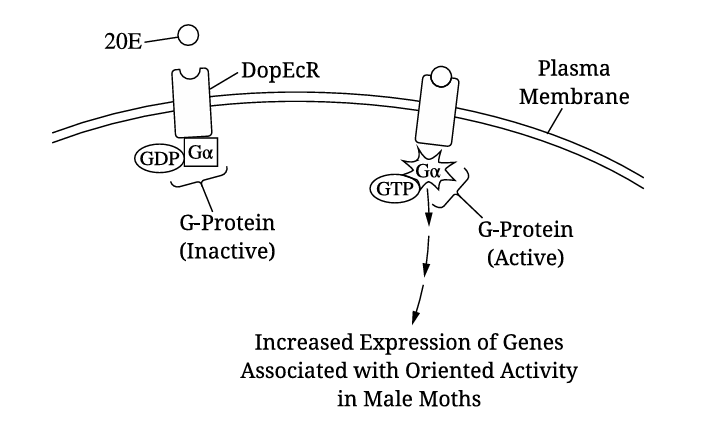
DopEcR is a G protein-coupled receptor. When 20E binds to DopEcR, GTP displaces the GDP bound to the G protein, and a signaling pathway is activated. The scientists hypothesize that this leads to the transcription of genes associated with the oriented activity observed in the male moths (Figure 1).
Figure 1. A simplified model of a signaling pathway activated by the binding of 20E to its receptor, DopEcR


(a) Many receptors are embedded in the plasma membrane. Describe the polarity of the portion of the receptor that is inside the membrane. 
(b) (i) Using the template provided, construct an appropriate graph that represents the data in Table 1. [3]
(ii) Based on the data in Table 1, determine the type of activity that was affected by inhibiting the expression of the DopEcR receptor. 
(c) (i) Based on Table 1, identify the treatment group in which the oriented activity was greater than 50% of the general activity. 
(ii) The scientists studied some moths with a mutation in the gene encoding the G protein. The mutation prevents GTP from displacing the GDP bound to the G protein. Based on Figure 1, predict the effect of this mutation on the oriented activity in male moths exposed to the pheromone. 
(d) (i) Expression of the gene encoding DopEcR is low in male moths during their first few days as adults, when they are sexually immature. Gene expression rapidly increases as the moths reach sexual maturity. The scientists claim that this increase in gene expression increases the likelihood of males finding females with whom to mate. Use evidence from the information provided to support the scientists’ claim. 
(ii) Based on Figure 1, explain how an inhibitor of the DopEcR pathway might serve as an effective chemical to protect crops from moth damage. 

Most-appropriate topic codes (AP Biology 2025 Course Framework):

Topic 2.3.A.2: Membrane protein structure — part A
Science Practice 4: Representing and Describing Data (graph construction) — part B.i
Science Practice 5: Statistical Tests and Data Analysis (data interpretation) — parts B.ii, C.i
Topic 4.2.B.1: Signal transduction pathways — part C.ii
Science Practice 6: Argumentation (supporting claims) — part D.i
Topic 4.3.B.2: Chemical effects on signaling pathways — part D.ii
▶️ Answer/Explanation

(a)
The portion of the receptor embedded inside the lipid bilayer is hydrophobic/nonpolar to interact with the fatty acid tails of phospholipids.
Answer: \(\boxed{\text{Hydrophobic / Nonpolar}}\)

(b)(i)
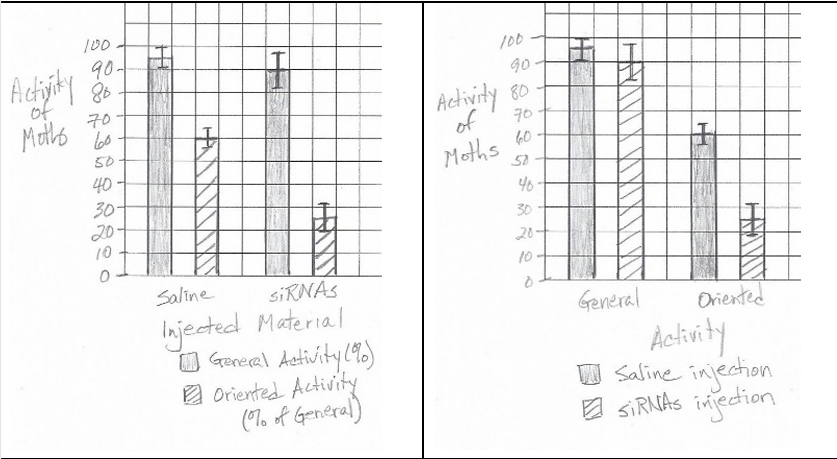
A bar graph with error bars should be constructed. The x-axis should show the two treatments (Control and siRNA), with two bars per treatment (one for General Activity, one for Oriented Activity). The y-axis should be labeled “Percent Activity.” Error bars should be plotted using the given ±SE\(_x\) values.
Key points: Correct graph type, accurate plotting of data and error bars, proper labeling.

(b)(ii)
Oriented activity was significantly reduced in siRNA-treated moths (25% vs. 60% in control), while general activity was less affected.
Answer: \(\boxed{\text{Oriented activity}}\)

(c)(i)
The control group (saline-injected moths) had oriented activity at 60% of general activity, which is >50%.
Answer: \(\boxed{\text{Control / Saline-injected group}}\)

(c)(ii)
The mutation prevents G-protein activation, blocking signal transduction. This would decrease oriented activity because genes associated with oriented behavior would not be transcribed.
Answer: \(\boxed{\text{Decreased oriented activity}}\)

(d)(i)
Increased DopEcR expression at sexual maturity allows more 20E binding and stronger signaling, leading to increased oriented activity toward pheromones, thereby improving mating success.
Evidence: Data show that inhibiting DopEcR reduces oriented activity; thus, increasing it should enhance oriented activity and mate-finding.

(d)(ii)
An inhibitor of the DopEcR pathway would reduce oriented activity toward pheromones, decreasing mating success and population growth, thus reducing crop damage from moth larvae.
Explanation: Less oriented activity → fewer matings → lower reproduction → fewer larvae damaging crops.

Question 3

Buffelgrass, an invasive grass species in southwestern desert ecosystems, is threatening the saguaro cactus, a keystone species in these ecosystems. Buffelgrass is drought-tolerant and can survive wildfires. However, the dry buffelgrass also acts as fuel for wildfires, causing the fires to be more severe. Older saguaro cacti can survive wildfires; however, many of the young cacti cannot.
Scientists conducted an experiment to determine whether they could control the abundance of the buffelgrass population. The scientists identified several native grass species that, when grown with buffelgrass, might reduce the abundance of buffelgrass. They grew buffelgrass in the presence of several different native grass species in greenhouses, in either nondrought (watered every 3 days) or drought (watered every 9 days) conditions. After twelve weeks, they measured the height and dry weight of the buffelgrass in each treatment group.
(a) Describe the effect that removing a keystone species will have on an ecosystem.
(b) Identify a control group the scientists should include in their experiment.
(c) State the null hypothesis of the experiment in which buffelgrass is grown in the presence of native grass species.
(d) Scientists have found that the population growth rates of native grasses are much slower than the population growth rate of buffelgrass following a wildfire. The scientists claim that wildfires will therefore increase the abundance of buffelgrass plants in the ecosystem. Based on the information given, justify the scientists’ claim.

Most-appropriate topic codes (AP Biology 2025 Course Framework):

Topic 8.6.B.1: Keystone species effects — part A
Science Practice 3: Questions and Methods (experimental design) — parts B, C
Topic 8.7.B.1: Invasive species dynamics — part D
▶️ Answer/Explanation

(a)
Removing a keystone species will reduce biodiversity and/or ecosystem resilience, potentially causing the ecosystem to collapse.
Answer: \(\boxed{\text{Removal reduces biodiversity/ecosystem resilience}}\)

(b)
The control group should be buffelgrass grown alone (without any native grass species), under both drought and nondrought conditions.
Answer: \(\boxed{\text{Buffelgrass grown alone}}\)

(c)
The null hypothesis states that there will be no difference in buffelgrass abundance (height/dry weight) when grown with native grasses compared to when grown alone.
Answer: \(\boxed{\text{Native grasses have no effect on buffelgrass abundance}}\)

(d)
Wildfires reduce native grass populations (slow recovery), while buffelgrass survives and grows rapidly. This reduces competition for resources (water, nutrients, light), allowing buffelgrass to increase in abundance.
Answer: \(\boxed{\text{Reduced competition allows buffelgrass to dominate}}\)

Question 4

Twenty million years ago the Caribbean Sea and Pacific Ocean were connected, and water flowed freely between the two bodies of water. Many of the same marine species were found in both areas. Over millions of years, the land referred to as the Isthmus of Panama formed, eventually closing off the connection between the Caribbean Sea and Pacific Ocean and creating two separate bodies of water. The ecology of these two marine habitats was dramatically altered by this land formation. The warmer Caribbean water could no longer flow west, so the Pacific water cooled and became more nutrient-rich, while the Caribbean water became warmer.
(a) Describe the genetic evidence that evolution is occurring in a population. 
(b) Explain how the isolation of marine species by the formation of a land barrier can lead to divergent evolution of those species. 
The formation of the Isthmus of Panama connected two continents, North America and South America. Many North American land animal species migrated to South America after the formation of the isthmus and occupied similar niches as South American species.
(c) Predict the effect the formation of the isthmus had on resource availability for South American species. 
(d) Justify your prediction in part (c). 

Most-appropriate topic codes (AP Biology 2025):

Topic 7.6.B.2: Molecular evidence for evolution — part A
Topic 7.10.C.1: Allopatric speciation — part B
Topic 8.5.B.4: Competition and niche dynamics — parts C, D
▶️ Answer/Explanation

(a)
Genetic evidence that evolution is occurring in a population includes changes in allele frequencies or genotype frequencies over generations. These changes can be measured directly from genetic data and indicate that some alleles are becoming more or less common due to evolutionary forces such as natural selection, genetic drift, or gene flow.

Answer: \(\boxed{\text{Change in allele frequencies/genotype frequencies over time.}}\)

(b)
The formation of a land barrier creates geographic (and reproductive) isolation between populations of the same species. This prevents gene flow. Over time, the two separated populations experience different environmental conditions (e.g., temperature, nutrient availability) that apply different selective pressures. This leads to divergent evolution, where each population accumulates distinct genetic changes and may eventually become separate species (allopatric speciation).

Answer: \(\boxed{\text{Reproductive isolation/lack of gene flow combined with different selective pressures leads to divergent allele frequencies and traits.}}\)

(c)
The migration of North American species into South America after the isthmus formed increased the number of species competing for similar resources. Therefore, resource availability for the native South American species decreased.

Answer: \(\boxed{\text{Resource availability decreased.}}\)

(d)
Justification: With the arrival of North American species that occupied similar ecological niches, there was an increase in interspecific competition for the same limited resources (e.g., food, space, nesting sites). More species competing for the same pool of resources means that, on average, each species (and individual) has access to fewer resources.

Answer: \(\boxed{\text{Increased competition due to more species in similar niches reduces the amount of resources available per species/individual.}}\)

Question 5

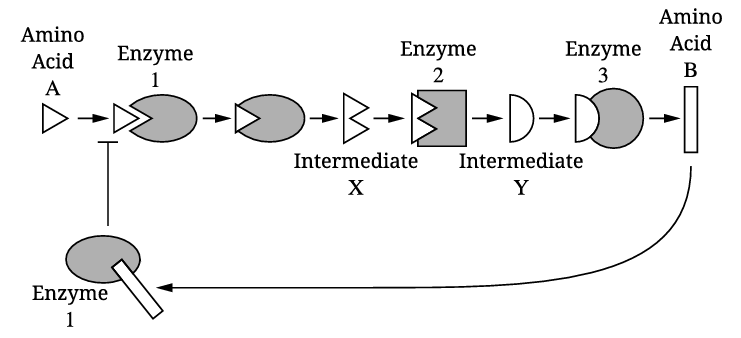
Figure 1 shows the reactions of the metabolic pathway used to synthesize amino acid B from amino acid A in cells.

Figure 1. Synthesis of amino acid B from amino acid A


(a) Describe a characteristic of an enzyme’s active site that allows it to catalyze a specific chemical reaction. 
(b) Based on Figure 1, explain how the binding of amino acid A to enzyme 1 is regulated by amino acid B. 
(c) Using the information in Figure 1, identify the product of the reaction catalyzed by enzyme 2: intermediate X, intermediate Y, or amino acid B. 
(d) Based on Figure 1, explain how a change in pH could affect enzyme 3 in such a way that amino acid B cannot be produced. 

Most-appropriate topic codes (AP Biology 2025):

Topic 3.1.A.2: Enzyme-substrate specificity — part A
Topic 4.4.A.1: Feedback mechanisms — part B
Topic 3.3.A.3: Sequential metabolic pathways — part C
Topic 3.2.A.1: Environmental effects on enzymes — part D
▶️ Answer/Explanation

(a)
The active site of an enzyme has a specific three-dimensional shape and charge distribution that is complementary to its substrate(s). This precise compatibility allows the enzyme to bind specifically to its substrate and lower the activation energy for the reaction.
Answer: \(\boxed{\text{Specific shape/complementarity to substrate}}\)

(b)
Amino acid B acts as a noncompetitive (allosteric) inhibitor of enzyme 1. It binds to an allosteric site on enzyme 1, causing a conformational change that reduces enzyme 1’s activity and prevents amino acid A from binding to the active site. This is an example of feedback inhibition in a metabolic pathway.
Answer: \(\boxed{\text{B binds allosterically to inhibit enzyme 1}}\)

(c)
According to Figure 1, enzyme 2 catalyzes the conversion of intermediate X into intermediate Y. Therefore, the product of the reaction catalyzed by enzyme 2 is intermediate Y.
Answer: \(\boxed{\text{Intermediate Y}}\)

(d)
A change in pH outside the optimal range for enzyme 3 can disrupt the hydrogen bonds and ionic interactions that maintain the enzyme’s tertiary structure. This can lead to denaturation, altering the shape of the active site so that intermediate Y can no longer bind effectively, preventing the production of amino acid B.
Answer: \(\boxed{\text{pH change can denature enzyme 3 / alter active site shape}}\)

Question 6

The \( ald \) gene of fruit flies encodes the ALD protein, which is associated with both the centromeres of chromosomes and protein filaments produced during meiosis. In the absence of functional ALD proteins, gamete-producing cells enter anaphase I before homologous chromosomes are correctly aligned. As a result, the gametes produced do not contain the correct numbers of chromosomes.
Scientists generated four mutations in the \( ald \) gene: \( ald1 \), \( ald3 \), \( ald23 \), and \( del \), which was a deletion of the gene. To study the role of the ALD protein in meiosis, scientists used gamete-forming metaphase cells from groups of flies with different \( ald \) genotypes. Some of the flies were homozygous for the wild-type allele of \( ald \): WT/WT. Other flies were heterozygous for different \( ald \) alleles: \( WT/del \); \( ald1/del \); \( ald3/ald23 \); \( ald23/del \). The scientists measured the percent of metaphase cells that contained ALD-associated filaments (Figure 1A) and the amount of ALD protein produced by each of the cell types (Figure 1B).

Figure 1A. Percent of Metaphase Cells with ALD-Associated Filaments

Figure 1B. ALD Protein (Western Blot)

(a) Based on Figure 1A, identify the fly genotype in which the average percent of metaphase cells with ALD-associated filaments is close to 12%. 
(b) Based on Figure 1B, describe the difference in ALD protein production between gamete-forming metaphase cells of flies with the genotype \( ald3/ald23 \) and flies with the genotype \( ald23/del \). 
(c) Scientists hypothesize that gamete-forming metaphase cells can produce a normal amount of ALD-associated filaments even when they produce about half as much ALD protein as the wild-type cells produce. Use the data in Figures 1A and 1B to support the scientists’ hypothesis. 
(d) For gamete-forming metaphase cells of the \( WT/del \) and \( ald1/del \) flies, explain why the phenotypes observed in Figure 1A differ even though the amount of ALD protein produced (Figure 1B) does not. 

Most-appropriate topic codes (AP Biology 2025):

Science Practice 5: Statistical Tests and Data Analysis (graph interpretation) — parts A, B
Science Practice 6: Argumentation (hypothesis support) — part C
Topic 6.7.A.1 & 1.7.A.6: Mutation effects and protein structure-function — part D
▶️ Answer/Explanation

(a)
Method: Examine Figure 1A, which is a bar graph showing the average percent of metaphase cells with ALD-associated filaments for different genotypes. Identify the bar with a height closest to the 12% mark on the y-axis.
Answer: \(\boxed{ald1/del}\)

(b)
Method: Examine Figure 1B, which is a Western blot. The thickness of each band correlates with the amount of ALD protein produced. Compare the band for the \( ald3/ald23 \) genotype to the band for the \( ald23/del \) genotype.
Answer: \(\boxed{\text{Cells with genotype } ald3/ald23 \text{ produce more ALD protein than cells with genotype } ald23/del \text{, which produce little to no ALD protein.}}\)

(c)
Method: To support the hypothesis, find a pair of genotypes where one produces about half the protein of the wild-type (WT/WT) but has a similar percentage of cells with filaments. Compare the WT/WT and WT/del data points in both figures.

  1. In Figure 1B, the band for WT/del is visibly thinner than for WT/WT, indicating it produces about half the amount of ALD protein.
  2. In Figure 1A, the bars for WT/WT and WT/del are both near 100%, showing no significant difference in the percentage of cells with filaments.

This direct comparison shows that halving the protein amount does not reduce filament formation, supporting the hypothesis.
Answer: \(\boxed{\text{The WT/del cells produce about half the ALD protein of WT/WT cells (Fig 1B), yet the percent of cells with filaments is similarly high (Fig 1A), supporting the hypothesis.}}\)

(d)
Method: Analyze why two genotypes (WT/del and ald1/del) with similar protein amounts (medium bands in Fig 1B) have vastly different phenotypes (function) (~100% vs. ~12% cells with filaments in Fig 1A). The difference must lie in the quality or functionality of the protein produced.

  1. The \( del \) allele produces no protein.
  2. The \( WT \) allele produces normal, functional protein.
  3. The \( ald1 \) allele produces a protein, but the mutation likely makes it non-functional or less effective.

Therefore, WT/del cells have one functional allele and produce enough working protein for normal filament formation. The ald1/del cells produce a similar amount of protein, but the protein from the ald1 allele is defective, leading to the mutant phenotype.
Answer: \(\boxed{\text{The } ald1 \text{ mutation produces a non-functional or less effective ALD protein, whereas the } WT \text{ allele produces functional protein. Thus, } WT/del \text{ cells have functional protein and a normal phenotype, while } ald1/del \text{ cells do not.}}\)

Scroll to Top