
Question 1
(Note: Your calculator should be in radian mode.)
Most-appropriate topic codes (CED):
• TOPIC 5.1: Using the Mean Value Theorem — part (b)
• TOPIC 1.15: Connecting Limits at Infinity and Horizontal Asymptotes — part (c)
• TOPIC 5.5: Using the Candidates Test to Determine Absolute (Global) Extrema — part (d)
▶️ Answer/Explanation
(a)
Average value = \(\frac{1}{4-0}\int_{0}^{4} C(t) \, dt\)
Using a calculator: \(\frac{1}{4}(11.112896) \approx 2.778\)
Answer: 2.778 .
(b)
Average rate of change = \(\frac{C(4)-C(0)}{4-0} = \frac{5.128031 – 0}{4} \approx 1.282008\)
Set \(C'(t) = 1.282008\):
\(\frac{38}{25+t^2} = 1.282008\)
Solving for \(t\): \(t \approx 2.154\) .
(c)
Limit expression: \(\lim_{t\to\infty} C'(t) = \lim_{t\to\infty} \frac{38}{25+t^2}\)
Evaluation: 0 .
(d)
\(A(t)\) is maximized when \(A'(t)=0\) or at endpoints.
\(A'(t) = C'(t) – 0.1 \ln(t) = 0 \Rightarrow t \approx 11.442\)
Candidates Test:
• \(t=4\): \(A(4) = C(4) \approx 5.128\)
• \(t=11.442\): \(A(11.442) \approx 7.317\)
• \(t=36\): \(A(36) \approx 1.743\)
Maximum value occurs at \(t = 11.442\) .
Question 2
Most-appropriate topic codes (CED):
• TOPIC 8.7: Volumes with Cross Sections — part (b)
• TOPIC 8.10: Volume with Washer Method: Revolving Around Other Axes — part (c)
• TOPIC 2.2: The Derivative as a Function — part (d)
▶️ Answer/Explanation
(a)
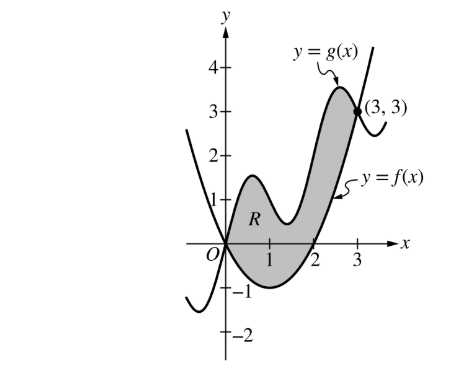
The area of \(R\) is given by the integral of the upper curve minus the lower curve from \(x=0\) to \(x=3\).
Area \( = \int_{0}^{3} (g(x) – f(x)) \, dx \)
Using a calculator to evaluate:
Area \( \approx 5.137\) (or \(5.136\)) .
(b)
The volume is the integral of the area of the cross sections.
Area of cross section \(= (\text{base}) \times (\text{height}) = (g(x) – f(x)) \cdot x\).
Volume \( = \int_{0}^{3} x(g(x) – f(x)) \, dx \)
Using a calculator:
Volume \( \approx 7.705\) (or \(7.704\)) .
(c)
Using the washer method with outer radius \(R(x) = g(x) – (-2) = g(x) + 2\) and inner radius \(r(x) = f(x) – (-2) = f(x) + 2\):
Volume \( = \pi \int_{0}^{3} \left( (g(x) + 2)^{2} – (f(x) + 2)^{2} \right) \, dx \) .
(d)
Tangent lines are parallel when their slopes are equal, so \(f^{\prime}(x) = g^{\prime}(x)\).
\(f^{\prime}(x) = 2x – 2\).
Set \(2x – 2 = 1 + \pi \cos(\pi x)\).
Using a calculator to solve for \(x\) in the interval \(0 < x < 1\):
\(x \approx 0.676\) (or \(0.675\)).
Question 3
| \(t\) (minutes) | \(0\) | \(2\) | \(8\) | \(10\) |
|---|---|---|---|---|
| \(R(t)\) (words per minute) | \(90\) | \(100\) | \(150\) | \(162\) |
Most-appropriate topic codes (CED):
• TOPIC 1.16: Intermediate Value Theorem — part (b)
• TOPIC 6.2: Approximating Riemann Sums (Trapezoidal) — part (c)
• TOPIC 8.2: Motion Problems (Total Distance/Accumulation) — part (d)
▶️ Answer/Explanation
(a)
\( R'(1) \approx \frac{R(2)-R(0)}{2-0} = \frac{100-90}{2} = 5 \)
The unit is words per minute per minute (or words/min²).
(b)
Since \(R\) is differentiable, it is continuous on \([0, 10]\).
\(R(8) = 150\) and \(R(10) = 162\).
Since \(150 < 155 < 162\), by the Intermediate Value Theorem, there must be a value \(c\) in the interval \((8, 10)\) (and thus in \(0 < c < 10\)) such that \(R(c) = 155\) .
(c)
Trapezoidal sum approximation:
\( \int_{0}^{10}R(t)dt \approx \frac{1}{2}(2-0)(R(0)+R(2)) + \frac{1}{2}(8-2)(R(2)+R(8)) + \frac{1}{2}(10-8)(R(8)+R(10)) \)
\( = \frac{1}{2}(2)(90+100) + \frac{1}{2}(6)(100+150) + \frac{1}{2}(2)(150+162) \)
\( = 190 + 3(250) + 312 = 1252 \)
(d)
The total number of words read is the integral of the rate \(W(t)\) from \(0\) to \(10\):
\( \int_{0}^{10} W(t) dt = \int_{0}^{10} (-\frac{3}{10}t^2 + 8t + 100) dt \)
\( = [ -\frac{1}{10}t^3 + 4t^2 + 100t ]_{0}^{10} \)
\( = (-100 + 400 + 1000) – 0 \)
\( = 1300 \)
The teacher has read 1300 words .
Question 4
Most-appropriate topic codes (CED):
• TOPIC 5.9: Connecting a Function, Its First Derivative, and Its Second Derivative — part (b)
• TOPIC 6.6: Applying Properties of Definite Integrals — part (c)
• TOPIC 5.5: Using the Candidates Test to Determine Absolute (Global) Extrema — part (d)
▶️ Answer/Explanation
(a)
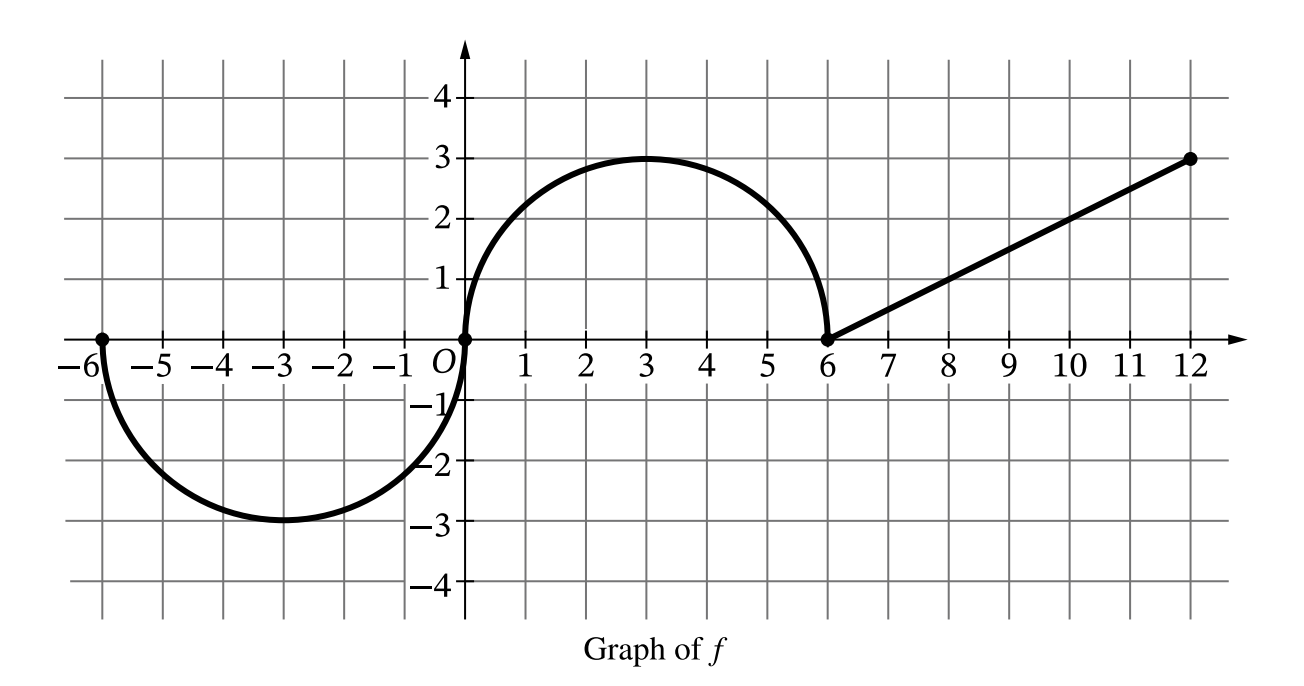
\(g^{\prime}(x)=f(x)\)
\(g^{\prime}(8)=f(8)=1\)
Reason: The Fundamental Theorem of Calculus.
(b)
A point of inflection occurs where \(g^{\prime \prime}(x)=f^{\prime}(x)\) changes sign, which corresponds to where the graph of \(f\) changes from increasing to decreasing or decreasing to increasing.
This occurs at \(x=-3\) and \(x=3\).
(c)
\(g(12) = \int_{6}^{12} f(t) dt = \frac{1}{2}(6)(3) = 9\)
\(g(0) = \int_{6}^{0} f(t) dt = -\int_{0}^{6} f(t) dt = -\frac{1}{2}\pi(3)^{2} = -\frac{9\pi}{2}\).
(d)
\(g\) attains an absolute minimum when \(g^{\prime}(x)=f(x)=0\) or at an endpoint.
\(f(x)=0\) at \(x=-6, 0, 6\).
Candidates Test:
• \(g(6) = 0\)
• \(g(0) = -4.5\pi \approx -14.137\)
• \(g(-6) = \int_{6}^{-6} f(t) dt = -\int_{-6}^{6} f(t) dt = -(-\frac{9\pi}{2} + \frac{9\pi}{2}) = 0\)
• \(g(12) = 9\)
The absolute minimum is at \(x=0\).
Question 5
Most-appropriate topic codes (CED):
• TOPIC 8.2: Connecting Position, Velocity, and Acceleration of Functions Using Integrals — part (d)
▶️ Answer/Explanation
(a)
Velocity is the derivative of position: \(v_{H}(t) = x_{H}^{\prime}(t)\).
Using the chain rule: \(v_{H}(t) = e^{t^{2}-4t} \cdot (2t-4)\).
At \(t=1\):
\(v_{H}(1) = e^{1-4} \cdot (2-4) = -2e^{-3}\).
(b)
Particles move in opposite directions when their velocities have opposite signs.
\(v_{H}(t) = (2t-4)e^{t^{2}-4t}\). Since \(e^{t^{2}-4t} > 0\), the sign of \(v_{H}\) is determined by \(2t-4\).
\(v_{H}(t) < 0\) for \(0 < t < 2\) and \(v_{H}(t) > 0\) for \(2 < t < 5\).
\(v_{J}(t) = 2t(t^{2}-1)^{3}\). Since \(2t > 0\) for \(t>0\), the sign of \(v_{J}\) is determined by \(t^{2}-1\).
\(v_{J}(t) < 0\) for \(0 < t < 1\) and \(v_{J}(t) > 0\) for \(1 < t < 5\).
Comparing signs:
• \(0 < t < 1\): \(v_{H} < 0, v_{J} < 0\) (Same)
• \(1 < t < 2\): \(v_{H} < 0, v_{J} > 0\) (Opposite)
• \(2 < t < 5\): \(v_{H} > 0, v_{J} > 0\) (Same)
Particles move in opposite directions on the interval \(1 < t < 2\).
(c)
At \(t=2\), \(v_{J}(2) = 2(2)(2^{2}-1)^{3} = 4(3)^{3} = 108 > 0\).
We are given \(v_{J}^{\prime}(2) > 0\), which means acceleration \(a_{J}(2) > 0\).
Since velocity and acceleration have the same sign (both positive), the speed of particle \(J\) is increasing.
(d)
Position at \(t=2\) is given by \(x_{J}(2) = x_{J}(0) + \int_{0}^{2} v_{J}(t) \, dt\).
\(x_{J}(2) = 7 + \int_{0}^{2} 2t(t^{2}-1)^{3} \, dt\).
Let \(u = t^{2}-1\), then \(du = 2t \, dt\). Limits: \(t=0 \to u=-1\), \(t=2 \to u=3\).
\(\int_{-1}^{3} u^{3} \, du = \left[ \frac{1}{4}u^{4} \right]_{-1}^{3} = \frac{1}{4}(3^{4} – (-1)^{4}) = \frac{1}{4}(81-1) = 20\).
\(x_{J}(2) = 7 + 20 = 27\)
The position is 27.
Question 6
Most-appropriate topic codes (CED):
• TOPIC 4.6: Approximating Values of a Function Using Local Linearity and Linearization — part (b)
• TOPIC 3.7: Selecting Procedures for Calculating Derivatives (Vertical Tangents) — part (c)
• TOPIC 4.5: Related Rates — part (d)
▶️ Answer/Explanation
(a)
Differentiate with respect to \(x\):
\( \frac{d}{dx}(y^3 – y^2 – y + \frac{1}{4}x^2) = \frac{d}{dx}(0) \)
\( 3y^2 \frac{dy}{dx} – 2y \frac{dy}{dx} – 1 \frac{dy}{dx} + \frac{1}{2}x = 0 \)
\( \frac{dy}{dx}(3y^2 – 2y – 1) = -\frac{1}{2}x \)
\( \frac{dy}{dx} = \frac{-x}{2(3y^2 – 2y – 1)} \).
(b)
Find the slope at \((2, -1)\):
\( \frac{dy}{dx}\Big|_{(2,-1)} = \frac{-2}{2(3(-1)^2 – 2(-1) – 1)} = \frac{-2}{2(3+2-1)} = \frac{-2}{2(4)} = -\frac{1}{4} \)
Tangent line equation: \( y – (-1) = -\frac{1}{4}(x – 2) \Rightarrow y = -1 – \frac{1}{4}(x – 2) \)
Approximate \(y\) at \(x=1.6\):
\( y(1.6) \approx -1 – \frac{1}{4}(1.6 – 2) = -1 – \frac{1}{4}(-0.4) = -1 + 0.1 = -0.9 \).
(c)
Vertical tangent occurs when the denominator of \(\frac{dy}{dx}\) is zero (and numerator is non-zero).
\( 2(3y^2 – 2y – 1) = 0 \Rightarrow 3y^2 – 2y – 1 = 0 \)
\( (3y + 1)(y – 1) = 0 \)
\( y = -\frac{1}{3} \) or \( y = 1 \).
Given \(y > 0\), the coordinate is \( y = 1 \).
(d)
Differentiate \(2xy + \ln y = 8\) with respect to \(t\):
\( 2\left( \frac{dx}{dt}y + x\frac{dy}{dt} \right) + \frac{1}{y}\frac{dy}{dt} = 0 \)
At \((4, 1)\) with \(\frac{dx}{dt} = 3\):
\( 2(3(1) + 4\frac{dy}{dt}) + \frac{1}{1}\frac{dy}{dt} = 0 \)
\( 6 + 8\frac{dy}{dt} + \frac{dy}{dt} = 0 \)
\( 9\frac{dy}{dt} = -6 \Rightarrow \frac{dy}{dt} = -\frac{6}{9} = -\frac{2}{3} \).