Home / AP Calculus BC 2025 Free-Response Questions and Answer

Question 1

An invasive species of plant appears in a fruit grove at time \(t=0\) and begins to spread. The function \(C\) defined by \(C(t)=7.6 \arctan(0.2t)\) models the number of acres in the fruit grove affected by the species \(t\) weeks after the species appears. It can be shown that \(C^{\prime}(t)=\frac{38}{25+t^{2}}\).
(Note: Your calculator should be in radian mode.)
(a) Find the average number of acres affected by the invasive species from time \(t=0\) to time \(t=4\) weeks. Show the setup for your calculations.
(b) Find the time \(t\) when the instantaneous rate of change of \(C\) equals the average rate of change of \(C\) over the time interval \(0\le t\le4\). Show the setup for your calculations.
(c) Assume that the invasive species continues to spread according to the given model for all times \(t>0\). Write a limit expression that describes the end behavior of the rate of change in the number of acres affected by the species. Evaluate this limit expression.
(d) At time \(t=4\) weeks after the invasive species appears in the fruit grove, measures are taken to counter the spread of the species. The function \(A\), defined by \(A(t)=C(t)-\int_{4}^{t}0.1 \ln(x)dx\), models the number of acres affected by the species over the time interval \(4\le t\le36\). At what time \(t\), for \(4\le t\le36\), does \(A\) attain its maximum value? Justify your answer.

Most-appropriate topic codes (CED):

TOPIC 8.1: Finding the Average Value of a Function on an Interval — part (a)
TOPIC 5.1: Using the Mean Value Theorem — part (b)
TOPIC 1.15: Connecting Limits at Infinity and Horizontal Asymptotes — part (c)
TOPIC 5.5: Using the Candidates Test to Determine Absolute (Global) Extrema — part (d)
▶️ Answer/Explanation
Detailed solution

(a)
The average number of acres is given by the integral:
\( \frac{1}{4-0}\int_{0}^{4} C(t) \, dt \)
Using a graphing calculator to evaluate the integral:
\( \frac{1}{4}(11.112896) \approx 2.778 \)
The average number of acres affected is 2.778 .

(b)
The average rate of change of \(C\) over \(0 \le t \le 4\) is:
\( \frac{C(4)-C(0)}{4-0} = \frac{5.128031 – 0}{4} \approx 1.282008 \)
We set the instantaneous rate of change \(C'(t)\) equal to the average rate of change:
\( \frac{38}{25+t^2} = 1.282008 \)
Using a calculator solver:
\( t \approx 2.154 \) .

(c)
Limit expression:
\( \lim_{t\to\infty} C'(t) = \lim_{t\to\infty} \frac{38}{25+t^2} \)
Value:
\( = 0 \).

(d)
\(A(t)\) is maximized when \(A'(t)=0\) or at endpoints. First, find \(A'(t)\):
\( A'(t) = C'(t) – 0.1 \ln(t) \)
Set \(A'(t) = 0\):
\( \frac{38}{25+t^2} – 0.1 \ln(t) = 0 \)
Using a calculator, the critical point in the interval is \(t \approx 11.442\) (or \(11.4417\)).
Apply the Candidates Test:
• \(t=4\): \(A(4) = C(4) – 0 \approx 5.128\)
• \(t=11.442\): \(A(11.442) = C(11.442) – \int_{4}^{11.442} 0.1 \ln(x) \, dx \approx 7.317\)
• \(t=36\): \(A(36) = C(36) – \int_{4}^{36} 0.1 \ln(x) \, dx \approx 1.743\)
The maximum value occurs at \(t = 11.442\) weeks .

Question 2

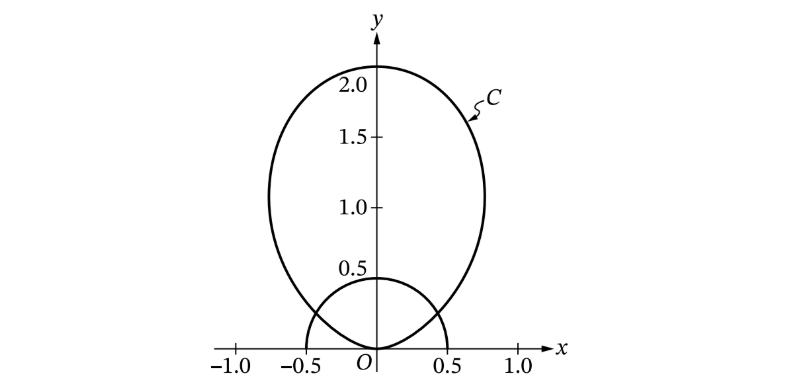
Curve \(C\) is defined by the polar equation \(r(\theta)=2 \sin^{2}\theta\) for \(0\le\theta\le\pi\). Curve \(C\) and the semicircle \(r=\frac{1}{2}\) for \(0\le\theta\le\pi\) are shown in the xy-plane.
(Note: Your calculator should be in radian mode.)
(a) Find the rate of change of \(r\) with respect to \(\theta\) at the point on curve \(C\) where \(\theta=1.3\). Show the setup for your calculations.
(b) Find the area of the region that lies inside curve \(C\) but outside the graph of the polar equation \(r=\frac{1}{2}\). Show the setup for your calculations.
(c) It can be shown that \(\frac{dx}{d\theta}=4 \sin \theta \cos^{2}\theta-2 \sin^{3}\theta\) for curve \(C\). For \(0\le\theta\le\frac{\pi}{2}\), find the value of \(\theta\) that corresponds to the point on curve \(C\) that is farthest from the y-axis. Justify your answer.
(d) A particle travels along curve \(C\) so that \(\frac{d\theta}{dt}=15\) for all times \(t\). Find the rate at which the particle’s distance from the origin changes with respect to time when the particle is at the point where \(\theta=1.3\). Show the setup for your calculations.

Most-appropriate topic codes (CED):

TOPIC 9.7: Polar Coordinates and Derivatives — part (a)
TOPIC 9.9: Area of a Polar Region — part (b)
TOPIC 9.8: Motion and Optimization in Polar Coordinates — part (c)
TOPIC 4.4: Related Rates — part (d)
▶️ Answer/Explanation
Detailed solution

(a)
We calculate the derivative of \(r\) with respect to \(\theta\) at \(\theta=1.3\):
\( \frac{dr}{d\theta}\Big|_{\theta=1.3} \approx 1.031 \)
The rate of change is 1.031 .

(b)
First, find the intersection points of \(r=2\sin^2\theta\) and \(r=\frac{1}{2}\) in the interval \(0\le\theta\le\pi\):
\( 2\sin^2\theta = \frac{1}{2} \Rightarrow \sin^2\theta = \frac{1}{4} \Rightarrow \sin\theta = \frac{1}{2} \)
The intersections occur at \(\theta = \frac{\pi}{6}\) and \(\theta = \frac{5\pi}{6}\) .
The area is given by the integral:
\( \frac{1}{2}\int_{\pi/6}^{5\pi/6} \left( (2\sin^2\theta)^2 – (\frac{1}{2})^2 \right) d\theta \)
Using a calculator, the area is approximately 2.067 (or 2.066) .

(c)
The point farthest from the y-axis maximizes the x-coordinate, \(x(\theta) = r(\theta)\cos\theta\).
We set \(\frac{dx}{d\theta} = 0\):
\( 4 \sin \theta \cos^{2}\theta-2 \sin^{3}\theta = 0 \)
Solving for \(\theta\) in \(0\le\theta\le\frac{\pi}{2}\), we get \(\theta \approx 0.955317\) .
We apply the Candidates Test on \(0\le\theta\le\frac{\pi}{2}\):
• \(\theta=0 \Rightarrow x(0) = 0\)
• \(\theta=0.955 \Rightarrow x(0.955) \approx 0.770\)
• \(\theta=\frac{\pi}{2} \Rightarrow x(\frac{\pi}{2}) = 0\)
The maximum value occurs at \(\theta = 0.955\) .

(d)
We use the chain rule to find the rate of change of distance from the origin (\(r\)) with respect to time (\(t\)):
\( \frac{dr}{dt} = \frac{dr}{d\theta} \cdot \frac{d\theta}{dt} \)
At \(\theta=1.3\):
\( \frac{dr}{dt} = (1.031003)(15) \approx 15.465 \)
The rate of change is 15.465.
Question 3

A student starts reading a book at time \(t=0\) minutes and continues reading for the next \(10\) minutes. The rate at which the student reads is modeled by the differentiable function \(R\), where \(R(t)\) is measured in words per minute. Selected values of \(R(t)\) are given in the table shown.
\(t\) (minutes)\(0\)\(2\)\(8\)\(10\)
\(R(t)\) (words per minute)\(90\)\(100\)\(150\)\(162\)
(a) Approximate \(R^{\prime}(1)\) using the average rate of change of \(R\) over the interval \(0\le t\le2\). Show the work that leads to your answer. Indicate units of measure.
(b) Must there be a value \(c\), for \(0<c<10\), such that \(R(c)=155\)? Justify your answer.
(c) Use a trapezoidal sum with the three subintervals indicated by the data in the table to approximate the value of \(\int_{0}^{10}R(t)dt\). Show the work that leads to your answer.
(d) A teacher also starts reading at time \(t=0\) minutes and continues reading for the next \(10\) minutes. The rate at which the teacher reads is modeled by the function \(W\) defined by \(W(t)=-\frac{3}{10}t^{2}+8t+100\), where \(W(t)\) is measured in words per minute. Based on the model, how many words has the teacher read by the end of the \(10\) minutes?

Most-appropriate topic codes (CED):

TOPIC 2.1: Average Rate of Change — part (a)
TOPIC 1.16: Intermediate Value Theorem — part (b)
TOPIC 6.2: Approximating Riemann Sums (Trapezoidal) — part (c)
TOPIC 8.2: Motion Problems (Total Distance/Accumulation) — part (d)
▶️ Answer/Explanation
Detailed solution

(a)
\( R'(1) \approx \frac{R(2)-R(0)}{2-0} = \frac{100-90}{2} = 5 \)
The unit is words per minute per minute (or words/min²).

(b)
Since \(R\) is differentiable, it is continuous on \([0, 10]\).
\(R(8) = 150\) and \(R(10) = 162\).
Since \(150 < 155 < 162\), by the Intermediate Value Theorem, there must be a value \(c\) in the interval \((8, 10)\) (and thus in \(0 < c < 10\)) such that \(R(c) = 155\).

(c)
Trapezoidal sum approximation:
\( \int_{0}^{10}R(t)dt \approx \frac{1}{2}(2-0)(R(0)+R(2)) + \frac{1}{2}(8-2)(R(2)+R(8)) + \frac{1}{2}(10-8)(R(8)+R(10)) \)
\( = \frac{1}{2}(2)(90+100) + \frac{1}{2}(6)(100+150) + \frac{1}{2}(2)(150+162) \)
\( = 1(190) + 3(250) + 1(312) \)
\( = 190 + 750 + 312 = 1252 \)

(d)
The total number of words read is the integral of the rate \(W(t)\) from \(0\) to \(10\):
\( \int_{0}^{10} W(t) dt = \int_{0}^{10} (-\frac{3}{10}t^2 + 8t + 100) dt \)
\( = \left[ -\frac{1}{10}t^3 + 4t^2 + 100t \right]_{0}^{10} \)
\( = (-100 + 400 + 1000) – 0 \)
\( = 1300 \)
The teacher has read 1300 words.

Question 4

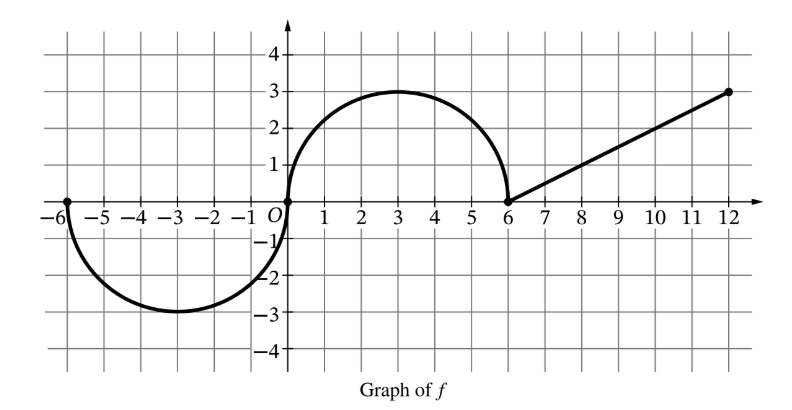
The continuous function \(f\) is defined on the closed interval \(-6\le x\le12\). The graph of \(f\), consisting of two semicircles and one line segment, is shown in the figure.
Let \(g\) be the function defined by \(g(x)=\int_{6}^{x}f(t)dt\).
(a) Find \(g^{\prime}(8)\). Give a reason for your answer.
(b) Find all values of \(x\) in the open interval \(-6<x<12\) at which the graph of \(g\) has a point of inflection. Give a reason for your answer.
(c) Find \(g(12)\) and \(g(0)\). Label your answers.
(d) Find the value of \(x\) at which \(g\) attains an absolute minimum on the closed interval \(-6\le x\le12\). Justify your answer.

Most-appropriate topic codes (CED):

TOPIC 6.4: The Fundamental Theorem of Calculus and Accumulation Functions — part (a)
TOPIC 5.9: Connecting a Function, Its First Derivative, and Its Second Derivative — part (b)
TOPIC 6.6: Applying Properties of Definite Integrals — part (c)
TOPIC 5.5: Using the Candidates Test to Determine Absolute (Global) Extrema — part (d)
▶️ Answer/Explanation
Detailed solution

(a)
\(g^{\prime}(x)=f(x)\)
\(g^{\prime}(8)=f(8)=1\)
Reason: The Fundamental Theorem of Calculus.

(b)
A point of inflection occurs where \(g^{\prime \prime}(x)=f^{\prime}(x)\) changes sign, which corresponds to where the graph of \(f\) changes from increasing to decreasing or decreasing to increasing.
This occurs at \(x=-2\) and \(x=6\).

(c)
\(g(12) = \int_{6}^{12} f(t) dt = \frac{1}{2}(6)(-3) = -9\)
\(g(0) = \int_{6}^{0} f(t) dt = -\int_{0}^{6} f(t) dt = -\frac{1}{2}\pi(3)^{2} = -\frac{9\pi}{2}\)

(d)
\(g\) attains an absolute minimum when \(g^{\prime}(x)=f(x)=0\) or at an endpoint.
\(f(x)=0\) at \(x=-6, 0, 12\).
Candidates Test:
• \(x=-6\): \(g(-6) = \int_{6}^{-6} f(t) dt = -9\pi \approx -28.27\)
• \(x=0\): \(g(0) = -\frac{9\pi}{2} \approx -14.14\)
• \(x=12\): \(g(12) = -9\)
The absolute minimum is at \(x=-6\).

Question 5

Let \(y=f(x)\) be the particular solution to the differential equation \(\frac{dy}{dx}=(3-x)y^{2}\) with initial condition \(f(1)=-1\).
(a) Find \(f^{\prime\prime}(1)\), the value of \(\frac{d^{2}y}{dx^{2}}\) at the point \((1,-1)\). Show the work that leads to your answer.
(b) Write the second-degree Taylor polynomial for \(f\) about \(x=1\).
(c) The second-degree Taylor polynomial for \(f\) about \(x=1\) is used to approximate \(f(1.1)\). Given that \(|f^{\prime\prime\prime}(x)|\le60\) for all \(x\) in the interval \(1\le x\le1.1\), use the Lagrange error bound to show that this approximation differs from \(f(1.1)\) by at most \(0.01\).
(d) Use Euler’s method, starting at \(x=1\) with two steps of equal size, to approximate \(f(1.4)\). Show the work that leads to your answer.

Most-appropriate topic codes (CED):

TOPIC 4.7: Using Implicit Differentiation — part (a)
TOPIC 10.11: Finding Taylor Polynomials — part (b)
TOPIC 10.12: Lagrange Error Bound — part (c)
TOPIC 7.5: Approximating Solutions Using Euler’s Method — part (d)
▶️ Answer/Explanation
Detailed solution

(a)
First, find \(f'(1)\):
\(\frac{dy}{dx}\Big|_{(1,-1)} = (3-1)(-1)^2 = 2(1) = 2\)
Next, differentiate \(\frac{dy}{dx}=(3-x)y^{2}\) with respect to \(x\) using the product and chain rules:
\(\frac{d^{2}y}{dx^{2}} = -1 \cdot y^2 + (3-x) \cdot 2y \frac{dy}{dx}\)
Evaluate at \((1, -1)\):
\(f”(1) = -(-1)^2 + (3-1)(2)(-1)(2)\)
\(f”(1) = -1 + (2)(-2)(2) = -1 – 8 = -9\).

(b)
The second-degree Taylor polynomial is given by:
\(T_2(x) = f(1) + f'(1)(x-1) + \frac{f”(1)}{2!}(x-1)^2\)
Substituting the values:
\(T_2(x) = -1 + 2(x-1) – \frac{9}{2}(x-1)^2\).

(c)
Lagrange Error Bound formula:
\( \text{Error} \le \frac{\max|f”'(x)|}{3!} |x-c|^3 \)
Given \(\max|f”'(x)| \le 60\) and \(x=1.1, c=1\):
\( \text{Error} \le \frac{60}{6} |1.1-1|^3 \)
\( \text{Error} \le 10 (0.1)^3 = 10(0.001) = 0.01 \)
Thus, the approximation differs by at most 0.01.

(d)
Euler’s method with 2 steps of size \(\Delta x = \frac{1.4-1}{2} = 0.2\):
Step 1: \((x_0, y_0) = (1, -1)\)
\(y_1 = y_0 + f'(x_0, y_0) \Delta x = -1 + 2(0.2) = -0.6\)
New point: \((1.2, -0.6)\)
Step 2: Calculate slope at \((1.2, -0.6)\)
\(\frac{dy}{dx} = (3-1.2)(-0.6)^2 = (1.8)(0.36) = 0.648\)
\(y_2 = y_1 + f'(x_1, y_1) \Delta x = -0.6 + 0.648(0.2)\)
\(y_2 = -0.6 + 0.1296 = -0.4704\)
\(f(1.4) \approx -0.470\) (or -0.4704).

Question 6

The Taylor series for a function \(f\) about \(x=4\) is given by \(\sum_{n=1}^{\infty}\frac{(x-4)^{n+1}}{(n+1)3^{n}}=\frac{(x-4)^{2}}{2\cdot3}+\frac{(x-4)^{3}}{3\cdot3^{2}}+\frac{(x-4)^{4}}{4\cdot3^{3}}+\dots+\frac{(x-4)^{n+1}}{(n+1)3^{n}}+\dots\) and converges to \(f(x)\) on its interval of convergence.
(a) Using the ratio test, find the interval of convergence of the Taylor series for \(f\) about \(x=4\). Justify your answer.
(b) Find the first three nonzero terms and the general term of the Taylor series for \(f^{\prime}\), the derivative of \(f\), about \(x=4\).
(c) The Taylor series for \(f^{\prime}\) described in part (b) is a geometric series. For all \(x\) in the interval of convergence of the Taylor series for \(f^{\prime}\), show that \(f^{\prime}(x)=\frac{x-4}{7-x}\).
(d) It is known that the radius of convergence of the Taylor series for \(f\) about \(x=4\) is the same as the radius of convergence of the Taylor series for \(f^{\prime}\) about \(x=4\). Does the Taylor series for \(f^{\prime}\) described in part (b) converge to \(f^{\prime}(x)=\frac{x-4}{7-x}\) at \(x=8\)? Give a reason for your answer.

Most-appropriate topic codes (CED):

TOPIC 10.13: The Ratio Test and Interval of Convergence — part (a)
TOPIC 10.15: Representing Functions as Power Series — part (b)
TOPIC 10.2: Geometric Series — part (c)
TOPIC 10.13: Radius and Interval of Convergence — part (d)
▶️ Answer/Explanation
Detailed solution

(a)
We use the ratio test:
\( \lim_{n\to\infty} \left| \frac{a_{n+1}}{a_n} \right| = \lim_{n\to\infty} \left| \frac{(x-4)^{n+2}}{(n+2)3^{n+1}} \cdot \frac{(n+1)3^n}{(x-4)^{n+1}} \right| \)
\( = \lim_{n\to\infty} \left| \frac{x-4}{3} \cdot \frac{n+1}{n+2} \right| = \frac{|x-4|}{3} \)
Setting the limit \( < 1 \):
\( \frac{|x-4|}{3} < 1 \Rightarrow |x-4| < 3 \Rightarrow -3 < x-4 < 3 \Rightarrow 1 < x < 7 \).
Check endpoints:
• At \(x=1\): \(\sum \frac{(-3)^{n+1}}{(n+1)3^n} = \sum \frac{3(-1)^{n+1}}{n+1}\). Converges (Alternating Harmonic Series).
• At \(x=7\): \(\sum \frac{3^{n+1}}{(n+1)3^n} = \sum \frac{3}{n+1}\). Diverges (Harmonic Series).
Interval of convergence: \(1 \le x < 7\).

(b)
Differentiate the series for \(f\) term by term:
\(f(x) = \frac{(x-4)^2}{2\cdot 3} + \frac{(x-4)^3}{3\cdot 3^2} + \frac{(x-4)^4}{4\cdot 3^3} + \dots + \frac{(x-4)^{n+1}}{(n+1)3^n} + \dots\)
\(f'(x) = \frac{2(x-4)}{2\cdot 3} + \frac{3(x-4)^2}{3\cdot 3^2} + \frac{4(x-4)^3}{4\cdot 3^3} + \dots + \frac{(n+1)(x-4)^n}{(n+1)3^n} + \dots\)
Simplify to find the first three nonzero terms:
\(\frac{x-4}{3} + \frac{(x-4)^2}{3^2} + \frac{(x-4)^3}{3^3}\)
General term: \(\frac{(x-4)^n}{3^n}\).

(c)
The series \(\sum_{n=1}^{\infty} \left(\frac{x-4}{3}\right)^n\) is geometric with first term \(a = \frac{x-4}{3}\) and ratio \(r = \frac{x-4}{3}\).
Sum \( = \frac{a}{1-r} = \frac{\frac{x-4}{3}}{1 – \frac{x-4}{3}} \)
Multiply numerator and denominator by 3:
\( = \frac{x-4}{3-(x-4)} = \frac{x-4}{7-x} \).

(d)
The radius of convergence is \(R=3\), so the series converges for \(|x-4| < 3\).
At \(x=8\), \(|8-4| = 4\).
Since \(4 > 3\), \(x=8\) is outside the interval of convergence.
Therefore, the series does not converge to \(f'(8)\).

Scroll to Top