Question 1
(Note: Your calculator should be in radian mode.)
Most-appropriate topic codes (CED):
• TOPIC 5.1: Using the Mean Value Theorem — part (b)
• TOPIC 1.15: Connecting Limits at Infinity and Horizontal Asymptotes — part (c)
• TOPIC 5.5: Using the Candidates Test to Determine Absolute (Global) Extrema — part (d)
▶️ Answer/Explanation
(a)
The average number of acres is given by the integral:
\( \frac{1}{4-0}\int_{0}^{4} C(t) \, dt \)
Using a graphing calculator to evaluate the integral:
\( \frac{1}{4}(11.112896) \approx 2.778 \)
The average number of acres affected is 2.778 .
(b)
The average rate of change of \(C\) over \(0 \le t \le 4\) is:
\( \frac{C(4)-C(0)}{4-0} = \frac{5.128031 – 0}{4} \approx 1.282008 \)
We set the instantaneous rate of change \(C'(t)\) equal to the average rate of change:
\( \frac{38}{25+t^2} = 1.282008 \)
Using a calculator solver:
\( t \approx 2.154 \) .
(c)
Limit expression:
\( \lim_{t\to\infty} C'(t) = \lim_{t\to\infty} \frac{38}{25+t^2} \)
Value:
\( = 0 \).
(d)
\(A(t)\) is maximized when \(A'(t)=0\) or at endpoints. First, find \(A'(t)\):
\( A'(t) = C'(t) – 0.1 \ln(t) \)
Set \(A'(t) = 0\):
\( \frac{38}{25+t^2} – 0.1 \ln(t) = 0 \)
Using a calculator, the critical point in the interval is \(t \approx 11.442\) (or \(11.4417\)).
Apply the Candidates Test:
• \(t=4\): \(A(4) = C(4) – 0 \approx 5.128\)
• \(t=11.442\): \(A(11.442) = C(11.442) – \int_{4}^{11.442} 0.1 \ln(x) \, dx \approx 7.317\)
• \(t=36\): \(A(36) = C(36) – \int_{4}^{36} 0.1 \ln(x) \, dx \approx 1.743\)
The maximum value occurs at \(t = 11.442\) weeks .
Question 2
(Note: Your calculator should be in radian mode.)
Most-appropriate topic codes (CED):
• TOPIC 9.9: Area of a Polar Region — part (b)
• TOPIC 9.8: Motion and Optimization in Polar Coordinates — part (c)
• TOPIC 4.4: Related Rates — part (d)
▶️ Answer/Explanation
(a)
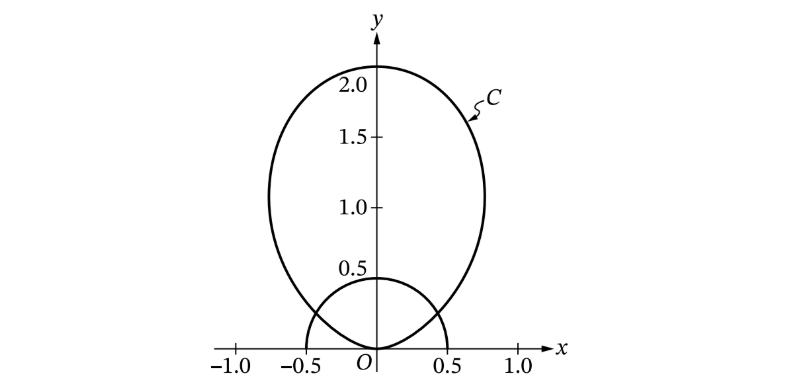
We calculate the derivative of \(r\) with respect to \(\theta\) at \(\theta=1.3\):
\( \frac{dr}{d\theta}\Big|_{\theta=1.3} \approx 1.031 \)
The rate of change is 1.031 .
(b)
First, find the intersection points of \(r=2\sin^2\theta\) and \(r=\frac{1}{2}\) in the interval \(0\le\theta\le\pi\):
\( 2\sin^2\theta = \frac{1}{2} \Rightarrow \sin^2\theta = \frac{1}{4} \Rightarrow \sin\theta = \frac{1}{2} \)
The intersections occur at \(\theta = \frac{\pi}{6}\) and \(\theta = \frac{5\pi}{6}\) .
The area is given by the integral:
\( \frac{1}{2}\int_{\pi/6}^{5\pi/6} \left( (2\sin^2\theta)^2 – (\frac{1}{2})^2 \right) d\theta \)
Using a calculator, the area is approximately 2.067 (or 2.066) .
(c)
The point farthest from the y-axis maximizes the x-coordinate, \(x(\theta) = r(\theta)\cos\theta\).
We set \(\frac{dx}{d\theta} = 0\):
\( 4 \sin \theta \cos^{2}\theta-2 \sin^{3}\theta = 0 \)
Solving for \(\theta\) in \(0\le\theta\le\frac{\pi}{2}\), we get \(\theta \approx 0.955317\) .
We apply the Candidates Test on \(0\le\theta\le\frac{\pi}{2}\):
• \(\theta=0 \Rightarrow x(0) = 0\)
• \(\theta=0.955 \Rightarrow x(0.955) \approx 0.770\)
• \(\theta=\frac{\pi}{2} \Rightarrow x(\frac{\pi}{2}) = 0\)
The maximum value occurs at \(\theta = 0.955\) .
(d)
We use the chain rule to find the rate of change of distance from the origin (\(r\)) with respect to time (\(t\)):
\( \frac{dr}{dt} = \frac{dr}{d\theta} \cdot \frac{d\theta}{dt} \)
At \(\theta=1.3\):
\( \frac{dr}{dt} = (1.031003)(15) \approx 15.465 \)
The rate of change is 15.465.
Question 3
| \(t\) (minutes) | \(0\) | \(2\) | \(8\) | \(10\) |
|---|---|---|---|---|
| \(R(t)\) (words per minute) | \(90\) | \(100\) | \(150\) | \(162\) |
Most-appropriate topic codes (CED):
• TOPIC 1.16: Intermediate Value Theorem — part (b)
• TOPIC 6.2: Approximating Riemann Sums (Trapezoidal) — part (c)
• TOPIC 8.2: Motion Problems (Total Distance/Accumulation) — part (d)
▶️ Answer/Explanation
(a)
\( R'(1) \approx \frac{R(2)-R(0)}{2-0} = \frac{100-90}{2} = 5 \)
The unit is words per minute per minute (or words/min²).
(b)
Since \(R\) is differentiable, it is continuous on \([0, 10]\).
\(R(8) = 150\) and \(R(10) = 162\).
Since \(150 < 155 < 162\), by the Intermediate Value Theorem, there must be a value \(c\) in the interval \((8, 10)\) (and thus in \(0 < c < 10\)) such that \(R(c) = 155\).
(c)
Trapezoidal sum approximation:
\( \int_{0}^{10}R(t)dt \approx \frac{1}{2}(2-0)(R(0)+R(2)) + \frac{1}{2}(8-2)(R(2)+R(8)) + \frac{1}{2}(10-8)(R(8)+R(10)) \)
\( = \frac{1}{2}(2)(90+100) + \frac{1}{2}(6)(100+150) + \frac{1}{2}(2)(150+162) \)
\( = 1(190) + 3(250) + 1(312) \)
\( = 190 + 750 + 312 = 1252 \)
(d)
The total number of words read is the integral of the rate \(W(t)\) from \(0\) to \(10\):
\( \int_{0}^{10} W(t) dt = \int_{0}^{10} (-\frac{3}{10}t^2 + 8t + 100) dt \)
\( = \left[ -\frac{1}{10}t^3 + 4t^2 + 100t \right]_{0}^{10} \)
\( = (-100 + 400 + 1000) – 0 \)
\( = 1300 \)
The teacher has read 1300 words.
Question 4
Most-appropriate topic codes (CED):
• TOPIC 5.9: Connecting a Function, Its First Derivative, and Its Second Derivative — part (b)
• TOPIC 6.6: Applying Properties of Definite Integrals — part (c)
• TOPIC 5.5: Using the Candidates Test to Determine Absolute (Global) Extrema — part (d)
▶️ Answer/Explanation
(a)
\(g^{\prime}(x)=f(x)\)
\(g^{\prime}(8)=f(8)=1\)
Reason: The Fundamental Theorem of Calculus.
(b)
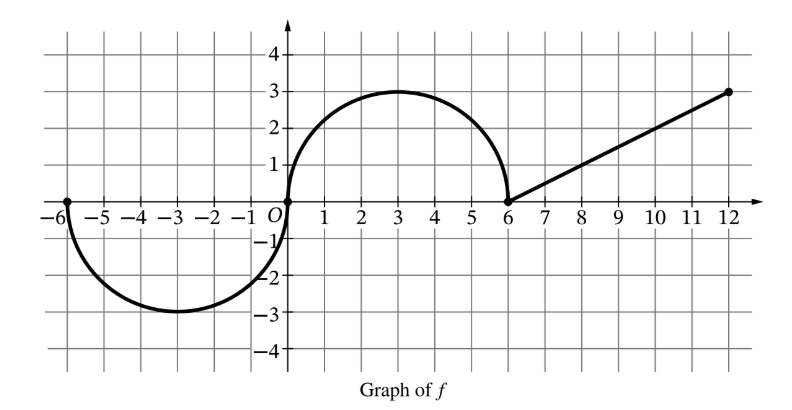
A point of inflection occurs where \(g^{\prime \prime}(x)=f^{\prime}(x)\) changes sign, which corresponds to where the graph of \(f\) changes from increasing to decreasing or decreasing to increasing.
This occurs at \(x=-2\) and \(x=6\).
(c)
\(g(12) = \int_{6}^{12} f(t) dt = \frac{1}{2}(6)(-3) = -9\)
\(g(0) = \int_{6}^{0} f(t) dt = -\int_{0}^{6} f(t) dt = -\frac{1}{2}\pi(3)^{2} = -\frac{9\pi}{2}\)
(d)
\(g\) attains an absolute minimum when \(g^{\prime}(x)=f(x)=0\) or at an endpoint.
\(f(x)=0\) at \(x=-6, 0, 12\).
Candidates Test:
• \(x=-6\): \(g(-6) = \int_{6}^{-6} f(t) dt = -9\pi \approx -28.27\)
• \(x=0\): \(g(0) = -\frac{9\pi}{2} \approx -14.14\)
• \(x=12\): \(g(12) = -9\)
The absolute minimum is at \(x=-6\).
Question 5
Most-appropriate topic codes (CED):
• TOPIC 10.11: Finding Taylor Polynomials — part (b)
• TOPIC 10.12: Lagrange Error Bound — part (c)
• TOPIC 7.5: Approximating Solutions Using Euler’s Method — part (d)
▶️ Answer/Explanation
(a)
First, find \(f'(1)\):
\(\frac{dy}{dx}\Big|_{(1,-1)} = (3-1)(-1)^2 = 2(1) = 2\)
Next, differentiate \(\frac{dy}{dx}=(3-x)y^{2}\) with respect to \(x\) using the product and chain rules:
\(\frac{d^{2}y}{dx^{2}} = -1 \cdot y^2 + (3-x) \cdot 2y \frac{dy}{dx}\)
Evaluate at \((1, -1)\):
\(f”(1) = -(-1)^2 + (3-1)(2)(-1)(2)\)
\(f”(1) = -1 + (2)(-2)(2) = -1 – 8 = -9\).
(b)
The second-degree Taylor polynomial is given by:
\(T_2(x) = f(1) + f'(1)(x-1) + \frac{f”(1)}{2!}(x-1)^2\)
Substituting the values:
\(T_2(x) = -1 + 2(x-1) – \frac{9}{2}(x-1)^2\).
(c)
Lagrange Error Bound formula:
\( \text{Error} \le \frac{\max|f”'(x)|}{3!} |x-c|^3 \)
Given \(\max|f”'(x)| \le 60\) and \(x=1.1, c=1\):
\( \text{Error} \le \frac{60}{6} |1.1-1|^3 \)
\( \text{Error} \le 10 (0.1)^3 = 10(0.001) = 0.01 \)
Thus, the approximation differs by at most 0.01.
(d)
Euler’s method with 2 steps of size \(\Delta x = \frac{1.4-1}{2} = 0.2\):
Step 1: \((x_0, y_0) = (1, -1)\)
\(y_1 = y_0 + f'(x_0, y_0) \Delta x = -1 + 2(0.2) = -0.6\)
New point: \((1.2, -0.6)\)
Step 2: Calculate slope at \((1.2, -0.6)\)
\(\frac{dy}{dx} = (3-1.2)(-0.6)^2 = (1.8)(0.36) = 0.648\)
\(y_2 = y_1 + f'(x_1, y_1) \Delta x = -0.6 + 0.648(0.2)\)
\(y_2 = -0.6 + 0.1296 = -0.4704\)
\(f(1.4) \approx -0.470\) (or -0.4704).
Question 6
Most-appropriate topic codes (CED):
• TOPIC 10.15: Representing Functions as Power Series — part (b)
• TOPIC 10.2: Geometric Series — part (c)
• TOPIC 10.13: Radius and Interval of Convergence — part (d)
▶️ Answer/Explanation
(a)
We use the ratio test:
\( \lim_{n\to\infty} \left| \frac{a_{n+1}}{a_n} \right| = \lim_{n\to\infty} \left| \frac{(x-4)^{n+2}}{(n+2)3^{n+1}} \cdot \frac{(n+1)3^n}{(x-4)^{n+1}} \right| \)
\( = \lim_{n\to\infty} \left| \frac{x-4}{3} \cdot \frac{n+1}{n+2} \right| = \frac{|x-4|}{3} \)
Setting the limit \( < 1 \):
\( \frac{|x-4|}{3} < 1 \Rightarrow |x-4| < 3 \Rightarrow -3 < x-4 < 3 \Rightarrow 1 < x < 7 \).
Check endpoints:
• At \(x=1\): \(\sum \frac{(-3)^{n+1}}{(n+1)3^n} = \sum \frac{3(-1)^{n+1}}{n+1}\). Converges (Alternating Harmonic Series).
• At \(x=7\): \(\sum \frac{3^{n+1}}{(n+1)3^n} = \sum \frac{3}{n+1}\). Diverges (Harmonic Series).
Interval of convergence: \(1 \le x < 7\).
(b)
Differentiate the series for \(f\) term by term:
\(f(x) = \frac{(x-4)^2}{2\cdot 3} + \frac{(x-4)^3}{3\cdot 3^2} + \frac{(x-4)^4}{4\cdot 3^3} + \dots + \frac{(x-4)^{n+1}}{(n+1)3^n} + \dots\)
\(f'(x) = \frac{2(x-4)}{2\cdot 3} + \frac{3(x-4)^2}{3\cdot 3^2} + \frac{4(x-4)^3}{4\cdot 3^3} + \dots + \frac{(n+1)(x-4)^n}{(n+1)3^n} + \dots\)
Simplify to find the first three nonzero terms:
\(\frac{x-4}{3} + \frac{(x-4)^2}{3^2} + \frac{(x-4)^3}{3^3}\)
General term: \(\frac{(x-4)^n}{3^n}\).
(c)
The series \(\sum_{n=1}^{\infty} \left(\frac{x-4}{3}\right)^n\) is geometric with first term \(a = \frac{x-4}{3}\) and ratio \(r = \frac{x-4}{3}\).
Sum \( = \frac{a}{1-r} = \frac{\frac{x-4}{3}}{1 – \frac{x-4}{3}} \)
Multiply numerator and denominator by 3:
\( = \frac{x-4}{3-(x-4)} = \frac{x-4}{7-x} \).
(d)
The radius of convergence is \(R=3\), so the series converges for \(|x-4| < 3\).
At \(x=8\), \(|8-4| = 4\).
Since \(4 > 3\), \(x=8\) is outside the interval of convergence.
Therefore, the series does not converge to \(f'(8)\).
