
AP Chemistry 1.5 Atomic Structure and Electron Configuration - Exam Style questions - FRQs- New Syllabus
Question
(ii) When manganese forms cations, electrons are lost from which subshell first? Identify both the number and letter associated with the subshell.
| Mass of empty beaker | \( 60.169\ \mathrm{g} \) |
| Mass of beaker and \( \mathrm{Mn}(s) \) | \( 61.262\ \mathrm{g} \) |
| Mass of beaker and \( \mathrm{Mn}_{x}\mathrm{Cl}_{y}(s) \) after heating to constant mass | \( 62.673\ \mathrm{g} \) |
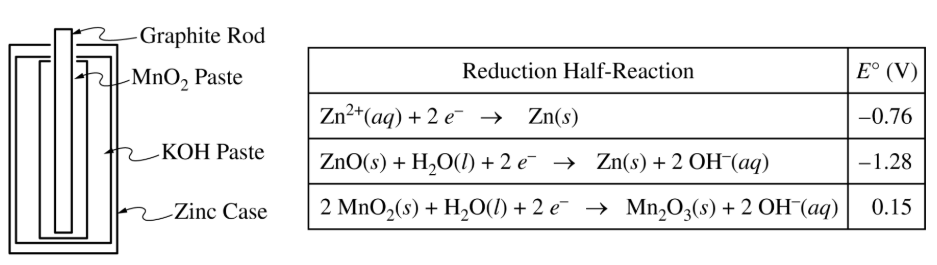
(ii) Calculate the value of \( E^\circ_{\mathrm{cell}} \) for the overall reaction.
(iii) Calculate the value of \( \Delta G^\circ \) in \( \mathrm{kJ/mol}_{\mathrm{rxn}} \).
(iv) A student claims that the total mass of an alkaline battery decreases as the battery operates because the anode loses mass. Do you agree with the student’s claim? Justify your answer.
Most-appropriate topic codes (AP Chemistry):
• Topic \( 1.3 \) — Elemental Composition of Pure Substances (Parts \( \mathrm{(b)} \), \( \mathrm{(c)} \), \( \mathrm{(d)} \), \( \mathrm{(e)} \))
• Topic \( 9.8 \) — Galvanic (Voltaic) and Electrolytic Cells (Parts \( \mathrm{(f)(i)} \), \( \mathrm{(f)(iv)} \))
• Topic \( 9.9 \) — Cell Potential and Free Energy (Parts \( \mathrm{(f)(ii)} \), \( \mathrm{(f)(iii)} \))
▶️ Answer/Explanation
(a)(i)
Accept one of the following:
\( 1s^2\,2s^2\,2p^6\,3s^2\,3p^6\,4s^2\,3d^5 \)
or \( [\mathrm{Ar}]\,4s^2\,3d^5 \)
(a)(ii)
\( 4s \)
(b)
\( 62.673\ \mathrm{g} – 61.262\ \mathrm{g} = 1.411\ \mathrm{g\ Cl} \)
(c)
\( 1.411\ \mathrm{g\ Cl} \times \dfrac{1\ \mathrm{mol\ Cl}}{35.45\ \mathrm{g\ Cl}} = 0.03980\ \mathrm{mol\ Cl} \)
(d)
\( \dfrac{0.03980\ \mathrm{mol\ Cl}}{0.0199\ \mathrm{mol\ Mn}} = 2.00 \)
Therefore, the empirical formula is \( \mathrm{MnCl}_{2} \).
(e)
Less than. If some of the \( \mathrm{Mn}_{x}\mathrm{Cl}_{y} \) splatters out, the final measured mass is smaller, so the calculated mass and moles of chlorine are smaller.
(f)(i)
\( \mathrm{2\,MnO}_{2}(s) + \mathrm{H}_{2}\mathrm{O}(l) + 2\,e^- \rightarrow \mathrm{Mn}_{2}\mathrm{O}_{3}(s) + 2\,\mathrm{OH}^-(aq) \)
\( \mathrm{Zn}(s) + 2\,\mathrm{OH}^-(aq) \rightarrow \mathrm{ZnO}(s) + \mathrm{H}_{2}\mathrm{O}(l) + 2\,e^- \)
Overall:
\( \mathrm{2\,MnO}_{2}(s) + \mathrm{Zn}(s) \rightarrow \mathrm{Mn}_{2}\mathrm{O}_{3}(s) + \mathrm{ZnO}(s) \)
(f)(ii)
\( E^\circ_{\mathrm{cell}} = 0.15\ \mathrm{V} – (-1.28\ \mathrm{V}) = 1.43\ \mathrm{V} \)
(f)(iii)
\( \Delta G^\circ = -nFE^\circ \)
\( \Delta G^\circ = -(2)(96{,}485)(1.43)\left(\dfrac{1\ \mathrm{kJ}}{1000\ \mathrm{J}}\right) = -276\ \mathrm{kJ/mol}_{\mathrm{rxn}} \)
(f)(iv)
Disagree. The battery is sealed, so the total mass remains the same.