Home / AP Chemistry 2.5 Lewis Diagrams – Exam Style questions – FRQs

AP Chemistry 2.5 Lewis Diagrams - Exam Style questions - FRQs- New Syllabus

Question

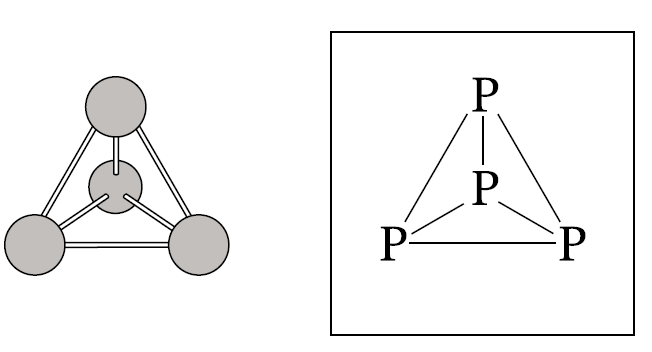
White phosphorus is composed of \( \mathrm{P_4} \) molecules with a tetrahedral structure, as shown in the diagram on the left. Each \( \mathrm{P} \) atom is bonded to the other three \( \mathrm{P} \) atoms by single bonds, as shown in the incomplete Lewis diagram on the right.
A. In the box in part A, complete the Lewis diagram for \( \mathrm{P_4} \) by drawing the nonbonding electrons.
B. The reaction of white phosphorus with oxygen to form \( \mathrm{P_4O_{10}}(s) \) is thermodynamically favorable at \(298\ \mathrm{K}\). The reaction is represented by equation \(1\).
Equation \(1\): \( \mathrm{P_4}(s) + 5\ \mathrm{O_2}(g) \rightarrow \mathrm{P_4O_{10}}(s) \)
(i) The entropy change of the reaction, \( \Delta S^\circ \), is negative. Using particle-level reasoning, explain why the entropy decreases as the reaction progresses.
(ii) The enthalpy change of the reaction, \( \Delta H^\circ \), is also negative. A student claims that the favorability of the reaction is driven by enthalpy and not by entropy. Is the student’s claim correct? Justify your answer by using the relationship between \( \Delta G^\circ \), \( \Delta H^\circ \), and \( \Delta S^\circ \).
\( \mathrm{P_4O_{10}}(s) \) reacts exothermically with water to form phosphoric acid, as represented by equation \(2\).
Equation \(2\): \( \mathrm{P_4O_{10}}(s) + 6\ \mathrm{H_2O}(l) \rightarrow 4\ \mathrm{H_3PO_4}(aq) \)
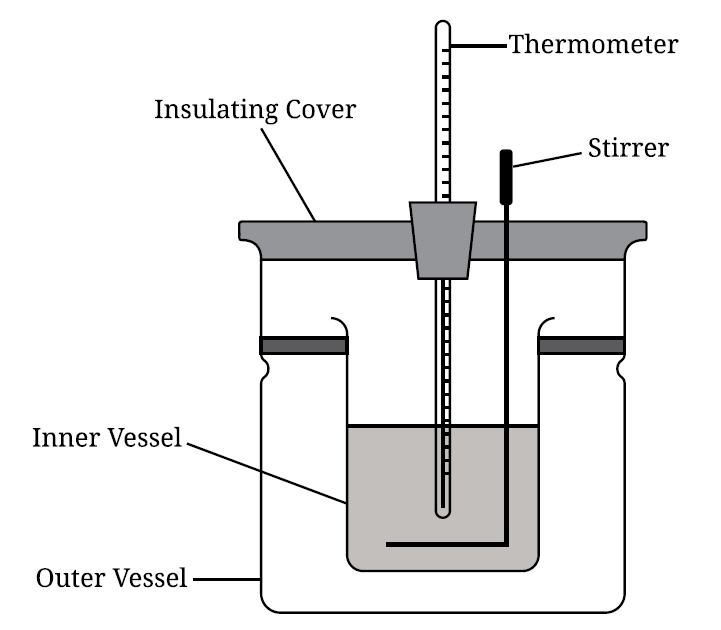
A chemist uses a calorimetry experiment to determine the enthalpy change for the reaction, as represented by the following diagram.
C. The chemist carries out the calorimetry experiment and records the following information.
Mass of \( \mathrm{P_4O_{10}} \)\(0.100\ \mathrm{g}\)
Mass of \( \mathrm{H_2O} \)\(100.0\ \mathrm{g}\)
Initial temperature\(22.00^\circ\mathrm{C}\)
Final temperature\(22.38^\circ\mathrm{C}\)
Molar mass of \( \mathrm{P_4O_{10}} \)\(283.9\ \mathrm{g\ mol^{-1}}\)
Specific heat of \( \mathrm{H_2O} \)\(4.18\ \mathrm{J\ g^{-1}\ ^\circ C^{-1}}\)
(i) Calculate the amount of heat, \( q \), released during the experiment, in \( \mathrm{kJ} \). Assume that the specific heat of the solution is the same as that of water.
(ii) Calculate the value of \( \Delta H^\circ_{\mathrm{rxn}} \) for equation \(2\) in \( \mathrm{kJ\ mol^{-1}_{rxn}} \). Include the sign in your answer.
D. The chemist weighed out \(0.100\ \mathrm{g}\) of \( \mathrm{P_4O_{10}} \) and \(100.0\ \mathrm{g}\) of \( \mathrm{H_2O} \) to perform a second trial. In the second trial, some of the solid \( \mathrm{P_4O_{10}} \) stuck to the weighing paper and was not transferred to the calorimeter. Given that \( \mathrm{P_4O_{10}} \) is the limiting reactant, would \( \Delta T \) for the second trial be greater than, less than, or equal to the value in the first trial? Justify your answer.
\( \mathrm{P_4}(s) \) also reacts readily with \( \mathrm{Cl_2}(g) \) to produce phosphorus trichloride, \( \mathrm{PCl_3}(g) \), which in turn reacts with \( \mathrm{Cl_2}(g) \) in an equilibrium process to produce \( \mathrm{PCl_5}(g) \).
Equation \(3\): \( \mathrm{P_4}(s) + 6\ \mathrm{Cl_2}(g) \rightarrow 4\ \mathrm{PCl_3}(g) \qquad \Delta H^\circ_1 = -1148\ \mathrm{kJ\ mol^{-1}_{rxn}} \)
Equation \(4\): \( \mathrm{PCl_3}(g) + \mathrm{Cl_2}(g) \rightleftharpoons \mathrm{PCl_5}(g) \qquad \Delta H^\circ_2 = -88\ \mathrm{kJ\ mol^{-1}_{rxn}} \)
E. Calculate the standard enthalpy of formation of \( \mathrm{PCl_5}(g) \) represented by equation \(5\).
Equation \(5\): \( \frac14\mathrm{P_4}(s) + \frac52\mathrm{Cl_2}(g) \rightarrow \mathrm{PCl_5}(g) \qquad \Delta H_f^\circ = ? \)
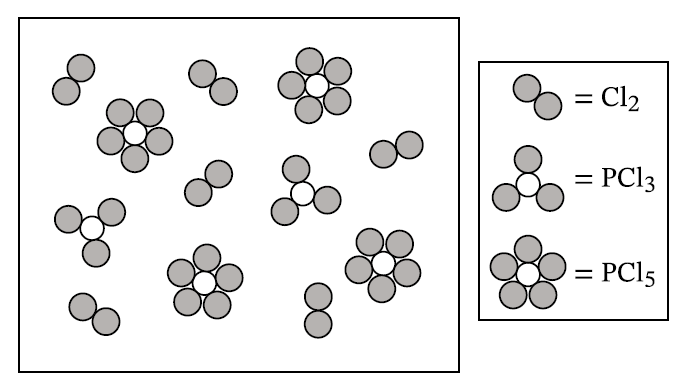
F. Equation \(4\) for the reaction that occurs is shown.
\( \mathrm{PCl_3}(g) + \mathrm{Cl_2}(g) \rightleftharpoons \mathrm{PCl_5}(g) \qquad \Delta H^\circ_2 = -88\ \mathrm{kJ\ mol^{-1}_{rxn}} \)
(i) If each particle in the diagram represents a partial pressure of \(1.00\ \mathrm{atm}\), what is the value of \(K_p\) for the equilibrium mixture at \(546\ \mathrm{K}\)?
(ii) Does the value of \(K_p\) increase, decrease, or remain the same when the temperature is increased to \(596\ \mathrm{K}\)? Justify your answer based on \( \Delta H^\circ_2 \).

Most-appropriate topic codes (AP Chemistry CED)

Topic 2.5 — Lewis Diagrams (Lewis structures and lone pairs)
Topic 9.1 — Introduction to Entropy (entropy changes in reactions)
Topic 9.3 — Gibbs Free Energy and Thermodynamic Favorability (relationship \( \Delta G^\circ = \Delta H^\circ – T\Delta S^\circ \))
Topic 6.3 — Heat Transfer and Thermal Equilibrium (calorimetry and \( q = mc\Delta T \))
Topic 6.4 — Heat Capacity and Calorimetry (calculating enthalpy change)
Topic 6.9 — Hess’s Law (combining thermochemical equations)
Topic 7.4 — Calculating the Equilibrium Constant (\(K_p\) from partial pressures)
Topic 7.10 — Reaction Quotient and Le Châtelier’s Principle (temperature effects on equilibrium)
▶️ Answer/Explanation

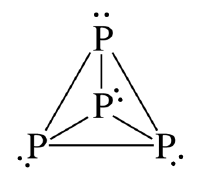
A
Each phosphorus atom forms three bonds and therefore has one lone pair of electrons. Thus one lone pair is present on each \( \mathrm{P} \) atom in the tetrahedral \( \mathrm{P_4} \) structure.
B(i)
Gas particles have more possible arrangements than solids. During the reaction gaseous \( \mathrm{O_2} \) molecules are converted into solid \( \mathrm{P_4O_{10}} \), so particle freedom decreases. Therefore entropy decreases and \( \Delta S^\circ < 0 \).

B(ii)
Yes. \( \Delta G^\circ = \Delta H^\circ – T\Delta S^\circ \). Since \( \Delta H^\circ < 0 \), the reaction releases energy and favors spontaneity. Because \( \Delta S^\circ < 0 \), entropy does not favor spontaneity. Therefore the reaction is driven by enthalpy.

C(i)
\( q = mc\Delta T \)
\( q = (100.1)(4.18)(22.38-22.00) \)
\( q = 160\ \mathrm{J} = 0.160\ \mathrm{kJ} \)

C(ii)
\( q_{rxn} = -q_{solution} = -0.160\ \mathrm{kJ} \)
moles \( \mathrm{P_4O_{10}} = \frac{0.100}{283.9} = 3.52\times10^{-4}\ \mathrm{mol} \)
\( \Delta H^\circ_{rxn} = \frac{-0.160}{3.52\times10^{-4}} = -450\ \mathrm{kJ\ mol^{-1}_{rxn}} \)

D
Less than. Because some \( \mathrm{P_4O_{10}} \) did not react, fewer moles reacted and less heat was released. Therefore the temperature increase is smaller.

E
Using Hess’s law:
\( \Delta H_f^\circ = \frac14\Delta H_1^\circ + \Delta H_2^\circ \)
\( \Delta H_f^\circ = \frac14(-1148) + (-88) = -375\ \mathrm{kJ\ mol^{-1}} \)

F(i)
\( K_p = \frac{P_{PCl_5}}{P_{PCl_3}P_{Cl_2}} \)
\( K_p = \frac{4.00}{(2.00)(6.00)} = 0.333 \)

F(ii)
Decrease. Because \( \Delta H^\circ_2 \) is negative, the forward reaction is exothermic. Increasing temperature favors the reverse reaction, so \( K_p \) decreases.

Scroll to Top