Home / AP Chemistry: 2.5 Lewis Diagrams- Exam Style questions with Answer- MCQ

AP Chemistry: 2.5 Lewis Diagrams- Exam Style questions with Answer- MCQ

Question

The figure presents two diagrams of the C H 2 O molecule. In diagram 1, the Carbon atom is bonded to the two Hydrogen atoms and the Oxygen atom with single bonds. There are three nonbonding pairs of electrons on the Oxygen atom. In diagram 2, the Carbon atom is bonded to the two Hydrogen atoms with single bonds. The Carbon atom is bonded to the Oxygen atom with a double bond. There are two nonbonding pairs of electrons on the Oxygen atom.

Which of the diagrams above best represents the CH2O molecule, and why?

A Diagram 1, because all bond angles are 180°.
 
B Diagram 1, because all atoms have a formal charge of 0.
 
C Diagram 2, because the molecule has a trigonal pyramidal shape.
 
D Diagram 2, because all atoms have a formal charge of 0.
Answer/Explanation

Ans:D

Diagram 2 represents a molecule in which both C and O have a complete octet and all atoms have a formal charge of zero.

Question

Based on formal charges, which of the following is the best Lewis electron-dot diagram for H3NO?

A  The figure presents a diagram of an H 3 N O molecule. The Nitrogen atom is bonded to the Oxygen atom and two Hydrogen atoms with single bonds. There is one nonbonding pair of electrons on the Nitrogen atom. There are two nonbonding pairs of electrons on the Oxygen atom. The Oxygen atom is bonded to the third Hydrogen atom by a single bond.
 
B  The figure presents a diagram of an H 3 N O molecule. The Nitrogen atom is bonded to three Hydrogen atoms and the Oxygen atom by single bonds. There are three nonbonding pairs of electrons on the Oxygen atom.
 
C  The figure presents a diagram of an H 3 N O molecule. The oxygen atom is bonded to the nitrogen atom and two Hydrogen atoms with single bonds. There is one nonbonding pair of electrons on the Oxygen atom. There are two nonbonding pairs of electrons on the Nitrogen atom. The nitrogen atom is bonded to the third Hydrogen atom by a single bond.
 
The figure presents a diagram of an H 3 N O molecule. The oxygen atom is bonded to the nitrogen atom and three hydrogen atoms with single bonds. There are three nonbonding pairs of electrons on the Nitrogen atom.
 
Answer/Explanation

Ans:A

 When the formal charge of each atom in this diagram is determined using the rule (formal charge of an atom = the number of valence electrons of the atom (the number of electrons in lone pairs + half the number of electrons in bonds with other atoms)), the sum of the formal charges on all the atoms in H3NO is equal to zero. A sum of formal charges on all atoms equal to zero is preferable.

Question

The figure presents two Lewis diagrams of C O 2. Diagram 1 shows the Carbon atom bonded to both of the Oxygen atoms by double bonds. Each Oxygen atom has two nonbonding pairs of electrons. Diagram 2 shows the Carbon atom bonded to one of the Oxygen atoms by a single bond. There are three pairs of nonbonding electrons on the first Oxygen atom. The Carbon atom is bonded to the second Oxygen atom by a triple bond. There is one pair of nonbonding electrons on the second Oxygen atom.

Which of the Lewis diagrams shown above is the more likely structure of CO2, and why?

A Diagram 1, because all the atoms have a formal charge of 0.
B Diagram 1, because double bonds are stronger than triple bonds.
C Diagram 2, because all the atoms have a formal charge of 0.
D Diagram 2, because triple bonds are stronger than double bonds.
Answer/Explanation

Ans:A

When the formal charge of each atom in diagram 1 is determined using the rule (formal charge of an atom = the number of valence electrons of the atom (the number of electrons in lone pairs + half the number of electrons in bonds with other atoms)), the results are zero for each of the three atoms. A molecular structure in which all formal charges are zero is preferable to one in which some formal charges are not zero. And in diagram 2, the results for the three atoms (going left to right) are 1, 0, and +1, respectively.

Question

Which of the following Lewis electron-dot diagrams represents the molecule that contains the smallest bond angle?
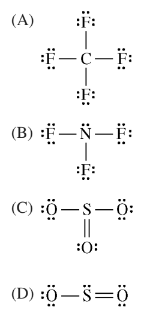
 

Answer/Explanation

Ans:A

Question

Which of the following Lewis electron-dot diagrams represents the molecule that is the most polar?

Answer/Explanation

Ans:C

Scroll to Top