\( \mathrm{C_3H_6O_3(aq) + NaOH(aq) \rightarrow NaC_3H_5O_3(aq) + H_2O(l)} \)
A student is studying the reaction between lactic acid, \( \mathrm{C_3H_6O_3} \), and sodium hydroxide, \( \mathrm{NaOH} \), as represented in the balanced equation above.
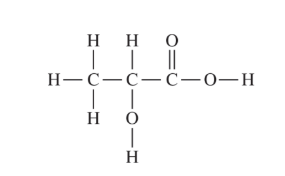
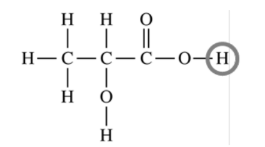
(a) The structural formula of lactic acid is shown in the following diagram. Circle the hydrogen atom that most readily participates in the chemical reaction with sodium hydroxide.
(b) The student begins the experiment by dissolving \( 10.22\ \mathrm{g} \) of sodium hydroxide (molar mass \( 40.00\ \mathrm{g/mol} \)) in enough water to produce \( 500.\ \mathrm{mL} \) of solution. Calculate the molarity of the sodium hydroxide solution.
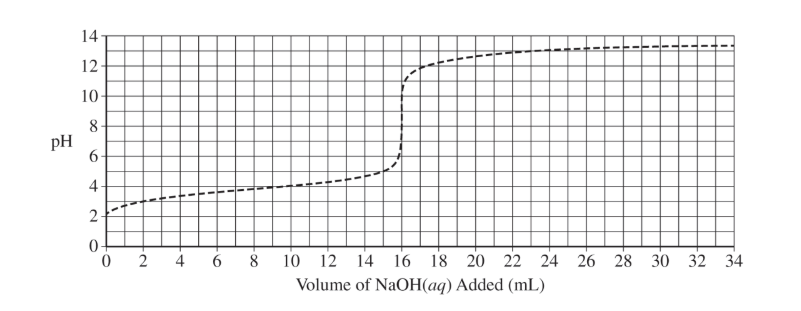
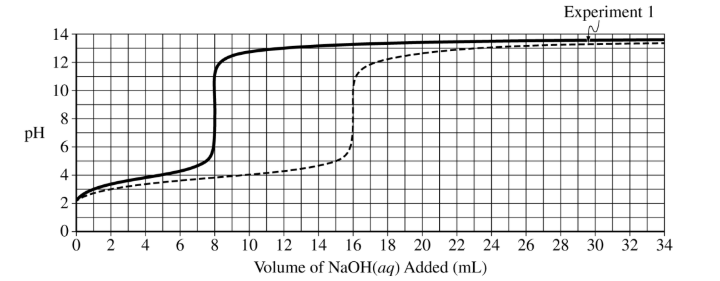
The student uses the sodium hydroxide solution from part (b), a buret, a pH meter, and a \( 100\ \mathrm{mL} \) Erlenmeyer flask to titrate a \( 25.0\ \mathrm{mL} \) sample of lactic acid solution. The student’s data are shown in the following graph.
(c) Use the information in the graph to determine the approximate \( pK_a \) of lactic acid. ____________
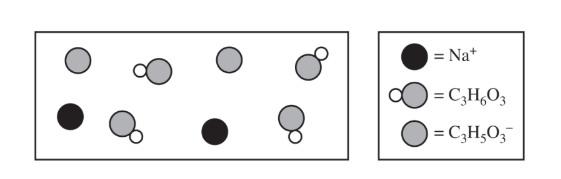
(d) The preceding diagram represents the relative amounts of major species in a sample of the solution in the flask at one point during the titration. (Note that water molecules are omitted.)
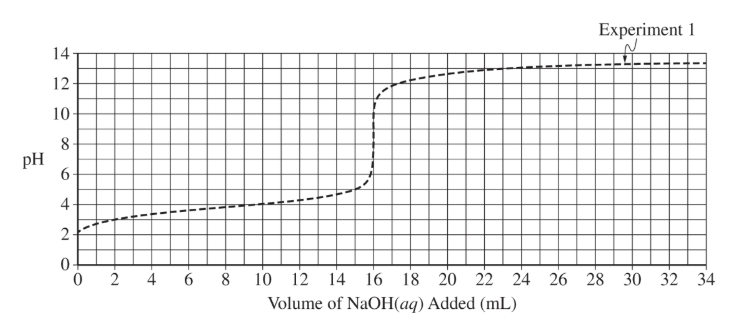
(i) Draw an X on the preceding titration curve at a point in the titration where the reaction mixture would be represented by this diagram.
(ii) Justify your answer.
| Experiment | Mass of \( \mathrm{NaOH(s)} \) (grams) | Volume of Solution (mL) | Titration Curve |
|---|
| 1 | \( 10.22 \) | \( 500. \) | Already shown on graph |
| 2 | \( 20.44 \) | \( 500. \) | ? |
(iii) The student repeats the experiment but uses a solution of \( \mathrm{NaOH(aq)} \) with twice the concentration. On the following graph, draw the titration curve that would be expected for experiment 2.
(e) In a third experiment, the student investigates the enthalpy of the reaction between lactic acid and sodium hydroxide. The student combines \( 100.0\ \mathrm{mL} \) of a \( 0.500\ \mathrm{M} \) lactic acid solution at \( 20.0^\circ \mathrm{C} \) with \( 100.0\ \mathrm{mL} \) of a \( 0.500\ \mathrm{M} \) \( \mathrm{NaOH} \) solution at \( 20.0^\circ \mathrm{C} \) in a calorimeter. The final temperature is \( 23.2^\circ \mathrm{C} \). Assume density \( = 1.00\ \mathrm{g/mL} \) and \( c = 4.2\ \mathrm{J/(g\cdot^\circ C)} \).
(i) Calculate the quantity of heat produced, in J.
(ii) Calculate \( \Delta H_{rxn} \), in \( \mathrm{kJ/mol} \). Include the sign.
(iii) If heat is lost to surroundings, will the calculated \( \Delta H \) be smaller in magnitude? Justify.
Most-appropriate topic codes (AP Chemistry):
• Topic \( 8.6 \) — Molecular Structure of Acids and Bases (Part (a))
• Topic \( 4.6 \) — Introduction to Titration (Part (b))
• Topic \( 8.5 \) — Acid–Base Titrations (Parts (c), (d))
• Topic \( 6.4 \) — Heat Capacity and Calorimetry (Part (e)(i))
• Topic \( 6.6 \) — Introduction to Enthalpy of Reaction (Parts (e)(ii), (e)(iii))