
AP Chemistry 7.11 Introduction to Solubility Equilibria - Exam Style questions - FRQs- New Syllabus
Question
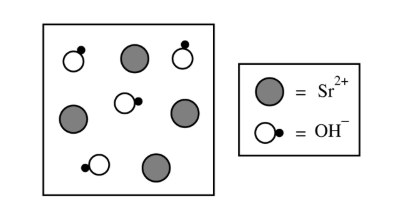
(ii) Calculate the value of \( K_{sp} \) for \( \mathrm{Sr(OH)}_{2} \).
Most-appropriate topic codes (AP Chemistry):
• Topic \( 7.12 \) — Common-Ion Effect (Part \( \mathrm{(c)} \))
▶️ Answer/Explanation
(a)
For a correct answer:
Accept one of the following:
• The student’s drawing shows an incorrect ratio of \( \mathrm{Sr}^{2+} \) and \( \mathrm{OH}^{-} \) ions.
• The student’s drawing is not charge-balanced.
Since each \( \mathrm{Sr}^{2+} \) ion must be accompanied by two \( \mathrm{OH}^{-} \) ions, the diagram should show twice as many hydroxide ions as strontium ions.
(b)(i)
For the correct calculated value:
\( 0.043\ \mathrm{mol\ Sr}^{2+}\!/\mathrm{L} \times \dfrac{2\ \mathrm{mol\ OH}^{-}}{1\ \mathrm{mol\ Sr}^{2+}} = 0.086\ \mathrm{M\ OH}^{-} \)
The coefficient \( 2 \) in the dissolution equation means hydroxide concentration is twice the strontium ion concentration.
Therefore, \( \boxed{[\mathrm{OH}^{-}] = 0.086\ \mathrm{M}} \).
(b)(ii)
For the correct calculated value, consistent with part \( \mathrm{(b)(i)} \):
\( K_{sp} = [\mathrm{Sr}^{2+}][\mathrm{OH}^{-}]^{2} = (0.043)(0.086)^{2} = 3.2 \times 10^{-4} \)
Squaring \( [\mathrm{OH}^{-}] \) is important because there are \( 2 \) hydroxide ions in the balanced dissolution equation.
Thus, \( \boxed{K_{sp} = 3.2 \times 10^{-4}} \).
(c)
For the correct answer and a valid justification:
Less than. Because the \( \mathrm{Sr(NO}_{3})_{2}(aq) \) solution already contains a common ion, \( \mathrm{Sr}^{2+}(aq) \), the solubility of \( \mathrm{Sr(OH)}_{2} \) will be decreased, resulting in a lower value of \( [\mathrm{OH}^{-}] \).
Adding extra \( \mathrm{Sr}^{2+} \) shifts the dissolution equilibrium to the left, so less \( \mathrm{Sr(OH)}_{2} \) dissolves and fewer hydroxide ions are produced.