
AP Physics 1 - 4.3 Conservation of Linear Momentum- Exam Style questions- MCQs
Conservation of Linear Momentum AP Physics 1 MCQ
Unit 4: Linear Momentum
Weightage : 10-15%
Question
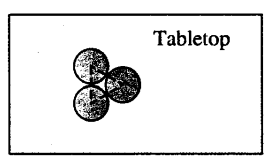
Three identical disks are initially at rest on a frictionless, horizontal table with their edges touching to form a triangle, as shown in the top view above. An explosion occurs within the triangle, propelling the disks horizontally along the surface.
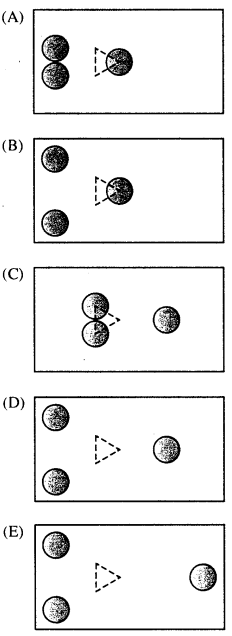
Which of the following diagrams shows a possible position of the disks at a later time? (In these diagrams, the triangle is shown in its original position.)
▶️ Answer/Explanation
Correct Answer: \( \boxed{\mathrm{E}} \)
Before the explosion, all three disks are at rest. Therefore, the total initial momentum of the system is
\( \vec{p}_{\text{initial}} = 0 \)
The explosion is an internal interaction, so the total linear momentum of the three-disk system must be conserved.
Thus,
\( \vec{p}_{\text{final}} = 0 \)
Since the disks are identical, their masses are equal. The vector sum of their momenta must remain zero at all times.
Another way to view the problem is through the center of mass. Because there is no external horizontal force acting on the system, the center of mass remains at its original position.
Therefore, any later arrangement of the disks must be consistent with an unchanged center of mass.
Among the choices shown, only diagram (E) places the disks in positions that can result from equal-mass disks moving away from the explosion while keeping the center of mass at the original location.
The other arrangements would shift the center of mass away from its initial position and therefore violate conservation of momentum.
Therefore, the correct answer is (E).
Question
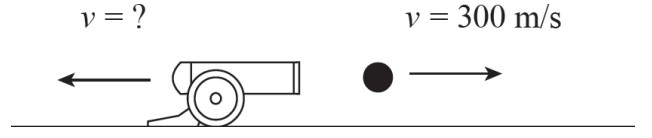
A soldier loads a \(10\,\mathrm{kg}\) cannonball into a \(300\,\mathrm{kg}\) cannon that is initially at rest on the ground. What is the recoil speed of the cannon if the cannonball is fired with a horizontal velocity of \(300\,\mathrm{m/s}\)?
(B) \(7.5\,\mathrm{m/s}\)
(C) \(10\,\mathrm{m/s}\)
(D) \(15\,\mathrm{m/s}\)
▶️ Answer/Explanation
Correct Answer: \( \boxed{\mathrm{C}} \)
Initially, both the cannon and the cannonball are at rest, so the total initial momentum of the system is zero.
By conservation of linear momentum:
\( p_i=p_f \)
\( 0=m_{\mathrm{cannon}}v_{\mathrm{cannon}}+m_{\mathrm{ball}}v_{\mathrm{ball}} \)
Substituting the given values:
\( 0=(300)v_{\mathrm{cannon}}+(10)(300) \)
\( 300v_{\mathrm{cannon}}=-3000 \)
\( v_{\mathrm{cannon}}=-10\,\mathrm{m/s} \)
The negative sign indicates that the cannon moves in the direction opposite to the cannonball.
Therefore, the recoil speed of the cannon is
\( 10\,\mathrm{m/s} \)
Therefore, the correct answer is (C).
Question
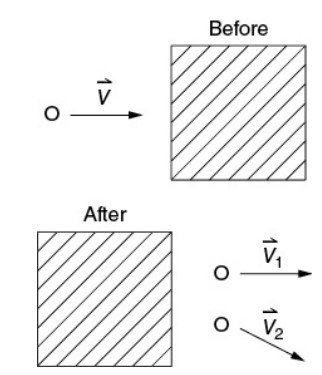
In an experiment, a marble rolls to the right at speed \(v\), as shown in the top diagram. The marble rolls under a canopy, where it is heard to collide with marbles that were not initially moving. Such a collision is known to be elastic. After the collision, two equal-mass marbles are observed leaving the canopy with velocity vectors \( \vec{v}_1 \) and \( \vec{v}_2 \) directed as shown.
Which of the following statements justifies why the experimenter believes that a third marble was involved in the collision under the canopy?
(B) Before collision, the only marble momentum was directed to the right. After the collision, the combined momentum of the two visible marbles has a downward component; another marble must have an upward momentum component to conserve momentum.
(C) Before collision, the only marble kinetic energy was directed to the right. After the collision, the combined kinetic energy of the two visible marbles is still to the right. Another marble must have a leftward kinetic energy component to conserve kinetic energy.
(D) Before collision, the only marble kinetic energy was directed to the right. After the collision, the combined kinetic energy of the two visible marbles has a downward component; another marble must have an upward kinetic energy component to conserve kinetic energy.
▶️ Answer/Explanation
Correct Answer: \( \boxed{\mathrm{B}} \)
Before the collision, the only moving marble travels horizontally to the right. Therefore, the system initially has:
\( p_x \neq 0 \)
\( p_y = 0 \)
After the collision, the two visible marbles move at angles below the horizontal. As a result, both marbles have downward momentum components.
The combined momentum of these two marbles therefore contains a net downward (\(-y\)) component.
However, momentum must be conserved in both the horizontal and vertical directions. Since the initial vertical momentum was zero,
\( \sum p_{y,\mathrm{final}} = 0 \)
The downward momentum of the two observed marbles must be balanced by an equal upward momentum component from another object.
This implies that a third marble must have left the collision region with an upward component of momentum.
Choices (C) and (D) are incorrect because kinetic energy is a scalar quantity and has no direction.
Choice (A) is incorrect because conservation of momentum does not require a leftward momentum component. The system’s total horizontal momentum should remain directed to the right.
Therefore, the correct answer is (B).