
AP Physics 1 - 7.4 Energy of Simple Harmonic Oscillators- Exam Style questions- MCQs
Energy of Simple Harmonic Oscillators AP Physics 1 MCQ
Unit 7: Oscillations
Weightage : 10-15%
Question
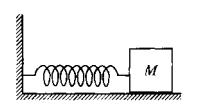
An ideal massless spring is fixed to the wall at one end, as shown above. A block of mass \(M\) attached to the other end of the spring oscillates with amplitude \(A\) on a frictionless, horizontal surface. The maximum speed of the block is \(v_m\). The force constant of the spring is
(B) \( \frac{Mgv_m}{2A} \)
(C) \( \frac{Mv_m^2}{2A} \)
(D) \( \frac{Mv_m^2}{A^2} \)
(E) \( \frac{Mv_m^2}{2A^2} \)
▶️ Answer/Explanation
Correct Answer: \( \boxed{\mathrm{D}} \)
For a mass-spring system undergoing simple harmonic motion, mechanical energy is conserved.
At maximum displacement \(A\), all the energy is elastic potential energy:
\( U_s=\frac{1}{2}kA^2 \)
At equilibrium, the speed is maximum \((v_m)\), and all the energy is kinetic:
\( K=\frac{1}{2}Mv_m^2 \)
Applying conservation of energy,
\( \frac{1}{2}kA^2=\frac{1}{2}Mv_m^2 \)
Solving for \(k\),
\( k=\frac{Mv_m^2}{A^2} \)
Therefore, the spring constant is \( \frac{Mv_m^2}{A^2} \).
Hence, the correct answer is \( \boxed{\mathrm{D}} \).
Question
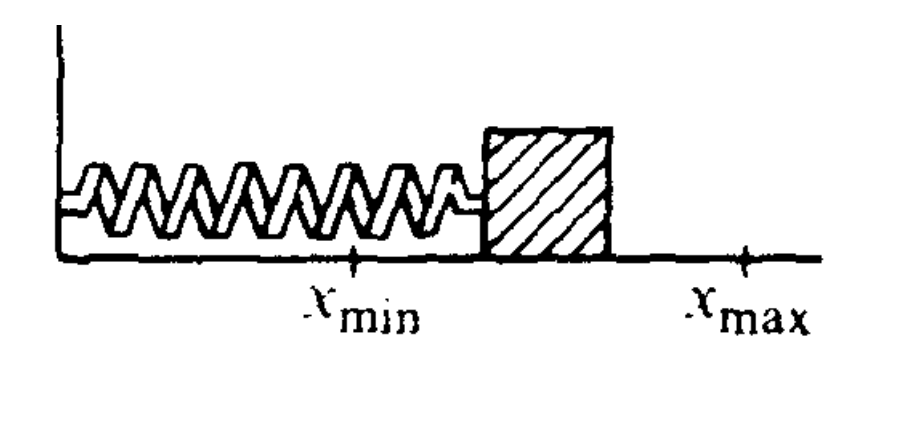
A block oscillates without friction on the end of a spring as shown. The minimum and maximum lengths of the spring as it oscillates are, respectively, \(x_{\min}\) and \(x_{\max}\). The graphs below can represent quantities associated with the oscillation as functions of the length \(x\) of the spring.
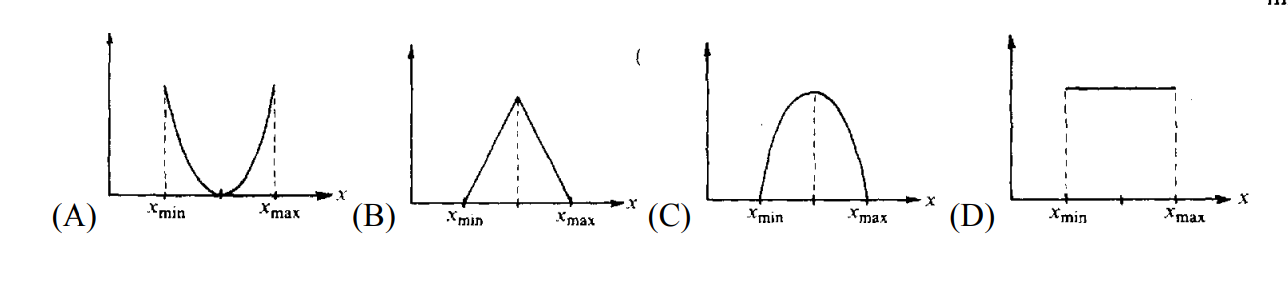
Which graph can represent the kinetic energy of the block as a function of \(x\)?
(B) B
(C) C
(D) D
▶️ Answer/Explanation
Answer: C
The kinetic energy is zero at the turning points \(x_{\min}\) and \(x_{\max}\), where the block momentarily stops.
The kinetic energy is maximum at the equilibrium position, where the speed is maximum.
Since the total mechanical energy is constant,
\( K = E – U \)
Because the spring potential energy is a parabola opening upward, the kinetic energy is a parabola opening downward.
Therefore, the correct graph is (C).
Question
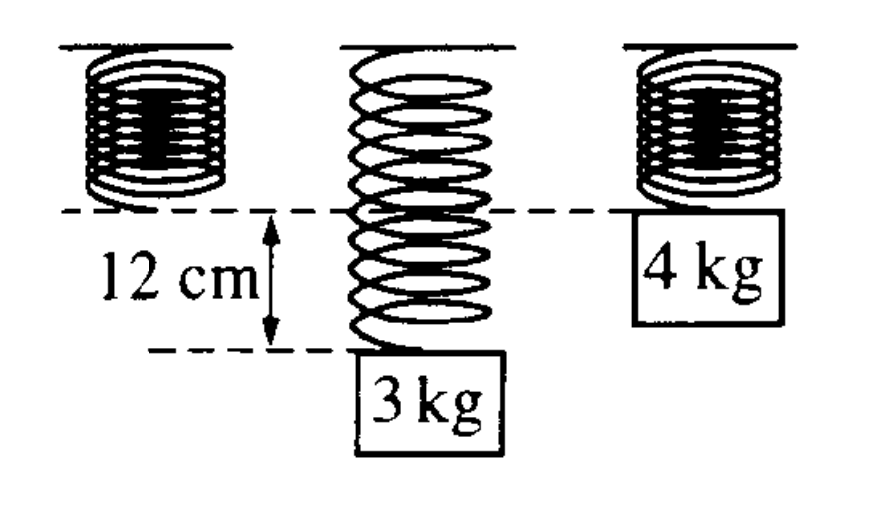
A block of mass 3.0 kg is hung from a spring, causing it to stretch 12 cm at equilibrium, as shown. The 3.0 kg block is then replaced by a 4.0 kg block, and the new block is released from the position shown, at which the spring is unstretched. How far will the 4.0 kg block fall before its direction is reversed?
(B) 24 cm
(C) 32 cm
(D) 48 cm
▶️ Answer/Explanation
Correct Answer: \( \boxed{\mathrm{C}} \)
For the 3.0 kg mass at equilibrium:
\( mg=kx \)
\( (3)(10)=k(0.12) \)
\( k=250\ \mathrm{N/m} \)
For the 4.0 kg mass, use energy conservation:
\( mgx=\frac{1}{2}kx^2 \)
\( (4)(10)x=\frac{1}{2}(250)x^2 \)
\( 40x=125x^2 \)
\( x=\frac{40}{125}=0.32\ \mathrm{m} \)
\( x=32\ \mathrm{cm} \)
Therefore, the block falls \( \boxed{32\ \mathrm{cm}} \).