
AP Physics 1 - 2.2 Forces and Free-Body Diagrams- Exam Style questions- MCQs
Forces and Free-Body Diagrams AP Physics 1 MCQ
Unit: 2. Force and Translational Dynamics
Weightage : 10-15%
Question
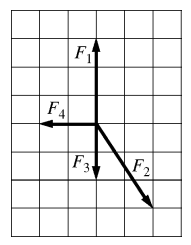
The coplanar forces \(F_{1}\), \(F_{2}\), \(F_{3}\), and \(F_{4}\) represented above can act on an object. If the object is initially at rest, which combination of the forces would result in static equilibrium?
(B) \(F_{1}\), \(F_{2}\), and \(F_{4}\) only
(C) \(F_{2}\), \(F_{3}\), and \(F_{4}\) only
(D) All four forces
(E) No combination of the forces would result in equilibrium.
▶️ Answer/Explanation
Correct Answer: \( \boxed{\mathrm{B}} \)
For an object to remain in static equilibrium, the net force acting on it must be zero:
\[ \sum \vec{F}=0 \]
From the diagram:
• \(F_{1}\) acts upward.
• \(F_{4}\) acts to the left.
• \(F_{2}\) acts diagonally downward and to the right.
• \(F_{3}\) acts downward.
The diagonal force \(F_{2}\) can be resolved into horizontal and vertical components.
The rightward component of \(F_{2}\) balances the leftward force \(F_{4}\), while the downward component of \(F_{2}\) balances the upward force \(F_{1}\).
Thus,
\( \vec{F}_{1}+\vec{F}_{2}+\vec{F}_{4}=0 \)
Therefore, these three forces alone can produce equilibrium.
If \(F_{3}\) is also included, an additional downward force remains unbalanced, so the net force would no longer be zero.
Hence the combination that results in static equilibrium is \(F_{1}\), \(F_{2}\), and \(F_{4}\) only.
A quick vector check shows that the horizontal and vertical components cancel separately, which is the key requirement for equilibrium in two dimensions.
Question
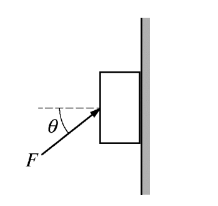
A block is held at rest against a wall by a force of magnitude \(F\) exerted at an angle \(\theta\) from the horizontal, as shown in the figure above. Let \(\vec{F}_g\) be the gravitational force exerted by Earth on the block, \(\vec{F}_N\) be the normal force exerted by the wall on the block, and \(\vec{F}_f\) be the frictional force exerted by the wall on the block. Which of the following statements about the magnitudes of the forces on the block must be true? Select two answers.
(B) \(F\cos\theta=F_N\)
(C) \(F\sin\theta=F_g\pm F_f\)
(D) \(F=F_g+F_N\pm F_f\)
▶️ Answer/Explanation
Correct Answers: \( \boxed{\mathrm{B}} \) and \( \boxed{\mathrm{C}} \)
Since the block is at rest, it is in static equilibrium. Therefore, the net force in both the horizontal and vertical directions must be zero.
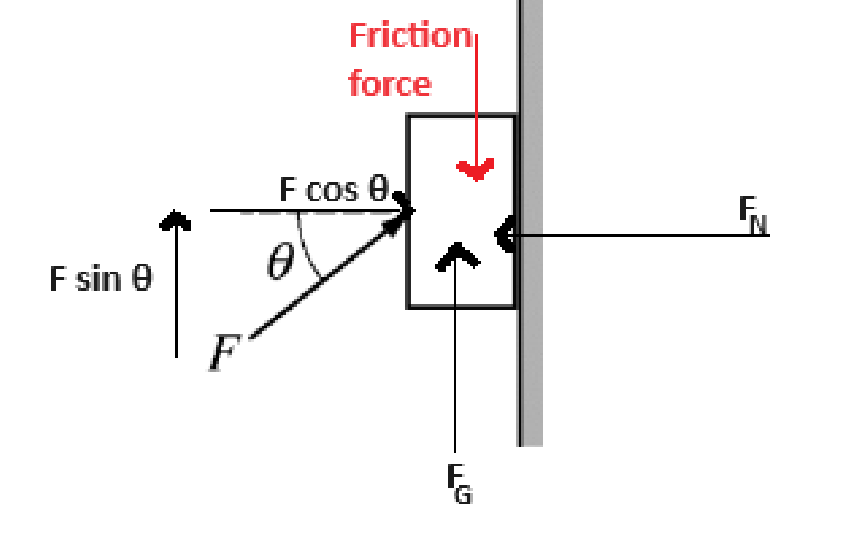
In the horizontal direction, the applied force has component \(F\cos\theta\) directed toward the wall.
The wall exerts a normal force \(F_N\) in the opposite direction.
Applying equilibrium in the horizontal direction: \(F\cos\theta=F_N\).
Therefore, statement (B) must be true.
In the vertical direction, the forces are: \(F\sin\theta\), the weight \(F_g\), and the friction force \(F_f\).
Depending on the situation, friction may act upward or downward to prevent motion.
Thus the vertical equilibrium condition is \(F\sin\theta=F_g\pm F_f\).
Therefore, statement (C) must also be true.
Statement (A) would only be true if friction were absent, which is not necessarily the case.
Statement (D) incorrectly adds force magnitudes directly. Forces are vectors and must be combined component by component.
Hence, the correct answers are \( \boxed{\mathrm{B}} \) and \( \boxed{\mathrm{C}} \).
Question
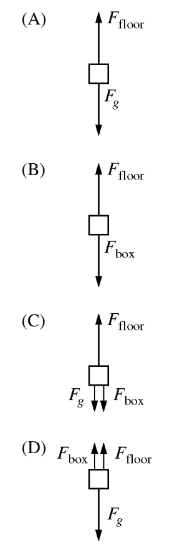
Assume the elevator is moving at constant speed, and consider the bottom box in the stack that has two boxes of mass \(2M\). Let \(F_{\text{floor}}\) be the force exerted by the floor on the box, \(F_g\) be the force exerted by gravity on the box, and \(F_{\text{box}}\) be the force exerted by the top box on the bottom box. Which of the following best represents the forces exerted on the bottom box?
▶️ Answer/Explanation
Correct Answer: \( \boxed{\mathrm{D}} \)
Because the elevator moves at constant speed, its acceleration is zero. Therefore, the bottom box is in equilibrium and the net force acting on it must be zero.
Three forces act on the bottom box:
• The gravitational force \(F_g\), acting downward.
• The force \(F_{\text{box}}\) exerted by the upper box on the bottom box, acting downward.
• The normal force \(F_{\text{floor}}\) exerted by the floor on the bottom box, acting upward.
Since the box is in equilibrium, \(F_{\text{floor}} = F_g + F_{\text{box}}\).
Therefore, the free-body diagram must contain one upward force from the floor and two downward forces: the weight of the bottom box and the contact force from the upper box.
Among the choices, only diagram (D) correctly shows all three forces acting on the bottom box.
Note that \(F_{\text{box}}\) is not an upward force. It is the force exerted by the top box on the bottom box and therefore acts downward according to Newton’s Third Law.
Hence, the correct answer is \( \boxed{\mathrm{D}} \).