
AP Physics 1 - 7.2 Frequency and Period of SHM- Exam Style questions- MCQs
Frequency and Period of SHM AP Physics 1 MCQ
Unit 7: Oscillations
Weightage : 10-15%
Question

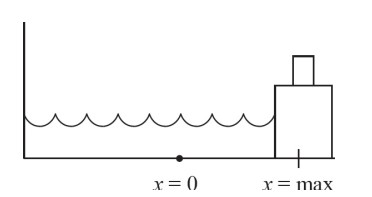
In the figure above, the coefficient of static friction between the two blocks is \(0.80\). If the blocks oscillate with a frequency of \(2.0\,\mathrm{Hz}\), what is the maximum amplitude of the oscillations if the small block is not to slip on the large block?
(B) \(5.0\,\mathrm{cm}\)
(C) \(6.2\,\mathrm{cm}\)
(D) \(7.5\,\mathrm{cm}\)
(E) \(9.4\,\mathrm{cm}\)
▶️ Answer/Explanation
Correct Answer: \( \boxed{\mathrm{B}} \)
For simple harmonic motion,
\( x=A\cos(\omega t+\phi) \)
Differentiating twice gives the acceleration:
\( a=-A\omega^2\cos(\omega t+\phi) \)
Therefore, the maximum acceleration is
\( a_{\max}=A\omega^2 \)
The small block will not slip if static friction can provide the required maximum horizontal force:
\( \mu_s mg \ge mA\omega^2 \)
Canceling \(m\),
\( A \le \frac{\mu_s g}{\omega^2} \)
Using
\( \omega=2\pi f=2\pi(2.0)=4\pi\ \mathrm{rad/s} \)
\( A \le \frac{(0.80)(10)}{(4\pi)^2} \)
\( A \approx 0.050\,\mathrm{m} \)
\( A \approx 5.0\,\mathrm{cm} \)
Therefore, the maximum amplitude that prevents slipping is \( 5.0\,\mathrm{cm} \).
Hence, the correct answer is \( \boxed{\mathrm{B}} \).
Question
A spring-block system is oscillating without friction on a horizontal surface. If a second block of equal mass were placed on top of the original block at a time when the spring is at maximum compression, which of the following quantities would NOT be affected?
(B) Maximum speed
(C) Amplitude
(D) All of the above quantities would be affected.
▶️ Answer/Explanation
Correct Answer: \( \boxed{\mathrm{C}} \)
The frequency of a spring-block oscillator is
\( f=\frac{1}{2\pi}\sqrt{\frac{k}{m}} \)
Since the mass doubles when an identical block is added, the frequency decreases. Therefore, the frequency is affected.
At maximum compression, the block momentarily has zero speed and all of the system’s energy is spring potential energy:
\( PE_{\max}=\frac{1}{2}kA^2 \)
Adding the second block at this instant does not change the spring constant \(k\) or the compression distance \(A\). Therefore, the total mechanical energy remains unchanged.
Since the spring still stores the same maximum potential energy, it will reach the same maximum compression and extension distances after the block is added.
Thus, the amplitude remains unchanged.
The maximum kinetic energy remains equal to the total energy:
\( \frac{1}{2}mv_{\max}^2=\frac{1}{2}kA^2 \)
Because the mass increases while the total energy remains the same, the maximum speed must decrease.
Therefore, the only quantity that is not affected is the amplitude.
Therefore, the correct answer is (C).
Question
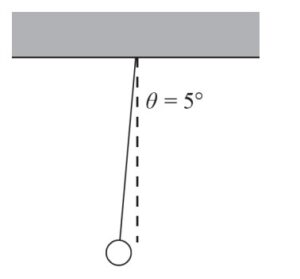
A \(2\,\mathrm{kg}\) mass is attached to a massless, \(0.5\,\mathrm{m}\) string and is used as a simple pendulum by extending it to an angle \( \theta = 5^\circ \) and allowing it to oscillate. Which of the following changes will change the period of the pendulum? Select two answers.
(B) Changing the initial extension of the pendulum to a \(10^\circ\) angle
(C) Replacing the string with a \(0.25\,\mathrm{m}\) string
(D) Moving the pendulum to the surface of the Moon
▶️ Answer/Explanation
Correct Answer: \( \boxed{\mathrm{C,\ D}} \)
For a simple pendulum undergoing small-angle oscillations, the period is
\( T = 2\pi\sqrt{\dfrac{L}{g}} \)
where \(L\) is the length of the string and \(g\) is the acceleration due to gravity.
Notice that the mass of the pendulum does not appear in the equation, so changing the mass from \(2\,\mathrm{kg}\) to \(1\,\mathrm{kg}\) will not affect the period.
For small oscillation angles, the period is also independent of amplitude. Therefore, increasing the initial angle from \(5^\circ\) to \(10^\circ\) does not significantly change the period.
Replacing the string with a \(0.25\,\mathrm{m}\) string changes \(L\), which changes the period.
Moving the pendulum to the Moon changes the value of \(g\), which also changes the period.
Therefore, the changes that affect the period are (C) and (D).