
AP Physics 1- 2.6 Gravitational Force - Exam Style questions - FRQs- New Syllabus
Gravitational Force AP Physics 1 FRQ
Unit: 2. Force and Translational Dynamics
Weightage : 10-15%
Question
• \( a_1 < a_2 \)
• \( a_1 = a_2 \)
Most-appropriate topic codes (AP Physics 1):
• Topic \( 8.3 \) — Fluids and Newton’s Laws (Part \( \mathrm{A} \), Part \( \mathrm{B} \), Part \( \mathrm{C} \))
• Topic \( 2.5 \) — Newton’s Second Law (Part \( \mathrm{B} \))
• Topic \( 2.6 \) — Gravitational Force (Part \( \mathrm{A} \), Part \( \mathrm{B} \))
▶️ Answer/Explanation
A
\( \boxed{a_1 < a_2} \)
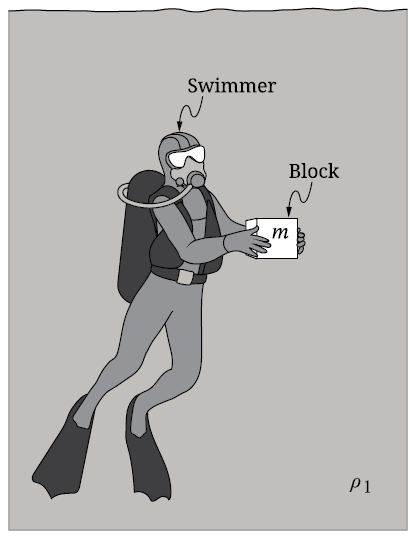
In both scenarios, the block has the same mass, so the downward gravitational force \( mg \) is the same. The upward force is the buoyant force.
Because salt water has greater density than fresh water \( (\rho_2 > \rho_1) \), the buoyant force exerted on the same fully submerged block is larger in salt water. Therefore, the net upward force is larger in Scenario \( 2 \), so the initial upward acceleration is larger in Scenario \( 2 \).
So the block speeds up more quickly in salt water because the upward push from the fluid is greater while the weight stays unchanged.
B
Start with Newton’s second law:
\( \sum F_y = ma \)
Take upward as positive. The forces on the block are: buoyant force upward and weight downward.
\( F_B – mg = ma \)
For a completely submerged block, the buoyant force is
\( F_B = \rho V g \)
Substitute into Newton’s second law:
\( \rho V g – mg = ma \)
Factor out \( g \):
\( g(\rho V – m) = ma \)
Solve for \( a \):
\( a = \dfrac{\rho V g – mg}{m} \)
\( a = \dfrac{\rho V g}{m} – g \)
Therefore, \( \boxed{a=\dfrac{\rho V g}{m}-g} \)
This makes sense physically: if the buoyant force exactly equals weight, then \( \rho V g = mg \) and the acceleration would be \( 0 \).
C
Yes, the expression is consistent with the claim in part \( \mathrm{A} \).
From \( a=\dfrac{\rho V g}{m}-g \), the acceleration increases as \( \rho \) increases because the term \( \dfrac{\rho V g}{m} \) increases, while \( g \) and the block’s \( m \) and \( V \) stay the same.
Since \( \rho_2 > \rho_1 \), it follows that \( a_2 > a_1 \), which agrees with the conclusion in part \( \mathrm{A} \).