
Question
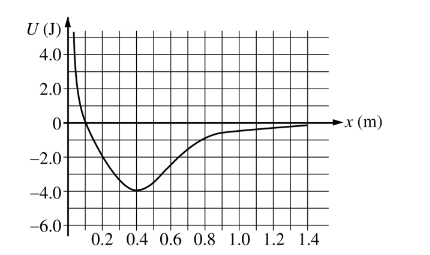
The variable x represents the position of particle A in a two-particle system. Particle B remains at rest. The graph above shows potential energy U of the system as a function of x .
The x-component of the force on particle A when it is at x = 0.15 m is most nearly
(A) –20 N
(B) –2.0 N
(C) –1.0 N
(D) 2.0 N
(E) 20 N
Answer/Explanation
Ans:E