
AP Physics 1 - 5.4 Rotational Inertia- Exam Style questions- MCQs
Rotational Inertia AP Physics 1 MCQ
Unit 5: Torque and Rotational Dynamics
Weightage : 10-15%
Question

Which of the following objects has the greatest rotational inertia?
(B) A \(1\,\mathrm{kg}\) hollow ball with radius of \(5\,\mathrm{cm}\)
(C) A \(5\,\mathrm{kg}\) solid ball with radius of \(5\,\mathrm{cm}\)
(D) A \(5\,\mathrm{kg}\) hollow ball with radius of \(5\,\mathrm{cm}\)
▶️ Answer/Explanation
Correct Answer: \( \boxed{\mathrm{D}} \)
Rotational inertia depends on both the mass of an object and how that mass is distributed relative to the axis of rotation.
In general,
\( I \propto mr^2 \)
so a larger mass produces a larger rotational inertia.
Comparing the choices, objects (A) and (B) each have a mass of only \(1\,\mathrm{kg}\), while objects (C) and (D) have a mass of \(5\,\mathrm{kg}\). Therefore, (A) and (B) can be eliminated.
Next, compare the \(5\,\mathrm{kg}\) objects. A hollow sphere has more of its mass located farther from the axis of rotation than a solid sphere.
Since rotational inertia increases when mass is distributed farther from the axis, a hollow sphere has a greater rotational inertia than a solid sphere of the same mass and radius.
Therefore, the \(5\,\mathrm{kg}\) hollow sphere has the greatest rotational inertia.
Hence, the correct answer is (D).
Question

The solid disk shown has mass \(M\) and radius \(R\). The rotational inertia of the disk about axis 1, which passes through the disk’s center, is
\( I_{\mathrm{cm}}=\frac{1}{2}MR^{2} \).
What is the rotational inertia of the disk about axis 2, which is tangential to the disk’s edge?
(B) \( \frac{2}{5}MR^{2} \)
(C) \( MR^{2} \)
(D) \( \frac{1}{3}MR^{2} \)
(E) \( \frac{2}{3}MR^{2} \)
▶️ Answer/Explanation
Correct Answer: \( \boxed{\mathrm{A}} \)
Since axis 2 is parallel to axis 1 and tangent to the edge of the disk, the distance between the two axes is
\( h=R \)
Apply the parallel-axis theorem:
\( I=I_{\mathrm{cm}}+Mh^{2} \)
Substituting the given values:
\( I=\frac{1}{2}MR^{2}+M(R)^{2} \)
\( I=\frac{1}{2}MR^{2}+MR^{2} \)
\( I=\frac{3}{2}MR^{2} \)
Therefore, the rotational inertia of the disk about the tangential axis is
\( \frac{3}{2}MR^{2} \)
Hence, the correct answer is (A).
Question
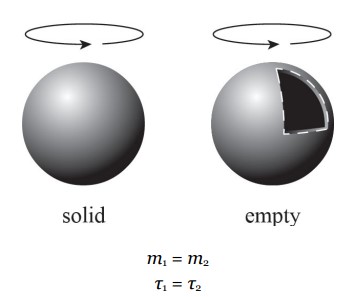
Two spheres of equal size and equal mass are rotated with an equal amount of torque. One of the spheres is solid with its mass evenly distributed throughout its volume, and the other is hollow with all of its mass concentrated at the edges.
Which sphere would rotate faster?
(B) Hollow sphere
(C) They would rotate at equal rates.
(D) Additional information is required to determine the relative rates of rotation.
▶️ Answer/Explanation
Correct Answer: \( \boxed{\mathrm{A}} \)
The rotational motion of each sphere is governed by Newton’s second law for rotation:
\( \tau = I\alpha \)
where:
\( \tau \) = applied torque
\( I \) = rotational inertia
\( \alpha \) = angular acceleration
Since the same torque is applied to both spheres,
\( \alpha = \frac{\tau}{I} \)
The sphere with the smaller rotational inertia will have the greater angular acceleration and will therefore spin up more quickly.
Rotational inertia depends on how far the mass is distributed from the axis of rotation.
For a solid sphere:
\( I_{\text{solid}}=\frac{2}{5}MR^2 \)
For a hollow sphere:
\( I_{\text{hollow}}=\frac{2}{3}MR^2 \)
Because
\( \frac{2}{5}MR^2 < \frac{2}{3}MR^2 \),
the solid sphere has the smaller rotational inertia.
Therefore, for the same applied torque, the solid sphere experiences the greater angular acceleration and reaches a higher rotational speed in the same amount of time.
Hence, the correct answer is (A).