
AP Physics 2 - 15.6 Compton Scattering- Exam Style questions- MCQs
15.6 Compton Scattering AP Physics 2 MCQ
Unit 15: Modern Physics
Weightage : 15–18%
Question
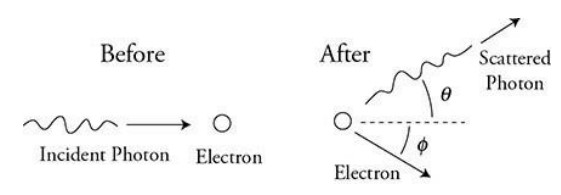
A photon of wavelength \(\lambda\) collides with a stationary electron, glancing off at an angle \(\theta\), while the electron moves off at an angle \(\phi\) measured from the original path of the photon, as shown in the figure. Which of the following statements correctly states the effect on the wavelength of the scattered photon and why?
(B) The wavelength of the scattered photon decreases because the photon transfers momentum to the electron in the interaction.
(C) The wavelength of the scattered photon remains the same because the photon is acting as a particle during the collision.
(D) The wavelength of the scattered photon increases because the photon transfers energy to the electron in the interaction.
▶️ Answer/Explanation
Correct Answer: \( \boxed{\mathrm{D}} \)
In Compton scattering, the incident photon transfers part of its energy and momentum to the electron. As a result, the scattered photon has a lower energy than before the collision.
Since photon energy is related to wavelength by
\(E=hf=\dfrac{hc}{\lambda}\),
a decrease in photon energy corresponds to an increase in wavelength.
The Compton wavelength shift is given by
\(\Delta\lambda=\dfrac{h}{m_ec}(1-\cos\theta)\),
which is always nonnegative, confirming that the scattered photon always has a wavelength greater than or equal to the incident wavelength.
Therefore, the correct answer is (D).
Question
Photons can scatter electrons, and the trajectories of the electrons will obey the law of conservation of momentum. These facts are observed in the
(B) Michelson-Morley experiment
(C) Compton effect
(D) Doppler effect
▶️ Answer/Explanation
Correct Answer: \( \boxed{\mathrm{C}} \)
The Compton effect occurs when a high-energy photon (such as an X-ray) collides with an electron.
During the collision, both energy and momentum are conserved. The photon transfers part of its energy and momentum to the electron, causing:
• The electron to recoil with kinetic energy.
• The scattered photon to have a lower energy, lower frequency, and longer wavelength.
The photon momentum is given by
\(p=\dfrac{h}{\lambda}\)
The successful explanation of Compton scattering provided strong evidence that light behaves as particles (photons) carrying momentum.
Therefore, the correct answer is (C).
Question
What is the maximum possible wavelength shift \( \Delta\lambda_{\mathrm{max}} \) in a Compton scattering event, and at what scattering angle does it occur?
(B) \(4.85\times10^{-12}\,\mathrm{m}\) at \( \theta=180^\circ \)
(C) \(2.43\times10^{-12}\,\mathrm{m}\) at \( \theta=180^\circ \)
(D) \(4.85\times10^{-12}\,\mathrm{m}\) at \( \theta=90^\circ \)
▶️ Answer/Explanation
Correct Answer: \( \boxed{\mathrm{B}} \)
The Compton wavelength shift is given by
\( \Delta\lambda=\dfrac{h}{m_e c}\left(1-\cos\theta\right) \)
The quantity \(1-\cos\theta\) is largest when the scattering angle is \( \theta=180^\circ \), since
\( \cos180^\circ=-1 \)
Therefore,
\( \Delta\lambda_{\mathrm{max}} =\dfrac{h}{m_e c}\left(1-(-1)\right) =\dfrac{2h}{m_e c} \)
Using \( \dfrac{h}{m_e c}=2.43\times10^{-12}\,\mathrm{m} \),
\( \Delta\lambda_{\mathrm{max}} =2\left(2.43\times10^{-12}\right) =4.85\times10^{-12}\,\mathrm{m} \)
This maximum shift occurs during backscattering, when the photon is scattered through an angle of \(180^\circ\).
Therefore, the correct answer is (B).