
AP Physics 2- 15.6 Compton Scattering- FRQs- New Syllabus
Compton Scattering AP Physics 2 FRQ
Unit 15: Modern Physics
Weightage : 15–18%
Question
Most-appropriate topic codes (AP Physics 2):
• Topic \(15.6\) — Compton Scattering (Part \( \mathrm{(c)} \))
▶️ Answer/Explanation
(a)
For a matter wave, the de Broglie wavelength is related to momentum by \( \lambda=\dfrac{h}{p} \).
Since the electron is moving nonrelativistically, \(p=m_ev\). Therefore,
\( \lambda=\dfrac{h}{m_ev} \)
Solve for \(v\):
\( v=\dfrac{h}{m_e\lambda} \)
Substitute \(h=6.63\times 10^{-34}\,\text{J}\cdot\text{s}\), \(m_e=9.11\times 10^{-31}\,\text{kg}\), and \(\lambda=5.0\,\text{nm}=5.0\times 10^{-9}\,\text{m}\).
\( v=\dfrac{6.63\times 10^{-34}}{\left(9.11\times 10^{-31}\right)\left(5.0\times 10^{-9}\right)} \)
\( v=1.46\times 10^{5}\,\text{m/s} \)
\(\boxed{v\approx 1.5\times 10^{5}\,\text{m/s}}\)
(b)
When the electron and positron annihilate, their mass energy is converted into photon energy. The electron is also moving, so its kinetic energy should be included.
The total photon energy is
\( E_{\text{tot}}=2m_ec^2+\dfrac{1}{2}m_ev^2 \)
The factor \(2\) is used because both the electron and positron have rest mass \(m_e\).
Substitute \(m_e=9.11\times 10^{-31}\,\text{kg}\), \(c=3.00\times 10^8\,\text{m/s}\), and \(v=1.5\times 10^5\,\text{m/s}\).
\( E_{\text{tot}}=2\left(9.11\times 10^{-31}\right)\left(3.00\times 10^8\right)^2+\dfrac{1}{2}\left(9.11\times 10^{-31}\right)\left(1.5\times 10^5\right)^2 \)
Rest energy of both particles:
\( 2m_ec^2=2\left(9.11\times 10^{-31}\right)\left(9.00\times 10^{16}\right)=1.64\times 10^{-13}\,\text{J} \)
Kinetic energy of the electron:
\( K=\dfrac{1}{2}\left(9.11\times 10^{-31}\right)\left(1.5\times 10^5\right)^2\approx 1.0\times 10^{-20}\,\text{J} \)
The kinetic energy is much smaller than the rest energy, but it is included in the expression.
\( E_{\text{tot}}\approx 1.64\times 10^{-13}\,\text{J} \)
\(\boxed{E_{\text{tot}}\approx 1.6\times 10^{-13}\,\text{J}}\)
(c)
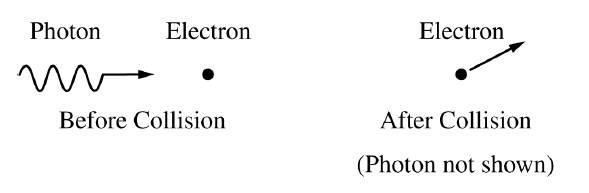
After the collision, the photon must move in a direction that allows momentum to be conserved in both the horizontal and vertical directions. Initially, the photon has momentum only toward the right, and the electron is at rest. After the collision, the electron moves upward and to the right, so it has an upward component of momentum. To conserve vertical momentum, the photon after the collision must have a downward component of momentum. The photon can also move to the right so that the total horizontal momentum after the collision can match the original photon momentum.
Therefore, a possible direction for the photon after the collision is down and to the right.
Energy is also conserved. During the collision, some of the original photon’s energy is transferred to the electron as kinetic energy. Since photon energy is related to frequency by \(E=hf\), a photon with less energy has a lower frequency.
Thus, the photon that exists after the collision has a frequency lower than the frequency of the original photon.
\(\boxed{\text{The photon can move down and to the right, and its frequency is lower than before the collision.}}\)